Snowflake · Study
Snowflake Interview Process & Questions
TrueInterview
July 24, 2026 · 14 min read
Snowflake interviews are decided by follow-ups: course ordering gains durations and batches, interval scheduling gains an at-most-K cap, and tree problems gain a minimum-deletion target. Several rejected candidates solved the base problem and ran out of time on the extension. Practical building is the second trait: an in-memory file system, a transactional key-value store or a rate limiter, written from a blank editor with self-written tests, can appear at any stage. Design prompts are platform internals rather than consumer apps. Hiring runs team by team, and mixed feedback often adds a round instead of ending the process.
This guide breaks down each stage of the Snowflake interview, what interviewers evaluate in each round, and how to prepare, with questions candidates were actually asked.
Verified: Based on 69 candidate-reported interview experiences, cross-checked against recent public accounts.
Snowflake interview process
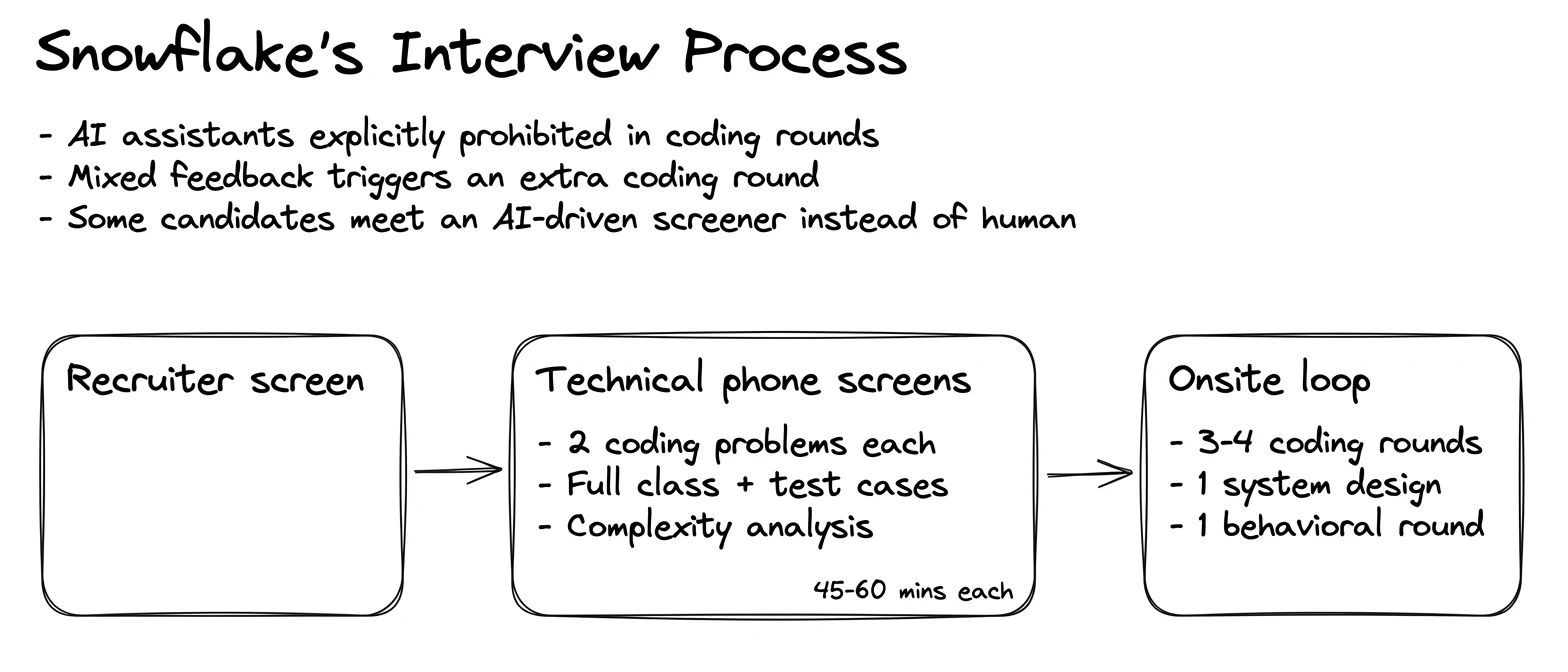
The structure is stable, but the content follows the interviewer and the team. The usual sequence is a recruiter call, sometimes an assessment or automated screener, two technical phone screens of 45–60 minutes, often on the same day, and a final loop of three to five rounds. The process typically takes four to six weeks. In one offer case, team matching, two hiring-manager calls and references took about three weeks after the virtual onsite.
Level changes the shape. Early-career and mid-level (IC2) loops are mostly coding plus one design and one behavioral round. Senior candidates usually get one phone screen in system design, and Staff-targeted loops add an expertise deep dive and an AI-assisted build round. Frontend candidates get JavaScript, TypeScript and React exercises, data engineering candidates get SQL, Python and pipeline modeling, and AI-focused roles can include a round on large language model fundamentals.
Here's what the interview process can look like:
- Recruiter screen (sometimes an assessment or AI screener): A short call on background, logistics and team interests.
- Technical phone screens (usually two): 45–60 minute live coding calls with a follow-up that changes the constraints; for senior roles one may be system design.
- Onsite coding interviews: One or two rounds of algorithms and practical component builds with hand-written tests.
- System design interview: An hour on an infrastructure component, pushed into consistency and failure handling.
- Behavioral and hiring manager interviews: Project, conflict and failure stories, plus calls during team matching.
- Expertise and AI-assisted rounds (senior and some teams): A project deep dive and a design-then-build exercise.
Tip: Split each coding round into thirds. Finish and test the base problem in the first third, so the remaining time goes to the follow-up. Rejections in the reports cluster around candidates who debugged the base solution until the hour ran out.
Recruiter screen and online assessment
The recruiter call usually lasts 15–30 minutes and covers background, motivation, relocation, work authorization and, for infrastructure roles, the tools you have run in production. Some recruiters send template questions in advance or ask you to pick two or three teams of interest, which shapes matching later. One recruiter said explicitly that AI assistants may not be used during the interviews.
Some candidates take an online assessment first; one who later received an offer completed six, mostly dynamic programming. Others meet an on-demand AI interviewer, taken within a one-week window with camera and screen sharing on. It asks about Java, Python and SQL depth, distributed-systems problems, the project you owned most and your team's use of AI tools, and it follows up on whatever you mention.
Interviewers evaluate:
- Scope and level fit: Whether recent work matches the target level and the teams with open headcount.
- Stack depth: Hands-on use of the languages and infrastructure you list; the automated screener probes anything you mention.
- Ownership: A project you personally drove, explained with specifics rather than team-level summaries.
Ask the recruiter for the exact format and language of each round, because some descriptions have been wrong. One candidate was told the role was full-stack and then sat two framework-only frontend rounds.
Sample questions for the recruiter screen and online assessment
Here are some questions reported by recent candidates:
-
Which platform or infrastructure projects have you worked on, and with which tools and stack?
-
Walk through the project you feel the most personal ownership over and the hardest distributed-systems problem in it.
-
How does your current company use AI tools in day-to-day engineering?
Technical phone screens
Expect two live coding calls of 45–60 minutes in a shared editor, often with no starter code: you write the class, the input handling and your own tests. One call was split into 10 minutes of introductions, 40 of coding and 10 of questions. Problems are medium to hard and most have a planned second stage. Graph ordering, multi-source BFS, weighted interval scheduling and tree deletion are the most common families.
The follow-ups are predictable in kind. Course ordering gains durations with parallel execution, then batches. Interval scheduling gains an at-most-K limit. Nearest-cake distances on a grid become a global assignment problem. Tree height with deleted nodes becomes minimum deletions under a height cap, and one interviewer ruled out dynamic programming for that step. A string calculator gains nesting. Some screens are practical builds, such as a rate limiter capped at 3 requests per second and 20 per 10 seconds that counts drops, or an event logger with constant-time receive and binary-search counts.
Interviewers evaluate:
- Speed to a correct baseline: Leaving time for the extension; one candidate who missed the K-event follow-up in a 40-minute window was rejected.
- Adapting without a rewrite: Adding a dimension to a DP state or a field to BFS state while keeping invariants intact.
- Clarifying inputs: Two candidates lost the time they needed after wrong assumptions about the input format. One interviewer withheld constraints to see whether the candidate would ask.
- Self-testing: Edge cases such as an empty tree, a marked root or a reversed time range, traced aloud.
- Explaining complexity live: Stating time and space for each step, including deduplication and top-K retrieval.
Practice each common family as a two-stage drill, solving the base in 15 minutes and the twist in 20.
Note: Mixed screen feedback often adds a coding round rather than ending the process. One candidate who ran out of time on the nested calculator got a third screen.
Sample questions for the technical phone screens
Here are some questions reported by recent candidates:
-
Order courses by prerequisites, then compute the minimum finish time with durations and parallel execution, then in batches.
-
Choose at most K non-overlapping events or courses to maximize total value or credits.
-
Given a tree with some nodes deleted, find the tallest remaining subtree, then the minimum deletions so the height does not exceed K.
-
On a DAG where each node allows or disallows letters and flags propagate along edges, report allowed minus disallowed letters per node.
-
Compute height of tree with deleted nodes; minimize deletions
Onsite coding interviews
The final loop usually has one or two hour-long coding rounds mixing a harder algorithm problem with a practical build. Builds include an in-memory file system with path parsing, mkdir and ls; a JSON parser handling escapes and malformed input; a thread-safe transactional key-value store with O(1) begin, commit and rollback; a sliding-window rate limiter; and a priority task executor that skips tasks already run. Some rounds ban built-in ordered maps; one candidate wrote a binary search tree with range queries from scratch.
Algorithm rounds reuse the phone-screen families at higher difficulty: parallel task execution with skippable tasks, unbounded-knapsack query profit within K minutes, a dish sequence matched against ingredients in O(1) space and then as a stream, and the shortest click path between wiki pages when the link API can fail. Expect concurrency follow-ups such as parallelizing a BFS or computing subtree sums with multiple threads. Some interviewers want code that runs in main against their tests; where pseudocode is allowed, candidates who wrote full code reported it helped.
Interviewers evaluate:
- Clean abstractions: Classes with clear responsibilities, such as a trie node with metadata or a stack of write sets for nested transactions.
- Edge cases as features: Invalid paths, root deletion, duplicate inserts and empty collections, handled explicitly rather than patched in.
- Debugging discipline: Working through a failing test calmly. A single unfixed parent-pointer or path bug has preceded rejections.
- Code quality under pressure: One candidate was rejected for weak coding signal after being told clean code was optional.
- Concurrency reasoning: Where locks go, what contention looks like, and whether independent partitions can avoid sharing state.
Build the file system, transactional store, rate limiter and JSON parser end to end at least once, each with your own test suite.
Note: Interviewer style varies widely. Candidates reported a last-minute interviewer swap, an interviewer unfamiliar with the chosen language, and insistence on one specific method. Ask early which approach the interviewer expects, and narrate your reasoning so the signal still gets recorded.
Sample questions for the onsite coding interviews
Here are some questions reported by recent candidates:
-
Implement an in-memory file system that creates nested directories on demand and lists a file path as the file itself.
-
Build a key-value store whose nested transactions roll back in constant time, then make it safe under concurrent access.
-
Add tasks with priorities and timestamps, allow duplicates, and execute by priority without running any task twice.
System design interview
Most loops have one design round of 45–60 minutes; senior candidates may also get one as a phone screen. Prompts are platform components: an ACL service answering permission checks for other services, a low-latency audit-log service, a cron scheduler with pause and resume, S3-style storage that deduplicates content, a client logging library that batches without hurting responsiveness, a cloud queue that survives crashes, a query notebook that returns results to the client, and a ticket-automation service that hands tickets to an AI component to open pull requests.
Interviewers move quickly into the data model, partitioning, replication, retries, idempotency and partial failure. One senior candidate had to write lock acquire and release pseudocode with deadlock handling. A textbook job-scheduler walkthrough was judged unremarkable. Frontend loops instead get client architecture, such as a calendar whose recurring events can be moved one instance at a time.
Interviewers evaluate:
- Scoping: Agreeing on traffic, consistency and success criteria before drawing.
- Data models: Principals, resources and role inheritance for access control, and schemas for lifecycle tracking.
- Failure semantics: Execution guarantees, missed runs during a pause, retries with backoff and jitter, and crash recovery.
- Original trade-offs: Reasoning tied to the prompt, such as inline versus post-process deduplication, rather than a memorized template.
- Pacing: Reaching every requirement; one audit-log candidate ran out of time.
Practice five platform prompts aloud, writing the API and data model first and spending at least ten minutes on failures.
Tip: When a prompt feels vague, ask what the interviewer most wants to see: the permission model, the scheduling semantics or the scaling story. One candidate failed the same phone design stage twice, two years apart, and traced both failures to not asking.
Sample questions for the system design interview
Here are some questions reported by recent candidates:
-
Design a reusable, low-latency service that decides whether a principal may perform an action on a resource, including how rules are versioned without downtime.
-
Design a scheduler for cron-style jobs that can be paused and resumed, assuming unlimited workers, and decide what happens to runs missed during a pause.
-
Design object storage that never stores the same content twice while preserving each user's logical view.
Behavioral and hiring manager interviews
The behavioral round runs 45–60 minutes with a hiring manager or senior leader, and coding screens may open with 10–15 minutes on your resume. Themes are your proudest project, conflict, failure, mentoring, tight deadlines, pushing back, and why you are leaving. Several interviewers now ask how you use AI tools day to day. Hiring-manager calls during team matching cover interests and background; one candidate was advised to read the team's engineering blog first.
Interviewers evaluate:
- Personal ownership: What you decided and built, with follow-ups that test whether the work was really yours.
- Customer and business impact: Outcomes tied to users or revenue, in line with the company's customer-first values.
- Disagreement handling: How you pushed back, what evidence you used, and how you committed afterward.
- Concise delivery: Some managers interrupt for shorter answers, so lead with the result and expand only on request.
Prepare six to eight stories covering ownership, conflict, failure, mentoring and deadlines, each with a technical core you can defend in detail.
Sample questions for the behavioral and hiring manager interviews
Here are some questions reported by recent candidates:
-
Tell me about the project you are most proud of, a conflict with a teammate, and a time you failed.
-
Describe a time you pushed back on a decision.
-
What piece of advice would you give your current team, and why are you leaving?
Expertise and AI-assisted rounds
Staff-targeted and some specialist loops add two formats. The expertise deep dive reviews your resume and asks you to present a major project; one candidate lost half the slot before presenting. The AI-assisted round starts with a joint design, such as a key-value store, then builds it with an AI assistant allowed, unlike the rest of the loop, so confirm the setup. AI-focused roles may instead get a round on transformers, attention, training objectives and prompting, where one candidate's strong coding did not offset weak answers.
Interviewers evaluate:
- Depth on your own work: Why each design decision was made, which alternatives you rejected, and what failed.
- Directing the assistant: Breaking the build into steps, checking generated code, and keeping the design coherent.
- Domain fundamentals: For AI roles, a working grasp of modern model internals rather than general ML alone.
Prepare a 20-minute project walkthrough with an architecture sketch, and practice building a small service with an AI assistant against a timer.
Sample questions for the expertise and AI-assisted rounds
Here are some questions reported by recent candidates:
-
Present a major project end to end and defend its design trade-offs.
-
Design a key-value store together with the interviewer, then build it with AI assistance.
-
Explain attention and the training objectives behind large language models.
How Snowflake makes hiring decisions
Each interviewer submits feedback and the hiring team debriefs on the whole loop. The bar is high: several rejected candidates felt every round had gone well. Mixed signals tend to produce another round rather than a verdict. Level is set from loop feedback; one Staff candidate was offered Senior, then had extra conversations with a different hiring manager and a teammate, and was rejected after insisting on Staff. Hiring is team by team, matching runs through hiring-manager calls and can stall when headcount is limited, and one offer included a reference check. Rejections came the next day or about a week after the final round, usually without feedback, and one candidate heard nothing for two months.
Tip: If the recruiter proposes a lower level after the onsite, ask what feedback drove it and what further conversations would be needed. A down-level discussion reopens the evaluation rather than closing it.
How to prepare for the Snowflake interview
- Drill two-stage problems: Practice course ordering, interval scheduling, multi-source BFS and tree deletion, then their twists: batches, at most K picks, global assignment and minimum deletions.
- Build the signature components: Write an in-memory file system, a transactional key-value store, a JSON parser and a multi-rule rate limiter from a blank file, each with tests.
- Write and run your own tests: Untested code has cost offers.
- Clarify input and output first: List or stream, boolean or full assignment, and the constraints.
- Prepare concurrency answers: Know how to make a store thread-safe, parallelize BFS across threads, and write lock acquire and release with deadlock avoidance.
- Rehearse platform design: ACL checks, schedulers, audit logs, deduplicated storage and queues, with real time on failure handling.
- Prepare stories with technical depth: Cover ownership, conflict, failure, mentoring and pushback, plus how you use AI tools.
- Confirm the format and language: Ask whether rounds are in person or virtual, whether AI is allowed, and which language the interviewer can review.
About working at Snowflake
Snowflake builds a cloud data platform for warehousing, data engineering, data sharing, applications and AI workloads, with storage separated from compute across the major public clouds. Core database work is mostly C++, with Java, Go and Python in services and tooling. Engineers own features from design through production, which is why state, failure and concurrency come up even in coding rounds.
| Level | Primary focus | Impact scope |
|---|---|---|
| IC1 (Software Engineer) | Delivering well-scoped features with guidance | Tasks within one team |
| IC2 (Software Engineer) | Owning features and components end to end | One team's systems |
| IC3 (Senior Software Engineer) | Leading designs and mentoring | A team and its neighbors |
| IC4 (Senior or Staff; titles vary) | Technical direction across components | Several teams |
| IC5 (Principal Software Engineer) | Architecture and long-range strategy | An organization |
Snowflake hires engineers across the database engine, developer platform and AI groups. Teams include:
- Database engineering: Query processing and execution in the core engine.
- Foundation Database (FDB): The distributed transactional key-value store behind platform services.
- Unistore and hybrid tables: Transactional and analytical processing in one platform.
- Cortex and Snowflake Intelligence: AI services, search, agents and their infrastructure.
- Developer platform: Snowpark Container Services, Native Apps and Streamlit.
Experience and education requirements
Postings typically ask for a bachelor's degree or higher in computer science or a related field, strong data structures and algorithms, and proficiency in C++, Java, Go or Python. Senior roles expect several years of distributed systems or database work. Query engine, storage or cloud infrastructure experience is a real advantage on core-engine teams, and frontend roles expect production React and TypeScript.
FAQs about the Snowflake interview
How long does the Snowflake interview process take?
Typically four to six weeks from the recruiter call to a decision; team matching, references or extra rounds can stretch it.
What is the hardest round of the Snowflake interview?
Most candidates name a coding round with a hard follow-up, such as minimum tree deletions or K-limited interval scheduling. At senior levels, rejections cluster in system design.
Can you get down-leveled?
Yes. A Staff candidate was offered Senior after the onsite, which brought further conversations with a new hiring manager.
How much does a Snowflake software engineer make?
Approximate US total compensation:
- IC1: ~$240K
- IC2: ~$340K
- IC3: ~$560K
Packages combine base salary and restricted stock, and stock is a large share of the total from IC2 upward.
Is the Snowflake interview remote?
Phone screens and most final loops are virtual. Some onsites were held in person, and one candidate was told no virtual option existed, so confirm before you plan travel.