Snapchat · Study
Snapchat Software Engineer Interview Process
TrueInterview
July 24, 2026 · 12 min read
Snapchat's Software Engineer loop is decided less by algorithm recall than by two things candidates underprepare: building a small stateful component from scratch, such as a list with its own iterator or an in-memory pub/sub bus, and defending it under concurrency questions once it works. Problems are familiar patterns with one rule changed, the question bank repeats rarely, and the panel reportedly needs about three of four technical rounds to pass. Level is not settled until the end: one senior candidate who completed every round was offered the level below.
This guide breaks down each stage of the Snapchat Software Engineer interview, what interviewers evaluate in each round, and how to prepare, with questions candidates were actually asked.
Verified: Based on 11 candidate-reported interview experiences, primarily from 2025 Q4 through 2026 Q2, cross-checked against recent public accounts.
Snapchat Software Engineer interview process
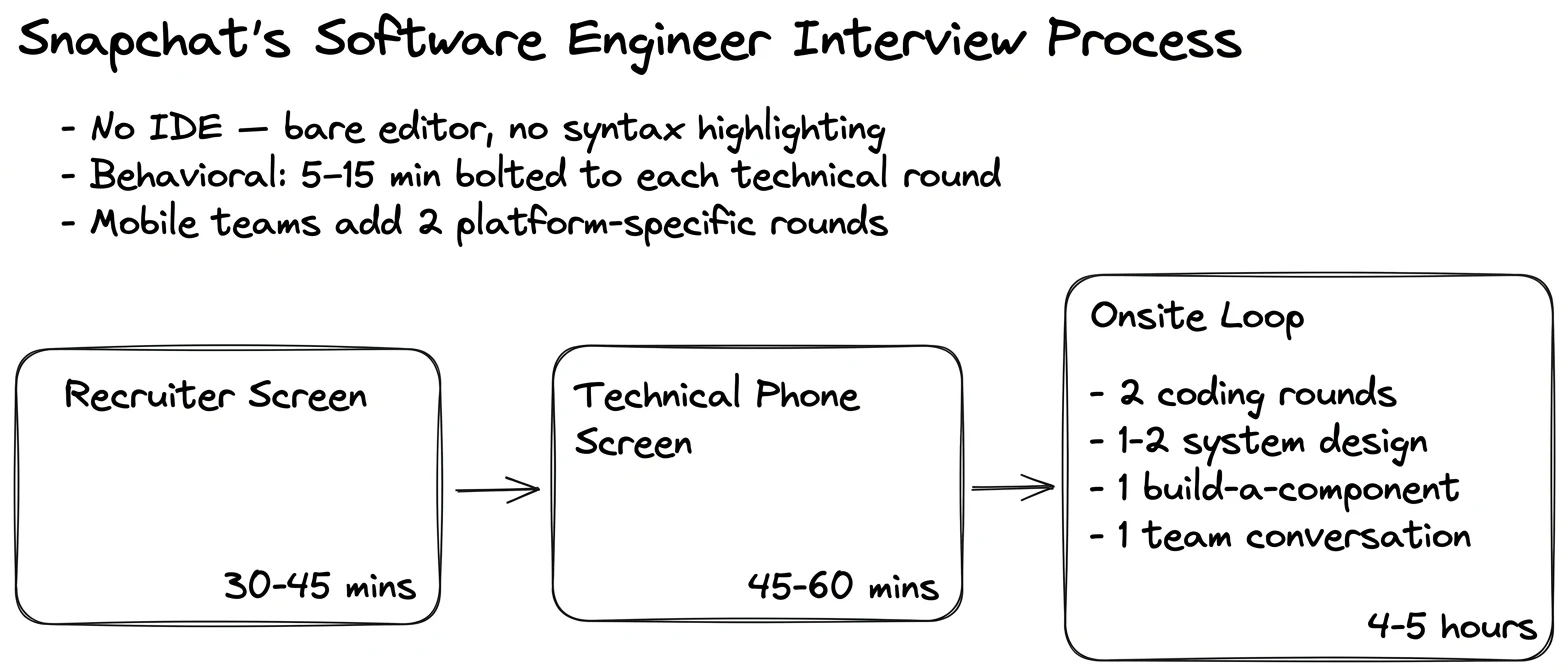
Snap runs a recruiter screen, an initial technical interview and a virtual loop tailored to role and level, usually over three to six weeks. Some roles are tied to a team from the start; others match near the offer. Virtual interviews require the camera on.
Reported loops ranged from a single combined round to six rounds for an iOS role, and two candidates sat three or four phone rounds, including design, instead of an onsite. Mid-level and senior loops carry one or two system design rounds; mobile teams add platform rounds.
Here's what the interview process can look like:
- Recruiter screen: A 30 to 45 minute call on background, interest in Snap, level and timeline.
- Technical phone screen (one, sometimes three or four): About 45 to 60 minutes of short behavioral questions or a resume pass, then one coding problem.
- Coding interviews (usually two): Hour-long rounds of medium problems with a custom twist and a follow-up.
- Low-level design interview: Build a small component without library shortcuts, then extend it and make it thread-safe.
- System design interview (one or two, mid-level and above): A design anchored in Snap's own products or a write-heavy service.
- Mobile domain interviews (iOS and Android teams): A hands-on UI exercise and a platform-knowledge deep dive.
- Behavioral and team conversation: Value-based questions, mostly embedded in technical rounds, plus a closing Q&A with the team.
Tip: Ask the recruiter which formats each round uses and confirm the target level in writing before the loop. Candidates expecting pure coding met unannounced design rounds, and a senior candidate learned only after the loop that the opening had changed level.
Technical phone screen
The screen runs 45 to 60 minutes in a plain shared editor with no autocomplete and, in reported cases, no execution. It opens with a short introduction and often two or three behavioral or resume questions, then one coding problem, typically a medium graph or grid problem. Reported problems include the largest perimeter among several islands, a yes-or-no Word Ladder, and two-sum in one pass with a set. Interviewers follow a working solution with an optimization question, such as reducing the visited grid to in-place marking.
Candidates with three or four phone rounds met a fire-spread grid, a weighted dependency graph, top-K autocomplete, an LRU cache and subset products of primes; one sequence opened with two design prompts in one call.
Interviewers evaluate:
- Recognizing the base pattern under the twist: Seeing that maximum island perimeter is a traversal with per-cell edge counting, not a new algorithm.
- Clean code in a bare editor: Variable scoping and naming errors that an IDE would flag are caught only by the interviewer's test.
- Complexity and space trade-offs: Stating time and space unprompted, then reasoning about in-place marking or recursion depth.
Practice BFS and DFS grid problems in a plain editor, dry-running your own example before declaring the code finished.
Note: The interviewer runs a concrete example against your code. A rejected candidate reused an outer-scope variable inside a BFS loop, could not find the bug until a hint with two minutes left, and had no time for questions.
Sample questions for the technical phone screen
Here are some questions reported by recent candidates:
-
Return the largest perimeter among all islands in a grid of land and water, then reduce the extra space.
-
Decide whether a start word can become an end word by changing one letter at a time through dictionary words.
-
Fire spreads one cell per step and you may wait at the start; find the longest wait that still leaves a safe path to the goal.
-
Given primes, return every product formed by multiplying any subset of them, including the empty product.
Coding interviews
Loops usually include two hour-long coding rounds, sometimes with two problems in one round. Difficulty sits at medium with occasional hard follow-ups; the difficulty comes from the variant. Grids gain a time dimension, graphs become latency-weighted service dependencies, and sliding windows run over event streams. Reported problems include multi-source BFS to evacuate a grid with blockers and exits, the minimum completion time of a service given its transitive dependencies, maximum unique users in any fixed time window, checking whether cards in the game Set form a valid set, and Decode Ways and Combination Sum variants. Interviewers often write their own problems.
Interviewers evaluate:
- Clarifying the changed rule: Asking whether waiting is allowed, whether reuse is allowed, or what counts as overlap before coding.
- Picking the structure out loud: Topological order plus dynamic programming for weighted DAGs, binary search over BFS for latest departure.
- A running solution, not a sketch: A brute force with no path to the efficient version is a reported rejection pattern.
- Composure with quiet interviewers: Some rounds are warm and hint-giving, others terse; narration is graded either way.
Practice BFS variants, topological sort with weights, sliding windows over timestamps and backtracking until each takes under 25 minutes.
Sample questions for the coding interviews
Here are some questions reported by recent candidates:
-
Given login events with timestamps, find the most unique users active in any window of fixed length.
-
Each service has a latency and dependencies forming a DAG; compute the earliest time a target service can finish.
-
Given a grid with blockers, people and exits, find the minimum time to evacuate everyone or report it impossible.
-
Decide whether a collection of cards with four features forms a valid set.
Low-level design interview
This is the most Snapchat-specific round on the track. In about 45 to 60 minutes you build one small component from scratch while the interviewer adds requirements. Reported prompts: a list without built-in collections, then its Iterator, then a generic map returning a new list; an in-memory pub/sub with CreateTopic, PublishMessage and SubTopic, extended so publishing notifies subscribers; an LRU cache where each item has its own size and eviction continues until the total fits; and a sliding-window rate limiter. One pub/sub session also held 10 minutes of behavioral questions and 5 for Q&A.
Interviewers evaluate:
- Interfaces from memory: Writing your language's iterator signature and generics correctly without an IDE.
- Stable public API under extension: Adding notification or eviction without rewriting what already works.
- A coherent locking story: Write lock for mutations, read lock for reads, channels versus mutexes, and what races under concurrent publish.
- Edge cases that change types: An empty list, or a
mapwhose output type differs from the input.
Practice building a linked list with iterator, a pub/sub bus, a weighted LRU cache and a rate limiter, each in under 40 minutes, then add thread safety.
Note: Finishing the base task is not passing. A rejected candidate's rate limiter was followed by race conditions, concurrent hash maps, Java's
synchronized, and the interviewer's stated preference for avoiding locks. In another session no code ran at all, and correctness was argued aloud.
Sample questions for the low-level design interview
Here are some questions reported by recent candidates:
-
Implement a list without built-in collections, add an iterator, then add a
mapthat returns a new list. -
Build an in-memory pub/sub with topics and subscriptions, then make publishing notify subscribers safely under concurrency.
-
Implement an LRU cache where items have different sizes and eviction removes as many items as needed.
System design interview
Mid-level and senior loops include one or two design rounds of about an hour; the L5 loop and the rejected onsite each had two. Prompts skew to Snap's own surfaces: Stories with per-user favorites, persistent saving and offline access; Stories for millions of concurrent viewers; and the Spotlight swipe feed. Write-heavy prompts are also common: a URL shortener with click counts, ad-click metrics with real-time and offline queries, and a distributed ID generator. Ride matching and price-drop alerting appear too.
Interviewers evaluate:
- Product behavior first: What a viewer sees offline, how favorites sync across devices, when ephemeral content expires.
- Write-path design: Asynchronous logging, stream processing and a stated consistency trade-off for counters and aggregates.
- Media delivery: Storage for ephemeral media, CDN placement and caching for swipe navigation.
- Failure reasoning under pressure: Clock skew in ID generation and node failures, defended rather than abandoned.
Practice Stories, a short-video feed and an event aggregator end to end, stating the product requirements before the architecture.
Sample questions for the system design interview
Here are some questions reported by recent candidates:
-
Design Snapchat Stories with favorites, saved stories and offline access, synced across devices.
-
Design ad-click metrics collection and alerting that serves real-time dashboards and offline analysis.
-
Design a distributed unique ID generator that stays ordered and survives clock skew.
-
Design a URL shortener whose click counter absorbs high write throughput.
Mobile domain interviews
iOS and Android loops add platform rounds; the reported iOS loop had six rounds, two on the platform. The first is a hands-on Xcode exercise: a scrollable grid with configurable rows and columns where tapping a square recolors it and opens a detail screen that passes the color back. The second is a deep dive on dispatch-queue output ordering, class versus struct, copy-on-write, stack versus heap, and weak versus unowned, ending with a dictionary built without the built-in type.
Interviewers evaluate:
- State and navigation: Clean data flow between screens matters more than visual polish.
- Concurrency prediction: Correctly ordering output from tasks dispatched to serial, concurrent and main queues.
- Memory semantics: Value versus reference types and avoiding retain cycles.
Rehearse a small multi-screen app in a declarative UI framework and predict dispatch-queue output on paper.
Sample questions for the mobile domain interviews
Here are some questions reported by recent candidates:
-
Build a tappable color grid with a detail screen that returns the chosen color to the grid.
-
Predict the print order of code that dispatches work across several queues.
Behavioral and team conversation
Snap assesses its values, Kind, Smart and Creative, through behavioral questions in nearly every round, usually 5 to 15 minutes, rather than one dedicated hour; some loops add a full behavioral round. Questions cover a challenging project, disagreement on a team, cross-functional work and trade-offs under deadline. Many loops close with a conversational Q&A on tech stack, release process and code review.
Interviewers evaluate:
- Concrete incidents: One situation with your actions and its outcome, not a philosophy of teamwork.
- Metrics and leadership: Numbers behind the impact and decisions you personally drove.
- Decision quality under ambiguity: How you chose with incomplete information and what you learned.
Prepare six to eight compact stories that fit in five minutes each.
Tip: Snap suggests Situation, Action, Impact, Learning for answers. Ending each story with what you would do differently covers the learning step that compressed answers drop.
Sample questions for the behavioral and team conversation
Here are some questions reported by recent candidates:
-
Tell me about a challenging project and the trade-offs you made under a tight deadline.
-
How do you handle a disagreement with a teammate?
How Snapchat levels and evaluates Software Engineer candidates
Interviewers score technical skill and values separately, and a hiring committee decides. Candidates describe the bar as roughly three of four technical rounds; two weak rounds is the reported rejection line. The target level is set before the loop but can move after it: an L5 candidate was offered L4 because the L5 opening had closed. Rejections arrive as automated emails without feedback.
Tip: If you are targeting Level 5 or above, ask whether the opening is still held at that level before the final round, and decide in advance whether you would accept a down-level.
How to prepare for the Snapchat Software Engineer interview
- Build components without libraries, then defend them: Build a list with iterator, a pub/sub bus, a weighted LRU cache and a rate limiter, then explain read-write locks, channels versus mutexes and a lock-free option.
- Reserve time for your own questions: Candidates who debugged to the last minute lost the chance and regretted it.
- Train on twisted classics: Grids with time, weighted DAGs, windows over event streams, and changed-rule backtracking.
- Code in a plain editor: Dry-run your own example; scoping slips have ended phone screens.
- Design Snap's own products: Stories with offline sync, the Spotlight feed and ad-click aggregation, product behavior first.
- Compress your stories: Six to eight Situation, Action, Impact, Learning stories that fit in five minutes and carry metrics.
- Pin down level and round formats early: Confirm the target level and whether design or domain rounds are included.
About the Snapchat Software Engineer role
Snap engineers build Snapchat's camera, messaging, Stories, Spotlight, Snap Map and Lenses, plus the ads platform and AR glasses. Snap works "default together", with teams in an office four or more days a week. In April 2026 Snap cut about 1,000 roles, roughly 16% of staff, and closed more than 300 openings, while the AR glasses unit, a subsidiary called Specs Inc. since January 2026, kept hiring.
| Level | Primary focus | Impact scope |
|---|---|---|
| Level 3 | Entry level: well-scoped features on mobile, backend or full-stack teams | Components within one team |
| Level 4 | Independent ownership of features and services | A team's product area |
| Level 5 | Senior: design leadership, cross-team delivery and mentoring | Several services or a product surface |
Snapchat hires Software Engineers across the product and platform. Teams include:
- Camera and Lenses: The camera stack and AR effects, often in Objective-C, Swift and C++.
- Content and Spotlight: Stories, the short-video feed and media delivery.
- Ads platform: Ad serving, measurement and the click and metrics pipelines.
- Web and desktop: Full-stack web applications, front-end performance and shared libraries.
- Specs: AR glasses hardware, software and the Lens Studio developer platform.
Software Engineer experience and education requirements
Level 3 postings ask for a technical bachelor's degree or equivalent experience and fluency in a language such as Java, Kotlin, Swift, Python or C++. Level 4 asks for two or more years after a bachelor's, one after a master's, or a PhD. Level 5 asks for six years after a bachelor's, five after a master's, or two after a PhD. Distributed systems, microservices or mobile experience is preferred by team.
FAQs about the Snapchat Software Engineer interview
How long does the Snapchat Software Engineer interview process take?
Typically three to six weeks from recruiter call to decision; multi-phone-round processes and level changes add time.
What is the hardest round of the Snapchat Software Engineer interview?
The low-level design round, for candidates who prepared only algorithms: a from-scratch build, live extensions and a concurrency interrogation in one hour. Senior candidates also report system design rounds that challenge every choice.
Can you use AI tools during the interview?
Not unless told otherwise. Snap's guidance bars outside resources, including AI, by default; some technical rounds are now AI-assisted, and the recruiter and interviewer say in advance when AI is permitted.
How much does a Snapchat Software Engineer make?
Posted U.S. base salary ranges in the highest-cost pay zone (California, Washington and New York City):
- Level 3: ~$118K to $176K base
- Level 4: ~$157K to $235K base
- Level 5: ~$209K to $313K base
Packages add restricted stock units on top of base, and ranges are lower in the other two pay zones.