Snapchat · Study
Snapchat Machine Learning Engineer Interview Process
TrueInterview
July 24, 2026 · 13 min read
The Snapchat Machine Learning Engineer loop tests three things on equal terms, and a weak hour in any of them can end the candidacy. A rapid-fire fundamentals round asks textbook questions and grades the mechanism behind them, not the name. ML design prompts use Snap's own surfaces, mainly ads ranking and short-video recommendation, and move within minutes into distributed training and serving. A standard coding round sits beside both at the same bar other engineers face. Project defense also runs through the whole loop: interviewers return to your resume in the screen, the fundamentals round and the behavioral round, and keep asking whether a model was needed at all.
This guide breaks down each stage of the Snapchat Machine Learning Engineer interview, what interviewers evaluate in each round, and how to prepare, with questions candidates were actually asked.
Verified: Based on 12 candidate-reported interview experiences, primarily from 2026 Q1 through 2026 Q2, cross-checked against recent public accounts.
Snapchat Machine Learning Engineer interview process
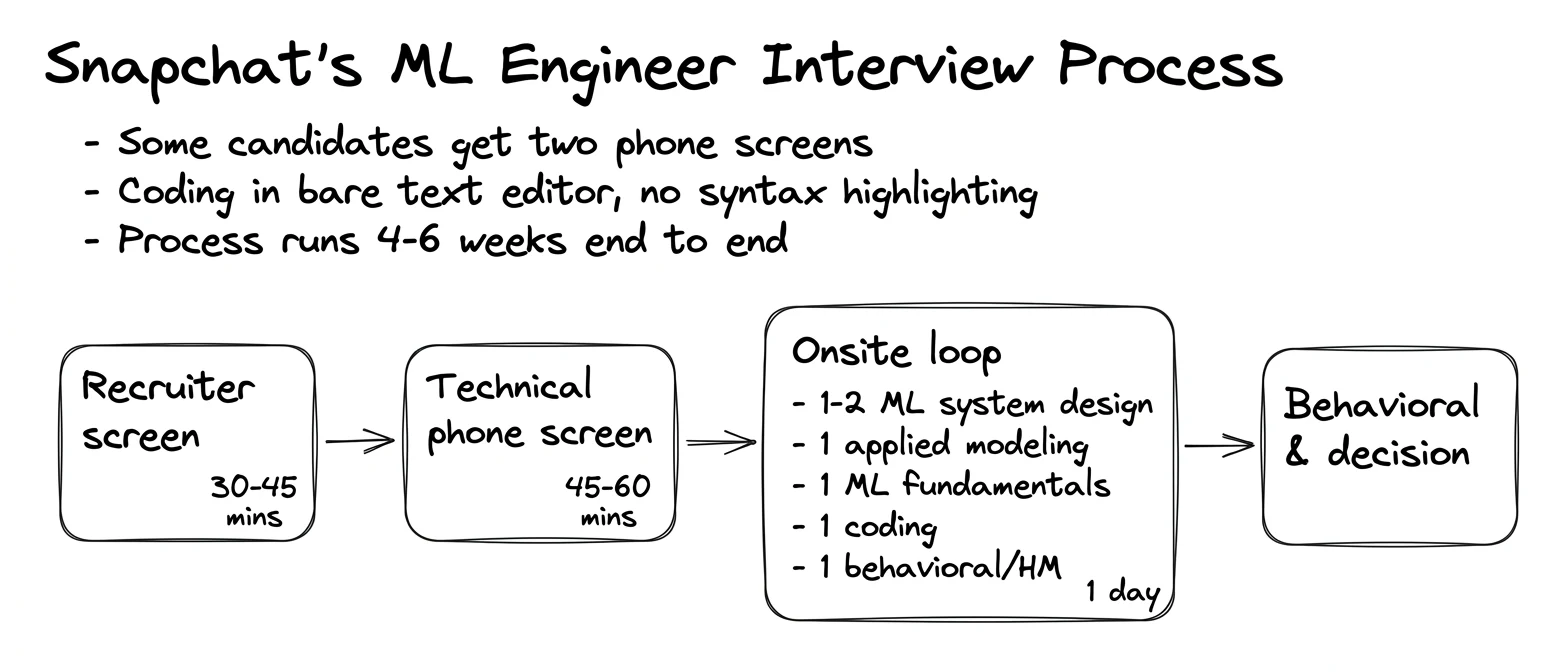
Snap hires MLEs into specific teams, so the design prompts follow the team's domain. Ads teams ask about ranking and conversion modeling, content teams about video and Lens recommendation, and search teams about retrieval. The skeleton is a recruiter call, one or two technical screens, and a final loop of four to six rounds, usually held on one day. Several loops ran in person on a whiteboard.
The screen depends on level: a project discussion plus coding for most mid-level candidates, pure theory for some, and pure design for one staff candidate. One new graduate sat four phone rounds in place of an onsite, and staff loops can add a product-thinking round.
Here's what the interview process can look like:
- Recruiter screen: Background, motivation, level and team targeting, and the list of rounds.
- Technical phone screen (one or two): About an hour mixing a project deep dive, ML fundamentals and one coding problem, or a design discussion at senior levels.
- Coding interview: One hour-long round of standard data structures and algorithms, sometimes in a plain editor or on a whiteboard.
- ML system design interview (one or two): Ads ranking, short-video recommendation, or distributed training and serving.
- Applied ML design interview: Modeling choices, features, labels and metrics for a product problem, or a product discussion at staff level.
- ML fundamentals interview: A fast quiz on regularization, normalization, optimizers, Transformers and evaluation.
- Behavioral and hiring manager interview: An adversarial project defense, innovation stories and a team conversation.
Tip: Ask the recruiter for the exact list of rounds. One candidate found a whiteboard system design round on the day that had never been mentioned, and every technical round still carried 5 to 10 minutes of behavioral questions.
Technical phone screen
The screen is a video call of 45 to 60 minutes with a shared editor. The usual shape is about 20 minutes on a recent project, covering problem framing, model iterations, the metrics you chose and what you would change, followed by one coding problem. Other screens add a block of theory in the same hour, which leaves little time for the code. Reported problems are binary search with careful off-by-one handling and a dry run, Basic Calculator III expression parsing with precedence and nested parentheses, Course Schedule cycle detection, K Closest Points to Origin, and Number of Islands followed by Trapping Rain Water in one session.
Theory screens asked about layer versus batch normalization, calibration, imbalanced data, overfitting in linear versus deep models, and positional encoding. Two candidates sat a second screen. One got the same design topic twice, sparse-text video retrieval, and the second interviewer pushed harder on the weak spots from the first.
Interviewers evaluate:
- Clean code on a classic problem: Sloppy or partial code on a well-known problem hurts even when the theory went well.
- Explicit state reasoning: For cycle detection, the three visit states and why two are not enough, plus Kahn's algorithm for an ordering.
- Trade-off awareness: Heap versus quickselect for k closest points, with the difference between interview and production use.
- Project ownership: Why you chose the metric and what you tried before the final model.
Practice classic medium problems in a plain editor, capped at 25 minutes each, after a 20-minute project walkthrough.
Sample questions for the technical phone screen
Here are some questions reported by recent candidates:
-
Decide whether all courses can be finished from prerequisite pairs using DFS with three visit states, then produce an ordering with BFS.
-
Evaluate a string expression with the four operators and nested parentheses, then discuss a past LLM fine-tuning project.
-
Design query retrieval over short videos when only about 20% have any text, and explain the limits of embedding retrieval.
Coding interview
The loop usually has one hour-long coding round. Some candidates coded in a bare text editor with no syntax highlighting, others on a whiteboard. No report mentions ML-themed puzzles: the problems are arrays, graphs, dynamic programming and data-structure design. Reported problems include 4Sum with no duplicate quadruplets and an explicit O(n³) target using sorting and two pointers, and grouping a connection network with union-find, path compression and union by rank. Others are a dynamic-programming problem with a subtle state-transition bug, a data structure with O(1) get and add, and an upward walk through a binary tree with parent pointers using lowest common ancestors.
Interviewers are collaborative: when one candidate's test failed, the interviewer helped trace an off-by-one in the recurrence.
Interviewers evaluate:
- Complexity stated before code: Why sorting plus two pointers removes the extra log factor in 4Sum.
- Duplicate and edge handling: Skipping repeated values, missing targets and unreachable nodes.
- Implementation detail: Path compression and union by rank written out, not just named.
Keep a steady routine of graph, two-pointer, dynamic-programming and design-a-structure problems until each takes under 30 minutes.
Sample questions for the coding interview
Here are some questions reported by recent candidates:
-
Return all unique quadruplets that sum to a target in O(n³) time without duplicates, then compare hash-based and two-pointer approaches.
-
Build a structure that supports
getandaddin O(1) time. -
From a starting node in a tree with parent pointers, follow a sequence of values and return the path traversed.
ML system design interview
Most loops have one or two whiteboard design rounds of about an hour, built on Snap products. Ads prompts cover feature representation for user, ad and context, and multi-task models that predict clicks and conversions with a shared bottom and task-specific towers. They also cover delayed conversion labels, calibration, wide-and-deep versus cross-network layers, and advertiser fairness constraints that do not wreck revenue. Video prompts cover candidate generation, two-tower retrieval, real-time feature stores, pointwise ranking, and re-ranking for diversity and freshness. They also cover cold start, short-term interest drift, explore versus exploit, and A/B metrics tied to long-term retention rather than click-through rate.
One round was entirely about distributed training and inference: parameter servers, model parallelism, batch versus streaming features, and online learning to keep the model fresh. A staff round moved from aligning retrieval with ranking to the cost of moving data between servers.
Interviewers evaluate:
- Full lifecycle without prompting: Objective, candidates, features, model, re-ranking, experiments and monitoring.
- Infrastructure depth: Sharding, serving latency against model complexity, and feature freshness.
- Label realism: Delayed or missing labels, position bias and feedback loops.
- Metric alignment: Offline metrics that predict the online business goal.
- Attacking your own design: Where embedding retrieval or a popularity-driven ranker breaks.
Rehearse an ads ranker and a short-video recommender end to end, then spend as long on their failure modes and serving costs.
Note: A candidate rejected after a five-round loop said that missing hands-on distributed training experience showed within minutes and decided the outcome. Another lost the screen stage by not explaining in a structured way why dense retrieval fails: rare queries drift, a fixed-size vector is a bottleneck, and compositional queries are hard.
Sample questions for the ML system design interview
Here are some questions reported by recent candidates:
-
Design feed ads ranking: map the business objective to a model, choose features, handle delayed conversions, and calibrate online.
-
Design a short-video feed that adapts to a user's short-term interests and balances exploration with exploitation.
-
Design distributed training and low-latency inference for a short-video recommender, including parameter servers and freshness.
Applied ML design interview
This round is about modeling judgment for a product rather than infrastructure. Reported prompts include a recommender for Snapchat Lenses with cold start for new items and new users, and weighted logistic regression across levels of engagement. Others are a restaurant recommender that needed architecture, features, offline and online metrics, and diversity. One candidate designed an automatic tagging pipeline for shop listings using fused image and text models, precision@k and coverage, with merchant corrections as feedback. Another designed a trustworthy ranking system whose labels arrive hours or days after an impression, and one designed the interface of a training platform for retrieving features and models. At staff level, this slot was a product discussion of a favorite app and how to improve it.
Interviewers evaluate:
- Label and loss choice: How several engagement outcomes become training targets and weights.
- Cold start: Separate plans for new users and new items.
- Handling ambiguity: Clarifying questions and stated assumptions on prompts that are deliberately vague.
- Iteration after launch: How feedback and corrections flow back into the model.
Practice turning a one-line product prompt into labels, features, a model choice and two metrics within ten minutes.
Sample questions for the applied ML design interview
Here are some questions reported by recent candidates:
-
Design Lens recommendations, including cold start and weighted logistic regression over engagement levels.
-
Build a ranking system whose true engagement labels arrive days later, keeping it auditable and robust to feedback loops.
-
Tag newly listed products with category, brand and attributes from images and text, then improve it with merchant corrections.
ML fundamentals interview
The fundamentals round is a dedicated hour of quick questions, sometimes paired with a second project deep dive. Reported topics include the bias-variance decomposition term by term, L1 versus L2 with their geometry and sparsity, and the learnable parameters in batch normalization. Others are batch versus layer normalization and internal covariate shift, SGD, momentum and Adam including bias correction, and vanishing gradients and which activations cause them. The round also covers loss functions, imbalanced-data strategy and evaluation, trees versus deep models, and Transformer internals from Q, K and V to multi-head attention. One loop ended with a math problem to derive an algorithm from first principles and code it.
Interviewers evaluate:
- Mechanism over definition: Why a technique works and when it fails.
- Speed and precision: Two exact sentences beat a slow derivation.
- Linking regimes: The same problem, such as overfitting, handled in linear models and deep networks.
- Production pitfalls: Training-serving skew, calibration and monitoring.
Drill each core concept until you can give its mechanism, a failure case and an alternative in under a minute.
Note: This is the round most often cited after a rejection. The questions sound basic, but hesitation reads as not knowing, and one or two imprecise answers can outweigh good coding and design rounds.
Sample questions for the ML fundamentals interview
Here are some questions reported by recent candidates:
-
Which parameters does batch normalization learn, and when would you use layer normalization instead?
-
Name three ways to regularize a deep network and explain how each one reduces overfitting.
-
Derive scaled dot-product attention from the input, then explain what breaks without positional encoding.
Behavioral and hiring manager interview
The behavioral round puts one project under close review: its context, technical design and modeling method. The interviewer repeatedly asks whether building a model was needed at all. Other rounds asked for examples of innovation, meaning times you found a new solution rather than carried out a standard one, along with conflict, cross-functional work and ambiguity. Hiring-manager conversations cover the team's mission and current projects, followed by open questions.
Interviewers evaluate:
- Justified complexity: The non-ML baseline you compared against and why the model beat it.
- Original contribution: A specific idea of yours that changed the outcome.
- Candor about failure: What you would do differently and what you learned.
Prepare two projects you can defend down to the baseline, the metric and monitoring, plus one clear innovation story.
Sample questions for the behavioral and hiring manager interview
Here are some questions reported by recent candidates:
-
Walk through a past project and explain why a model was the right tool instead of a simpler rule.
-
Describe a time you created a new solution instead of applying the standard approach.
-
How did you settle a disagreement with a cross-functional partner over a trade-off?
How Snapchat levels and evaluates Machine Learning Engineer candidates
Candidates describe the outcome as turning on the weakest round rather than an average. Several were rejected after feeling good about every round, including a new graduate who cleared four. Rejections arrived by email without specifics, one two days after the final round and another after several days of silence. Snap cut about 1,000 jobs in April 2026 and closed more than 300 open roles, and machine learning engineers were among those affected. At least one candidate finished a loop just before the cuts, so headcount can change after an otherwise good loop. The reports do not describe a formal cooldown period.
How to prepare for the Snapchat Machine Learning Engineer interview
- Drill fundamentals as mechanisms: Normalization parameters, optimizer bias correction, L1 geometry and positional encoding, each in two precise sentences.
- Build two Snap-shaped designs: An ads ranker with multi-task heads and delayed labels, and a short-video recommender with retrieval, re-ranking and cold start.
- Learn the infrastructure layer: Parameter servers, sharding, streaming features and serving latency come up in most design rounds.
- Study failure modes: Be ready to explain why embedding retrieval, popularity-driven ranking and click-through metrics break.
- Keep coding sharp: Practice graphs, union-find, two pointers, dynamic programming and O(1) structures in a plain editor.
- Defend every model: Prepare the baseline and the non-ML alternative for each project on your resume.
- Bring an innovation story: Show an idea of your own, not only competent delivery.
About the Snapchat Machine Learning Engineer role
Snap MLEs build, deploy and maintain the models behind Snapchat at scale, from ad ranking and search to recommendations and generative features, prototyping and launching them with product and infrastructure teams. Ranking infrastructure and system design are named qualifications even at mid-level. Most roles follow Snap's default-together policy of four or more days a week in the office.
| Level | Primary focus | Impact scope |
|---|---|---|
| Level 3 | Building and shipping models within an existing pipeline | Features on one team |
| Level 4 | Owning models and features end to end | A team's model or surface |
| Level 5 | Leading ranking or modeling projects and their system design | A team's ML direction |
| Level 6 (Staff) | Setting technical direction for a stack such as ad optimization | Several teams |
Snapchat hires Machine Learning Engineers across several areas. Teams include:
- Ad ranking and ads platform: Click and conversion prediction, targeting and marketplace optimization.
- Search ranking: Relevance, quality and personalization models.
- Content recommendation: Ranking short-video and story feeds.
- Lenses and AR: Lens recommendation and the Lens Studio ecosystem, with hiring continuing in the Specs unit.
- Generative ML: Generative models, segmentation, detection and tracking.
Machine Learning Engineer experience and education requirements
Level 3 postings ask for a bachelor's in a technical field plus a year of post-degree ML experience, or a master's. Level 5 asks for about five years after a bachelor's, four after a master's, or one to two after a PhD, plus experience in ranking, recommendation, search or content understanding. Staff ad-ranking roles ask for about eight years. Python with PyTorch or TensorFlow is the expected stack. Posted base ranges in the highest US pay zone are about $118K to $176K at Level 3 and $173K to $259K at Level 4, plus RSUs.
FAQs about the Snapchat Machine Learning Engineer interview
How long does the Snapchat Machine Learning Engineer interview process take?
Typically several weeks from the recruiter call to a decision, longer when a second screen is added. Decisions after the final round came anywhere from two days to more than a week later.
What is the hardest round of the Snapchat Machine Learning Engineer interview?
The fundamentals round causes the most rejections, because it is fast and does not accept approximate answers. The distributed ML design round is the deepest, because it needs modeling and infrastructure knowledge in the same hour.
Is there an online assessment or take-home?
No report mentions one. Every stage was live, on a video call, a whiteboard or a plain editor.
Is the coding bar lower for Machine Learning Engineers?
No. Problems are standard data structures and algorithms at the same level other engineering tracks face.