Snapchat · Study
Snapchat Interview Process & Questions
TrueInterview
July 24, 2026 · 12 min read
Three details decide most Snapchat outcomes. Behavioral questions are not confined to one slot: candidates on both tracks describe five to ten minutes of collaboration or trade-off probing inside nearly every technical round. Coding happens in a bare editor and is usually extended after the first working version. The final call goes to a review of the whole panel, where clearing roughly three of four technical rounds is the reported threshold, and that review can offer a lower level than the one you interviewed for.
This guide breaks down each stage of the Snapchat interview, what interviewers evaluate in each round, and how to prepare, with questions candidates were actually asked.
Verified: Based on 23 candidate-reported interview experiences, cross-checked against recent public accounts.
Snapchat interview process
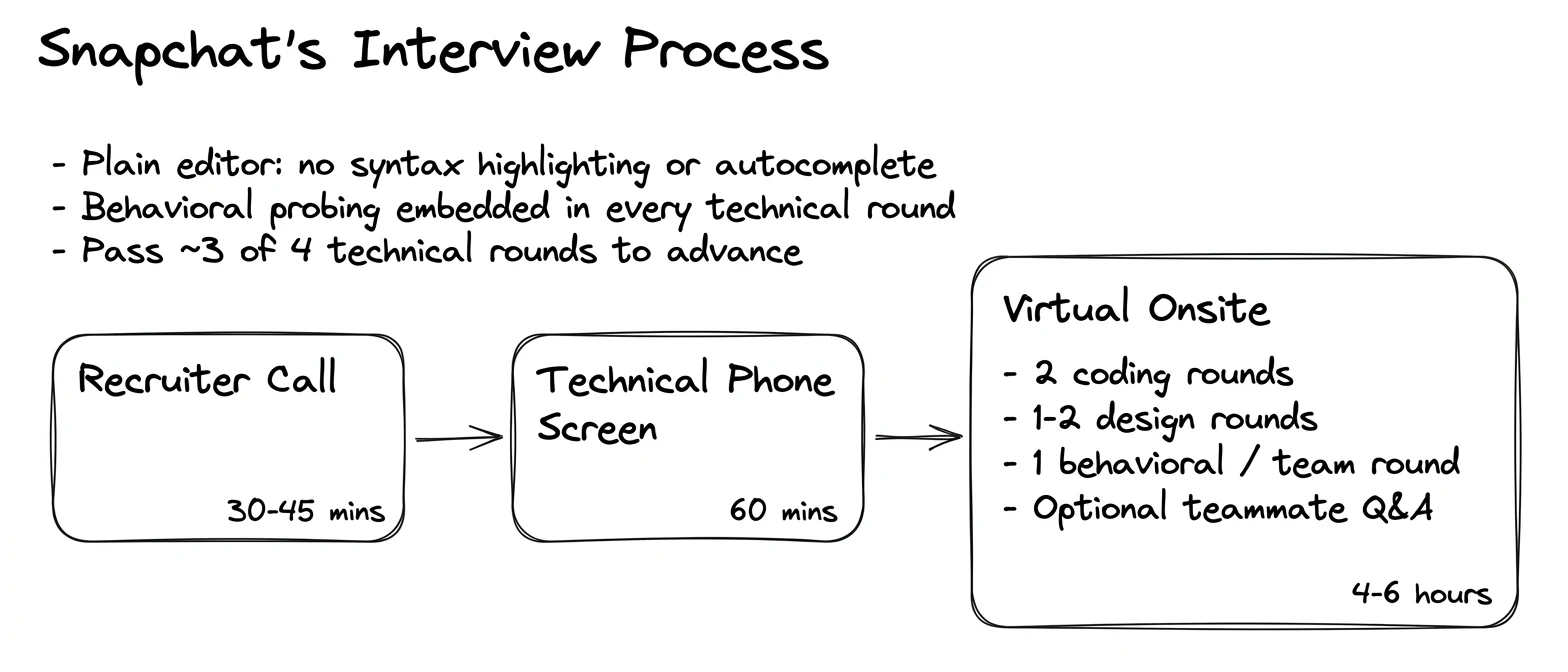
Content follows the hiring team: ads teams ask about click aggregation, Stories teams about ephemeral media, and mobile teams add a platform round. A typical process runs three to six weeks: a recruiter call, one technical phone screen, and an onsite of four to six rounds of 45–60 minutes. Several loops on both tracks ran entirely as three or four phone interviews with no separate onsite day.
Software Engineer loops are usually two coding rounds, one or two system design rounds, and a behavioral or team conversation; a Level 5 loop had two of each. Machine Learning Engineer loops swap a coding round for ML system design, a fundamentals round and a project retrospective, and new grads still sit ML design. Staff candidates reported a design-only phone screen and a product-sense round.
Here's what the interview process can look like:
- Recruiter screen: A 30–45 minute call on background, motivation, target level and the round list.
- Technical phone screen: About 45–60 minutes in a shared editor with a resume or behavioral segment and one or two coding problems; ML candidates may get fundamentals or ML design instead.
- Coding interviews: Medium algorithm problems with a twist, or a from-scratch component build such as a custom list or an in-memory pub/sub system.
- System design and ML design interviews: Product-grounded design for engineers; ranking, recommendation and retrieval design for ML candidates.
- ML fundamentals interview (ML track): A fast question-and-answer round on regularization, normalization, optimizers and transformers.
- Behavioral and hiring manager conversation: Project scrutiny and values questions, often paired with a team Q&A.
Tip: Ask the recruiter for the round list and target level in writing, then prepare for every format anyway. Candidates were surprised by an unannounced system design round and by a downlevel offer after a completed loop.
Recruiter screen
The call is non-technical and lasts 30–45 minutes: background, why Snap, languages, compensation expectations and target level. Recruiters outline the rounds, but the outline is not always complete; one machine learning candidate met a whiteboard system design round nobody had mentioned.
Interviewers evaluate:
- Level fit: The scope of your recent work, which sets whether the loop targets Level 4, Level 5 or staff. Leveling can still move after the onsite.
- Domain match: Ads, ranking, media or mobile experience, depending on the team that opened the role.
- Motivation: A specific reason tied to Snap's products (camera, Stories, Spotlight, Lenses, Specs).
- Logistics: Location and Snap's default-together model of four or more office days a week.
Use this call to confirm the round list, the level, and that the headcount is still open.
Sample questions for the recruiter screen
Here are some questions reported by recent candidates:
- Walk me through your background and the project you are proudest of.
- Why Snap, and which of our products do you use?
Technical phone screen
The screen is a 45–60 minute video call in a shared editor with no syntax highlighting, autocomplete or test runner. Software Engineer screens open with two or three behavioral questions, then one problem: the maximum perimeter across all islands in a grid, a Word Ladder variant returning only reachability, or two-sum with a set. The interviewer then runs a concrete example against your code. Machine Learning Engineer screens split the hour into about 20 minutes of project deep dive, a fundamentals block, and a problem such as course-schedule cycle detection, K closest points or Basic Calculator III.
Some loops run several phone rounds instead. One software loop had four: a fire-spreading grid escape (binary search over BFS), the longest weighted path through a service-dependency DAG, top-K autocomplete for a prefix, and a URL shortener with click counts.
Interviewers evaluate:
- Clean first-pass code: A wrong variable inside a BFS loop, caught by the interviewer's test case, consumed one candidate's remaining time.
- Follow-up handling: Expect a space optimization (reusing the grid instead of a visited matrix) or an alternative such as heap versus quickselect.
- Precise state reasoning: For cycle detection, explicit unvisited, visiting and visited states, and why two states are not enough.
Practice medium graph and grid problems in a plain text editor and dry-run every solution aloud.
Note: Interviewers almost always continue after a correct answer. Candidates who stopped at the first working version had no time left for the optimization discussion, which is graded as heavily as the original problem.
Sample questions for the technical phone screen
Here are some questions reported by recent candidates:
-
Return the largest perimeter among all islands in a 0/1 grid, then reduce the extra space by reusing the grid.
-
Fire spreads one cell per step and you may wait at the start; find the longest wait that still lets you reach the exit.
-
Decide whether all courses can be finished given prerequisite pairs, then produce an order with Kahn's algorithm.
Coding interviews
Onsite coding rounds run 45–60 minutes. Problems are medium with occasional hard follow-ups, usually a familiar pattern with one rule changed: the most unique users in any fixed-length login window, validating a Set card hand, Decode Ways and Combination Sum variants, 4Sum without duplicates, or union-find over network connections. Candidates describe a large question bank with few repeats.
A distinctive Software Engineer format is the component build. Candidates built a singly linked list without built-in collections, then an Iterator, then a generic map; an in-memory pub/sub system guarded by a read-write lock; and an LRU cache whose items have different sizes. The code often never runs; the grade comes from the concurrency follow-up. Mobile loops add a platform round, such as a tappable color grid in Xcode or Grand Central Dispatch ordering.
Interviewers evaluate:
- Adapting a known pattern: Spotting which rule changed before reaching for a memorized solution.
- API and class design: Clean interfaces, correct generics, and the iterator signature in your language from memory.
- Concurrency reasoning: Which shared state needs a write lock and how notifications are delivered safely.
- Debugging out loud: Interviewers often pair-debug a failing case; staying vocal earns signal.
Write a list with an iterator, a cache and a pub/sub bus from memory, then add a thread-safety follow-up to each.
Sample questions for the coding interviews
Here are some questions reported by recent candidates:
-
Given timestamped logins, find the most unique users active within any window of fixed length.
-
Build a list without built-in collections, add an iterator, then a
mapthat returns a list of a different type. -
Implement an LRU cache where items have different sizes and eviction continues until the total fits.
System design and ML design interviews
Design rounds run 45–60 minutes, and prompts come from Snap's own products. Software Engineer prompts include Stories with favorites, saving and offline access across devices; the Spotlight swipe feed; ad click metrics with real-time and offline queries; a URL shortener with a high-write click counter; and a distributed UUID generator challenged on clock skew.
Machine Learning Engineer prompts center on ranking: a short-video feed that adapts to short-term interest, ads ranking with multi-task towers for click and conversion rates, Lens recommendation with cold start, ranking under delayed labels, and distributed training with parameter servers. ML rounds often drift from modeling into infrastructure, and one rejected candidate named that gap as the deciding factor.
Interviewers evaluate:
- Product grounding: Starting from how the feature behaves for users (freshness, offline viewing, swipe latency) before naming storage.
- Write-heavy aggregation: Asynchronous logging, stream processing and an explicit consistency trade-off for counters.
- End-to-end ML lifecycle: Objective, labels, features, retrieval and ranking, offline and online metrics, cold start and monitoring.
- Knowing failure modes: Why embedding retrieval struggles with rare or compositional queries, and how to correct popularity bias.
Use the app first and sketch a backend for each major surface.
Sample questions for the system design and ML design interviews
Here are some questions reported by recent candidates:
-
Design Stories with saved favorites and offline access that stays in sync across devices.
-
Design the backend for the Spotlight video feed with swipe up and down navigation.
-
Design short-video search when only about a fifth of the videos have any text, then explain where embedding retrieval breaks.
ML fundamentals interview
This ML-track round is a fast question-and-answer session. Reported topics include the learnable parameters in batch normalization, batch versus layer normalization, L1 versus L2 geometry, Adam and SGD, attention and positional encoding, vanishing gradients, calibration and imbalanced data. One round ended with a math problem requiring an algorithm derived from first principles.
Interviewers evaluate:
- Precision at speed: Short, exact answers; the pace leaves no room to reason toward one.
- Intuition behind the formula: Why Adam needs bias correction, why multi-head attention helps.
- Practical judgment: Tree ensembles versus deep models, and evaluation on skewed labels.
Rehearse two-minute spoken explanations of each core concept, including when it fails.
Sample questions for the ML fundamentals interview
Here are some questions reported by recent candidates:
-
What are the learnable parameters in batch normalization, and when would you pick layer normalization instead?
-
Derive the attention output from Q, K and V, and say what happens without positional encoding.
Behavioral and hiring manager interview
Many loops add a dedicated round on past projects, conflict, cross-functional work and ambiguity. Project scrutiny is pointed: a staff ML candidate was asked repeatedly whether a model had been necessary at all, and another was asked specifically for examples of innovation. Loops often close with a hiring manager or teammate Q&A about the team's mission and practices.
Interviewers evaluate:
- Kind, smart, creative: Snap's stated values, heard as candor, sharp judgment and original ideas.
- Justified complexity: Whether a simpler approach would have worked and how impact was measured.
- Honest trade-offs: What broke after launch; polished success stories without this read as evasive.
Prepare two projects that survive a challenge on whether they were needed, plus one story about an idea you invented.
Sample questions for the behavioral and hiring manager interview
Here are some questions reported by recent candidates:
-
Tell me about a challenging project and the trade-off you would revisit.
-
Describe a time you came up with a novel solution rather than the standard one.
How Snapchat makes hiring decisions
A hiring committee reviews the panel's feedback after the final round. Candidates report the bar as passing about three of four technical rounds: one weak round is recoverable, two usually are not. Level is decided here, not at the recruiter call; a candidate who completed a Level 5 loop was offered Level 4 because Level 5 openings were gone. Team matching can follow and can stall during hiring pauses. Decisions took two days to more than a week, and rejections arrive as an automated email with no round-level feedback.
Note: Headcount moves outcomes. Snap cut about 1,000 roles and closed more than 300 open requisitions in April 2026, and a new-grad ML candidate who felt every round went well was rejected around then. A rejection is weak evidence about your performance.
How to prepare for the Snapchat interview
- Code in a bare editor: Practice without highlighting or autocomplete and finish each problem with a spoken dry run; most reported failures were slips found by the interviewer's test.
- Add your own follow-up: Cut the memory, make it thread-safe, or change one constraint on every practice problem.
- Build components from scratch: A list with an iterator and
map, a size-weighted LRU cache, and a locked pub/sub bus without library collections. - Design from the product outward: Sketch Stories, Spotlight and ad click metrics from the user's view first, including offline behavior.
- Know why your ML designs fail (ML track): For each ranking component, list its failure modes and the serving trade-offs.
- Drill fundamentals at speed (ML track): Exact two-minute answers on normalization, regularization, optimizers and attention.
- Defend every project: Be ready to argue the system was needed, how impact was measured, and what you invented.
About working at Snapchat
Snap Inc. builds Snapchat (camera messaging, Stories, Spotlight, the Snap Map, Lenses), Snapchat+, a large ads business, and Specs AR glasses on Snap OS. Snapchat reported about 493 million daily active users in the second quarter of 2026. After the April 2026 restructuring, leadership described smaller teams leaning heavily on AI coding tools. Headquarters is in Santa Monica, with engineering hubs including the Bay Area, Seattle and New York.
| Level | Primary focus | Impact scope |
|---|---|---|
| Level 3 | Delivers well-defined features with guidance | Tasks within one team |
| Level 4 | Owns features end to end and designs components | A feature or service |
| Level 5 | Leads multi-component projects | A product area across teams |
| Level 6 (staff) | Sets technical direction | Multiple teams or a platform |
Snapchat hires engineers across several orgs. Teams include:
- Content and Spotlight: Stories, the Spotlight feed, and their recommendation and ranking.
- Ads platform: Ad ranking, prediction, delivery and measurement.
- Camera and Lenses: The AR effects pipeline and Lens discovery.
- Messaging and core app: Chat and client infrastructure on iOS and Android.
- Specs and Snap OS: AR glasses software, embedded OS and on-device vision.
Experience and education requirements
Postings ask for a bachelor's degree in a technical field or equivalent experience. Machine Learning Engineer Level 4 roles ask for about three years of post-degree ML experience (two with a master's) in ranking, recommendations, search or content understanding. Common languages are Java, Go, C++, Python, Swift and Kotlin, and postings expect fluent, carefully reviewed use of AI coding tools.
FAQs about the Snapchat interview
How long does the Snapchat interview process take?
Typically three to six weeks from recruiter call to decision. Team matching and hiring pauses can add weeks after a pass.
What is the hardest round in the Snapchat interview?
For engineers, the component build: implementing from scratch without library help, then defending concurrency after it works. For ML candidates, the fundamentals round, where strong practitioners lose ground on speed and precision.
Can you be down-leveled?
Yes. Level is set after the onsite, and a Level 5 candidate was offered Level 4. Confirm the target level and headcount before the onsite.
How much does a Snapchat engineer make?
Snap posts base salary ranges by pay zone; Zone A covers California, Washington and New York City. Posted Zone A bases are about $157K–$235K for Software Engineer Level 4 and $209K–$313K for Level 5, and Machine Learning Engineer Level 4 postings list about $147K–$259K. Packages add RSU equity on top of base.