Sigmacomputing · Study
Sigma Computing Interview Process & Questions
TrueInterview
September 4, 2026 · 9 min read
Sigma Computing's technical prompts are small versions of its own product, such as a spreadsheet with formula cells, a pivot table or a boolean formula evaluator. Each prompt arrives in parts that reuse the earlier design, so the first draft's structure decides the round. Clear reasoning can carry an unfinished part: one candidate advanced without coding the last step of the pivot table.
This guide breaks down each stage of the Sigma Computing interview, what interviewers evaluate in each round, and how to prepare, with questions candidates were actually asked.
Verified: Based on 6 candidate-reported interview experiences, cross-checked against recent public accounts.
Sigma Computing interview process
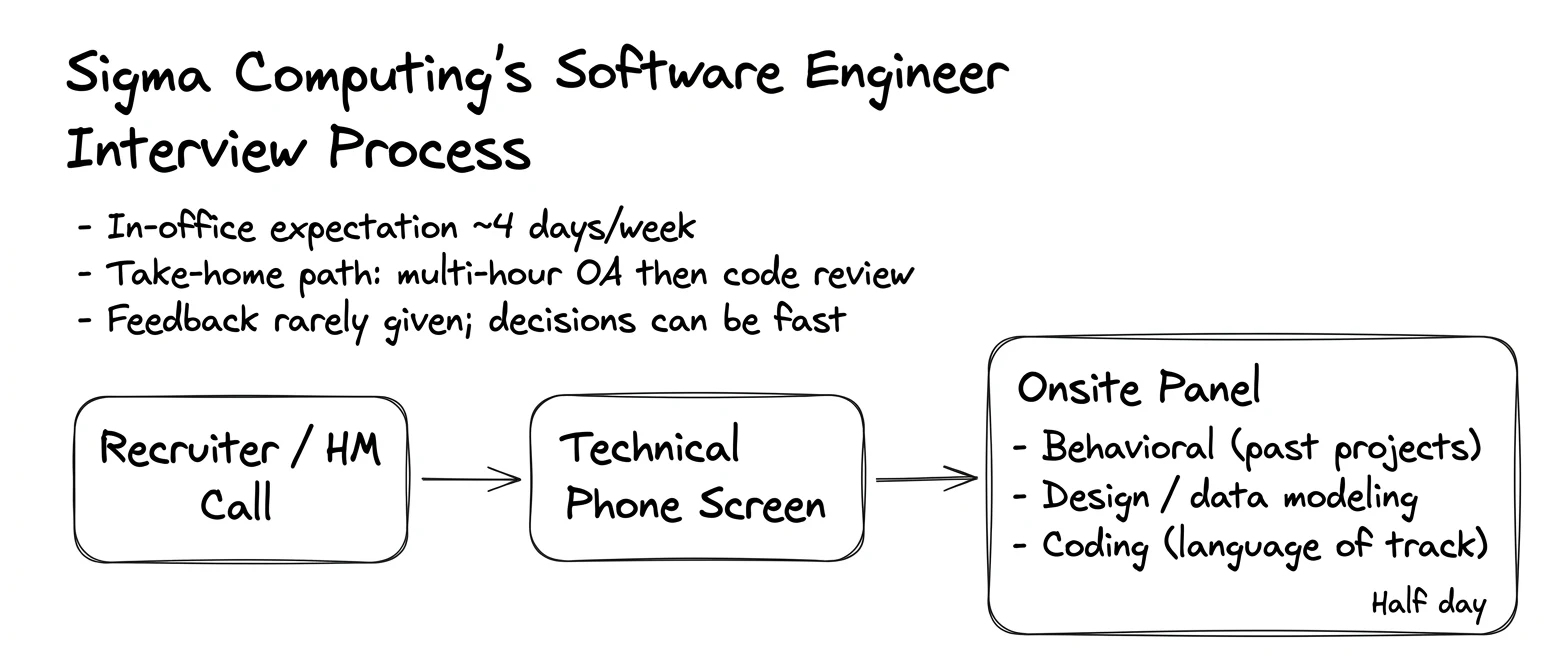
The loop is short. Most candidates have a recruiter call, one live technical screen, then an onsite of about three rounds: behavioral, design and a second coding round. Some 2025 candidates instead started with an online assessment, followed by a session in which an engineer reviewed their submitted code. The process typically takes three to four weeks.
The shape changes little by level, but the design round follows the track. A front-end candidate designed the data model of a rich-text editor. Back-end and full-stack design rounds typically focus on scaling a service. Every engineering role is in office, with San Francisco roles reported at four days a week.
Here's what the interview process can look like:
- Recruiter screen: A short call about the team, your background and the in-office expectation.
- Online assessment and code review (some candidates): A timed set of product-flavored problems, then an engineer walks through your submission.
- Technical phone screen: A live, multi-part build of a spreadsheet, pivot table or formula evaluator, starting from a provided skeleton.
- Behavioral interview: Past projects, collaboration and conflict.
- Design interview: A data-model-first design, such as a rich-text editor for front-end candidates.
- Coding interview: A second practical build, such as an async task scheduler in JavaScript.
Tip: Ask the interviewer what later parts will add before writing part one. Formulas, totals and wider axes are the reported extensions, and a structure built for them avoids a rewrite under time pressure.
Recruiter screen
The call covers the product, the team and the in-office expectation. One San Francisco candidate withdrew on learning the role required four office days a week. Some candidates speak with the hiring manager instead.
Interviewers evaluate:
- Location fit: Willingness to work from the San Francisco, New York, London or Sydney office most of the week.
- Track fit: Front-end, back-end, full-stack, compiler or reliability experience matched to an open team.
- Motivation: A specific reason to build analytics on top of cloud data warehouses.
Settle the office schedule before investing in technical preparation.
Sample questions for the recruiter screen
Here are some questions reported by recent candidates:
- Tell me about your most recent project and your role in it.
- Are you able to work from the office four days a week?
Online assessment and code review
Some 2025 candidates started with a take-home style assessment before any live interview. One report describes a window of up to four hours, with product-flavored problems written in Python. A separate session followed in which an engineer walked through the submitted code and asked about the decisions behind it. Candidates describe the problems as not difficult and the reviewers as patient.
Interviewers evaluate:
- Code structure: Whether the submission separates storage, evaluation and output cleanly.
- Ownership of decisions: Explaining why you chose a structure and what you would change.
- Extension readiness: How easily your code takes a new requirement during the review.
Write the assessment as code you will defend line by line, because the review is a second technical round.
Sample questions for the online assessment and code review
Here are some questions reported by recent candidates:
- Walk through your submission and explain the data structure you chose for storage.
- How would your code change if a new operation were added?
Technical phone screen
The screen is a live coding session in a shared editor, usually starting from a skeleton the interviewer provides. Three prompt families recur. The first is a spreadsheet class with fixed, ordered columns and unbounded, sparse rows that supports getting and setting cells and printing the first n rows, including rows that were never written. Its follow-up adds formula cells that sum two other cells and requires cycle detection. The second is a pivot table: aggregate one column by two others with a custom printer, then add row and column totals, then allow multi-column axes. The third is an evaluator for a boolean formula tree with AND, OR, comparisons, integer truthiness and mixed-type comparisons.
Interviewers often name the technique, such as maps and sets for the pivot table or a visited set for cycles. Structure, narration and testing outweigh how many parts you finish. Variants differ from widely shared versions in details such as whether empty rows print, so read carefully.
Interviewers evaluate:
- Extensible first draft: A cell store and an evaluator that take formula cells without a rewrite.
- Cycle handling: Treating formula references as a directed graph and stopping circular references instead of recursing forever.
- Following given semantics: Implementing the stated rules exactly, such as zero being false and a mismatched-type comparison returning false.
- Communication: Stating the plan for an unfinished part clearly enough to earn credit for it.
Build a spreadsheet class and a pivot table from scratch, then extend each twice without rewriting.
Note: A front-end candidate did not finish the third part of the pivot table but explained the approach clearly and still advanced to the onsite. Running out of time is survivable; silence about the plan is not.
Sample questions for the technical phone screen
Here are some questions reported by recent candidates:
-
Implement a sparse spreadsheet with get, set and print-first-n-rows, then let a cell hold the sum of two other cells and detect cycles.
-
Build a pivot table that sums one column across two axis columns, add row and column totals, then support three columns as axes.
-
Evaluate a boolean formula tree with logical and relational operators, then extend it to support variables.
-
Implement a Mini Spreadsheet with Get/Set, Row Printing, and Add Formulas with Cycle Handling
Behavioral interview
A standard behavioral round on past experience, collaboration and conflict resolution, focusing on your most recent project. In 2025 reports, it was sometimes held back to back with the final technical round.
Interviewers evaluate:
- Project depth: What you personally built and the trade-offs you made on your latest project.
- Collaboration: How you work with design, product and other engineers.
- Conflict resolution: A real disagreement and how it ended.
Prepare two detailed project stories and one conflict story with a clear outcome.
Sample questions for the behavioral interview
Here are some questions reported by recent candidates:
- Walk through your most recent project in depth.
- Describe a conflict with a teammate and how you resolved it.
Design interview
For a front-end candidate in 2026, the prompt was to design a rich-text editor, and the interviewer steered almost the whole hour into the data model rather than a standard system-design flow. The candidate rated it the hardest round. Earlier back-end loops had a system design round focused on how to scale a solution. Design discussions typically favor precise models of documents, cells and operations over generic architecture boxes.
Interviewers evaluate:
- Data model: How a document, its formatting spans and the selection are represented.
- Operations: How edits, undo and redo map onto that model.
- Trade-offs: Flat versus tree representations and their cost for common edits.
- Scaling (back-end): Where load lands and how the service grows.
Practice designing one component's data model out loud for 45 minutes without naming a framework.
Tip: Lead with the model, not the architecture. The rich-text candidate found that services, caching and scale barely came up.
Sample questions for the design interview
Here are some questions reported by recent candidates:
-
Design a rich-text editor, focusing on how the document and formatting are modeled.
-
Explain how a back-end solution scales.
Coding interview
The onsite coding round uses the track's language. For a front-end candidate, it was a JavaScript task manager that runs callbacks by their timeout. If a 20 ms task is submitted before a 10 ms task, the 10 ms task still fires first. The follow-up passed a list of tasks per call: tasks within a batch run in timeout order, but every task in one batch must finish before the next batch starts. Several further variations followed, all testing promises and async control flow.
Interviewers evaluate:
- Async fluency: Promises, timers and the event loop handled correctly.
- Ordering guarantees: Keeping order across batches while sorting within them.
- Incremental design: A class that absorbs each new variation.
- Testing: Small timing examples checked as you go.
Drill promise chaining and timer ordering until batch-preserving schedulers are routine.
Sample questions for the coding interview
Here are some questions reported by recent candidates:
-
Implement a task manager that executes callbacks in order of their timeouts regardless of submission order.
-
Extend it so each call takes a batch, ordered by timeout internally, with batches completing in call order.
How Sigma Computing makes hiring decisions
Reports say little about the decision mechanics. Decisions can arrive quickly after the onsite, and feedback after a rejection is rarely given. Level follows the posting, and the reports describe no down-leveling or formal cooldown.
How to prepare for the Sigma Computing interview
- Build the spreadsheet family: Sparse cells, row printing, formula cells and cycle detection with a visited set.
- Build the pivot table three ways: Two axes, then totals, then multi-column axes, using only maps and sets.
- Implement a small evaluator: Walk a formula tree with stated truthiness and type-mismatch rules, then add variables.
- Ask what comes next: Learn the later parts before writing part one.
- Narrate and test: State the plan for any part you may not finish.
- Model before architecture: Practice designing editors and tables as data models.
- Confirm the office schedule early: All engineering roles are in office.
About working at Sigma Computing
Sigma, founded in 2014 and based in San Francisco, builds a spreadsheet-style analytics platform that runs on cloud warehouses such as Snowflake, Databricks and BigQuery. In May 2026 it raised an $80 million Series E at a $3 billion valuation, with more than $200 million in annual recurring revenue, and is pushing into AI apps and agents. Engineers work in office in San Francisco and New York, with London and Sydney offices as well.
Sigma Computing hires engineers across product and platform teams. Teams include:
- Compiler: Translating spreadsheet operations into optimized SQL query plans, with a Rust back end and TypeScript front end.
- Product engineering: Back-end, front-end and full-stack work on workbooks, apps and the editor.
- AI and ML: Agents and AI features over governed warehouse data.
- Observability and reliability: Metrics, tracing and alerting in Go and Kubernetes, with an on-call rotation.
Experience and education requirements
Senior postings ask for five or more years building production software and staff postings ask for ten or more. A new-grad program and internships cover early-career hires. Postings emphasize strong computer science fundamentals; compiler roles add query optimization and database internals, and front-end roles use TypeScript.
FAQs about the Sigma Computing interview
How long does the Sigma Computing interview process take?
Typically three to four weeks from the first call to a decision.
What is the hardest round of the Sigma Computing interview?
Candidates rate the design round hardest, because it goes deep on data modeling rather than following a familiar system-design template.
How much does a Sigma Computing software engineer make?
Posted base salary ranges for San Francisco and New York in 2026:
- Senior Software Engineer: ~$170K–$240K base
- Staff Software Engineer: ~$240K–$270K base
Packages add equity on top of base pay.
Is the Sigma Computing interview remote?
Screens are remote. Onsites have been held both in the office and virtually, and the job itself is in office.