Shopify · Study
Shopify Interview Process & Questions
TrueInterview
August 22, 2026 · 5 min read
Shopify's engineering loop pairs an hour-long conversation about your life with a long pair-programming session, and the company publishes its own description of how each round works. This guide goes beyond the outline on the company page, but be clear about its footing: it draws on 14 real Shopify questions and 0 candidate interview reports. Everything below about the loop comes from Shopify's public description of its process and from the question bank, not from first-hand candidate accounts, so treat round shapes and timings as typical rather than guaranteed.
Interview Process
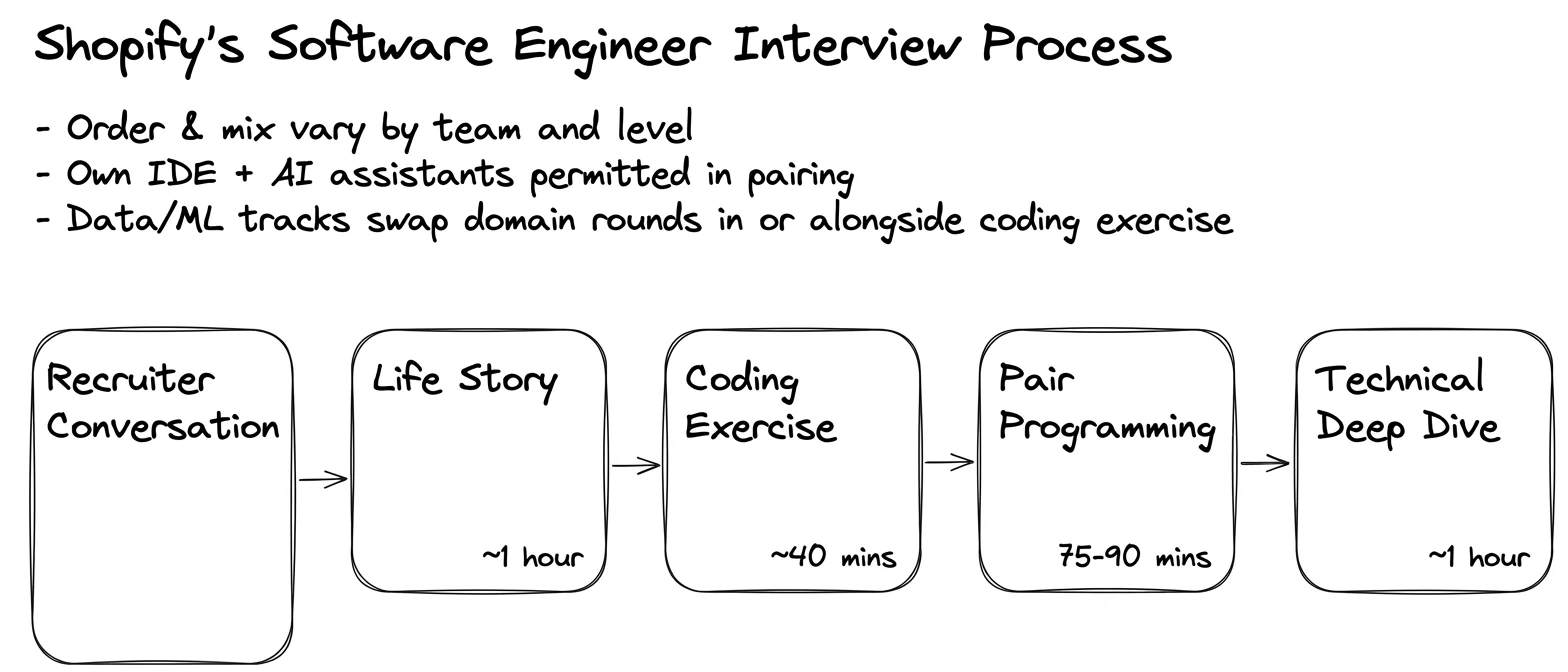
The stages below follow Shopify's public description of its process; the order and exact mix vary by team and level.
Recruiter contact and the Life Story. After an initial recruiter conversation about background and logistics, the first substantive round is typically the Life Story: a conversational interview, usually run by a recruiter rather than an engineer, that walks through your personal and professional history in roughly chronological order. Shopify has said it lasts about an hour and is used to read for impact, readiness, trust, engagement, and self-awareness. The company presents it as a genuine gate, and its own advice is to come as you are and reflect on the experiences that shaped your path rather than reciting a resume.
Coding exercise. A shorter live session, described publicly as around 40 minutes in a shared editor with a developer, in the language of your choice. It is pitched at algorithmic thinking and problem-solving approach. Shopify's own guidance is to ask clarifying questions before writing anything and to run the code often, debugging iteratively instead of chasing a perfect first draft. The question bank for this stage leans toward simulation and game-logic problems (robots on a grid, guess-the-number, word-guessing) rather than heavy data-structure puzzles.
Pair programming. The signature technical round: a longer session, described publicly as 75 to 90 minutes, where you write code while a Shopify developer collaborates, asks questions, and adds requirements. Language is your choice except that front-end roles are expected to use HTML, CSS, and JavaScript. More recent public descriptions of this round say candidates may work in their own IDE and use AI assistants, which shifts the grading toward how you direct the tool, whether you review and test what it produces, and how you communicate while doing it. Shopify states the evaluation criteria as communication, approach, edge-case handling, and code quality, and explicitly says a thoughtful incomplete solution beats a careless finished one.
Technical deep dive. A conversation, described publicly as about an hour, about previous projects you know thoroughly: business impact, architecture, technical decisions, trade-offs, what went wrong, and what you learned. Shopify advises picking projects of meaningful scope rather than solo side projects, and treating the round as a dialogue rather than a presentation.
Design and track-specific rounds. For senior and specialist tracks the loop typically adds a design conversation; the only design question in the bank is an ML system design prompt on product categorization, which suggests the design round is scoped to the candidate's domain rather than a generic scale puzzle. The bank also holds an ML modeling round (forecasting, targeting, fraud) and a SQL pair-programming session for data engineers, so data and ML tracks appear to swap in domain rounds in place of, or alongside, the general coding exercise.
Timelines between stages, the number of rounds in a given loop, and decision turnaround cannot be stated here: there are no first-hand reports behind this guide, and Shopify's public material does not commit to numbers. Ask your recruiter.
What Candidates Report
There are no candidate interview reports for Shopify behind this guide, so this section cannot offer first-hand themes. What can be said from Shopify's own published guidance and the shape of the question bank:
- The Life Story is treated as a real evaluation, and the stated traits (impact, readiness, trust, engagement, self-awareness) are what the interviewer is listening for.
- Shopify repeatedly frames coding rounds around iteration and communication: run the code, talk through the approach, ask questions.
- Pair programming is graded on collaboration and code quality as much as on reaching an answer; finishing is not the bar.
- The deep dive rewards projects with real scope and a candid account of trade-offs and mistakes.
- The question bank is dominated by practical simulation, object design, and domain-specific (ML, SQL) prompts rather than hard algorithmic puzzles.
These are what the company says it does, not verified candidate experience.
Coding Questions
The Shopify coding questions in the bank are concrete and stateful: robots following commands on a grid, guess-the-number and word-guessing games, and a dynamic-programming assessment for intern roles. Practice small, runnable programs with clean state handling and your own tests, since iterative execution is what the company explicitly asks for.
- Terminal Robot Simulator with Multiple Robots
- Simulate a Robot Following Commands on a Grid
- Cows and Bulls (Guess the Number)
- Word Guessing Game (Wordle-style)
- SWE / SDE Intern Coding OA (DP + C++/Ruby)
System Design Questions
The single design prompt in the bank is an ML system design problem close to Shopify's merchant domain: categorizing products into a taxonomy. Expect design rounds, where they occur, to be anchored in the commerce platform and the candidate's specialty; scope the problem, define the data and evaluation, and defend trade-offs.
Low-Level Design Questions
Object-design prompts pair naturally with a long pair-programming session: a 2D robot with turning, movement, and a CLI; an extensible text editor with multiple renderers; an in-memory Unix file system; an LRU cache. Each starts small and grows under added requirements, so keep interfaces narrow and the core methods actually compilable.
- Design a 2D Robot with Turning and Movement + CLI
- Design an Extensible Text Editor with Multiple Renderers
- In-Memory Unix File System
- LRU Cache (LC 146)
Behavioral Questions
Shopify's non-coding rounds carry real weight: the Life Story and the technical deep dive are both evaluated conversations. The bank also reflects track-specific rounds for ML and data candidates.
- Life Story / Values Interview
- Project / Technical Deep Dive
- ML Modeling Round (Forecasting / Targeting / Fraud)
How to Prepare
- Write your Life Story as a chronological narrative of decisions and turning points, including the ones that went badly, and rehearse it aloud; it is a graded hour, not a warm-up.
- Drill small stateful programs (grid simulations, game logic, caches, file systems) in your chosen language, running and testing as you go rather than writing everything first.
- Practice a 75 to 90 minute pairing session with a friend adding requirements mid-stream, narrating your thinking; if you plan to use an AI assistant, practice reviewing and testing its output out loud.
- Choose one or two projects with real scope for the deep dive and be ready to discuss architecture, trade-offs, failures, and impact in dialogue form.
- If you are on an ML or data track, expect domain rounds (modeling, SQL pairing, ML system design on commerce problems) and prepare those alongside the general coding exercise.
- Confirm format, tooling policy, and the number of rounds with your recruiter; this guide has no first-hand reports to pin those down for you.