Study
Scheduler Interview Questions by Round: 65 Reported (2026)
TrueInterview
October 19, 2026 · 16 min read
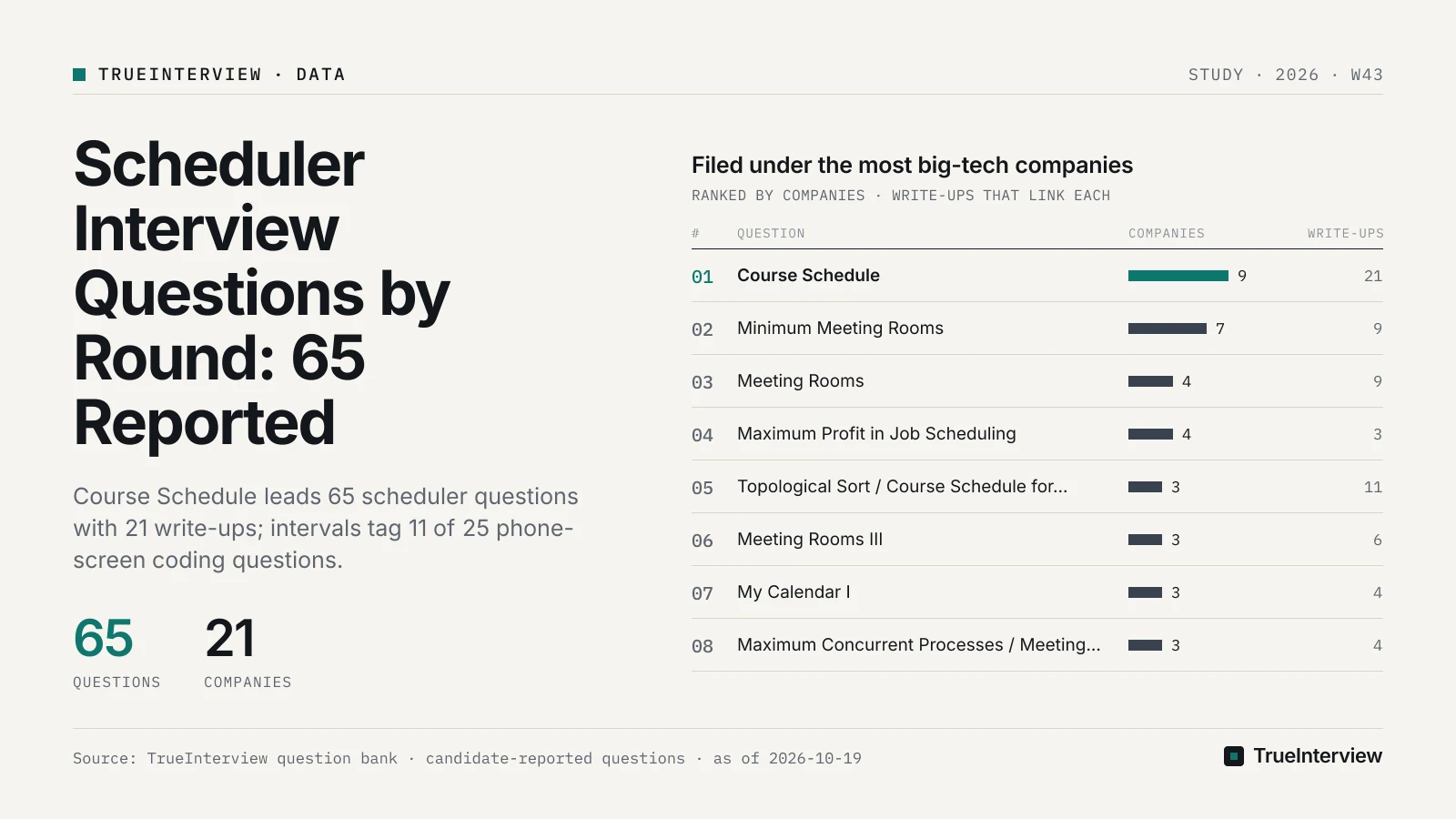
As of 2026-10-19, TrueInterview's bank holds 65 candidate-reported scheduler and calendar questions from 21 big-tech companies, and 54 were last reported in the past 12 months. The most-linked ones are interval and dependency-ordering problems, not LeetCode 621: Course Schedule is linked from 21 write-ups, and Meeting Rooms, Minimum Meeting Rooms and Meeting Rooms / Interval Scheduling Variants from 9 each. Phone-screen coding questions lean on intervals (11 of 25), while object-oriented design makes up 9 of the 15 other-format questions reported at the onsite. Drill the meeting-rooms ladder and Kahn's algorithm first, then prepare one scheduler design if you have an onsite.
Disclosure: TrueInterview is an interview-preparation product and publishes this article. Facts about other products come from their public pages on the dates listed under Sources.
What scheduler and calendar questions do big tech candidates report?
The family covers interval and meeting-room problems, dependency ordering in the Course Schedule line, task and job scheduler classes, and booking or calendar designs. By format, the 65 questions split into 44 coding (algorithm), 20 object-oriented design and 1 AI-assisted coding. On the coding side, intervals tag 17 of the 44 questions, ahead of greedy at 10.
The most-linked titles, sorted by candidate write-up links, with the level each candidate reported:
| Question | Companies in the write-ups | Write-up links | Senior-or-above vs junior-or-below links | Practise |
|---|---|---|---|---|
| Course Schedule | Amazon, Google, Snowflake, Uber, Netflix, Meta | 21 | 9 vs 12 | Course Schedule |
| Topological Sort / Course Schedule for Ads | Amazon, Netflix | 11 | 10 vs 1 | Course Schedule for Ads |
| Minimum Meeting Rooms | Uber, Amazon | 9 | 5 vs 4 | Minimum Meeting Rooms |
| Meeting Rooms | Amazon, Netflix, Uber | 9 | 4 vs 5 | Meeting Rooms |
| Design Meeting Scheduler | Uber | 9 | 8 vs 1 | Design Meeting Scheduler |
| Meeting Rooms / Interval Scheduling Variants | 9 | 6 vs 3 | Interval Scheduling Variants | |
| Data Labeling Task Scheduler | OpenAI | 8 | 6 vs 2 | Data Labeling Task Scheduler |
| Hotel Booking Reminder | Stripe | 7 | Not split | Hotel Booking Reminder |
These are candidate-reported questions reconstructed for practice, not any company's official list, and a link count measures what candidates wrote up rather than how often a company asks a question. The four meeting-room titles are separate bank entries, so their counts do not add up into one question.
Our take: the list rewards two templates. Sort-plus-heap on intervals covers the meeting-room rows, and Kahn's algorithm covers both Course Schedule rows. The company-specific titles further down are where those templates get applied, and the applied titles Course Schedule for Ads (10 vs 1) and Design Meeting Scheduler (8 vs 1) show the most lopsided senior-or-above splits.
Where does LeetCode 621 Task Scheduler fit?
Task Scheduler is a useful single drill, but it does not appear among the most-linked titles in the ranked table above. One blogger describes it as Lintcode #945 and Leetcode #621, asking for the fewest time units to finish all tasks. As the blogger describes it, the problem requires at least n units of time between any two identical tasks.
Hello Interview lists Task Scheduler as asked at NVIDIA, LinkedIn, Amazon and Google. Those are Hello Interview's reports and sit outside the counts in this article. Hello Interview describes the core challenge as "arranging high-frequency tasks to minimize idle slots" with frequency counting or a greedy/heap simulation. One candidate's report on that page says the question was an exact copy of the LeetCode problem, with follow-ups on "how to ensure a consistent total ordering when popping elements with the same frequency from the heap".
Our take: spend one evening on Task Scheduler and make your heap comparator deterministic, so ties break on a stable key such as the task label. Then move on to the titles in the ranked table.
Which meeting-room problems should you practise, and in what order?
Practise the meeting-room titles as one ladder: Meeting Rooms, then Minimum Meeting Rooms, then Meeting Rooms III and My Calendar I. Each has a recent report or a multi-company filing. Uber reported Meeting Rooms in a phone screen in 2026-09, Amazon reported Minimum Meeting Rooms in a phone screen in 2026-08, and ByteDance reported Meeting Rooms III in a phone screen in 2026-09.
| Question | Filing in the bank | Technique (our read) | Practise |
|---|---|---|---|
| Meeting Rooms | Filed under Uber, Amazon, Meta, Netflix | Sort by start, check each pair of neighbours for overlap | Meeting Rooms |
| Minimum Meeting Rooms | Filed under 7 companies, including Amazon, ByteDance, Google, Meta and Microsoft | Sort by start, keep a min-heap of end times; its peak size is the answer | Minimum Meeting Rooms |
| Meeting Rooms III | Filed under 3 companies, 6 write-ups | Two heaps: free rooms by index, busy rooms by end time | Meeting Rooms III |
| My Calendar I | Filed under Uber, Microsoft, Robinhood | Insert a booking only if it overlaps nothing already booked | My Calendar I |
| Maximum Concurrent Processes / Meeting Rooms | Filed under 3 companies, 4 write-ups | Same peak-overlap count as Minimum Meeting Rooms | Maximum Concurrent Processes |
Google's entry, Meeting Rooms / Interval Scheduling Variants, was reported in a Google phone screen in 2026-06. Its title suggests several interval variants; the reports here do not describe how the round runs, so treat the ladder above as the preparation for it.
Our take: for Minimum Meeting Rooms, the heap is the better default than the sweep line. The sweep (sorted starts and sorted ends with two pointers) is shorter when only the count matters, but the heap extends directly into Meeting Rooms III, where you must say which room each meeting gets. Whichever you pick, fix the boundary rule before you code. Treat intervals as half-open, so a meeting that ends exactly when the next begins does not conflict, and say so aloud, because the interviewer cannot see a boundary rule you never state.
Where do Course Schedule and topological sort fit?
Course Schedule is filed under 9 big-tech companies, more than any other title cited here, and Apple reported it in a phone screen in 2026-10. Topological sort tags 7 of the 44 coding questions. Treat Kahn's algorithm as phone-screen material that you can write from memory, not an onsite extra.
Wikipedia's topological sorting article calls scheduling jobs or tasks by their dependencies the canonical application of the technique, and notes that an order exists only if the graph has no directed cycles. In Wikipedia's description, Kahn's algorithm starts from the nodes with no incoming edges, and if edges remain when it finishes, the graph has a cycle and no order exists. The article says the usual algorithms run in time linear in nodes plus edges, and that an alternative is based on depth-first search.
Three related entries extend the base problem. Snapchat reported Course Schedule Cycle Detection in a phone screen in 2026-06, and Netflix reported Topological Sort / Course Schedule for Ads in a phone screen in 2026-07. TrueInterview's site also lists a Google question titled Course Scheduling and Dependency Variants, rated Hard, from October 2026. We read these titles as the same template under a different story, and would not assume more about their requirements than the titles say.
Our take: use Kahn's over the DFS version in an interview. The cycle check falls out of one comparison (nodes emitted against total nodes), and the in-degree table is easy to narrate while you type. Be ready for the question of why your order differs from the interviewer's: Wikipedia notes that the working set in Kahn's algorithm can be a set, a queue or a stack, which reflects that the order is not unique.
How do phone-screen and onsite versions differ?
The onsite changes the mix: phone-screen coding concentrates on intervals, while onsite coding spreads across greedy, intervals, graphs and topological sort, and object-oriented design makes up most of the other-format onsite questions. Questions appear in phone screens 32 times, onsites 32 times and online assessments 9 times, with overlap where a question was reported in several rounds.
| Round and format | Questions | Top topics or subtypes |
|---|---|---|
| Phone screen, coding | 25 | Intervals 11, greedy 5, topological sort 5, graphs 4 |
| Onsite, coding | 17 | Greedy 5, intervals 4, graphs 4, topological sort 4 |
| Onsite, other formats | 15 | Object-oriented design 9 |
Two onsite reports show the shift. Lyft's Job Scheduler was reported in an onsite in 2026-07 and is filed as a coding question, while Stripe's Hotel Booking Reminder was reported in an onsite in 2026-05 and is filed as object-oriented design. The OA sample is small, so do not plan your preparation around it.
Our take: read this way, phone-screen coding is an interval round with a dependency question beside it, and the onsite adds greedy choices to defend plus design questions on the same theme. If you have only one week before an onsite, keep the interval ladder warm and spend the new time on greedy correctness and one design.
Why do greedy interval answers fail?
Greedy interval answers fail on the sort key: start time, length or conflict count instead of finish time. Wikipedia's interval scheduling article says that picking the intervals that start earliest is not optimal, because accepting one very long early interval would force you to reject shorter requests. Greedy tags 5 of the 17 onsite coding questions, so expect to defend your key.
The article also says: "Selecting the shortest intervals or selecting intervals with the fewest conflicts is also not optimal." According to the article, the optimal rule for the unweighted problem is to take the interval with the earliest finishing time, and the algorithm runs in O(n log n) after sorting by finish time. Once each interval carries a profit, the goal becomes maximising total weight, which Wikipedia equates with a maximum-weight independent set in an interval graph, solvable in polynomial time.
Maximum Profit in Job Scheduling is the bank's weighted example, filed under Snowflake, Airbnb, Google and Pinterest, and linked from 3 write-ups, 2 of them by senior-or-above candidates. In our read it is where greedy stops: the standard approach sorts by end time and runs dynamic programming with a binary search for the last compatible job.
Our take: sorting by start is correct for Meeting Rooms and Minimum Meeting Rooms, because those questions check overlap or count concurrency rather than select a subset. It is wrong for selection. For every interval problem you practise, say which of those two kinds it is, name your sort key, and give the counterexample for the key you rejected.
When does a scheduler question become a design question?
It becomes a design question when the prompt is a system to model as classes rather than a function that returns a value. Object-oriented design accounts for 20 of the 65 questions, and for 9 of the 15 other-format questions reported at the onsite. Stripe's Hotel Booking Reminder is filed as object-oriented design. Uber's Design Meeting Scheduler is linked from 9 write-ups, all from Uber; the data behind this article does not give its format or round, but its title reads as a design prompt, so we treat it as design practice.
Design is a steady component, not a rising one. By share of write-up links, object-oriented design took 15%, 30%, 13% and 11% from 2025-Q4 to 2026-Q3, while coding (algorithm) took 85%, 70%, 85% and 89%. Quarter totals mostly reflect how many write-ups were collected, so compare shares only.
The reports behind this article do not describe the follow-ups in these design rounds, so what follows is our view. For a meeting or booking scheduler, we expect a senior interviewer to push on two decisions. The first is the conflict rule: reuse the half-open overlap check from the phone-screen problems, and decide whether a booking checks one room or searches across rooms. The second is concurrency: two requests for the same slot must not both succeed, so name your mechanism (a lock per room or a conditional write) before the interviewer asks.
For a reminder or job scheduler, the decisions move to firing on time and handling missed or duplicate runs. Kubernetes' CronJob documentation gives concrete behaviour to borrow for that discussion, as production practice rather than evidence of what interviews ask:
- The documentation says a CronJob starts one-time Jobs on a repeating schedule, and by default allows concurrently running Jobs.
- In Kubernetes, the Forbid policy skips a new run if the previous one has not finished, and the Replace policy swaps in the new run.
- Kubernetes says that after a Job misses its starting deadline, the CronJob skips that instance while future occurrences stay scheduled.
- Because a CronJob may occasionally create two Jobs or none for a scheduled time, the documentation says "the Jobs that you define should be idempotent".
- Without a specified time zone, the Kubernetes controller interprets schedules in its local time zone.
Our take: the time-zone and idempotency points are the two to raise yourself in a reminder or calendar design. Recurring meetings and daylight-saving changes are assumptions you state up front, not requirements any report in our bank confirms.
Which companies report scheduler questions most?
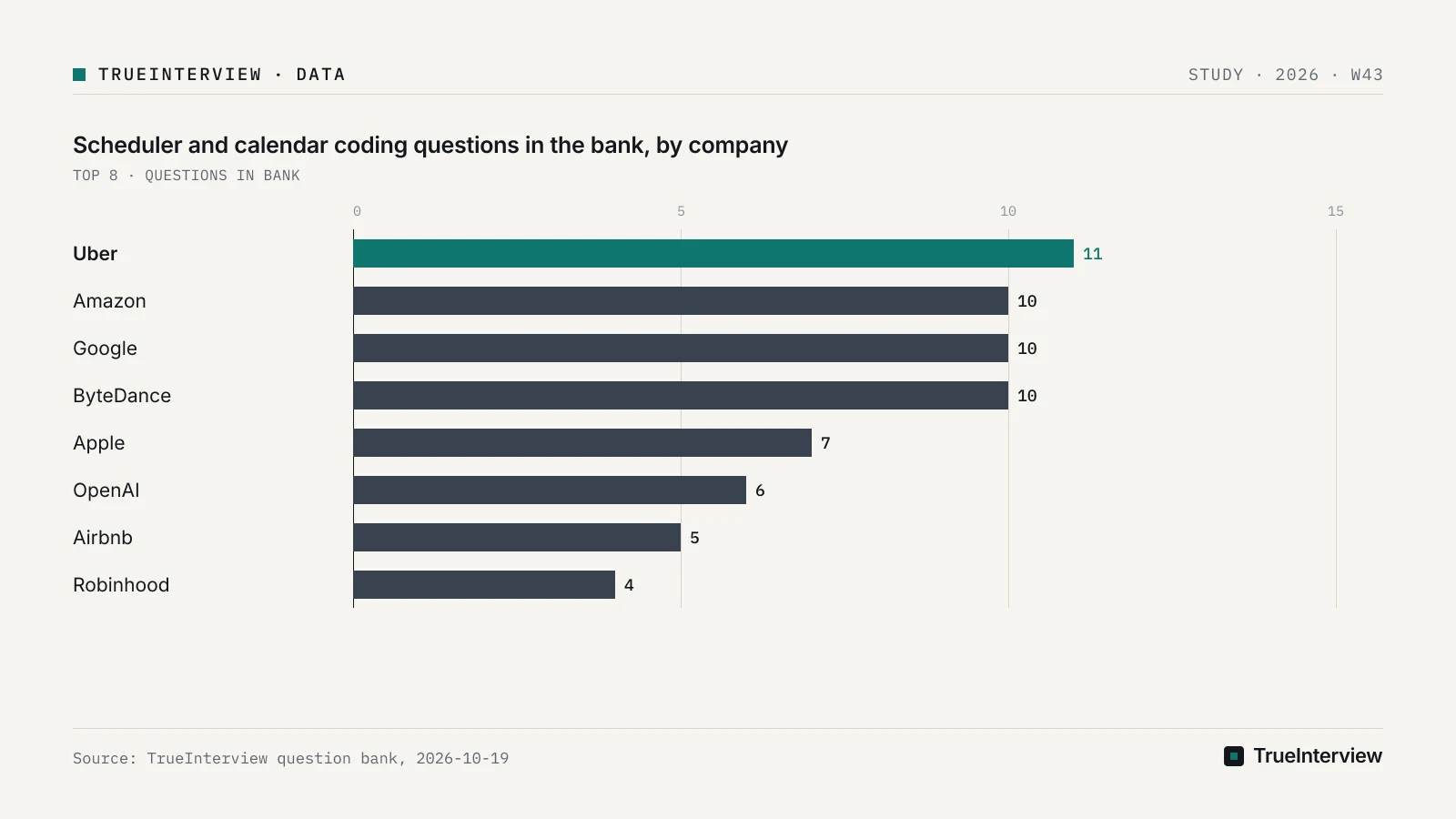
Uber leads the bank with 11 scheduler and calendar questions filed, followed by Amazon, Google and ByteDance at 10 each. These are filings of candidate-reported questions, not how often a company asks them. For an Uber loop, for example, that means adding Design Meeting Scheduler on top of the shared ladder.
| Company | Questions filed | Title to add from the bank |
|---|---|---|
| Uber | 11 | Design Meeting Scheduler |
| Amazon | 10 | Topological Sort / Course Schedule for Ads |
| 10 | Interval Scheduling Variants, Maximum Profit in Job Scheduling | |
| ByteDance | 10 | Meeting Rooms III |
| Apple | 7 | Course Schedule |
| OpenAI | 6 | Data Labeling Task Scheduler |
| Airbnb | 5 | Maximum Profit in Job Scheduling |
| Stripe | 4 | Hotel Booking Reminder |
OpenAI's Data Labeling Task Scheduler was reported in a phone screen in 2026-05. If OpenAI is on your list, have it ready before the phone screen rather than saving it for the onsite.
Decision rule (our view): if your next round is a phone screen, spend most of your time on the meeting-room ladder and Course Schedule. If it is an onsite, keep both, add greedy correctness and prepare one object-oriented scheduler design. Then add the title for your target company from the table above.
Worked example: a senior backend engineer with an Uber loop
Uber has the most scheduler and calendar questions filed in the bank, and its Meeting Rooms report came from a phone screen in 2026-09. For the phone screen, work up the ladder: Meeting Rooms, Minimum Meeting Rooms, then My Calendar I, then Course Schedule with Kahn's algorithm and cycle detection.
Then take Design Meeting Scheduler, linked from 9 write-ups, 8 of them by senior-or-above candidates. The data behind this article does not give its round, and reading it as a design prompt is our interpretation of the title, so practise it as a class model whichever round it lands in. Model rooms, meetings and bookings as classes, use the interval-overlap check from the phone-screen problems as the conflict rule, and raise recurring meetings as an assumption you would confirm rather than a reported requirement.
What changes at senior and staff level?
Senior candidates write up these questions more, not less: write-ups link them 94 times from candidates who reported a senior, staff-plus or manager level, against 70 from junior, new-grad or intern candidates. The skew is sharpest on the applied, company-specific titles in the ranked table, while plain Course Schedule leans junior.
By topic, intervals (27 senior-or-above against 21 junior-or-below links), heap (12 against 9) and two-pointers (7 against 4) lean senior, while graphs (12 against 18) and sorting (9 against 10) lean junior. Frontend Calendar UI is linked from 3 senior-or-above write-ups, and Minimum Meeting Rooms has one link from a staff-plus or manager candidate.
Our take: at senior level the textbook problem is assumed. The round turns on whether you carry the same idea into an applied setting (dependencies in an ads pipeline, a meeting scheduler as a class model, a task scheduler for labelling work) and say which requirements you are assuming. Once the ladder is fluent, spend your time on one applied dependency problem, one scheduler design and one task-scheduler variant, and open each by stating requirements before you code.
Down-leveling note (our view): the level signal in these loops sits in the design round and in how you handle follow-ups, not in whether you solve Course Schedule. A clean base solution with no stated assumptions reads as mid-level; naming the boundary rule, the tie-break and the concurrency mechanism without prompting is the senior signal.
Do ML and AI engineers see different scheduler questions?
Machine Learning Engineer write-ups account for 16 links, against 136 from software engineers, so treat any ML-side pattern as a lean. Within that small sample, Course Schedule draws 4 links from ML, AI, research or data-science candidates, and Course Schedule Cycle Detection and Data Labeling Task Scheduler draw 3 each.
If you are interviewing for an ML engineer role, keep dependency ordering high on your list, and add the labelling scheduler if OpenAI is on your list. The interval ladder still applies, since Meeting Rooms / Interval Scheduling Variants also draws 2 links from that group.
How we counted
Counts come from TrueInterview's question bank as of 2026-10-19 and cover 65 scheduler and calendar questions reported at 21 big-tech companies. They are candidate-reported questions reconstructed for practice, not any company's official question list. A question can be filed under several companies and reported in several rounds, so tallies overlap. Level and role splits count write-up links by the level and role each candidate reported, and a link count measures what candidates wrote up, not how often a company asks a question.
FAQ
What are the most common scheduler coding interview questions?
By write-up links, Course Schedule leads, followed by the Ads variant of Course Schedule and four titles tied just behind it: Minimum Meeting Rooms, Meeting Rooms, Design Meeting Scheduler and Google's interval scheduling variants (see the ranked table). Intervals and topological sort are among the top tags on the coding questions, so two templates cover the first rows of the table, and the company-specific titles apply them.
Is Task Scheduler (LeetCode 621) still worth practising?
Yes, as one drill rather than the core of your preparation. It is a frequency-counting problem solved with a heap or a formula, and the one follow-up reported on Hello Interview concerned tie-breaking in the heap. Practise it once, make your comparator deterministic, and return to the meeting-room ladder and Course Schedule, which lead the ranked table.
Which algorithm patterns do scheduler problems test?
Five patterns cover the coding side: sorting intervals, a min-heap of end times, a sweep line over starts and ends, topological sort with cycle detection, and greedy selection by earliest finish time. Dynamic programming appears once the intervals carry a profit, as in Maximum Profit in Job Scheduling. The design questions are a separate skill, judged on the class model, the conflict rule and how jobs or reminders fire.
What are good interview questions for a scheduler position?
That search usually refers to a project-management scheduler job, where questions cover timelines, resources and stakeholders. This page is about software engineering interviews, where "scheduler" means coding problems on intervals and dependencies, and object-oriented designs for meeting, booking and job schedulers. If you are an engineer, skip those lists and start with Meeting Rooms and Course Schedule.
When does a scheduler question become a system or object design question?
When the prompt asks you to build a component that holds state over time, such as a meeting scheduler, a booking reminder or a job runner, rather than return one answer from an input. In our bank, object-oriented design makes up most of the other-format onsite questions (see the round table), so expect the shift there. Prepare the entities, the conflict check, and how scheduled work fires on time and survives duplicate or missed runs.
Your practice plan
A three-week plan for someone working full time, about an hour on weekdays:
- Week one, first. Solve Meeting Rooms and then Minimum Meeting Rooms with a min-heap, stating the half-open boundary rule before you code.
- Week one, then. Extend the heap to Meeting Rooms III and write My Calendar I, then redo Minimum Meeting Rooms with a sweep line and compare the two.
- Week two, first. Write Kahn's algorithm from memory, then solve Course Schedule and Course Schedule Cycle Detection, returning an order and reporting a cycle.
- Week two, then. Solve Maximum Profit in Job Scheduling and, for each interval problem so far, write the counterexample for the sort key you rejected.
- Week three, first. If you have an onsite, sketch Design Meeting Scheduler or Hotel Booking Reminder as classes, with the conflict rule, concurrency control and idempotent reminders.
- Week three, then. Add your target company's title from the company table, such as Data Labeling Task Scheduler for OpenAI or Course Schedule for Ads for Amazon.
- Week three, last. Open the reported questions for your company in the question bank and run one timed mock on a title you have not seen.
Sources
- TrueInterview question bank — scheduler and calendar coding at big-tech companies — counted 2026-10-19
- Medium — checked 2026-10-19
- Leetcode 621. Task Scheduler | Hello Interview — checked 2026-10-19
- Topological sorting - Wikipedia — checked 2026-10-19
- Real FAANG Interview Questions by Company · TrueInterview — checked 2026-10-19
- Interval scheduling - Wikipedia — checked 2026-10-19
- CronJob | Kubernetes — checked 2026-10-19
Last reviewed: 2026-10-19.