Scale AI · Study
Scale AI Interview Process & Questions
TrueInterview
July 24, 2026 · 11 min read
Scale AI tests building more than puzzle-solving. The signature screen is one problem that grows in three parts within an hour, usually a deadline-ordered task scheduler that picks up dependencies and then deadline updates. The onsite adds a debugging round in an unfamiliar codebase and a practical round where you call an LLM API and validate what it returns. Behavioral rounds weigh as much as technical ones, and some loops ask how your current manager would rate you.
This guide breaks down each stage of the Scale AI interview, what interviewers evaluate in each round, and how to prepare, with questions candidates were actually asked.
Verified: Based on 19 candidate-reported interview experiences, cross-checked against recent public accounts.
Scale AI interview process
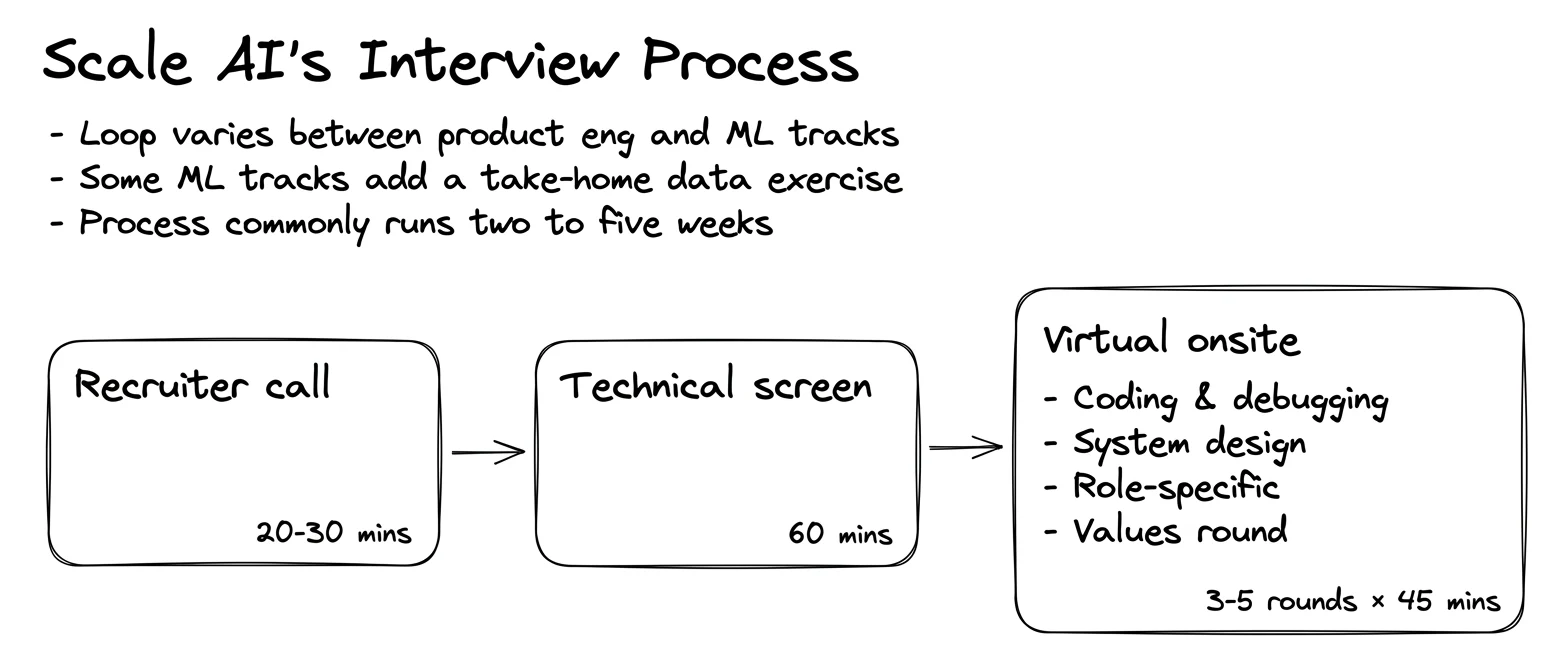
The skeleton holds across teams: a recruiter call, a 60-minute technical screen, then a virtual onsite of four to six rounds, typically three to five weeks end to end. Some experienced hires got only one live technical round plus a hiring-manager round.
Software Engineer onsites mix coding, debugging, an LLM API practical, system design and behavioral rounds. ML and research candidates get post-training theory, NumPy model components and a presentation instead. Level, and with it pay, is set by interview performance.
Here's what the interview process can look like:
- Recruiter screen: A 20–30 minute call about your current project, why you are leaving, why Scale, and the shape of the loop.
- Technical phone screen: A 60-minute live session on one multi-part coding problem in a shared editor, often with no hints.
- Debugging interview (onsite): Find and fix planted bugs in a multi-file feature or a short ML training script while narrating.
- LLM practical interview (onsite, engineering): Prompt an LLM API, format and validate the output, then discuss production concerns.
- System design interview (onsite): A large-scale design, often shaped around data pipelines, worker routing or schedulers.
- ML and research interviews (ML track): Post-training theory, NumPy sampling and attention, and a 45-minute presentation.
- Behavioral, credo and customer-engagement interviews: One or two values rounds, plus a customer-engagement or hiring-manager round on some tracks.
Tip: Build every first version with the next requirement in mind. In the scheduler reports, each part landed on top of the last: a plain heap had to absorb dependency counts, then deadline changes, with stale entries skipped lazily.
Recruiter screen
Recruiters cover your current project, how your time splits across coding, design and mentoring, and why you want to leave. One described the technical round as building or updating a production-ready system, not an algorithm puzzle.
Interviewers evaluate:
- Project ownership: One project you are proud of, with the architecture decisions you personally made and their impact.
- Motivation: A reason for Scale specifically, tied to AI data, evaluation, or enterprise and government AI.
- Pace fit: Comfort with fast priority changes and close contact with customers and operations staff.
- Role mapping: How your daily work lines up with the team's, which shapes the loop you get.
Ask for each remaining round and its format, since loops vary by team.
Sample questions for the recruiter screen
Here are some questions reported by recent candidates:
- Tell me about a project you are proud of.
- Why Scale AI, and why are you leaving your current role?
Technical phone screen
The screen is 60 minutes in a shared editor; one candidate's preferred language was unavailable, so confirm yours early. The dominant prompt is a three-part task scheduler: return tasks by earliest deadline from a min-heap, then block parents until their subtasks are done, then a third twist. That twist was an update_deadline rejected once a task is fully consumed, cycle detection plus parallelizable tasks, or production questions. One candidate never reached part three; another finished all three with passing tests and treated that as the bar.
Other screens used party-schedule time-range problems, where timestamp parsing and exact output format mattered as much as the logic, and a Game of Life variant in which firing neurons reset to six and idle ones count down by neighbor rules, with an in-place follow-up. One rejected candidate also had to design unit tests for production code. These families recur in onsite coding rounds, alongside rule-heavy card-game simulations.
Interviewers evaluate:
- Extensible structure: Maps from task ID to remaining-dependency count and current deadline, so each new part is an addition rather than a rewrite.
- Self-managed testing: Writing and running your own tests, since some interviewers stay silent the whole hour.
- Complexity under lazy deletion: Explaining why
get_nextstays O(log N) amortized when stale heap entries are popped at most once. - Exact spec reading: Custom rules and output formats are where points are lost.
Practice the full three-part scheduler against a 60-minute timer.
Note: Silence is not a bad sign. One candidate got no hints for a full hour, finished, answered one complexity question and advanced.
Sample questions for the technical phone screen
Here are some questions reported by recent candidates:
-
Implement
addTaskandconsumeTaskby earliest deadline, then block parents until all their subtasks are consumed. -
Add
update_deadlinethat repositions a pending task and rejects updates to fully consumed tasks. -
Compute the next state of a neuron grid under custom firing rules, first with a copy and then in place.
-
Task Scheduling to Minimize Overall Completion Deadline (with Dependencies and Heap Optimization)
-
Party Times / Peak Concurrent Parties (Time Range Overlap Counting)
Debugging interview
Software Engineer candidates got a multi-file project-assignment feature with two planted bugs: a variable not reset inside a loop and a wrong filter condition. ML candidates got a short training script with three or four one-line bugs, in an IDE-like environment with stepping. One candidate said communication outweighed raw problem-solving.
Interviewers evaluate:
- Navigation: Following the failing feature's path across files instead of reading every file top to bottom.
- Hypothesis-driven debugging: Saying what you suspect and why, then checking it.
- Narration: Explaining each step out loud, which is graded explicitly.
Rehearse a timed pass through an unfamiliar repository: run it, trace one feature, fix it.
Sample questions for the debugging interview
Here are some questions reported by recent candidates:
-
Fix the two bugs in a multi-file project-assignment feature: a counter not reset in a loop and a wrong filter predicate.
-
Repair a short ML training script with three or four one-line bugs and explain each fix.
LLM practical interview
You write a prompt for a given scenario, call a commercial LLM API, format the response into a required structure, then write a function that validates it. The discussion ends on production: monitoring, recovery from malformed output, retries and scaling.
Interviewers evaluate:
- Prompt precision: Constraining the output format enough to make validation tractable.
- Defensive validation: Treating model output as untrusted input, with a clear failure path.
- Production judgment: Logging bad outputs, bounded retries, fallbacks and rate limits.
Before the onsite, build one script that prompts a model, parses its JSON and validates it.
Sample questions for the LLM practical interview
Here are some questions reported by recent candidates:
-
Write a prompt for a scenario, call the API, format the response into a fixed structure, then validate it.
System design interview
The design round covers a large system end to end: data model, caching, service boundaries and trade-offs. Prompts often mirror Scale's business, such as classification and embedding pipelines, workers in a state machine behind a load balancer, or annotation flows with human review. Coding rounds also end in design: after the scheduler, one interviewer asked about crashes, idempotency and distribution, and the candidate rated their broad but shallow answer as average.
Interviewers evaluate:
- Failure handling: Persisting in-flight work, idempotent retries, and what happens when a worker dies.
- Human-in-the-loop mechanics: Task assignment, reviewer disagreement and quality audits, where relevant.
- Depth on one axis: Going deep on one hard component rather than touching every topic.
Practice taking each coding solution to production in ten minutes.
Sample questions for the system design interview
Here are some questions reported by recent candidates:
-
Make the deadline-based task scheduler production-ready: survive restarts, process idempotently and scale out consistently.
-
Extend a job scheduler to accept a continuous stream of new jobs while others run.
ML and research interviews
Phone screens pair a resume deep dive with post-training topics such as GRPO versus other RLHF methods. One applied loop instead held five phone interviews: annotation quality review, values, a RAG system, LLM-evaluation coding and past projects. Onsite coding is top-p sampling, then single-head and multi-head attention, in plain NumPy; one candidate's unoptimized code passed every test. Theory covers regularization, vocabulary size versus sequence length, fine-tuning data, and DPO versus GRPO versus PPO. The 45-minute presentation ends in a defense of your architecture choices.
Interviewers evaluate:
- LLM internals from scratch: Masking, scaling and head reshaping in attention, and sorting and renormalizing in top-p, without framework helpers.
- Post-training depth: When to use DPO, PPO or GRPO, and what each costs.
- Evaluation and data quality: Scoring model outputs and reviewing annotation quality, Scale's core business.
- Resume command: Motivation, contribution and hard parts of every listed project; one rejected researcher was grilled on a project, then GRPO.
Implement sampling and attention in NumPy from memory, and rehearse the presentation against a 45-minute clock.
Sample questions for the ML and research interviews
Here are some questions reported by recent candidates:
-
Implement nucleus sampling in NumPy, then single-head and multi-head attention.
-
Compare DPO, GRPO and PPO, and explain how you would format data for supervised fine-tuning.
-
Design a RAG system and write code that evaluates LLM outputs.
Behavioral, credo and customer-engagement interviews
Two Software Engineer candidates had two behavioral rounds: one on a proud project, feedback and a tight deadline, the other on side projects, strengths and weaknesses. The values round follows Scale's published credos: ambition, quality at every level, earning customer love and intellectual rigor. ML candidates were asked about disagreeing with a manager. In one customer-engagement round, the candidate had to name their manager and predict that manager's rating of them.
Interviewers evaluate:
- Ownership under pressure: A real deadline, your own decisions and a measurable result.
- Self-awareness: Specific weaknesses and feedback you acted on, not a disguised strength.
- Candor about your manager: A calm answer on how your manager would rate you, including where they would mark you down.
Prepare about eight credo-mapped stories plus a rehearsed answer about your manager's view of you.
Note: Technical strength alone has not been enough. One candidate who handled the attention and sampling coding was rejected after the credo and customer-engagement rounds, and in hindsight blamed unprepared values stories.
Sample questions for the behavioral, credo and customer-engagement interviews
Here are some questions reported by recent candidates:
-
Describe work you delivered under a tight deadline, and constructive feedback you received.
-
What is your current manager's name, and how would they rate you?
-
Describe a challenging project and why specifically it was hard.
How Scale AI makes hiring decisions
Rounds are judged together, but weak values or customer-engagement signals have sunk strong technical loops. Level, and the pay point within a posted range that can span several career levels, come from interview performance. Candidates describe a recruiter debrief call within a few days of the onsite, with offers sometimes waiting on director-level approval; decisions typically land within one to two weeks. Job postings state a 90-day wait before a candidate is reconsidered for the same role.
How to prepare for the Scale AI interview
- Drill the three-part scheduler: Heap by deadline, dependency counts, then deadline updates with lazy deletion, inside 60 minutes with your own tests.
- Restate custom rules before coding: Grid automata and party-time problems turn on exact transition rules and output formats.
- Rehearse an LLM API loop: Prompt, parse, validate and retry in one script, with answers ready on monitoring and recovery.
- Practice narrated debugging: Trace one feature through an unfamiliar multi-file repository, saying each hypothesis out loud.
- Take every solution to production: Persistence, idempotency and scaling; shallow answers here cost candidates.
- For ML roles, code from scratch: Top-p sampling and multi-head attention in NumPy, plus a DPO, GRPO and PPO comparison.
- Prepare for two behavioral rounds: Separate stories for deadlines, feedback, side projects and weaknesses, and an honest view of how your manager rates you.
About working at Scale AI
Scale AI builds data and evaluation infrastructure for AI: training and evaluation data for model labs, an enterprise generative AI platform, and government AI programs. Engineers work close to customers and labeling operations and ship first versions fast. After Meta's minority investment in mid-2025, the founding CEO left for Meta, about 14% of staff were laid off, and the business refocused on enterprise and government; a new CEO took over in August 2026.
Scale AI hires engineers across its data, platform and government businesses. Teams include:
- Generative AI data: Pipelines, tooling and quality systems producing post-training and evaluation data.
- Enterprise AI: The generative AI platform, with APIs for retrieval, inference and evaluation.
- Public Sector: AI products for defense and government, including deployments on controlled networks.
- Platform and infrastructure: Shared backend, developer experience and core infrastructure.
- ML research and ML systems: Post-training, evaluation and model-systems work.
Experience and education requirements
Engineering postings ask for three or more years of experience (seven or more for Staff), with Python or TypeScript, React, Node, SQL, Kubernetes and a major cloud; LLM and vector-database experience is preferred. ML research roles favor post-training or evaluation experience, often with published work.
FAQs about the Scale AI interview
How long does the Scale AI interview process take?
Typically three to five weeks from recruiter call to decision; senior loops that need extra approval run longer.
What is the hardest round of the Scale AI interview?
For engineers, the three-part phone screen, because all three parts must work within 60 minutes with little feedback. For ML candidates, the from-scratch NumPy and theory rounds, though the values and customer-engagement rounds have also ended strong technical loops.
How much does a Scale AI software engineer make?
Posted US base ranges run about $180K–$270K for Software Engineer roles and about $248K–$310K for Staff roles, varying by team and location. Packages add equity, and the offer depends on the level assigned in interviews.
Can I use AI tools during the Scale AI interview?
No. Looking up syntax, such as NumPy signatures, is allowed, but using an AI tool to generate answers is not.