Rubrik · Study
Rubrik Interview Process & Questions
TrueInterview
August 22, 2026 · 8 min read
Rubrik screens on reading speed as much as algorithms. Its timed coding stage packs three or four original, long-statement problems into one sitting, and one candidate spent a third of a 90-minute window just understanding the prompts. Later, the loop adds a "system coding" round that most companies do not have: building thread-safe primitives such as a bounded queue or a reader-writer lock, graded on whether you reason correctly about races and starvation.
This guide breaks down each stage of the Rubrik interview, what interviewers evaluate in each round, and how to prepare, with questions candidates were actually asked.
Verified: Based on 2 candidate-reported interview experiences, cross-checked against recent public accounts.
Rubrik interview process
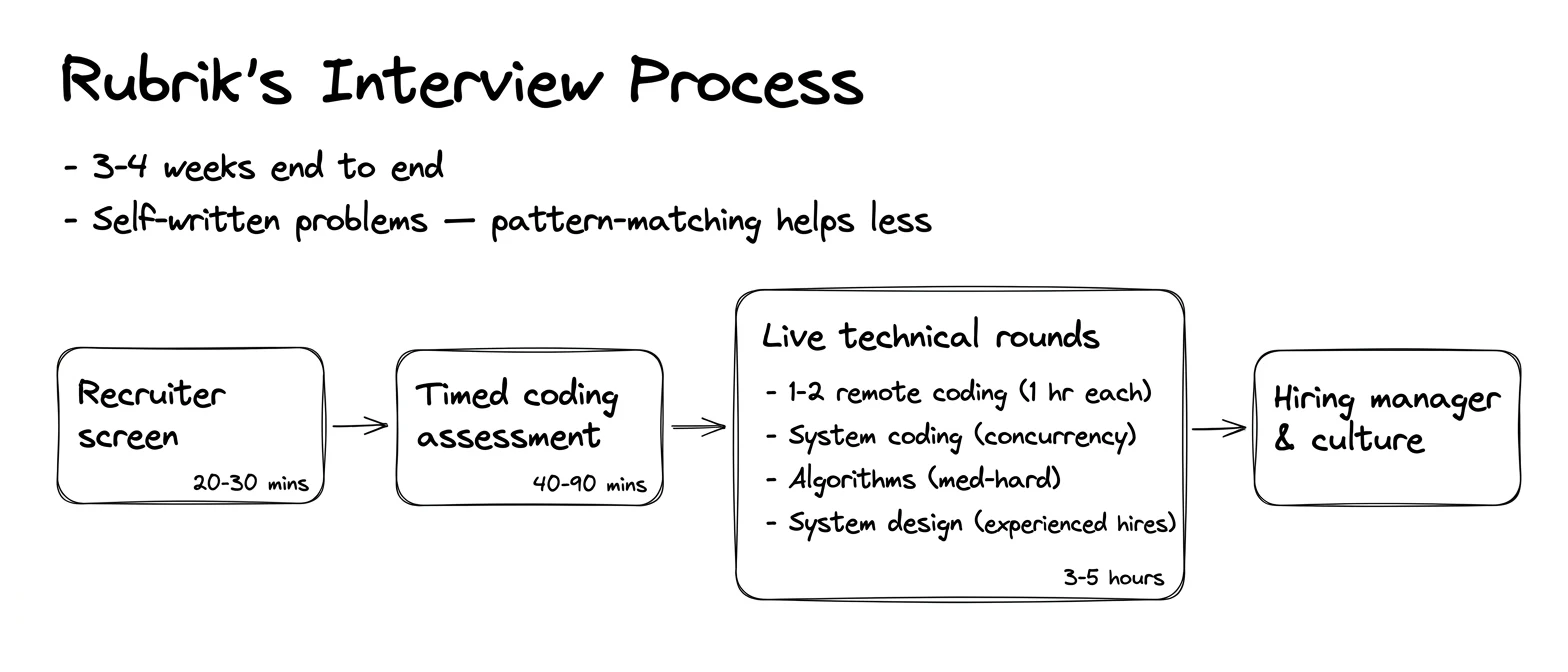
Both reports cover only the timed coding stage, so later rounds below follow recent public accounts. The usual sequence is a recruiter screen, a timed online assessment or coding screen, then a system coding round and an onsite of about four to five rounds. The onsite mixes hard algorithm rounds, operating systems and concurrency, and a behavioral or hiring-manager conversation. Experienced hires typically add system design. The whole process typically takes two to five weeks.
Here's what the interview process can look like:
- Recruiter screen: A short call about role, team, level and logistics.
- Online assessment: Three or four original problems under a tight clock, ranging from easy to hard.
- System coding interview: A live implementation of a concurrent component, such as a bounded blocking queue or a thread pool.
- Coding interviews: One or two live rounds of medium-to-hard algorithms.
- System design and project deep dive (experienced hires): Distributed systems design and a walkthrough of a system you built.
- Hiring manager interview: Ownership, past projects and fit.
Tip: Budget reading time explicitly. One candidate needed about 30 minutes of a 90-minute assessment just to understand three statements, and solved only one problem.
Recruiter screen
The recruiter covers team, level, location and which rounds your loop includes. Formats differ between new-grad, intern and experienced tracks, so confirm whether you get an online assessment or a live screen, and whether system design is included.
Interviewers evaluate:
- Systems background: Experience with storage, operating systems, distributed systems or security infrastructure.
- Level fit: Scope of past ownership against the target level.
- Logistics: Location, timeline and competing offers.
Ask explicitly whether the onsite includes a concurrency round, and prepare for it either way.
Online assessment
The timed coding stage comes in more than one size. In one version, a candidate got four problems in 40 minutes, two easy and two medium, and finished all of them. In the other, a 90-minute assessment had three problems rated medium or harder. That candidate spent about a third of the time reading, fully attempted only the first problem, and still hit a time-limit-exceeded verdict. Problems are original or heavily reworded, so recognizing a pattern helps less than parsing the statement accurately. The harder items need an efficient solution to pass.
Interviewers evaluate:
- Statement parsing: Turning a long, rule-heavy setup into a precise model.
- Triage: Clearing the easy problems in minutes to leave time for the hard ones.
- Efficiency: Hitting the complexity the hidden tests require, since a brute-force solution can time out even when it is correct.
- Recurrence spotting: Reusing smaller-subproblem results instead of recomputing them.
Practice long-statement problems under a hard timer, and write a three-line summary of each before coding.
Note: The candidate who failed the 90-minute version had seen a similar problem before and still could not finish it in time. Familiarity is not enough; you need the complete logic and an efficient implementation.
Sample questions for the online assessment
Here are some questions reported by recent candidates:
-
Build a tree from two equal-length vectors that define edges and hierarchy, then answer queries on whether each given ordering is a valid BFS traversal.
-
Given people's working-hour intervals, where overlap chains connect people, find the size of the largest connected group.
-
For every subarray of a permutation, find the k-th largest element, reusing the result from the previous, smaller subarray.
-
Remove duplicates from a singly linked list in two passes, and shift a string left or right using modular arithmetic.
-
Maximum Group Size by Overlapping Work Intervals (Connectivity via Overlap Paths)
System coding interview
This is Rubrik's distinctive round, and some loops have two. In a shared editor, you implement a concurrent component from primitives. Reported prompts include a bounded thread-safe queue, a thread-pool task executor with follow-ups on exception handling and timeouts, a reader-writer lock, and a data-transfer problem with one reader and several writers. Discussion goes into mutexes, semaphores, condition variables and starvation. Some candidates found the round drifted into operating systems and file-system questions instead of pure concurrency.
Interviewers evaluate:
- Correct synchronization: No races or lost wakeups, and conditions waited on in a loop.
- Deadlock and starvation reasoning: Lock ordering, and fairness between readers and writers.
- Failure handling: Timeouts, interrupted waits and exceptions thrown by tasks.
- Judgment: Explaining when threading is warranted and what each lock protects.
Practice building a blocking queue, a thread pool and a reader-writer lock from scratch in your interview language.
Tip: Say the invariant each lock protects before you write the code, then test it aloud with two threads interleaving at the worst possible moment. Follow-ups usually add a timeout or a failing task, and naming the invariants makes those changes easy.
Sample questions for the system coding interview
Here are some questions reported by recent candidates:
- Implement a bounded blocking queue that is safe for multiple producers and consumers.
- Build a thread-pool task executor, then add per-task timeouts and handling for tasks that throw.
- Implement a reader-writer lock and explain how it avoids writer starvation.
Coding interviews
Live algorithm rounds are typically an hour each and run medium to hard. Reported topics include tree problems such as lowest common ancestor with binary lifting, graph connectivity, interval reasoning and dynamic programming. Problems tied to Rubrik often have a competitive-programming flavor, with long narratives and tight constraints. Storage-flavored problems also appear, such as choosing a block size for deduplication.
Interviewers evaluate:
- Optimal approach: Reaching the efficient solution, not stopping at a working baseline.
- Constraint reading: Deriving the needed complexity from the input bounds.
- Clean implementation: Bug-free code for binary lifting, union-find or DP tables.
- Communication: Explaining the reasoning while you code.
Work through hard graph, tree and DP problems and explain each one aloud.
Sample questions for the coding interviews
Here are some questions reported by recent candidates:
-
Answer lowest-common-ancestor queries on a large tree efficiently using binary lifting.
-
Across several equal-length strings, choose a block length of at least k that saves the most storage when repeated blocks become references.
System design and project deep dive
Experienced candidates typically get a distributed systems design round and a deep dive into a system they built, with storage-flavored follow-ups on replication, metadata, incremental snapshots and recovery after partial failure. Design questions can also surface inside a coding round.
Interviewers evaluate:
- Storage fundamentals: Replication, consistency and metadata at scale.
- Failure recovery: What happens when nodes or disks are lost mid-operation.
- Depth of ownership: The trade-offs you made in your own system and why.
Prepare one design that centers on durability and recovery, and one project you can defend in depth.
Hiring manager interview
The loop typically closes with a hiring-manager or behavioral conversation about past projects and ownership. New-grad loops may hold a separate culture interview.
Interviewers evaluate:
- Ownership: Problems you drove to resolution end to end.
- Collaboration: How you work through disagreements on technical direction.
- Motivation: Interest in data security and infrastructure work.
Prepare three or four stories about owning a hard technical problem from start to finish.
How Rubrik makes hiring decisions
The online assessment is a hard filter scored on hidden tests, and later decisions weigh all onsite rounds together. Candidates describe a high technical bar, and interviewer engagement varies from round to round, so a weak-feeling round is not necessarily the deciding factor.
How to prepare for the Rubrik interview
- Read before you code: Summarize each long statement in three lines, covering inputs, rules and output.
- Triage the assessment: Clear easy problems in minutes and save most of the clock for the hardest one.
- Build concurrency primitives cold: Blocking queue, thread pool with timeouts, and reader-writer lock.
- Drill hard graphs and trees: BFS-order validation, interval connectivity with union-find or a sweep line, and binary lifting.
- Look for subarray recurrences: Practice dynamic programming that extends results from smaller ranges.
- Know storage fundamentals: Replication, snapshots, deduplication and recovery for the design round.
- Confirm the loop shape: Ask the recruiter which rounds your track includes.
About working at Rubrik
Rubrik builds data security and cyber-resilience software, delivered through Rubrik Security Cloud across on-premises, cloud and SaaS environments. Engineers work on storage, file systems, distributed metadata and security analytics from R&D hubs in Palo Alto, Bangalore and Tel Aviv.
Rubrik hires engineers across its data security platform. Teams include:
- Data protection: Backup, snapshots, replication and the storage layer underneath them.
- Cyber recovery: Ransomware detection, threat analytics and clean-point recovery.
- Data security posture: Discovering and classifying sensitive data across clouds, building on the 2023 Laminar acquisition.
- Identity resilience: Protecting and recovering identity systems.
- AI and data platform: The Annapurna platform and agentic AI work, expanded by the 2025 Predibase acquisition.
Experience and education requirements
Engineering roles typically ask for a computer science degree or equivalent and strong systems fundamentals in operating systems, concurrency and distributed systems. Postings commonly list Python and Go along with cloud experience on AWS, Azure or GCP. Senior roles typically expect around six or more years of experience.
FAQs about the Rubrik interview
How long does the Rubrik interview process take?
Typically two to five weeks from the recruiter call to a decision, depending on how quickly the system coding round and onsite are scheduled.
What is the hardest round of the Rubrik interview?
For many candidates it is the online assessment, which combines long statements, hard problems and a short clock. In the onsite, it is the system coding round on concurrency, which candidates rarely prepare for.
What language should I use?
Use one with solid concurrency primitives that you know well, such as Java, C++, Go or Python. You will need to write locks and condition variables without looking them up.