Rokt · Study
Rokt Interview Process & Questions
TrueInterview
October 13, 2026 · 8 min read
Rokt filters candidates with a timed cognitive aptitude test before any engineer is involved, so failing it ends the process before your coding is ever seen. The coding bar is unusual too: problems are relatively easy, but solutions must run and pass every provided test case. The same expression-calculator problem recurs across loops, served in parts of increasing difficulty.
This guide breaks down each stage of the Rokt interview, what interviewers evaluate in each round, and how to prepare, with questions candidates were actually asked.
Verified: Based on 3 candidate-reported interview experiences, cross-checked against recent public accounts.
Rokt interview process
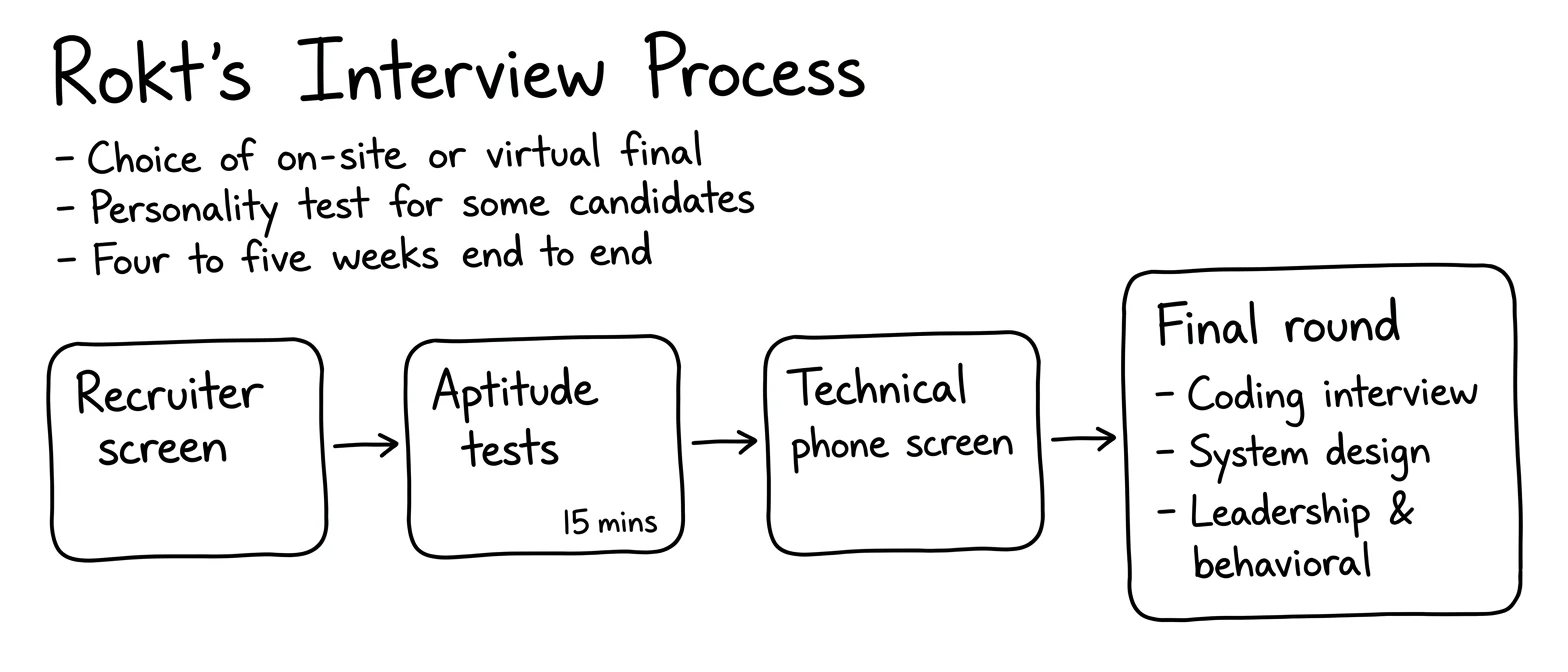
The loop typically starts with a recruiter (often through outreach), an aptitude test, and a coding phone screen, followed by a final round of three or more sessions. Candidates have been offered a choice between an on-site and a virtual final. In one recent loop each step took about a week to clear, and the final was scheduled two weeks after the phone screen. The process typically takes four to five weeks.
Content follows the team: backend candidates get large-scale system design, frontend candidates a dashboard architecture discussion, and infrastructure candidates may face a long fundamentals quiz. Loops typically end with a cross-team bar-raiser conversation on culture fit.
Here's what the interview process can look like:
- Recruiter screen: A short call on interest and fit, often after a recruiter reaches out first.
- Aptitude and personality tests: A timed cognitive aptitude test, sometimes paired with a personality questionnaire or a one-way recorded video answer.
- Technical phone screen: One easy-to-medium coding problem whose solution must run and pass all provided tests.
- Coding interview (final round): An expression calculator or similar parsing problem, often split into escalating parts.
- System design interview: Large-scale backend design, or a frontend dashboard architecture for UI roles.
- Leadership and behavioral interview: Past-experience questions, typically plus a bar-raiser-style round with a senior leader from another team.
Tip: Take a few full-length practice aptitude tests before you start. The test is the first gate, and one candidate who passed recommended practicing with sample questions beforehand.
Recruiter screen
Many candidates are approached by a recruiter. The call covers background, team, location and timing; many postings expect office attendance most days.
Interviewers evaluate:
- Team fit: Whether your expertise matches the specific team; one infrastructure rejection came down to a mismatch.
- Motivation: Why ecommerce technology and Rokt in particular.
Ask which team you are interviewing for and tailor your preparation to its stack.
Sample questions for the recruiter screen
Here are some questions reported by recent candidates:
- Tell me about yourself and what you work on now.
- Why Rokt, and why this team?
Aptitude and personality tests
The first assessment is the Criteria Cognitive Aptitude Test: verbal, math, logic and spatial questions, with the standard version at 50 questions in 15 minutes. Some candidates also receive a personality questionnaire. Others have recorded a one-way video answer, with a couple of minutes to prepare and a few minutes to record a single take. One candidate heard about a week after the test that they had passed.
Interviewers evaluate:
- Speed under time pressure: Answering many short items quickly, skipping hard ones rather than stalling.
- Accuracy: Simple arithmetic, word problems and pattern questions done without careless errors.
Take two or three timed practice tests and learn to skip any item that takes more than 20 seconds.
Note: This stage is automated and fully separate from your engineering skills. Treat it as a real filter: an otherwise strong engineer can be screened out here.
Sample questions for the aptitude and personality tests
Here are some questions reported by recent candidates:
- A timed cognitive test of verbal, numerical and logical reasoning items.
- A recorded answer about a software product or personal project you shaped and what it taught you.
Technical phone screen
The phone screen is typically a single live coding problem. Candidates describe the problem as easy, but the solution must run and pass every provided test case. Code that is almost right does not pass. In one loop the result came about a week later, along with the choice of an on-site or virtual final.
Interviewers evaluate:
- Executable code: A complete program that runs, not pseudocode or a sketch.
- Edge cases: Empty input, single elements and boundaries handled before the tests reveal them.
Practice solving easy and medium problems to a fully passing state, running your own tests before you call it done.
Sample questions for the technical phone screen
Here are some questions reported by recent candidates:
-
A simplified binary search, solved and run against the provided tests.
-
A single easy problem that had to compile, run and pass every provided test case.
Coding interview
The final coding round has repeatedly been an expression calculator. One candidate implemented a calculator with addition, subtraction, multiplication and division. Another had a basic-calculator variant presented as a single question in four parts, each adding difficulty, such as operator precedence and then parentheses. Candidates also report object-oriented prompts, such as implementing a text editor with a cursor, where follow-ups probe undo and efficient insertion.
Interviewers evaluate:
- Parsing structure: A clean tokenizer and evaluator that extend to new operators or parentheses without a rewrite.
- Precedence handling: Correct use of a stack or recursive descent for multiplication, division and nested parentheses.
- Incremental delivery: Each part fully working before you move to the next.
- Design for change: For the text editor, a buffer and cursor model that makes undo and insertion cheap.
Write a tokenizer plus evaluator from scratch until you can finish the parentheses version in 30 minutes.
Tip: Build the full-featured calculator design from the first part, with a tokenizer and an evaluator that handles precedence. One candidate noted that mastering the hardest variant covers every sub-part, while a quick first-part solution has to be rewritten later.
Sample questions for the coding interview
Here are some questions reported by recent candidates:
-
Implement a calculator for a string expression with
+,-,*and/. -
Extend a basic calculator over four parts of increasing difficulty, up to precedence and parentheses.
-
Implement a text editor with cursor movement, insertion, deletion and undo.
System design interview
Backend candidates get large-scale prompts. One recent candidate designed a CI/CD pipeline at the scale of a very large tech company. Frontend candidates walk through the frontend of a dashboard, with discussion of browser rendering, performance optimization and build automation.
Interviewers evaluate:
- Scale reasoning: Throughput, queuing and caching under heavy load.
- Pipeline stages: Build, test, artifact storage, deployment and rollback, with clear trade-offs.
- Frontend depth (UI roles): The rendering pipeline, bundle size, lazy loading and CI automation.
Prepare one infrastructure design (CI/CD or job scheduling) and, for UI roles, a dashboard architecture covering rendering and build tooling.
Sample questions for the system design interview
Here are some questions reported by recent candidates:
-
Design a CI/CD pipeline that can handle the build and deploy load of a very large engineering organization.
-
Walk through how you would build the frontend of a dashboard, covering browser performance and build automation.
Leadership and behavioral interview
The behavioral session covers past experiences, including what you would have done better in a past situation. Public accounts typically describe a final bar-raiser conversation with a senior leader from another department, focused heavily on culture fit. The culture prizes humility, so candor about mistakes helps.
For infrastructure roles, one recent interview was mostly a long run of short fundamentals questions, more than 50 by the candidate's estimate, followed by a simple binary search. The candidate solved the coding quickly but was rejected, apparently because their expertise did not match the team's needs.
Interviewers evaluate:
- Self-reflection: A specific thing you would do differently and why.
- Ownership: Measurable outcomes you personally drove.
- Breadth (infrastructure roles): Quick, accurate answers on networking, operating systems, databases and cloud fundamentals.
Prepare six to eight stories with outcomes, and for infrastructure roles review backend and cloud fundamentals broadly.
Sample questions for the leadership and behavioral interview
Here are some questions reported by recent candidates:
- Describe a past situation and what you could have done better.
- A rapid series of backend and infrastructure fundamentals questions, followed by a short binary search.
How Rokt makes hiring decisions
Rokt typically weighs the full loop together, with a senior leader from outside the team acting as bar raiser on culture fit. Team match carries real weight: strong coding did not save one infrastructure candidate whose expertise did not fit. Follow-up after the final can be slow, so ask for a decision date.
How to prepare for the Rokt interview
- Practice the aptitude test: Take timed practice tests and skip slow items.
- Code to green: Treat every coding round as pass-all-tests, and run your own edge cases before you finish.
- Master the calculator: Build a tokenizer and a precedence-aware evaluator that handles parentheses.
- Prepare object-oriented editors: Model a text editor's buffer, cursor and undo.
- Design at scale: Rehearse a CI/CD pipeline end to end, or a dashboard frontend for UI roles.
- Confirm the team: Learn the team's domain early and prepare its fundamentals in depth.
- Bring humble stories: Include what you would do differently.
About working at Rokt
Rokt builds ecommerce technology for the moment right after a purchase, placing relevant offers on confirmation pages through an AI-driven network. In 2025 it merged with the customer data platform mParticle. The company describes a flat structure of cross-functional squads and a published career framework, with offices in New York (headquarters), Seattle, Sydney and London.
| Level | Primary focus | Impact scope |
|---|---|---|
| Software Engineer | Building features with guidance | A squad's services |
| Senior Software Engineer | Owning complex features and mentoring | A product area |
| Staff Software Engineer | Architecture and technical direction across teams | Several teams or a platform |
| Principal Software Engineer | Company-wide technical strategy | Engineering-wide |
Rokt hires engineers across its platform. Teams include:
- Ecommerce platform: Core backend services behind offers on the transaction page.
- Machine learning and relevancy: Models and ML infrastructure that decide which offer each customer sees.
- Data platform: Pipelines and storage for transaction and relevancy data.
- mParticle: The customer data platform for real-time customer data.
Experience and education requirements
Postings typically ask for a computer science degree or equivalent experience plus professional backend or full-stack work; senior roles add mentoring and staff roles cross-team architecture.
FAQs about the Rokt interview
How long does the Rokt interview process take?
Typically four to five weeks: about a week each for the aptitude test and phone screen results, then a final round about two weeks later.
What is the hardest round of the Rokt interview?
The aptitude test surprises engineers most, since it is timed general reasoning. Among technical rounds, the multi-part calculator and large-scale design are hardest.
Is the Rokt interview remote?
Candidates have been offered a choice between an on-site and a virtual final round. The job itself typically expects office attendance most days.
How much does a Rokt software engineer make?
Posted New York and Boston ranges include:
- Senior Software Engineer (New York): $170K–$235K base, $245K–$360K target total compensation
- Staff Software Engineer (Boston): $290K–$360K base, $470K–$615K target total compensation
Packages combine a fixed salary with an equity grant.