Roblox · Study
Roblox Software Engineer Interview Process
TrueInterview
July 24, 2026 · 15 min read
Roblox coding problems come from a small, recurring bank framed in platform terms, such as a rate limiter keyed by user and experience or the most frequent call path in function logs. Each problem starts easy and gets harder through follow-ups, and some screens are graded on hidden tests. Most rejections come from system design, where interviewers often stay at a high level, let you choose how deep to go, and later fault the design for lacking depth. Senior loops add a project deep dive and a director round that tests whether you drove decisions yourself.
This guide breaks down each stage of the Roblox Software Engineer interview, what interviewers evaluate in each round, and how to prepare, with questions candidates were actually asked.
Verified: Based on 51 candidate-reported interview experiences, primarily from 2025 Q4 through 2026 Q3, cross-checked against recent public accounts.
Roblox Software Engineer interview process
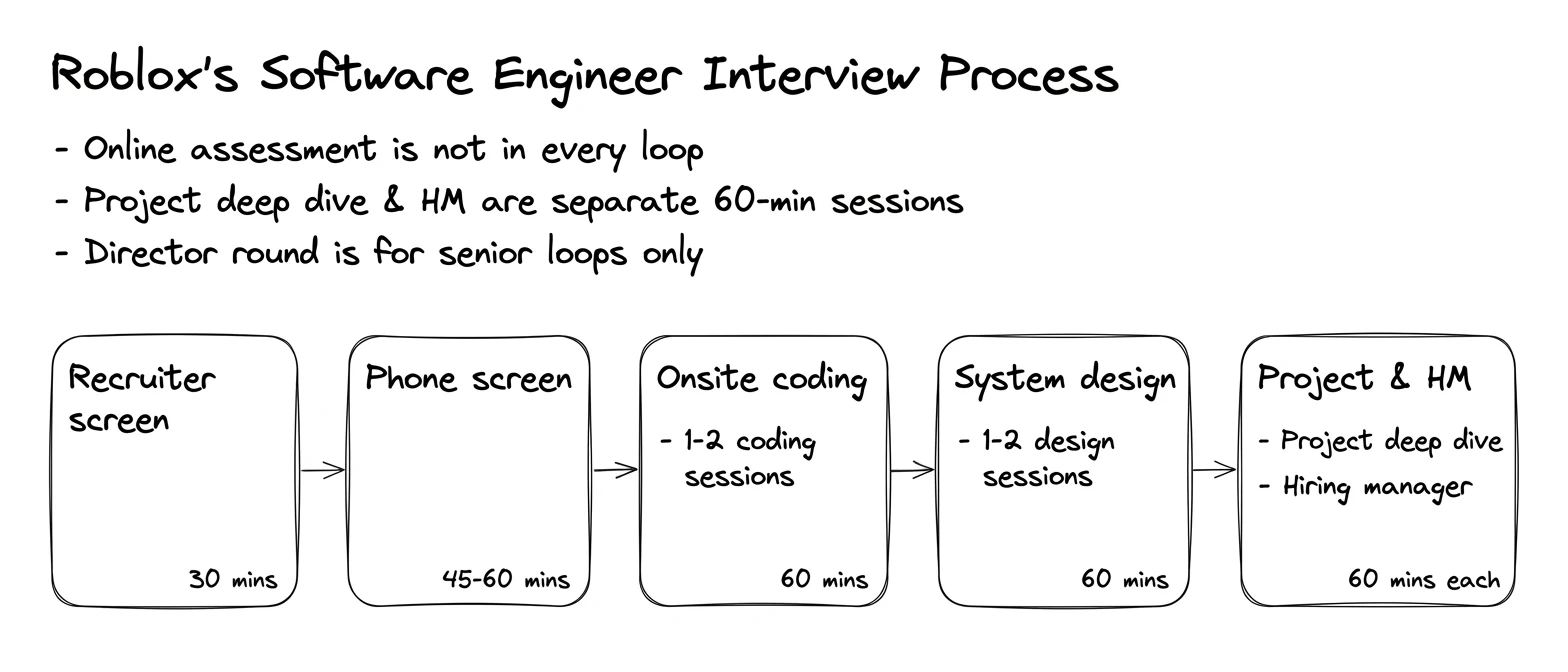
Roblox hires engineers onto specific teams, and interviewers are usually future colleagues, so design prompts follow the team's domain: payments, social features, data pipelines. The process starts with a recruiter call. Early-career candidates then take an online assessment, and most candidates have one or two phone screens. The onsite has three to six sessions, held virtually or in San Mateo. Most processes take three to six weeks, though one accepted offer took about three months.
New-grad loops center on the assessment and two coding problems. Mid-level loops typically have one coding round, one or two design rounds and a hiring manager round. Senior loops add a project deep dive and a director conversation, and principal candidates start with system design instead of coding.
Here's what the interview process can look like:
- Recruiter screen: A 30-minute call on background, operating scale, salary expectations and the three-day office policy.
- Online assessment (early career): Simulation games, a situational-judgment section and two timed CodeSignal problems.
- Technical phone screen (one or two): About an hour of live coding, most often a rate limiter with layered follow-ups.
- Coding interview (usually one): 45 to 60 minutes of runnable code on a parsing-heavy problem with two follow-ups.
- System design interview (one or two): An hour on a product feature at Roblox scale.
- Project deep dive (mid-level and above): An hour of questions on one project from your resume.
- Hiring manager and leadership interviews: Behavioral rounds on scale and ownership, plus a director or executive round for senior candidates.
Tip: Recruiters on this track often name the problem area of the coding round, such as rate limiting or call-stack parsing, and sometimes send written prep material. Use that. Treat the stated format with more caution: a senior candidate told to expect system design got a pure coding hour.
Recruiter screen
The recruiter call lasts about 30 minutes. It covers your projects, why you are looking, salary expectations, and whether you can work from the San Mateo headquarters three days a week, which is a firm requirement. Recruiters also ask about the traffic scale of systems you have built. Candidates describe them as unusually open about which languages are allowed and what the first technical round covers.
The call can end the process. A principal candidate for the Ads team was rejected the day after a screen with no technical questions, so how well your experience fits the team is screened from the start.
Interviewers evaluate:
- Team fit: How closely your past systems match the team's domain.
- Operating scale: Daily users, requests per second and data volume you have personally handled.
- Location commitment: A clear yes to three office days a week.
- Motivation: A specific reason for choosing Roblox.
Prepare a two-minute summary that includes the traffic numbers of your largest system, and ask exactly which topic families to expect.
Sample questions for the recruiter screen
Here are some questions reported by recent candidates:
- Walk me through your background and the projects on your resume.
- Why are you leaving your current role, and why Roblox?
- What are your salary expectations, and can you work on site three days a week?
Online assessment
Interns and new graduates receive the assessment right after applying and can spread it over about a week. It has three simulation games (a factory network with bottlenecks, a robot or vehicle builder crossing terrain, and a modular programming puzzle), about 23 workplace scenarios where you pick the most and least effective response, and two unproctored CodeSignal problems in about 50 minutes.
The coding problems are easy-to-medium simulation and data processing, and hidden tests decide the score. One candidate lost time on a laser-grid problem because the board was 1-indexed and the starting cell did not count as a step. Another failed hidden tests on a digit-rotation problem by comparing every pair instead of grouping by a canonical rotation. Experienced hires rarely take an assessment. One mid-level variant was a written design of a likes service covering schema, counts, race conditions and scaling.
Interviewers evaluate:
- Hidden-test correctness: Indexing conventions, off-by-one boundaries and large inputs.
- Efficient grouping: A canonical key or hash map instead of an O(n²) comparison.
- Systems thinking in the games: Trying several configurations to find the bottleneck.
- Scenario judgment: Assessing risk and telling stakeholders early, rather than hiding a bug or blaming another team.
Practice timed grid simulations and interval merging on CodeSignal, and play the official practice games first.
Note: In the modular programming game, functions must be wrapped up during the test phase to be callable later, and parameters are locked once that phase ends. Plan the full set of functions before writing any.
Sample questions for the online assessment
Here are some questions reported by recent candidates:
-
On a grid where lasers destroy whole rows and columns, find the longest safe straight-line walk from the start.
-
After each file chunk arrives as a byte range, return the merged consecutive ranges, treating [1, 3] and [4, 6] as one block.
-
Count the distinct pairs in an array where one number is a digit rotation of the other.
Technical phone screen
The screen is a 45- to 60-minute call in a shared editor, often with no introductions. The rate limiter is by far the most reported prompt. The base task is a shouldAllow method that allows at most N requests per sliding window; a deque works, some interviewers want a sorted set, and a token bucket is accepted. Follow-ups add independent per-user and per-experience windows, then per-game caps with an aggregate cap, stale-key cleanup and distributed behavior.
Other screens used topological sort with undeclared components or smallest-ID-first ordering, merge intervals plus meeting rooms, grid reachability, a trie, and a highest-earning-experience tracker. Some senior screens are system design instead: a distributed rate limiter, a URL shortener or matchmaking.
Interviewers evaluate:
- Pinned semantics: Whether window edges are inclusive and whether one limit or both must be exceeded; one interviewer worked through an example with five requests per second.
- Extensible first code: A limiter keyed by entity that can take a new dimension without a rewrite.
- Finishing under time: Running follow-up code, including entities seen for the first time.
- Complexity and memory: The amortized cost of each check and a policy for evicting idle keys.
Rehearse the rate limiter and topological sort until the base version takes 15 minutes.
Note: A candidate who wrote a limiter for a single client could not re-key it by user and experience in time. The candidate never got to run the hidden tests and was rejected. Build the first version for many keys even when the prompt names one.
Sample questions for the technical phone screen
Here are some questions reported by recent candidates:
-
Allow N requests per sliding window, then add per-user and per-experience limits and deny the request if either is exceeded.
-
Return a build order from dependency pairs, report cycles, and handle undeclared components without crashing.
-
Process UPDATE commands that change an experience's earnings (up or down) and GET_TOP commands that return the current highest earner.
-
Rate Limit by Multiple Request Fields (Per-Field / Multi-Dimensional)
Coding interview
Most onsites have one coding round of 45 to 60 minutes, run on CodeSignal with runnable code. One loop instead ran three quick rate-limiter variants and stressed speed. The most common family is call-stack logs: find the most frequent active call path from start and end events, or the top K functions across stack traces with alphabetical tie-breaks. Follow-ups ask for the longest stack, a new tie-break rule, or multithreaded logs reported per thread.
Other prompts include cursor operations in an editor-like structure, arranging items so no two adjacent ones match (feasibility, then construction), and IP bot detection over a time window with stale-entry cleanup. New-grad onsites included a hard hat-assignment problem followed by grid elimination in the style of Candy Crush. When time ran out, the interviewer accepted pseudocode for the rest.
Interviewers evaluate:
- Input contract: Empty traces, whether calls always nest, and what to return when K exceeds the number of distinct items.
- Bug-free parsing: The logic is simple but the code is long, and some interviewers insist that every test pass.
- Adapting to follow-ups: Adding a per-thread map or a tie-break rule without restarting.
- Boundaries: Empty state, a cursor at either end, and repeated operations.
Practice stack-plus-hash-map log parsing, including the multithreaded extension, until a full solution with tests takes 30 minutes.
Tip: Before coding, write three test inputs: an empty input, a tie, and a boundary case. A candidate who later received an offer said edge cases, not the algorithm, made the cursor round hard.
Sample questions for the coding interview
Here are some questions reported by recent candidates:
-
From function start and end logs, return the most frequent call path, then handle interleaved logs from several threads.
-
Return the top K function names across stack traces, breaking ties alphabetically.
-
Flag IPs that exceed a threshold within a time window, and evict stale entries so memory stays bounded.
System design interview
System design carries the most weight and causes the most rejections. Each round lasts about an hour, and IC4 and senior loops often have two. The most reported prompt is a like/unlike or favorites system. Other prompts include multiplayer matchmaking, delayed or held payments, a social-proof line on a game page, friend activity at 10 million users and 100,000 active games, notifications, and a full payment system.
Strong like-system answers cover every toggle transition, idempotent duplicates, a unique row per user and item, exact versus approximate counts, user-sharded interactions with item-sharded counters, Redis key formats, and a burst queue with reconciliation. The social-proof round asked for a real SQL query, a latency target, a hot-key plan, and a step-by-step diagnosis for a user who stops seeing the line. Interviewers seem to work from a checklist. Once the core requirements are met, extra polish counts as a bonus.
Interviewers evaluate:
- Depth you drive: Schema, keys, shard function and a failure path. One candidate was praised for requirement-gathering, never asked about Redis keys, and then rejected for a shallow design.
- State and idempotency: Correct toggles and payment holds, including duplicates and expired holds.
- Compared alternatives: A delayed-payment design that relied on one cloud vendor without weighing other queues drew criticism.
- Operations: Monitoring, failover and disconnects. A matchmaking candidate who went deep only on the algorithm did not advance.
- Flexibility: Following the interviewer's preferred path, such as real-time queries over a precomputed cache.
After the diagram, always write the schema, the cache keys and one failure scenario.
Note: Nods and note-taking do not mean you are passing. A matchmaking candidate was rejected the same afternoon. A senior candidate who stopped adding detail when the interviewer ended 20 minutes early was turned down for a "closer match." If time remains, offer the next layer yourself.
Sample questions for the system design interview
Here are some questions reported by recent candidates:
-
Design like and dislike for catalog items, with correct toggles, a user's liked list, exact counts and handling for hot items.
-
Design matchmaking that groups players by region, skill and party size without starving high-skill players.
-
Design payments that run on a future date or are held until conditions are met, with idempotency and capture or release.
-
Show "two of your friends and 12 others played this" on a game page, write the query, and debug a user who loses the line.
Project deep dive
A senior engineer, sometimes with a second interviewer, spends about an hour on one project you choose. It may be a presentation, with slides allowed, or a straight Q&A. Questions cover the architecture, the database choice, consistency and failure handling, scaling bottlenecks, monitoring, and what you would rebuild. Interviewers interrupt often, and sessions have run over time.
Interviewers evaluate:
- Individual decisions: What you chose and rejected, separate from the team's work.
- Measured impact: Numbers for latency, throughput or adoption. A rejected candidate believed vague impact hurt the round.
- Failure handling: How the system degraded and how you found the root cause.
- Retrospective honesty: One specific change you would make now.
Prepare a 10- to 15-minute narrative covering the problem, your role, your decisions, the outcome and what you learned, then practice answering three layers of "why."
Sample questions for the project deep dive
Here are some questions reported by recent candidates:
- Why did you choose that database, and how did you keep data consistent when a component failed?
- What were the scaling bottlenecks, and what would you change if you rebuilt it today?
Hiring manager and leadership interviews
The hiring manager round, 45 to 60 minutes, covers conflict, deadlines, ambiguity, trade-offs and why you want to join Roblox. What sets it apart is scale. Managers ask about daily users, data volume, requests per second, and incidents you handled as a system grew from thousands to millions of requests. Recruiters sometimes share the questions in advance. One senior behavioral round ran more than 15 scripted questions in 45 minutes.
Senior loops add a director, VP or senior-director round. It may focus on technical vision, prioritization and growing a team, or it may be a relaxed fit conversation. At senior levels it also confirms the offer level.
Interviewers evaluate:
- Hands-on scale: High-traffic work you did yourself, with numbers and an incident you owned.
- Initiative: Problems you found and decisions you drove. One rejection at the executive stage cited stories about carrying out assigned work.
- Reasoning: Why you took each step, not just the order of events.
- Long-term thinking: Maintainability trade-offs and how you would set a team's priorities.
Prepare six to eight short stories with numbers, at least three of which show a decision you pushed through against resistance.
Sample questions for the hiring manager and leadership interviews
Here are some questions reported by recent candidates:
-
Describe a system you ran as traffic grew by orders of magnitude, and the incidents along the way.
-
Tell me about disagreeing with a teammate on architecture under a tight deadline.
-
Why Roblox, and why did you leave each previous role?
How Roblox levels and evaluates Software Engineer candidates
The target level is set before the loop. IC1 and IC2 loops are mostly coding; from IC3 (Senior) upward, design and the deep dive carry the decision, and a director round confirms senior levels. Feedback is reviewed together after the loop, so one warm round predicts little, and rejection notes are generic. Decisions come within hours to a week, but processes also stall: one candidate passed every test in a coding round, then had the hiring manager round canceled. One candidate accepted an offer a level below target; another offered to down-level after a weak round and was still rejected.
Tip: Ask for a decision date after every stage and keep other processes moving. Senior offers have arrived the day after the onsite.
How to prepare for the Roblox Software Engineer interview
- Master every form of the rate limiter: Deque and sorted-set windows, token bucket, per-user and per-experience keys, aggregate caps and eviction of idle keys.
- Drill call-stack log parsing: Most frequent path, top K with tie-breaks, and per-thread results, written as runnable code.
- Practice topological sort with twists: Undeclared nodes, cycle reporting and smallest-ID-first ordering with a min-heap.
- Go deep in design without being asked: Write the schema, cache keys, shard keys, hot-key path and one failure, and compare two technology options.
- Rehearse the Roblox design set: Likes, matchmaking, delayed payments, social proof with SQL, and friend activity.
- Bring scale numbers: Daily users, requests per second, data volume and one incident for each major system.
- Build initiative stories: For senior loops, every story needs a problem you found and a decision you drove.
- Rehearse the assessment if you are early career: Replay the practice games and solve two grid or interval problems in 50 minutes.
About the Roblox Software Engineer role
Roblox engineers build the services behind a platform where creators publish experiences and tens of millions of daily users spend an in-platform currency. Small teams own services end to end, and their problems shape the interview: idempotent payments, hot keys from viral experiences and friend-graph fan-out. Employees work in the San Mateo office three days a week. Engineers are leveled on an IC scale, where IC1 is entry level and IC3 is Senior Software Engineer.
Roblox hires Software Engineers across the platform. Teams include:
- Economy and creator business: Virtual currency, transactions and creator payouts that must be accurate to the cent.
- Ads: The ads manager and a three-sided marketplace of advertisers, brands and publishers.
- Infrastructure: Deployment of thousands of microservices across on-premises data centers and the cloud.
- Data infrastructure: Event pipelines and aggregation for products and analytics.
- Safety: Account authentication, fraud detection and moderation.
- Engine: The runtime creators build on, with C++ and performance work.
Software Engineer experience and education requirements
Early-career postings ask for a degree in computer science or a related field, or equivalent experience, and proficiency in at least one language such as C++, C#, Java, Go, Python, Lua or Node.js. New graduates are matched to teams in areas such as discovery, the economy, the engine and infrastructure. Experienced hires are recruited for a specific team, and domain fit with that team weighs heavily. Any mainstream language is accepted in interviews.
FAQs about the Roblox Software Engineer interview
How long does the Roblox Software Engineer interview process take?
Usually three to six weeks, although one accepted offer took about three months. Rejections have arrived within hours of a round.
What is the hardest round of the Roblox Software Engineer interview?
System design. Several candidates who felt the round went well were rejected for insufficient depth. A candidate who received an offer called the payment-system round the hardest because the interviewer kept pushing on consistency and reconciliation.
Does Roblox ask dynamic programming?
Rarely. Most problems use hash maps, heaps, stacks, deques, intervals and graph traversal. However, one new-grad loop included a hard assignment-counting problem even though candidates had been told not to expect dynamic programming. The limits were small enough that backtracking worked.
How much does a Roblox Software Engineer make?
Approximate total annual compensation in the United States:
- IC1: ~$220K
- IC2: ~$310K
- IC3 (Senior): ~$390K
- IC4: ~$490K
- IC5: ~$700K
Packages are base salary plus a large stock grant. There is no annual cash bonus, sign-on bonuses are uncommon, and the size of the grant reportedly depends on interview performance.