Roblox · Study
Roblox Machine Learning Engineer Interview Process
TrueInterview
July 24, 2026 · 12 min read
Roblox hires Machine Learning Engineers into a specific team, so the interviewers are usually future colleagues and the ML modeling prompt is often taken from the team's current work. Every loop that reached the onsite included an hour-long deep dive on one of your projects or papers, followed by questions on how it would apply to Roblox. Coding is never waived: expect a practical medium problem, usually log parsing or a sliding window, where the follow-up changes the input.
This guide breaks down each stage of the Roblox Machine Learning Engineer interview, what interviewers evaluate in each round, and how to prepare, with questions candidates were actually asked.
Verified: Based on 5 candidate-reported interview experiences, primarily from 2026 Q1 through 2026 Q3, cross-checked against recent public accounts.
Roblox Machine Learning Engineer interview process
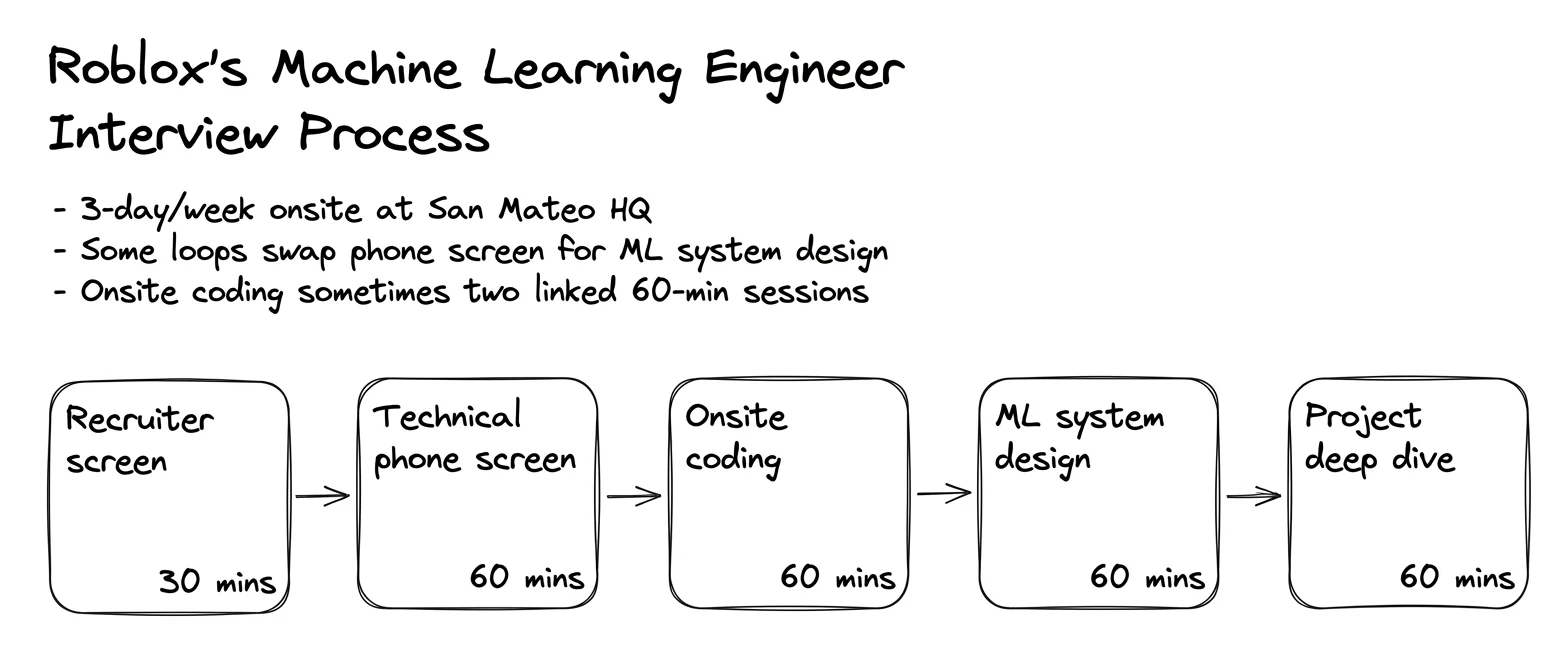
The loop depends on the hiring team. Reported loops ran from three to eight conversations: a recruiter call, one or two phone-screen sessions, and a virtual onsite of three or four rounds of 45 to 60 minutes. The phone-screen slot varies most. It was coding for some candidates, ML system design for one, and a project deep dive plus a hiring-manager conversation for a senior candidate. Senior loops add a director conversation that sets the level.
Here's what the interview process can look like:
- Recruiter screen: About 30 minutes on background, motivation and timeline, with no technical questions.
- Technical phone screen (one or two sessions): An hour of medium coding, ML system design or a project deep dive, depending on the team.
- Coding interview (one or two rounds): A practical medium problem in runnable code, then an extension.
- ML modeling interview: An hour designing a model end to end, from framing to loss, metrics and an online test.
- Project deep dive: An hour presenting one project or paper and defending every decision in it.
- Hiring manager and behavioral interview: About 45 minutes on motivation, ambiguity and past behavior.
- Director interview (senior candidates): A 45-minute conversation on scope and leadership that decides the level.
Tip: Ask the recruiter which rounds you will get and in what order. Recruiters on this track sent study material, an outline of the rounds and even behavioral questions in advance, and the phone screen differs enough between teams that preparing for the wrong format costs the round.
Recruiter screen
A 30-minute call, usually within a day or two of applying or after recruiter outreach, covers your experience, why you are moving, the team's problem area and the timeline. No technical questions were reported. Roblox asks most employees to work from its San Mateo headquarters Tuesday through Thursday, so location comes up here.
Interviewers evaluate:
- Domain fit: Recommendation, safety or generative AI experience that maps onto the open role.
- Seniority signal: The scope of projects you led, which shapes the level the loop targets.
- Motivation: A reason for Roblox specifically, beyond general interest in games.
- Timeline: Competing processes, since the rest of the loop can move very quickly.
Prepare a two-minute summary of your strongest ML project and a specific answer to why Roblox.
Technical phone screen
The screen is one hour with an engineer. Coding screens use ordinary data-structure problems rather than ML tooling: subarrays summing exactly to a target with an efficient window, or the most frequent caller-callee pair in a log of calls with timestamps, followed by questions on scale and edge cases. One recruiter-sourced candidate got an ML system design screen instead. A senior candidate's screen was two sessions, a one-hour project deep dive with two interviewers and a 45-minute hiring-manager conversation, and the onsite invitation followed two days later.
Interviewers evaluate:
- Working code within the hour: A complete pass before the extension questions start.
- Clarifying the input: Negative values, duplicates, ties and malformed log lines.
- Scaling the solution: How a frequency count changes when the log is streamed or does not fit in memory.
- Framing in design screens: Labels, data sources and metrics before any model.
Practice hash-map counting over logs and window problems until each takes under 25 minutes.
Note: A sum-to-target window only works as a two-pointer slide when all values are non-negative. Ask before coding: with negatives the answer is a prefix-sum hash map, and interviewers here say little to stop you building the wrong one.
Sample questions for the technical phone screen
Here are some questions reported by recent candidates:
-
Given a log of calls with caller, callee and timestamp, return the pair that occurs most often, then discuss scaling and edge cases.
-
Find the subarrays whose elements sum exactly to a given target using an efficient window technique.
-
Design an ML system that assigns genres to video games from scratch, where a game can belong to several genres.
Coding interview
The onsite holds one or two coding rounds of 45 to 60 minutes; one senior candidate was told Roblox runs a single coding round, while another loop had two linked ones. Code runs on CodeSignal, and problems are medium scenarios without dynamic programming or puzzle tricks. The most reported family parses function-call logs: find the most frequent call path with a stack, then handle interleaved logs from several threads with per-thread state. The logic is simple, but the volume of code is large and parsing details hide bugs.
The other family is fixed-size windows. Part one lists the start of every length-k window that contains a target value; part two returns the leftmost window with the most occurrences of the target, moving from an n-times-k scan to linear time with a running count. Interviewers pushed on windows longer than the array, repeated targets and ties, and offered little verbal feedback.
Interviewers evaluate:
- Extensible structure: Code the follow-up can reuse, such as per-thread stacks added to an existing parser, not a rewrite.
- Parsing discipline: Correct handling of start and end records and nesting before any optimization.
- Complexity improvement: Reaching linear time and explaining why the sliding count is correct.
- Self-testing: Running your own edge cases, since interviewer silence is not confirmation.
Practice log-parsing problems end to end in a runnable editor, including a multi-threaded variant.
Sample questions for the coding interview
Here are some questions reported by recent candidates:
-
Parse function enter and exit logs and return the most frequent call path, then extend it to interleaved multi-threaded logs.
-
Return the starting index of every fixed-length window that contains a target number at least once.
-
Return the leftmost fixed-length window with the most occurrences of a target, in linear time.
ML modeling interview
This hour starts from an open prompt, often from the hiring team's roadmap: a game recommendation system, a game genre classifier, broad personalization or abuse-detection spaces, and for one senior candidate a live, confidential team project. The expected sweep covers scoping, data and labels, features from metadata, text and images, model choice, loss function, optimizer, offline metrics and an online A/B test.
Interviewers probe two or three components rather than the whole list. In the recommendation prompt they focused on long-tail and cold-start games and on the loss definition; in the genre prompt, on multi-label assignment, where one candidate proposed a hierarchical classifier. Interviewers do not steer, and one candidate never reached deployment and monitoring.
Interviewers evaluate:
- Framing before modeling: What is predicted, what the label is and what data exists.
- Loss and objective choices: Why the loss fits the goal and how it handles imbalance or multiple labels.
- Platform hazards: Cold-start games, uneven quality of user-generated content and adversarial behavior in safety problems.
- Evaluation that reaches production: Offline metrics tied to an online experiment with guardrails.
Rehearse one recommender and one safety or content classifier, each in 45 minutes.
Tip: State your agenda in the first two minutes and name what you will skip. A senior candidate who still ran out of time advised covering the architecture quickly and spending the depth on long-tail handling and the loss function.
Sample questions for the ML modeling interview
Here are some questions reported by recent candidates:
-
Design a game recommendation system for Roblox users, with attention to long-tail and cold-start games and to the loss function.
-
Build a multi-label genre classifier for games combining structured metadata with icons and descriptions.
-
For a personalization or abuse-detection problem, walk through features, models, loss, optimizer, offline metrics and an A/B test.
Project deep dive
One senior engineer, or two interviewers from the team, spend an hour on a project you led or a paper you wrote: motivation, method, architecture, data pipeline, model choices and impact. Follow-ups cover failure cases, rejected alternatives, what you would change and how it would scale, then how the idea transfers to a Roblox problem such as recommendations or content moderation. One rejected candidate called the questioning intense; a senior candidate with a slide deck on work close to the team's ran past the hour on follow-ups and received an offer.
Interviewers evaluate:
- Ownership of decisions: Why each component beat its obvious alternative, in your own words.
- Quantified results: Baselines and how far the key metric moved.
- Honest failure analysis: What broke, how you found out and what you changed.
- Transfer to Roblox: A credible mapping onto recommendation, discovery or safety at Roblox's scale.
Pick the project closest to the team, build a short deck and rehearse with someone who interrupts often.
Sample questions for the project deep dive
Here are some questions reported by recent candidates:
-
Present a paper you authored, then explain how its method could improve in-game recommendations or content moderation.
-
Walk through a past project's data pipeline, model choices and failure cases, and how you would scale it.
Hiring manager and behavioral interview
These rounds run about 45 minutes and vary by interviewer. Hiring managers asked about background, why Roblox, and how you approach an ML problem with an ambiguous objective; one rejected candidate felt this conversation never connected. In a senior loop, one behavioral round fired more than 15 questions on conflict, leadership and failure in 45 minutes, following a script with almost no follow-ups. A second hiring-manager conversation late in the loop can be largely candidate-driven, built on your questions about the team.
Interviewers evaluate:
- Concise structure: Complete answers in about a minute, since no follow-up rescues a vague one.
- Handling ambiguity: Turning an unclear goal into a measurable objective.
- Motivation for Roblox: A specific link between your work and the platform's users, creators or safety needs.
- Quality of your questions: Informed questions about the team's roadmap.
Prepare 8 to 10 short stories and rehearse them at a one-minute pace.
Sample questions for the hiring manager and behavioral interview
Here are some questions reported by recent candidates:
-
Why Roblox, and why this team?
-
How would you approach a machine learning problem where the right objective is not defined?
-
Tell me about a conflict with a teammate and a project that failed.
Director interview
Senior candidates meet a director for 45 minutes, primarily to set the level. The director asks about projects you led, the scope you owned and standard behavioral topics, in a more formal tone than the hiring-manager rounds. In the reported case it placed the candidate at the highest senior level, one step below principal.
Interviewers evaluate:
- Scope of leadership: Projects driven from proposal to production, and the teams involved.
- Cross-system judgment: Trade-offs that affected more than one system.
- Trajectory: Whether recent scope supports the level under discussion.
Prepare your two largest projects with your exact role, team size and outcome.
How Roblox levels and evaluates Machine Learning Engineer candidates
Interviewers are the hiring team, so no separate team matching follows the offer. Feedback is combined after the loop, and rejected candidates pointed to coding and hiring-manager rounds that felt merely adequate, not to modeling gaps, so a strong design round does not carry a weak packet. Roblox uses an IC ladder starting at IC1; senior titles generally span IC3 and IC4, with principal above, and the director round sets the level for senior candidates. One candidate had a verbal offer the day after a two-day onsite, followed by a chat with the hiring manager and a senior technical lead before the written offer.
Tip: Line up your other timelines before the onsite. Candidates found it awkward to hold a next-day offer while other loops caught up.
How to prepare for the Roblox Machine Learning Engineer interview
- Confirm each round's format: Ask whether the phone screen is coding, ML design or a presentation, and use the recruiter's prep material.
- Master log parsing in runnable code: Call-path and caller-frequency problems with stacks and hash maps, including the multi-threaded extension.
- Drill fixed-window follow-ups: Go from listing windows to the leftmost best window in linear time, with ties handled.
- Build two Roblox-shaped designs: A game recommender with cold-start handling and a safety or multi-label classifier, each with a loss, metrics and an A/B test.
- Plan the modeling hour aloud: Go deep on one or two components and name what you defer.
- Prepare the deep dive as a defense: Baselines, measured impact, a failure, rejected alternatives and a Roblox application.
- Rehearse one-minute behavioral answers: Expect a scripted round of 15 or more questions.
About the Roblox Machine Learning Engineer role
Machine Learning Engineers at Roblox build production models for a platform of user-generated experiences, where content quality varies widely and safety stakes are high. The work spans data, training, real-time serving and monitoring, with modeling tied to latency and scale. Most employees work in San Mateo three days a week. Teams include:
- Recommendation systems: Ranking, retrieval and personalization for experiences, avatars and creator content, increasingly with multimodal and large language models.
- Safety and content safety: Real-time detection and remediation of abusive content across text, images, audio, video, avatars and code.
- Generative AI: Foundation models such as Cube, the 3D generation system introduced and partly open-sourced in 2025, and creator tools built on them.
- ML infrastructure: Training and serving platforms behind the safety and recommendation teams.
Machine Learning Engineer experience and education requirements
Senior postings ask for several years of production ML and a strong foundation in statistics and mathematics. Early-career PhD postings in recommendation systems ask for a completed or nearly completed PhD with a thesis aligned to Roblox's areas and top-venue publications. Python is standard, with C++, Go or Java also listed; some postings say visa sponsorship may not be available.
FAQs about the Roblox Machine Learning Engineer interview
How long does the Roblox Machine Learning Engineer interview process take?
About a month in the fastest reported case: a recruiter call within two days, a two-to-three-week wait for the phone screen, an onsite invitation two days later and a verbal offer the day after the onsite.
What is the hardest round of the Roblox Machine Learning Engineer interview?
The project deep dive, an hour of detailed questions on one piece of your work and its application to Roblox. The ML modeling round is close behind because an open prompt rarely fits in 60 minutes.
Is the Roblox Machine Learning Engineer interview remote?
Reported onsites were virtual, and one candidate split the onsite over two days. The job is usually based in San Mateo with three office days a week.
How much does a Roblox Machine Learning Engineer make?
Approximate total annual compensation in the United States:
- IC3: ~$340K
- IC4: ~$515K
- IC5: ~$560K
Packages are mostly base salary and restricted stock units, with little or no annual cash bonus.