Roblox · Study
Roblox Interview Process & Questions
TrueInterview
July 24, 2026 · 14 min read
Roblox interviews draw on a small set of recurring problems, each extended with follow-ups. A sliding-window rate limiter opens more screens than any other prompt, and call-stack log parsing and topological sort with a tie-break recur too. Candidates who knew these families still failed when their first version could not be extended. Most rejections come in design and leadership rounds: interviewers expect schemas, cache keys and a SQL query, and hiring managers ask for the traffic numbers behind your past work. The target team hires, and a director conversation that also sets the level ends most experienced loops.
This guide breaks down each stage of the Roblox interview, what interviewers evaluate in each round, and how to prepare, with questions candidates were actually asked.
Verified: Based on 56 candidate-reported interview experiences, cross-checked against recent public accounts.
Roblox interview process
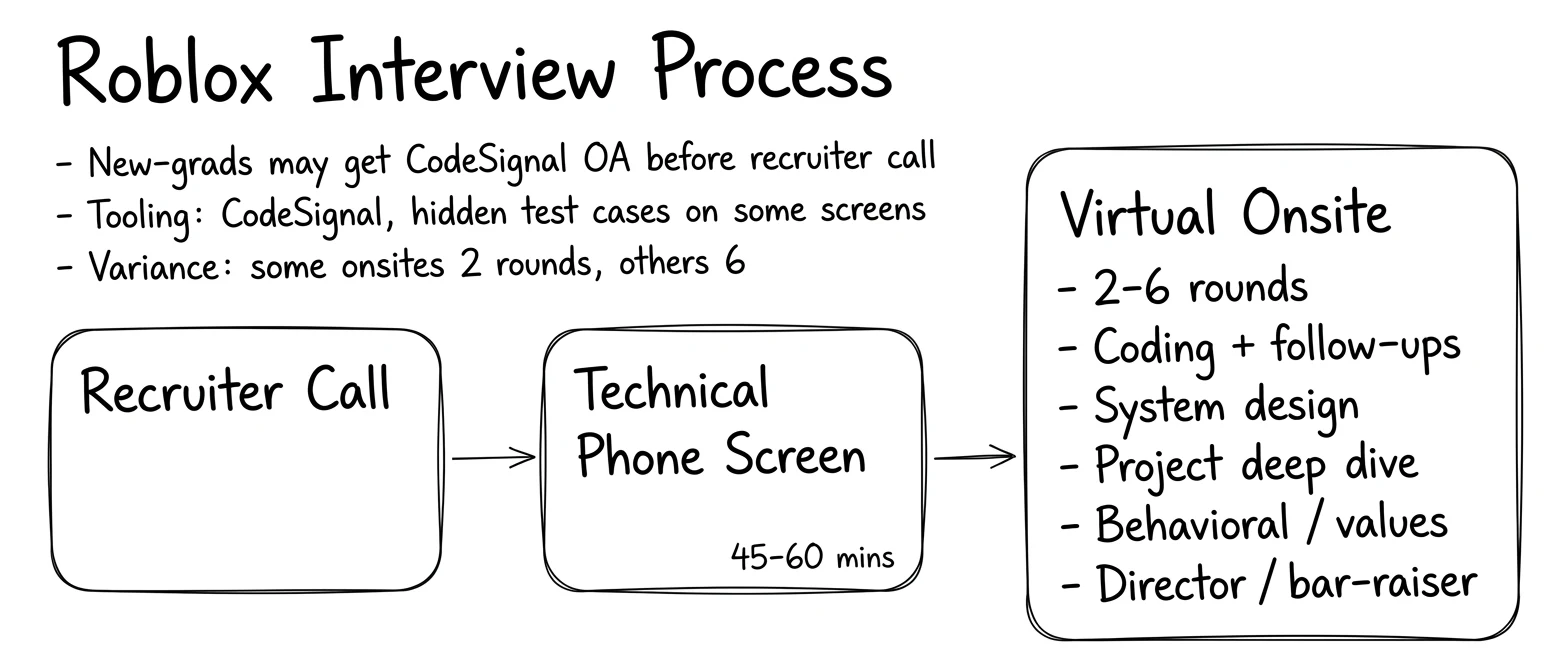
The hiring team runs its own loop, so round topics follow the team's domain: ads, fraud and payments, data infrastructure, frontend, or machine learning. Early-career applicants usually get an online assessment as soon as they apply. Experienced hires go from a recruiter call to one technical screen and then a virtual or in-person onsite. Reported onsites ranged from two rounds (one coding, one design) to six, and four or five is typical. The whole process has run from about three weeks to about three months.
New-grad and intern loops are mostly coding: an assessment, then a virtual onsite with two problems. Mid-level loops add system design and a hiring-manager round; senior loops add a project deep dive and a director or VP round that sets the level. Principal candidates were told their first technical round would be system design and the onsite would be in person.
Here's what the interview process can look like:
- Recruiter screen: A non-technical call of about 30 minutes about background, level, salary expectations and the three-day in-office policy.
- Online assessment (early career): Game-based cognitive tests, a workplace-judgment section and one or two timed coding problems.
- Technical phone screen: About an hour with one problem and two follow-ups that extend it, or a design prompt for senior candidates.
- Coding interviews: Usually one round for experienced hires and two for new grads, with practical, scenario-framed problems.
- System design interview: Social and game-platform features at scale. ML candidates get a modeling round instead, and frontend candidates a component design.
- Project deep dive: A senior engineer spends up to an hour questioning one project from your resume.
- Behavioral and leadership interviews: The hiring manager, plus a director, VP or senior director for experienced roles.
Tip: Write every first solution so it can take a key. Candidates rarely failed the base problem; they failed rewriting a single-key design into a per-entity one under time pressure.
Recruiter screen
Most experienced candidates come in through recruiter outreach; others apply cold. The call covers your background, why you are leaving, salary expectations and whether you can work three days a week from the office. Several candidates said recruiters were unusually open about the process: they shared prep material, named the topic families and described the first technical round.
Interviewers evaluate:
- Scale of past work: The traffic, data volume and user counts of systems you ran.
- Track alignment: Whether your recent work fits the role. Frontend recruiters ask how much of your work was really frontend.
- Logistics: Willingness to work from the office, location and compensation expectations.
Ask which problem families and rounds to expect, and prepare for the others anyway.
Note: Previews are directional. A senior candidate was told the screen would be system design and got a pure coding hour. A principal candidate was rejected the day after the recruiter call, before any technical round.
Sample questions for the recruiter screen
Here are some questions reported by recent candidates:
- Walk me through your background and the projects on your resume.
- Why Roblox, and why are you looking to leave your current role?
- Are you able to work from the office three days a week?
Online assessment
The early-career assessment arrives right after you apply. The game-based cognitive tests have been a vehicle builder for varied terrain, a factory line to debottleneck for profit, and a modular programming puzzle in which only functions written during the test phase can be called later. A situational-judgment section (23 items in one recent version, about one per minute) asks for the most and least effective response to workplace scenarios. Coding is usually two problems in 50 minutes; some versions had one longer application-style problem.
The problems are simulation and data processing graded on hidden tests. A candidate who compared digit rotations with nested loops timed out where grouping by a canonical rotation would have passed. Some candidates were rejected after the assessment with no feedback.
Interviewers evaluate:
- Hidden-test correctness: Off-by-one errors on a 1-indexed board and quadratic comparisons pass the samples and fail the hidden tests.
- Edge rules in the prompt: Ranges merge when
start <= prev_end + 1, and the starting cell counts as zero steps. - Judgment in scenarios: Weigh long-term risk, tell stakeholders early and find a workaround for a blocker; hiding a known bug is the trap.
- Exploration in the games: Trying several builds scores better than refining the first one that works.
Practice two timed simulation problems in 50 minutes and read every indexing rule twice before coding.
Sample questions for the online assessment
Here are some questions reported by recent candidates:
-
On a grid where each laser destroys its row and column, find the longest safe straight-line walk from a starting cell.
-
As file chunks arrive, return the merged consecutive byte ranges after each one.
-
Count the distinct pairs of numbers that are digit rotations of each other.
Technical phone screen
The screen runs 45 to 60 minutes in a shared editor, usually after a minute or two of introductions: one medium problem and two follow-ups. A deque rate limiter becomes per-user plus per-experience windows, then per-game caps under a user-wide cap. A course ordering adds smallest-ID-first, which needs a min-heap. A call-stack frequency count adds a tie-break and then separate counts per thread. Some screens grade against hidden test cases, which one candidate learned only after leaving the follow-up unfinished.
Senior candidates sometimes get a design prompt instead (a distributed token bucket, a URL shortener, matchmaking). ML screens have been a game-genre classifier, and frontend screens are UI tasks such as six piano keys in plain JavaScript driven by mouse and keyboard.
Interviewers evaluate:
- Clarifying the semantics: Window boundaries, and whether a request is denied when any limit is hit or only when all are.
- Extensibility: Whether the first version is a class keyed by entity, so the follow-up is a small change.
- Boundary handling: First-seen keys, empty traces, ties broken alphabetically, cycles and dependencies on items that were never listed.
- Cleanup: Removing stale keys so per-user maps do not grow without limit.
Drill each recurring family to its second follow-up, against a 45-minute timer.
Note: Spending ten minutes on design talk before coding a trie left one candidate with half an implementation. Interviewers here reward a working baseline first.
Sample questions for the technical phone screen
Here are some questions reported by recent candidates:
-
Implement
shouldAllow(timestamp)for N requests per sliding window, then enforce independent per-user and per-experience limits. -
Order courses by their prerequisites, always taking the smallest available ID and returning an empty list if there is a cycle.
-
From function start and end logs, find the most frequent call path, then report it separately for each thread.
-
Rate Limit by Multiple Request Fields (Per-Field / Multi-Dimensional)
Coding interviews
Experienced hires usually have one onsite coding round of about 45 minutes, often with runnable code. Problems are practical and long rather than tricky: most frequent call path over interleaved multithreaded logs, a cursor with many boundary cases, IP bot detection with expiry cleanup, or three quick rate-limiter variants in an hour. New-grad and intern onsites have two problems with two interviewers, recently a Candy Crush simulation and a hard hat-assignment variant.
Frontend onsites have used a hard problem with constraints loose enough for brute force, where explaining the approach counted more than optimizing.
Interviewers evaluate:
- Correctness under volume: Parsing-heavy problems hide bugs, and one interviewer insisted on code that passed every test case.
- Feasibility and construction: Some problems have two parts, such as deciding whether a schedule exists and then building one. Both parts are graded.
- Communication when time runs out: One new-grad candidate was allowed to finish in pseudocode.
Prepare simulation and parsing problems as carefully as graph problems, and write out test cases before coding.
Note: An early-career information session said dynamic programming would not appear this year. A hard problem in the style of a DP assignment problem appeared in a fall 2026 new-grad onsite anyway.
Sample questions for the coding interviews
Here are some questions reported by recent candidates:
-
Flag IPs that exceed a request threshold within a sliding window, with cleanup so the tracker does not grow forever.
-
Decide whether items can be scheduled so no two adjacent items match, then produce one valid schedule.
-
Assign hats to people so each wears a different hat, returning both the number of valid assignments and the maximum point total.
System design interview
Design rounds last about an hour and use social and game-platform features. The like/unlike system came up most often, probed on toggle rules, idempotent retries, hot items, exact versus approximate counts and Redis key layout; one version required change data capture across two databases. Other recent prompts: matchmaking for millions of concurrent players, delayed or held payments, a payment system with gateway reconciliation, real-time notifications, and a URL shortener.
The round drops to concrete detail fast. For a social-proof line on a game page (two friends' names plus a count of other players), one interviewer asked for the schema, a real SQL query, sharding against hot games, a latency budget and a debugging walkthrough. ML candidates get a modeling round instead (features, loss, cold-start games, the A/B test); frontend candidates designed an image feed with offline caching and an accessible dropdown.
Interviewers evaluate:
- Concrete artifacts: Tables with unique constraints, a state machine for each transition, cache keys and the query itself.
- Failure paths: Duplicate requests, rapid toggling, disconnects during matchmaking and reconciliation after a failed capture.
- Operational completeness: One rejected matchmaking design went deep on the algorithm and skipped monitoring, recovery and scaling policy.
- Trade-offs beyond one vendor: A delayed-payment candidate who relied only on AWS services was marked down for not comparing queue options.
Prepare the like system, matchmaking and delayed payment down to schema and failure handling.
Note: The interviewer staying high-level does not mean depth is optional. One candidate was praised for gathering requirements, was never asked about keys or queries, and was rejected for insufficient design depth.
Sample questions for the system design interview
Here are some questions reported by recent candidates:
-
Design like and dislike for catalog items with correct toggles, each user's own status, a list of their liked items and exact counts.
-
Design matchmaking that supports both casual quick-join and ranked play across regions without starving high-skill players.
-
Design a payment hold that authorizes funds now and captures or releases them later, including partial captures and expiry.
Project deep dive
Most experienced loops include an hour in which a senior engineer, or two interviewers, take apart one project you choose: motivation, architecture, data pipelines, store choices, failures, scaling, measurable impact and what you would rebuild. ML and research candidates present a paper and are asked how it applies to Roblox recommendations or moderation. Interruptions are constant; one candidate got through only one of two prepared papers.
Interviewers evaluate:
- Individual ownership: Which decisions you made, as opposed to work you were assigned.
- Quantified impact: Numbers for traffic, latency or revenue, not general descriptions.
- Depth under interruption: Whether you can go down to implementation detail on any part.
- Retrospective judgment: What failed, and what you would change now.
Prepare one 10–15 minute narrative going from problem to your role, key decisions, outcome and retrospective.
Sample questions for the project deep dive
Here are some questions reported by recent candidates:
-
Why did you choose that database, and how did you keep data consistent through failures?
-
How would the method in your paper apply to recommendations or content moderation here?
Behavioral and leadership interviews
The hiring manager round runs about 45 minutes, from candidate-led conversation to a script of more than 15 questions with no follow-ups. Managers ask for the scale you have worked at (daily actives, data volume, growth to millions of requests per second) plus conflict, deadlines and ambiguity. Experienced loops add a director, VP or senior-director round on technical vision, prioritization, why you are leaving and the hardest project you led; one candidate described it as mainly a leveling discussion.
Interviewers evaluate:
- Hands-on scale: Real numbers for systems you personally operated.
- Proactive decisions: A frontend candidate whose technical rounds all went well was rejected because the stories showed executing assigned tasks rather than making calls.
- Motivation: A specific reason for Roblox, its creators and its players. Experience with gaming or user-generated platforms helps.
- Values in practice: Respect for the community, taking responsibility, taking the long view and getting things done, shown through trade-offs.
Prepare short STAR stories that each fit in about three minutes, and know your scale numbers.
Sample questions for the behavioral and leadership interviews
Here are some questions reported by recent candidates:
-
Describe a system that grew from thousands to millions of requests per second: what broke and what you changed.
-
Tell me about a disagreement with a teammate on architecture under a tight deadline.
How Roblox makes hiring decisions
The target team runs the loop, so interviewers are likely future colleagues and no separate team-matching stage was reported. Interviewers grade against a checklist and give little feedback in the room; nodding and note-taking mean nothing. Level comes from the director round and the scope of your stories. One candidate accepted an offer a level lower, while another who offered to down-level after a weak loop was still rejected. A rejection has come four hours after a screen and a verbal offer the day after a two-day onsite; others waited a week or more, or lost contact with the recruiter.
Tip: After each stage, ask the recruiter directly what remains and when to expect a decision. Silence is not a signal either way.
How to prepare for the Roblox interview
- Build a keyed rate limiter: Write deque, sorted-set and token-bucket versions behind one class, then add per-user plus per-experience limits, aggregate caps and cleanup.
- Master call-stack parsing: Practice most frequent call path, longest stack and per-thread results from interleaved logs.
- Extend topological sort: Use a min-heap for smallest-ID ordering, detect cycles and handle dependencies that were never listed.
- Design down to the query: For likes, matchmaking and delayed payments, have the schema, state machine, cache keys, a SQL query and the failure path ready, and leave time for monitoring and recovery.
- Know your scale numbers: Daily actives, request rates and data volume for every system you will discuss.
- Rehearse one deep-dive project: Problem, your decisions, quantified results and a retrospective, delivered so it holds up under interruption.
- Time the assessment: For early-career roles, practice two simulation problems in 50 minutes and judgment scenarios that reward early communication.
About working at Roblox
Engineers build the engine, the cloud that runs experiences, creator tools, the virtual economy and social and safety systems. Teams own live services used by tens of millions of players daily, which is why loop questions keep returning to hot items, retries and freshness. Engineers work from the San Mateo headquarters three days a week.
| Level | Primary focus | Impact scope |
|---|---|---|
| IC1 (Software Engineer, early career) | Delivering well-defined tasks independently | Features within one team |
| IC2 (Software Engineer) | Owning components and services | One team's systems |
| IC3–IC4 (Senior Software Engineer) | Leading projects and design decisions | A team and its neighbors |
| IC5 (Principal Software Engineer) | Architecture and technical direction | Several teams or an area |
Roblox hires engineers and scientists across its platform. Teams include:
- Ads: Ad marketplace, auctions and pricing, and ads measurement.
- Economy and monetization: Virtual item purchases, creator earnings and payments.
- Trust and safety: Fraud, account security, moderation and safety tooling.
- Infrastructure and data: Continuous deployment across data centers and cloud, networking, and data infrastructure.
- Engine and creator tools: The client engine, performance and Studio.
- Discovery and social: Recommendations, search, friends and notifications.
Experience and education requirements
Early-career postings accept a current or completed degree in computer science or a related field, or equivalent practical experience. They ask for proficiency in at least one language such as C++, C#, Lua, Java, Go, Python or Swift. Engine roles weight C++ more heavily. Principal postings typically ask for eight or more years of experience.
FAQs about the Roblox interview
How long does the Roblox interview process take?
Usually a few weeks. The fastest reported process went from application to verbal offer in about three weeks; the slowest took about three months from first contact.
What is the hardest round of the Roblox interview?
System design for most experienced candidates, because interviewers go from the architecture to queries, keys and failure handling. For senior and frontend candidates, the leadership rounds at the end are where otherwise strong loops have been rejected.
Is there an online assessment?
Yes, for early-career roles and internships. It combines game-based cognitive tests, situational judgment and timed coding. Experienced hires usually skip it.
How are Roblox offers structured?
Candidates were told equity grants depend on interview performance, there is no annual bonus, and sign-on bonuses are uncommon.
Is the Roblox interview remote?
Screens are virtual. Onsites are virtual or in person, and principal-level candidates were told to travel to the office for theirs.