Roblox · Study
Roblox Frontend Engineer Interview Process
TrueInterview
July 31, 2026 · 14 min read
Roblox screens Frontend Engineers as specialists. Design outweighs algorithms: an image-feed design hour and an onsite dropdown-component session sit beside a single coding round and a UI build in vanilla JavaScript or React. The rounds that end loops come last. One candidate who passed every technical round was rejected because the profile read as fullstack rather than frontend and the project stories showed assigned work, not decisions the candidate drove.
This guide breaks down each stage of the Roblox Frontend Engineer interview, what interviewers evaluate in each round, and how to prepare, with questions candidates were actually asked.
Verified: Based on 51 candidate-reported interview experiences, primarily from 2025 Q4 through 2026 Q3, cross-checked against recent public accounts.
Roblox Frontend Engineer interview process
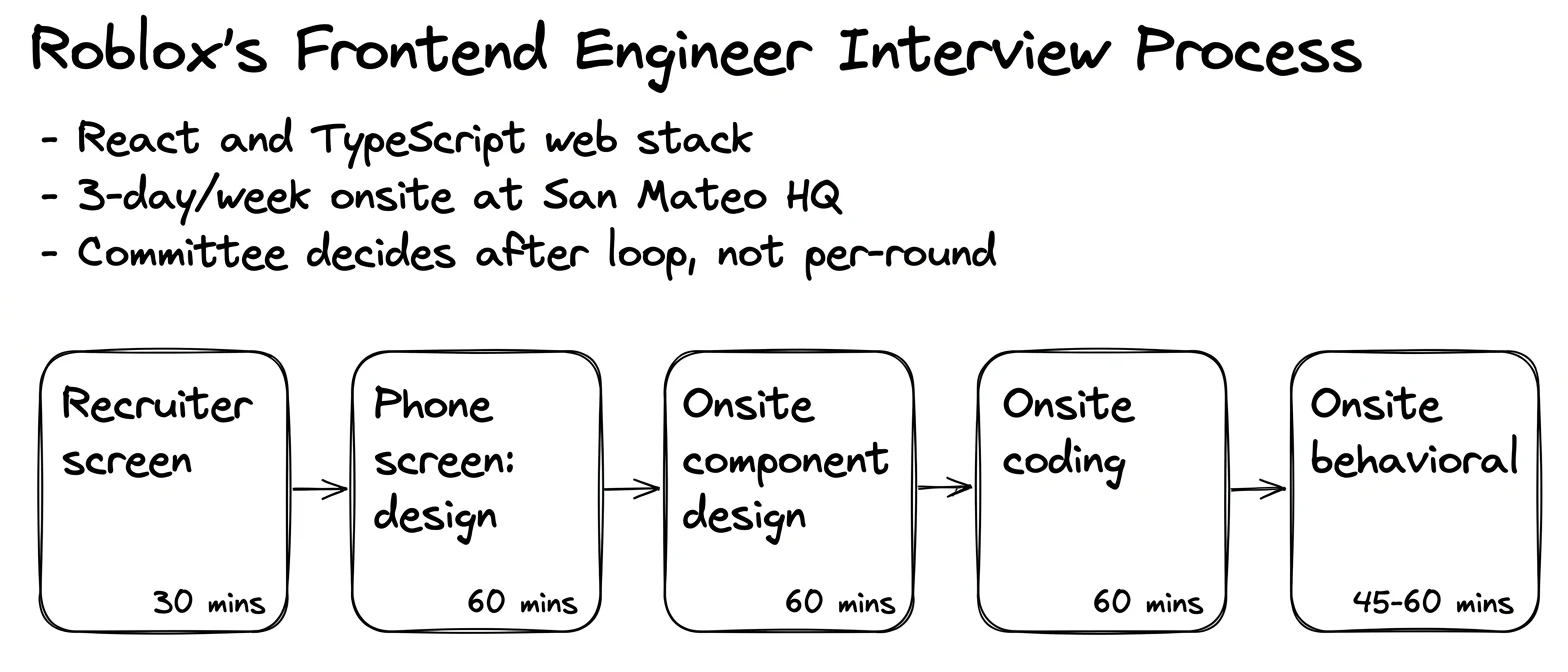
Roblox hires into specific teams, so interviewers are usually future colleagues and design prompts follow the team's product surface. Experienced candidates typically get a recruiter call, one technical screen, an onsite of three sessions (component design, coding, behavioral), then separate hiring manager and executive conversations. Reported timelines run from about two weeks to three months.
New-grad and intern loops lean on an online assessment and algorithm coding. Senior and principal candidates get design as the first technical round and a director conversation that also sets the level. Onsites are increasingly in person, and the job requires three office days a week (Tuesday to Thursday) in San Mateo.
Here's what the interview process can look like:
- Recruiter screen: About 30 minutes on background, salary, the office requirement and how frontend-heavy your work is.
- Online assessment (new grad and intern): Cognitive mini-games, a situational-judgment section and two coding problems in 50 minutes.
- Technical phone screen: 45 to 60 minutes building a UI component live, or a frontend design discussion.
- Frontend system design interview: An hour on a client feature such as an image feed or a reusable dropdown.
- Coding interview: One onsite hour on an algorithm problem, graded on explanation and complexity.
- Behavioral interview: A structured session on projects, collaboration and conflict.
- Hiring manager and executive interviews: Motivation, scope, ownership and, at senior levels, the level itself.
Tip: Recruiters on this track often describe the first technical round precisely, down to "a UI component that manages state and responds to user events." Take it literally but prepare the other format too: candidates told to expect design have been given pure coding, and the reverse.
Recruiter screen
Most candidates are sourced by recruiters, often through LinkedIn. The 30-minute call covers your resume, why you are looking, salary expectations and whether you can work from the office three days a week. Principal candidates are told the first technical round is system design and the onsite requires travel. Recruiters have been unusually open about format and have sent prep material. Candidates were also told that equity grants are sized partly by interview performance, there is no annual bonus, and signing bonuses are uncommon.
Interviewers evaluate:
- Frontend depth: Recent, owned React and TypeScript work rather than a general fullstack mix.
- Scale: Traffic and user counts on the surfaces you shipped.
- Location fit: A clear yes on the office schedule or on relocating.
- Motivation: A specific reason for Roblox, not gaming in general.
Prepare a two-minute summary that leads with your strongest frontend architecture or performance work.
Sample questions for the recruiter screen
Here are some questions reported by recent candidates:
- Walk through your background and the projects on your resume.
- Why are you leaving your current role, and what do you want next?
- Can you work from the San Mateo office three days a week?
Online assessment
The assessment goes mainly to new-grad and intern applicants, sometimes right after they apply. It opens with gamified tasks: a factory game (find bottleneck stations, route money to profitable lines), a builder game (assemble vehicles or robots to cross terrain) and Mars: Outpost, a modular programming game. A situational-judgment section of about 23 workplace scenarios follows, at roughly one per minute, picking the most and least effective response.
The coding part is two problems in 50 unproctored minutes on CodeSignal, leaning toward simulation and data processing: a robot on a grid where lasers destroy whole rows and columns, file chunks merged into consecutive byte ranges, digit-rotation pairs, and a grouping task modeled on group anagrams. Some finished in 20 minutes; others lost hidden tests to an O(N² · L) rotation comparison that timed out. At least one candidate was rejected at this stage.
Interviewers evaluate:
- Hidden-test correctness: Pairwise brute force passes samples and times out; a canonical minimal rotation is expected.
- Index precision: The laser grid is 1-indexed and the start cell counts as zero steps.
- Boundary rules: Chunks [1, 3] and [4, 6] merge because 4 is at most 3 + 1.
- Scenario judgment: Assessing risk, telling stakeholders and adding monitoring beats hiding a bug.
Practice timed simulation and interval problems with careful indexing, about 20 minutes each.
Note: In Mars: Outpost, only functions encapsulated during the test phase can be called later, and defaults cannot be changed afterward. Encapsulate everything before moving on.
Sample questions for the online assessment
Here are some questions reported by recent candidates:
-
Lasers destroy their whole row and column; return the robot's longest safe straight-line walk.
-
After each file-upload chunk arrives, return the current consecutive byte ranges.
-
A non-critical bug appears just before launch: pick the most and least effective response.
Technical phone screen
The screen is a 45- to 60-minute video call with an engineer and takes one of three forms. The most frontend-specific is a live UI build. One prompt was a six-key piano in vanilla HTML, CSS and JavaScript: holding the mouse or the matching letter key adds an active class, releasing removes it, chords work, other keys are ignored. Another was Tic-Tac-Toe in React with a configurable board and two players; that candidate never reached the game logic and also lost time when the shared editor stopped syncing and showed the interviewer a stale error.
The second form is the image-feed design hour described below. The third is an algorithm problem: one frontend candidate passed a most-frequent-element-in-a-call-stack problem with two follow-ups and was told the onsite would cover frontend coding, design and a hiring manager round.
Interviewers evaluate:
- Event handling: Correct keydown/keyup and mousedown/mouseup, including key repeat and releases outside the element.
- State modeling: One source of truth for active keys or board cells, so chords and board sizes fall out naturally.
- Requirement coverage: Every stated rule, input filtering included, before polish.
- Pace: A playable core early; setup that never reaches the logic reads as a miss.
Practice building small widgets from a blank file in 30 minutes, once in plain DOM code and once in React with TypeScript.
Tip: Run the starter environment in the first two minutes. When the editor misbehaves, the interviewer may see errors you cannot, and flagging it early protects your time.
Sample questions for the technical phone screen
Here are some questions reported by recent candidates:
-
Build a six-key piano in plain JavaScript that responds to held mouse buttons and letter keys, supports chords and ignores other keys.
-
Build two-player Tic-Tac-Toe in React with a configurable board size.
-
Find the most frequent function in a call stack, then add a tie-break and per-thread results.
Frontend system design interview
Design decides this track technically and can appear twice. The recurring screen prompt is an image feed. In one version the interviewer handed over a detailed API specification and requirements, removed likes and comments, and spent the hour on three areas: infinite loading under fast scrolling, offline support (what metadata to persist, serving loaded images without a connection, handling stale entries), and testing from cache unit tests to offline integration tests and scroll UI tests. Another version weighed pagination against infinite scroll, rendering performance and state management.
The onsite session is a component: a reusable dropdown built from scratch, probed on its props API, keyboard navigation, screen-reader semantics and positioning through a portal to escape a clipping parent. Some loops instead ran a backend-leaning prompt, a real-time notification system for millions of users with delivery guarantees and queuing; that candidate was rejected on backend depth.
Interviewers evaluate:
- Working inside the spec: Using the supplied API rather than re-scoping the problem.
- Concrete mechanisms: A named store, eviction and staleness rule, and windowing plan; "cache the images" loses the round.
- Accessibility: Focus management, keyboard behavior and roles, raised before being asked.
- Component API: Controlled versus uncontrolled state, composition points, empty and error states.
- Testing strategy: Which layer catches which failure, especially offline and scroll behavior.
Rehearse an image feed and an accessible dropdown aloud, each in 45 minutes from requirements to tests.
Note: When a detailed API is handed over, grading follows how well the design uses it. Time spent proposing a different backend contract is time not spent on offline support or tests.
Sample questions for the frontend system design interview
Here are some questions reported by recent candidates:
-
Design an infinitely scrolling image feed against a given API, covering fast scrolling, offline viewing and a layered test plan.
-
Design a reusable dropdown menu with keyboard support, screen-reader semantics and portal positioning.
-
Design a real-time notification system for millions of concurrent users with delivery guarantees.
-
Build an Image Feed (Infinite Scroll + Offline Support + Testing)
Coding interview
Roblox usually runs one onsite coding hour in a runnable editor (CodeSignal in recent loops). In the reported frontend loop it was a hard-tier problem with constraints relaxed enough that brute force passed; the grade rested on explaining the approach and analyzing complexity. JavaScript or TypeScript is fine.
Problems come from a bank shared with other engineering tracks. The most common family parses function-call logs: return the most frequent active call path, then handle interleaved multi-threaded logs with one stack per thread, or return the top K functions across stack traces with alphabetical ties. Others include a cursor with move, insert and delete across many boundary cases, a topological sort that must pick the smallest available ID, and, for new grads, a hat-assignment problem paired with a Candy Crush simulation. One interviewer accepted pseudocode when time ran out; another demanded bug-free code passing every test.
Interviewers evaluate:
- Clarifying first: Empty inputs, ties, K larger than the distinct count.
- Stated complexity: A correct bound for the naive approach and what optimizing would buy.
- Parsing discipline: Simple logic, but enough code to hide off-by-one and nesting bugs.
- Clean extension: Per-thread follow-ups should be a dictionary away, not a rewrite.
Drill stack-and-hash-map parsing problems and their multi-threaded extensions, narrating as you code.
Sample questions for the coding interview
Here are some questions reported by recent candidates:
-
From function start and end logs, return the most frequent active call path, then extend to interleaved threads.
-
Return the top K function names across stack traces, breaking ties alphabetically.
-
Order courses from prerequisites, always taking the smallest available ID, and report cycles.
Behavioral interview
A team member runs this onsite session, typically 45 to 60 minutes. It is tightly structured: past projects, cross-functional collaboration, a disagreement, a hard trade-off, learning unfamiliar technology, with little probing. One loop fit more than 15 questions into 45 minutes. Some loops add a project presentation challenged on trade-offs and what you would change.
Interviewers evaluate:
- Concise structure: Situation, action, result in about two minutes, since follow-ups may never come.
- Personal decisions: What you chose and against which alternative.
- Measured outcomes: Load-time, conversion or error-rate numbers.
- Design and product partnership: How a UI trade-off disagreement was resolved.
Prepare eight short stories, each turning on a decision you made, with a number attached.
Sample questions for the behavioral interview
Here are some questions reported by recent candidates:
-
Tell me about a time you disagreed with a teammate and how it was resolved.
-
Describe a difficult trade-off you made under a deadline.
-
How do you handle a blocker from a team you depend on?
Hiring manager and executive interviews
These come last, typically two 45-minute conversations: the hiring manager, then a director, VP or senior leader. The manager covers career goals, the team's challenges and the scale you have worked at, sometimes asking for daily active users and traffic figures. On this track the manager also checks quietly whether your background is frontend-specialized.
The executive asks why Roblox, why you left each role, and then dissects the hardest project you led, looking for decisions you drove. At senior levels the director round doubles as the leveling conversation. These rounds have ended loops in which every technical round passed, and one candidate's manager round was cancelled after a clean technical screen.
Interviewers evaluate:
- Ownership: A problem you found unassigned, the call you made, who disagreed and what shipped.
- Frontend specialization: Owned UI architecture, performance, accessibility or design-system work.
- Scope for the level: How many teams or users your decisions affected.
- Motivation: A concrete reason for Roblox's products and audience.
Rebuild two or three projects around one decision point each and rehearse them for an interviewer who keeps asking why.
Note: The documented rejection on this track followed strong technical feedback. The stated reasons were role alignment (fullstack, not frontend) and narratives showing execution without proactive decisions.
Sample questions for the hiring manager and executive interviews
Here are some questions reported by recent candidates:
-
Why Roblox, and why did you leave each previous role?
-
Walk me through the most challenging project you led and the decisions you made.
-
What is the largest traffic scale you have worked at, and what broke as it grew?
How Roblox levels and evaluates Frontend Engineer candidates
Feedback goes to a hiring committee, then VP and compensation review; no single interviewer decides. The target level is set before the loop but can move: one candidate accepted an offer a level below target, and offering to take a lower level after a weak loop has not saved an offer. Rejections have arrived the same afternoon; one senior verbal offer came the day after an onsite split over two days; other candidates waited weeks in committee and compensation review.
Tip: Confirm the target level before the onsite. At senior grades the director conversation sets it, so bring scope numbers (teams, users, surfaces) for the projects you plan to discuss.
How to prepare for the Roblox Frontend Engineer interview
- Master the image feed: Infinite loading against a given API, an offline cache with a staleness rule, and a three-layer test plan in under an hour.
- Build an accessible dropdown: Keyboard navigation, focus restoration, ARIA roles and portal positioning, with the API stated first.
- Code UI without a framework: Held keys, chords and ignored input in plain DOM code, then the same widget in React with TypeScript.
- Drill the log-parsing family: Call paths, top-K stack frames and per-thread extensions, with complexity stated up front.
- Front-load frontend evidence: Lead with performance fixes, accessibility work or component systems you owned, with numbers.
- Rewrite stories around decisions: What you noticed, what you chose over an alternative, who pushed back, what changed.
- Make "why Roblox" specific: Tie it to a surface such as discovery, the avatar marketplace or creator tools.
About the Roblox Frontend Engineer role
Frontend engineers build the website and app surfaces users and creators touch: discovery pages, the avatar marketplace, creator dashboards and internal engine tooling. The web stack is React and TypeScript. Some teams also work in Luau through internal React-inspired UI libraries that render across iOS, Android, Xbox and VR. Feature teams own a surface end to end with product, design and data partners.
| Level | Primary focus | Impact scope |
|---|---|---|
| IC1–IC2 (Software Engineer) | Shipping features and components | A single surface |
| IC3–IC4 (Senior Software Engineer) | Owning feature areas and technical direction | A team and its partners |
| IC5 (Principal) | Frontend architecture and standards | An organization |
| IC6 (Senior Principal) | Platform-wide technical strategy | Multiple organizations |
Roblox hires Frontend Engineers across teams including:
- Discovery: Home, search and recommendation surfaces for finding experiences.
- Avatar Marketplace: Commerce UI for avatar items across web and cross-platform clients.
- Avatar Search and Discovery: UI components that carry a majority of on-platform commerce.
- Engine Productivity Tools: Internal engine tooling in TypeScript, React and C#.
- Frontend Architecture: Frontend standards and the internal Luau UI libraries.
Frontend Engineer experience and education requirements
New-grad postings ask for a computer science or related degree (or enrollment), a language such as JavaScript, TypeScript, C++ or Lua, and a framework such as React, Angular or Vue. Senior postings ask for roughly five to eight years building user-facing React and TypeScript applications, with Redux- or Flux-style state management. Principal postings ask for eight or more years plus deep HTML, CSS and component-architecture expertise. Mobile or game development and Luau are pluses.
FAQs about the Roblox Frontend Engineer interview
How long does the Roblox Frontend Engineer interview process take?
Usually a few weeks to a month from the first technical round to a decision. One senior candidate had a verbal offer the day after the onsite; another counted three months from recruiter contact to offer.
What is the hardest round of the Roblox Frontend Engineer interview?
By where loops end, the executive round: short, with no technical work to lean on, and focused on proving you drove your projects. Among technical rounds, the frontend design hour, which must fit pagination, rendering, offline support and testing against an unfamiliar spec.
Is there an online assessment for frontend roles?
Mainly for new-grad and intern applicants: mini-games, situational judgment and two coding problems in 50 minutes. Experienced candidates usually go straight to a technical screen.
How much does a Roblox Frontend Engineer make?
Approximate total annual compensation for software engineers by level:
- IC1: ~$220K
- IC3: ~$340K–$420K
- IC4: ~$460K–$500K
- IC5: ~$680K–$760K
Packages are base salary plus a stock grant that dominates at senior levels, with no annual bonus.
Is the Roblox Frontend Engineer interview remote?
Screens are remote. Onsites are increasingly in person, and principal candidates were told to expect travel to San Mateo. The job requires three office days a week.