Rippling · Study
Rippling Interview Process & Questions
TrueInterview
July 24, 2026 · 14 min read
Rippling interviews through small, realistic pieces of business software: driver payouts, expense policies, article votes and loggers in coding, and news feeds, event pipelines and hotel booking in design. Each problem arrives in two or three parts, and the most common rejection reason is an unfinished last part. AI assistants are banned, optional or mandatory depending on the round, and candidates who cannot explain generated code are marked down. A hiring-manager project deep dive largely sets the level, and late down-levels are a recurring theme.
This guide breaks down each stage of the Rippling interview, what interviewers evaluate in each round, and how to prepare, with questions candidates were actually asked.
Verified: Based on 51 candidate-reported interview experiences, cross-checked against recent public accounts.
Rippling interview process
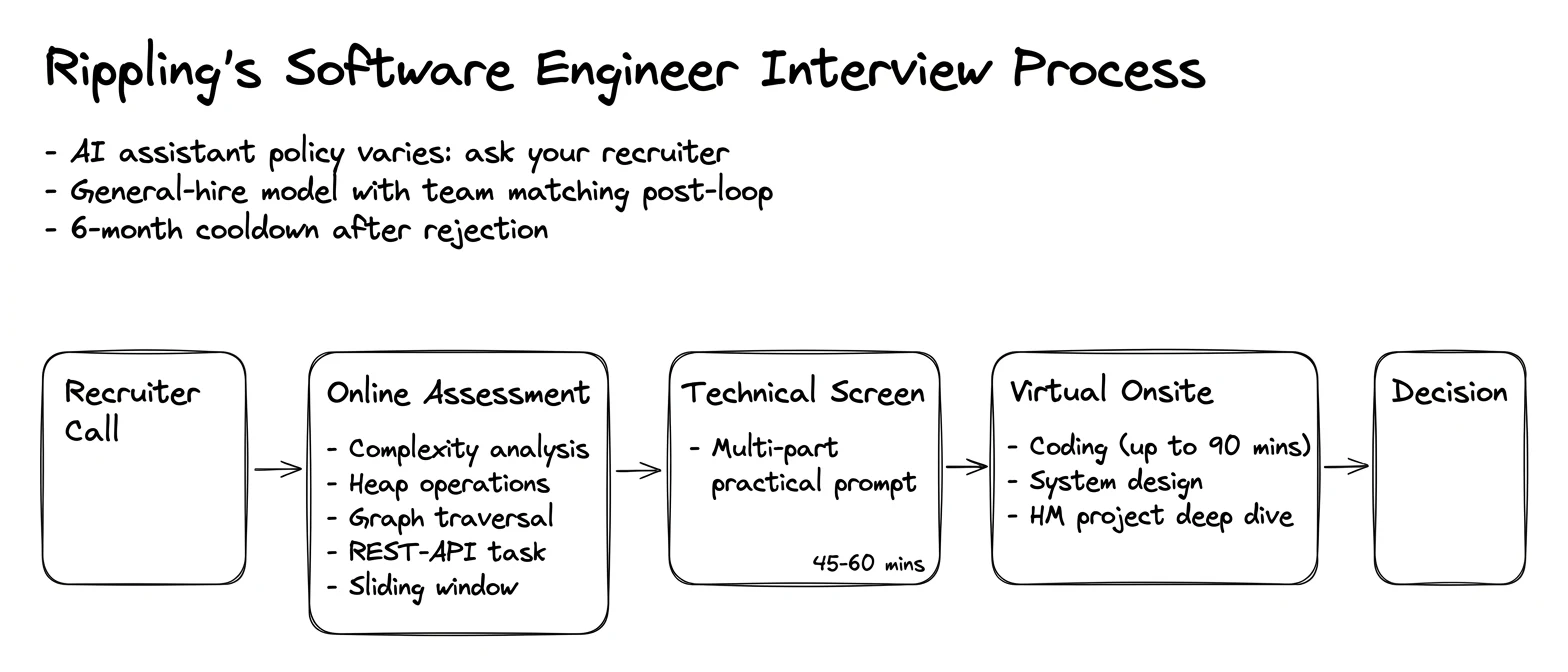
The loop is short. A recruiter call leads to one technical screen of 45–60 minutes, sometimes two, then a virtual onsite of two to four rounds: practical coding, system design and a hiring-manager deep dive. Recruiters describe a shift toward general hiring with team matching afterward, and the process usually wraps up within a few weeks.
Interns and early-career candidates often start with an online assessment and lean toward coding. From senior up, the screen is sometimes a design conversation, the onsite can hold two or three design rounds, and mentorship comes up. Data-focused roles get design rounds on pipelines, schemas and table layout.
Here's what the interview process can look like:
- Recruiter screen: A 30-minute call on background, motivation, level and the rules for each round, including the AI-tool policy.
- Online assessment (interns and early career): A timed test that mixes multiple-choice questions on complexity, heaps and graph traversal with two or three coding problems.
- Technical phone screen: A 45–60 minute live session, usually a multi-part practical coding problem and sometimes a system design discussion.
- Coding interviews (onsite): One or two rounds of 45–60 minutes that extend a small in-memory service through escalating requirements, sometimes with an AI assistant or as a small web API build.
- System design interview: One to three hour-long rounds on data-heavy product systems: news aggregation, event monitoring, booking, rule evaluation and payroll.
- Hiring manager interview: A project presentation, often with slides, followed by probing on decisions, impact and, for senior candidates, mentorship.
Tip: Plan every coding hour backward from the last part. Candidates who shipped two of three parts and talked through the third, with complexity stated for each method, advanced. Candidates who polished part one did not.
Recruiter screen
The call covers background, why Rippling, target level and logistics. It matters because rules vary by round: recruiters have described AI tools as allowed, encouraged or required. Some calls fold in behavioral questions such as a challenging project or scope creep.
Interviewers evaluate:
- Motivation: A specific reason for Rippling's product (HR, IT and spend on one employee data layer), not a generic interest in startups.
- Level fit: Years of experience and recent scope. Some teams apply a stricter years bar for senior than the recruiter first conveys.
- Project readiness: Whether you have one technically rich project you can present at the onsite.
Use the call to pin down the level criteria, the AI policy for each round, and whether you are interviewing for a specific team.
Note: Leveling surprises tend to come late. One candidate targeting senior learned after the onsite that the team required more than seven years for that level and was offered the level below. A staff candidate was moved down to senior after a single design round.
Sample questions for the recruiter screen
Here are some questions reported by recent candidates:
-
Walk through your current and previous roles, and why you are leaving.
-
Why Rippling, and which product areas interest you?
-
Tell me about a project where the scope kept growing, and how you handled it.
-
Explain Your Reason for Changing Roles and Your Interest in the Team
Online assessment
Interns and early-career applicants usually take a timed online test first. One version had six items: nested-loop complexity, a max-heap check, a depth-first traversal order, a heap insertion with heapify, a REST call returning the best price-to-weight chocolate, and a bounded-range sliding window. Another centered on one time-series problem plus a bonus question: the most drivers active at once in a rolling 24-hour window, where an end must be processed before a start at the same timestamp or hidden cases fail. A live coding hour usually follows.
Interviewers evaluate:
- Fundamentals: Heap operations and traversal order written out from memory, not just recognized.
- Boundary handling: Tie-breaking at equal timestamps and inclusive versus exclusive window edges.
- Practical coding: Calling an API, parsing its response, and computing over it cleanly.
- Window technique: A sliding window that tracks the running maximum and minimum efficiently.
Rehearse heap insertion by hand and one sweep-line problem with deliberate tie rules.
Sample questions for the online assessment
Here are some questions reported by recent candidates:
-
Return the maximum number of drivers active simultaneously in any 24-hour window, ending shifts before starting new ones at equal timestamps.
-
Fetch chocolates from an API and return the one with the highest price-to-weight ratio.
-
Find the longest subarray whose maximum and minimum differ by at most a given threshold.
Technical phone screen
Most screens are a 45–60 minute video call with an engineer in a shared editor, with no warm-up. The prompt comes from a recognizable family: a delivery-cost or driver-payout calculator, an expense validator with per-transaction and per-trip rules, a poker-style hand comparator, a logger with pluggable behaviors, a task list to filter and sort, or a virtual file system with search. Part one sets a baseline; later parts pay drivers only up to a cutoff, evaluate rules once a trip ends, compare hands with unknown cards, or add search to stored logs.
A meaningful minority of screens, especially at senior and above, are design conversations on ad-click aggregation, user-event tracking, hotel booking or news aggregation. Rejections often arrive the next day, most often citing the unfinished final part even when the approach was described aloud.
Interviewers evaluate:
- Completion: A working, tested implementation of every part they reach. Several candidates were rejected with the last part sketched but not coded.
- Money and time semantics: Integer cents rather than floating-point dollars, and millisecond timestamps in 64-bit integers with explicit boundary rules.
- Extensible structure: Hand-ranking rules or log behaviors as separate strategy or handler objects, not a chain of conditionals.
- Complexity per method: Stating time and space for each operation, and saying when a scan should become an index or heap.
- AI discipline: When a tool is used, the design comes first and every generated line can be explained and debugged.
Practice each family in a strict 45-minute box, leaving the final 15 minutes for the follow-up and tests.
Note: An AI assistant does not lower the bar. One candidate let a tool write a driver-payment class, could not fix its bug on a record ending exactly at the cutoff when the interviewer flagged it, and was rejected. Another interviewer warned against pasting the whole prompt into the tool, because the rephrased version silently drops constraints.
Sample questions for the technical phone screen
Here are some questions reported by recent candidates:
-
Ingest driving records and return the total pay for all records ending strictly before a given time, efficiently across repeated calls.
-
Compare two five-card hands, then report a winner, a tie or unknown when one hand is only partly known.
-
Build a logger that can filter a substring, truncate, capitalize or store messages in any combination, then add search over stored messages.
-
Filter out assigned or finished tasks, drop duplicates by description and due date, and sort by due date, priority and creation time, printing each parent's description.
-
Driver Payroll: sum salaries of driving records up to a timestamp
Coding interviews
Onsite coding rounds run 45–60 minutes at greater depth. The expense rules engine is the signature problem: a per-transaction restaurant cap, blocked airfare and entertainment, and per-trip totals grow into nested AND, OR and NOT conditions. Interviewers then ask what evaluate_rules should return, and a bare boolean loses signal because one transaction can break several policies. Other recurring rounds are an article-voting tracker with constant-time last-three-flips, expenses grouped by trip and category, a driver payout service with a paid-up-to cutoff, and a poker variant run as an AI-assisted round.
Some loops use a build round instead: a small REST service for posting and querying questions, or a JSON API on Python's standard-library HTTP server with no frameworks, tested live. Some prompts close with scale: millions of articles in memory, or millions of daily expenses against tens of thousands of rules.
Interviewers evaluate:
- Follow-up completion: One candidate left the per-trip grouping unfinished in one round and a last-three-flips print bug in another, and was rejected.
- Composable models: Rules as a composite tree, votes as an append-only per-user history, payouts as sorted records with a cursor.
- Debugging under time: An unresolved runtime bug in a task-manager round outweighed a strong expense round.
- Testing unprompted: A record ending exactly at the cutoff, a double upvote, an upvote then downvote, an empty history.
Drill the expense, vote, payout and hand-ranking problems until each part takes under 15 minutes, then practice one fresh problem cold.
Tip: Do not pretend a familiar problem is new. One candidate who did so said the interviewer saw through it and the time spent cost the round. Saying you have seen a variant and moving straight to a tested solution and its extensions reads better.
Sample questions for the coding interviews
Here are some questions reported by recent candidates:
-
Implement an expense policy engine with per-transaction and per-trip rules, compose rules with AND, OR and NOT, and return every violation with its reason.
-
Track upvotes and downvotes per user, count a repeated upvote once, log an upvote followed by a downvote as two entries, and return a user's last three flips in O(1).
-
Register drivers with hourly rates, record deliveries, mark everything before a timestamp as paid while tracking the unpaid balance, then find peak concurrent drivers in any 24-hour window.
-
Build a small REST service that accepts question submissions and returns the stored list.
-
Extend an Expense Rules Engine with Nested Boolean Conditions
System design interview
Design rounds are hour-long whiteboard discussions on data-heavy product systems. The news aggregator is the most frequent prompt: push versus pull from publishers, polling APIs under rate limits, clustering articles into stories, subscriptions, personalization with a freshness budget, and spotting high-engagement publishers from partitioned click logs. Next come event pipelines, where one ingestion layer feeds both a low-latency dashboard and an asynchronous warehouse path, with enrichment such as reverse geolocation and compliance tagging.
Other prompts include hotel booking (rooms versus room types, future dates only, synchronous versus asynchronous confirmation against external inventory), the rules engine at scale, payroll with regional taxes, a task scheduler that never loses work, role-based access control with inheritance, and a music player. Many interviewers bring a checklist and change a requirement mid-round, such as switching a city name to latitude and longitude.
Interviewers evaluate:
- Requirement anchoring: Pinning down metrics and what real time means. One offer followed a pivot from a cron-and-SQL sketch to streaming once the latency need was clear.
- Path separation: Keeping heavy analytics off the serving path, and handling late events and schema changes.
- Entity modeling: Room versus room type, or raw versus processed events.
- Correctness under concurrency: Idempotency keys against duplicate payouts, write-then-process ordering, and reconciliation with external systems.
- Steerability: Asking which way to go at each fork, since checklist-driven interviewers mark down exploration that misses their points.
Rehearse four shapes end to end: feed aggregation, dual-path event monitoring, booking against external inventory, and rule evaluation at scale.
Note: Interviewer experience varies widely, from collaborative sessions that end with candid feedback to dismissive ones with shifting requirements. Several candidates who felt a round went smoothly were still rejected, so restate the contract at every change and do not judge the round by the room.
Sample questions for the system design interview
Here are some questions reported by recent candidates:
-
Design a news aggregator with topic and publisher subscriptions, shared top stories, story clustering and fresh personalized feeds.
-
Design a tracking platform that ingests events from several products, enriches them with location and compliance tags, and serves both a fast dashboard and slow warehouse queries.
-
Design a hotel booking system that searches by location and dates, models rooms versus room types, and confirms bookings against third-party inventory.
-
Design a payroll system for monthly and biweekly runs that never pays twice under payday concurrency.
Hiring manager interview
The hiring-manager round is consistently a project deep dive, often three to five slides or a 5–10 minute walkthrough. The questioning afterward counts most: the hardest part, rejected alternatives, how responsibilities were split, and how you measured success. Senior candidates also get mentorship questions. Conflict, a weakness and daily AI use also come up, and some loops run this round as a screen before the onsite.
Interviewers evaluate:
- Personal contribution: Your decisions, separated clearly from the team's outcome.
- Business impact: Success criteria and metrics, not just launches. One candidate who covered the technical side well was rejected after a thin answer on impact.
- Depth on trade-offs: Defending a choice through several rounds of follow-up questions.
- Senior signals: Mentorship and raising the bar for others.
Build one slide-ready project story with a timeline, your own decisions, quantified impact and one thing you would redo.
Sample questions for the hiring manager interview
Here are some questions reported by recent candidates:
-
Present a recent end-to-end project: what made it succeed, and what business impact did it have?
-
What was the hardest technical problem in that project, and how did you solve it?
-
How do you mentor engineers, and what do you expect from a senior engineer?
-
What AI practices do you use or advocate on your team?
How Rippling makes hiring decisions
Feedback is weighed together after the loop, and borderline results are common: one candidate heard the signals were strong, then that they were borderline for senior. Level is effectively set by design and the deep dive, and down-levels come after the loop. Offers have come with pressure to decide quickly. Decisions arrive from the next day to about a week after the final round, and a rejection carries a six-month cooldown before reapplying.
Tip: Ask the recruiter for the exact level criteria and the team's years-of-experience bar before the onsite, so a down-level does not surprise you after the loop.
How to prepare for the Rippling interview
- Drill the recurring families: Payouts, expense rules, vote flips, partial hands, handler loggers and multi-key task sorting.
- Budget time for the last part: Reserve the final third of each hour for the follow-up and tests.
- Build a money-and-time toolkit: Integer cents, 64-bit timestamps, boundaries decided out loud, ends before starts at ties.
- Return failures with reasons: Violations with rule identifiers, not booleans.
- Practice with and without AI: Design first, request small pieces, and debug the invariants by hand.
- Rehearse four design shapes: Feeds, dual-path monitoring, external-inventory booking and rules at scale, with numbers for freshness and load.
- Prepare a deck-ready project: Timeline, your decisions, measured impact and, for senior roles, mentorship.
- Settle level and rules early: Confirm leveling, team matching and each round's AI policy before the loop.
About working at Rippling
Rippling builds HR, IT and spend software on a shared employee data layer, so a hire or termination flows into payroll, benefits, devices, app access and corporate cards. Product teams own a module end to end, mostly in Python and Django with MongoDB, plus Go, Kafka and Flink in data-heavy areas and React on the client. Several interviewers volunteered that the pace is intense and work-life balance is not the draw. Office-based employees are expected in at least three days a week, with hubs in San Francisco, New York and Seattle.
Engineering titles run from Software Engineer I and Software Engineer II to Senior, Staff and Senior Staff.
| Level | Primary focus | Impact scope |
|---|---|---|
| Software Engineer I | Shipping well-defined features in one product area | Tasks within a team |
| Software Engineer II | Owning features and services end to end | A team's systems |
| Senior Software Engineer | Leading projects, design ownership and mentoring | A product area |
| Staff Software Engineer | Cross-team architecture and technical direction | Several teams or a suite |
Rippling hires engineers across its product suites and platform. Teams include:
- HR products: Payroll, benefits, time and attendance, and talent and recruiting tools.
- IT products: Identity and access management, single sign-on, and device management and inventory.
- Spend products: Corporate cards, expense management, bill pay and travel.
- Platform: The shared employee data layer, app components, notifications, and product infrastructure and tools.
- AI Platform: Shared AI infrastructure used across the product suites.
Experience and education requirements
Software Engineer I postings ask for about a year of professional experience building production systems. Senior postings ask for five to six or more years, and staff backend postings ask for eight or more. Python, Django, MongoDB, Go and AWS experience is listed as preferred rather than required. Posted base ranges for senior software engineer roles in top-tier US locations have run from about $135K to $280K depending on team and location, with equity on top.
FAQs about the Rippling interview
How long does the Rippling interview process take?
Usually a few weeks from the recruiter call to a decision. Feedback after the final round has ranged from the next day to about a week.
What is the hardest round of the Rippling interview?
The multi-part coding rounds, because the bar is completion: most rejections cite an unfinished follow-up or an unresolved bug. For senior and staff candidates, checklist-driven system design rounds are the other common place offers are lost.
Can I use AI tools in the Rippling interview?
It depends on the round. Candidates have reported AI assistants as banned, optional, encouraged and mandatory, so confirm the policy before each round and practice in the tool you will use.
Is there an online assessment?
Mostly for interns and early-career applicants: a timed test with multiple-choice fundamentals and two or three coding problems. Experienced candidates usually go straight to a live screen.
Can I be down-leveled?
Yes. Senior candidates have been offered the level below after borderline feedback, and a staff candidate was moved to senior after the design round.
What happens after a rejection?
Rippling applies a six-month cooldown before you can reapply.