Reddit · Study
Reddit Software Engineer Interview Process
TrueInterview
July 24, 2026 · 14 min read
Reddit's Software Engineer loop tests practical modeling far more than algorithm tricks. The recurring prompts are small versions of the product (merging chat-message windows, scoring a tennis match, walking a moderator hierarchy, moving a subscription through billing states), each one problem with staged follow-ups that nobody is expected to finish. The onsite leans heavily on system design: one offer-track loop held three design rounds out of four. The least predictable round is the hiring manager's, a relaxed fit chat on generalist teams and a domain examination on specialized teams such as ads.
This guide breaks down each stage of the Reddit Software Engineer interview, what interviewers evaluate in each round, and how to prepare, with questions candidates were actually asked.
Verified: Based on 23 candidate-reported interview experiences, primarily from 2025 Q1 through 2026 Q2, cross-checked against recent public accounts.
Reddit Software Engineer interview process
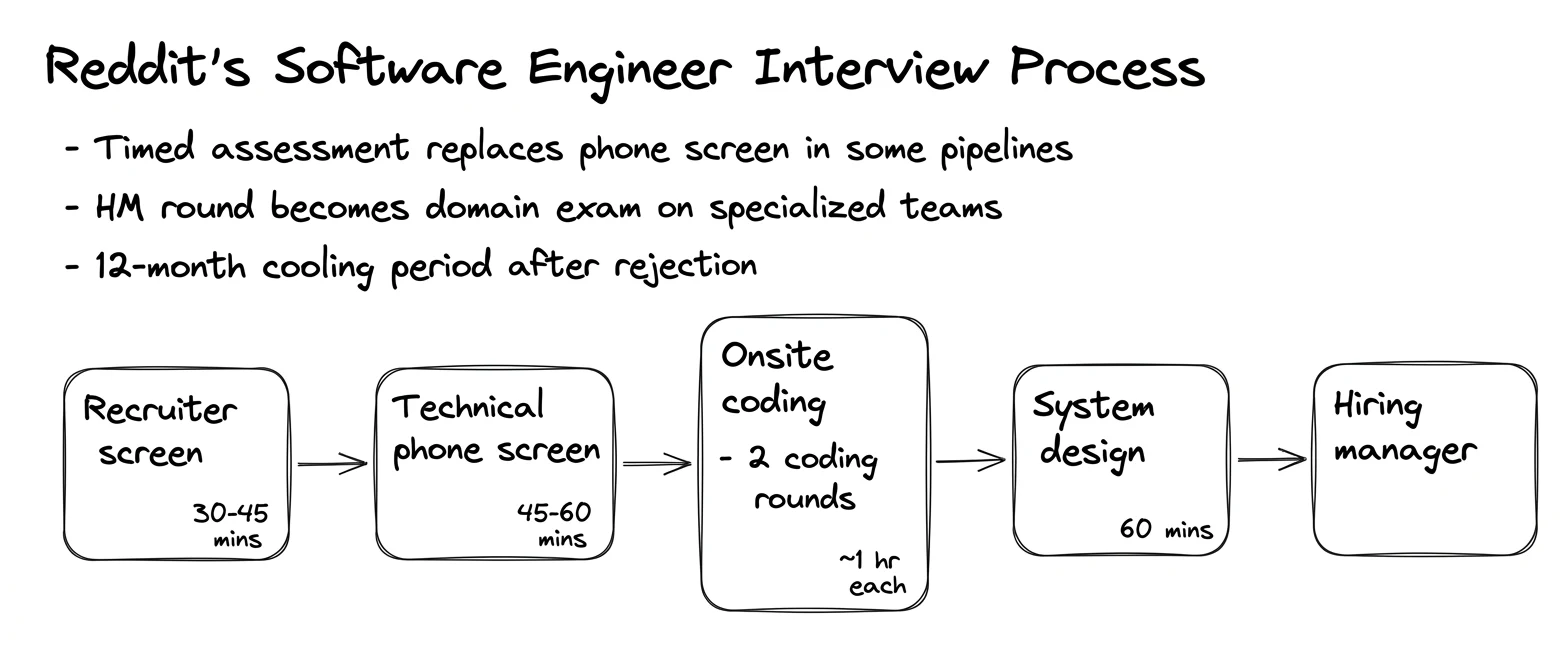
Reddit hires engineers into specific teams, and the requisition shapes the loop more than the level does. The skeleton is a recruiter call, one technical screen (replaced in some pipelines by a timed online assessment), then a fully virtual onsite of four to five hour-long rounds. The mix varies: two coding rounds and one design round, or one coding round and two or three design rounds, with a product-manager behavioral round on some teams.
Mid-level candidates see the most coding; senior candidates should expect design to dominate and to be pushed into rollout, testing and reliability. The fastest decision came three business days after the onsite; slower processes stalled for weeks between stages.
Here's what the interview process can look like:
- Recruiter screen: A 30 to 45 minute call on background, motivation, target level and which team owns the requisition.
- Online assessment (some pipelines): A timed, autograded implementation task such as a protocol server or a chat-message merge, graded on exact output.
- Technical phone screen: 45 to 60 minutes in a shared editor with one practical problem that grows through follow-ups, sometimes with a short design segment.
- Coding interview (one or two onsite): Hour-long rounds in the same staged style, occasionally a plain textbook problem.
- System design interview (one to three onsite): Product-shaped prompts such as leaderboards, live chat, notifications and rate limiting, scaled from a single server.
- Hiring manager interview: Recent work, highlights and lowlights, and, on specialized teams, a deep domain discussion.
- Cross-functional or behavioral interview (some loops): Collaboration with product, design and data partners, often run by a product manager.
Tip: Ask the recruiter which team owns the role and what each onsite round is. The same title produced a coding-heavy loop for one candidate, a design-heavy loop for another, and an hour of ad-serving questions for a third.
Online assessment
Some pipelines replace the live screen with a timed online assessment. The task is an implementation exercise, not a puzzle set. One recent version asked for a simplified memcached-style server speaking a line-based ASCII protocol over TCP: get returns a value header with the key and byte count, the raw bytes, then a terminating END line (only END for a missing key), and set must read exactly the declared number of bytes before replying STORED. Keys are validated against a character class, commands are case-sensitive, and a bonus extends get to several keys returned in request order.
Another version simulated chat retrieval: an API returns a sorted window of messages per ID, windows overlap, and the result must be one sorted, deduplicated list. Concatenating and sorting failed the time limits; the intended solution merges the sorted responses in linear time.
Interviewers evaluate:
- Exact conformance: Every byte of the expected output, including reading a fixed byte count whose trailing newline is not payload, and no stray lines for missing keys.
- Using data contracts: Noticing that each API response is already sorted and exploiting it instead of re-sorting.
- Edge handling: Missing keys, invalid keys, overlapping windows and duplicate IDs.
Practice small protocol and stream-merge implementations against a strict output spec, testing edge cases before submitting.
Sample questions for the online assessment
Here are some questions reported by recent candidates:
-
Implement
getandsetfor a simplified memcached text protocol on port 11211, then extendgetto accept several keys. -
Collect messages from overlapping context windows returned by a chat API, each already sorted, into one deduplicated sorted list in linear time.
Technical phone screen
The screen runs 45 to 60 minutes over video in a shared editor such as CoderPad, usually with five to ten minutes of introductions and then a single problem. The problem families repeat heavily. Merging message streams appears most often: deduplicate message lists without a built-in set and keep the highest version per ID, or use an endpoint that returns a message with five neighbors on each side to fetch everything between two IDs. Tennis scoring is close behind, from one game with deuce up to a full set with tie-breaks, or a match simulated from per-serve win probabilities. Others include a billing-status state machine, report-chain traversal, admin-log parsing and word ladders allowing one- or two-character changes.
Interviewers are usually friendly and willing to hint, though some simply watch. Follow-ups add a constraint rather than a new problem: per-community logs, a cache for a repeated get_chat_messages call, or memory limits for millions of log lines. Some screens are partly design: one opened with 20 minutes on a rate limiter, then asked for a fixed-window limiter in code. Results were promised within a week but often took longer.
Interviewers evaluate:
- A fast working baseline: Core logic running within the first 20 minutes, before refinement.
- Explicit modeling: A transition table or state machine with an error for illegal moves, not nested conditionals.
- Handling the artificial constraint: Deduplicating by ID in a map when sets are banned, and letting the version number decide which copy survives.
- Self-testing: Test cases for deuce cycles, terminal states and overlapping windows, often requested outright.
- Finishing what was stated: Every requirement you started, including output formatting.
Rehearse the recurring families in a plain editor with a timer, budgeting no more than seven minutes for clarifying questions.
Tip: Over-clarifying is a reported way to fail the tennis problem. One candidate spent the first half of a 45-minute screen on deuce and tie-break rules, had 20 minutes left to code, and was rejected with the set logic unfinished. Sketch the classes early and ask rule questions while implementing.
Sample questions for the technical phone screen
Here are some questions reported by recent candidates:
-
Merge several lists of message objects, deduplicate by ID without a set, sort by ID, then keep only the highest version of each message.
-
Model tennis scoring for a game and then a set, with a configurable number of games to win, an error on scoring after a game ends, and a tie-break at six-all.
-
Given a billing status and an event such as payment failed, trial expired or reinstate, return the next status or raise an error for an invalid transition.
-
Parse admin activity logs, list current admins by most recent addition, decide whether one admin can remove another, then support separate logs per community.
Coding interview
Onsite loops include one or two coding rounds of about an hour in the same staged style, scaled up. A representative round built a moderator system step by step: parse a log of moderator actions, decide whether one moderator can remove another based on appointment order, return a ranked list, add a community layer, and finally demote a moderator by one position, which pushed the candidate from a set and a dictionary to a doubly linked list. A related variant was announced as seven parts, and a candidate who finished two of them still advanced. The report-chain problem also recurs onsite: build a manager-to-reports map, list ancestors and descendants, find the lowest common manager, and print the chain indented.
Not every round is custom: some loops used a standard practice-bank problem, such as shortest palindrome by prepending characters or regrouping a linked list's odd and even nodes. AI assistance is not permitted.
Interviewers evaluate:
- Choosing the simplest sufficient structure: An adjacency map with DFS for a reporting tree, not union-find or a custom tree class.
- Refactoring as requirements grow: Swapping in an ordered structure when a demote or ranking operation needs constant-time updates.
- Completeness on attempted parts: Partial coverage of a long problem is fine; a started part left unfinished is noted.
Practice hierarchy and ordered-collection problems in multi-part form, adding one requirement every ten minutes without rewriting the earlier code.
Note: Cosmetic requirements count. A candidate returned the correct reporting chain but ran out of time before indenting the output as asked, and that gap was recorded; another lost time reaching for union-find before realizing a plain map and DFS was enough.
Sample questions for the coding interview
Here are some questions reported by recent candidates:
-
Build a moderator system from an action log with a removal-permission check, a ranked moderator list, a per-community layer and a demote operation.
-
Given a manager-to-reports adjacency list, print the hierarchy indented, list all managers above and reports below a person, and find the lowest common manager of two people.
-
Find the shortest palindrome obtainable by adding characters to the front of a string.
System design interview
Design carries the most weight onsite: one to three hour-long rounds, and one offer-track loop had a bill-status lifecycle, a rate limiter and a chat room. Prompts map to Reddit's product: a real-time game leaderboard with global ranking only, community live chat with presence and ordering, notifications for millions of users, the hottest post for any given day, a job scheduler and a distributed rate limiter. One interviewer covered five of these in a single round.
The expected path is to start from a single-server design and scale deliberately, then defend the trade-offs. In a live-chat round, the candidate had to fan one message out to five million concurrent users during a peak event and was challenged on cache-plus-pull against streaming push. Another candidate, asked for a feature store, found the interviewer spent most of the hour on deployment strategy, CI/CD, testing, caching and reliability rather than the boxes on the diagram.
Interviewers evaluate:
- Incremental scaling: A working single-server baseline, then storage, partitioning and caching added where the bottleneck appears.
- Query-specific storage: How top-K and relative-rank queries are served, and why the schema supports them.
- Defending a trade-off: Holding or revising a push versus pull choice under pushback with reasons, not repetition.
- Operational depth: Safe rollout, testing strategy, cache invalidation and behavior under load, raised without prompting.
Prepare the recurring Reddit-shaped prompts end to end, each with an operations pass covering rollout, testing and failure handling.
Sample questions for the system design interview
Here are some questions reported by recent candidates:
-
Design a real-time game leaderboard with no social features, starting from one server and scaling to a very large user base.
-
Design live chat for a community where one message must reach five million concurrent viewers during a peak event.
-
Design a feature store and explain how changes roll out safely, how it is tested and how it stays reliable under load.
Hiring manager interview
The hiring manager's hour varies more than any other round. On generalist teams it is a casual two-way conversation about team culture and what you would bring. More often it is a structured walk through recent work, with the manager asking for highlights and lowlights and pushing for several distinct stories.
On specialized teams it becomes a technical domain interview. One candidate who cleared the screen, a coding round and a leaderboard design spent the hiring manager's hour on ad serving, programmatic buying and ads metrics, and was rejected on domain depth that general preparation could not supply. That candidate also believed the manager's read colored how the behavioral rounds were scored.
Interviewers evaluate:
- Range of stories: Several concrete examples per theme, including a genuine lowlight.
- Domain fluency: For ads, ranking or infrastructure teams, the vocabulary and metrics of that domain.
- Ownership: What you personally decided and shipped, with outcomes.
Research the team's domain before this round and prepare at least two stories each for success, failure and conflict.
Note: If the requisition sits in ads or another specialty and you have no hands-on background there, treat this round as technical. It can decide the loop on its own even after every coding and design round has gone well.
Sample questions for the hiring manager interview
Here are some questions reported by recent candidates:
-
Walk through your recent work: the highlights, the lowlights and what you would change.
-
How does ad serving work end to end, and which metrics would you watch?
Cross-functional and behavioral interview
Some loops add a separate behavioral round focused on working with non-engineering partners, often run by a product manager. Scenarios cover past conflict with product managers, designers or data scientists, aligning on ambiguous requirements, and influencing a technical decision; a product manager may add product-sense questions on user empathy and trade-offs.
Interviewers evaluate:
- Low-ego collaboration: Being overruled gracefully and still shipping.
- Handling ambiguity: Turning a vague request into agreed requirements with partners.
- Influence without authority: Changing a decision with data rather than escalation.
- User empathy: Reasoning about how a trade-off lands for the people using the product.
Prepare three cross-functional stories with a clear disagreement, your action and a measured outcome.
Sample questions for the cross-functional and behavioral interview
Here are some questions reported by recent candidates:
-
Tell me about a conflict with a product manager or designer and how it was resolved.
-
Describe a time requirements were ambiguous and how you aligned the team.
-
How would you improve the experience for a new user, and what would you measure?
How Reddit levels and evaluates Software Engineer candidates
Interviewers submit feedback that is combined into a single decision with the hiring manager, whose read can weigh heavily on specialized teams. The target level is set before the onsite, but it can move afterward: in one senior loop the candidate was down-leveled after the onsite and the role at the lower level then had no headcount. Passing every test case and hearing positive feedback in the room did not guarantee an offer in several reports.
Decisions are fast when they are positive (one offer came three business days after the onsite) and often slow or silent otherwise, with promised one-week answers stretching to two weeks or never arriving. Candidates rejected after interviewing reported a 12-month cooling period before reapplying.
Tip: Follow up once after the promised date, then keep other processes moving. One candidate who solved the screen problem and wrote full tests heard nothing for two weeks and never received a formal answer.
How to prepare for the Reddit Software Engineer interview
- Drill the recurring families: Message merging with versions, tennis scoring, billing states, report chains and moderator logs.
- Timebox clarification: Spend five to seven minutes on questions, get a baseline running, then take follow-ups as small refactors.
- Practice without built-ins: Deduplicate with a map keyed by ID and order results yourself when sets are banned.
- Write tests as you go: Deuce cycles, terminal states, overlapping windows and illegal transitions are the cases interviewers ask for.
- Finish every stated requirement: Formatting such as indented output counts as much as the traversal behind it.
- Give every design an operations pass: Rollout, testing and failure handling for leaderboards, chat fan-out, notifications and rate limiting.
- Learn the team's domain: For ads, ranking or infrastructure roles, prepare for the hiring manager to test hands-on knowledge.
- Bring more stories than feels necessary: Several highlights, a real lowlight and cross-functional conflicts with measured outcomes.
About the Reddit Software Engineer role
Reddit's engineers build feeds and ranking, search, ads, safety and moderation tooling, chat and notifications, and the infrastructure underneath. Teams own their services end to end, and the company frames its values around making something people love, evolving continually, defaulting to openness and remembering the human. Many roles are open to remote candidates in the United States.
| Level | Primary focus | Impact scope |
|---|---|---|
| IC1–IC2 (Software Engineer) | Well-scoped features with guidance | Components within one team |
| IC3 (Software Engineer III) | Independent delivery of larger features and services | A team's systems |
| IC4 (Senior Software Engineer) | Design ownership, technical leadership and mentoring | A team and its neighbors |
| IC5 (Staff Software Engineer) | Technical direction across several teams | An area or org |
| IC6–IC7 (Senior Staff and Principal) | Architecture and strategy for a major product line | An organization |
Reddit hires Software Engineers across the product and platform. Teams include:
- Ads: Ad formats, the advertiser-facing Ads Manager, ads safety and verification, and measurement integrations.
- Consumer product: Feeds, comments, chat, notifications and community features.
- Safety and moderation: Moderator tools, content review and enforcement systems.
- Developer platform: The ecosystem that lets external developers build apps on Reddit.
- Infrastructure: Compute platform on Kubernetes, build and deployment tooling, and storage.
- Machine learning and data: Ranking, recommendations, feature stores and ML infrastructure.
Software Engineer experience and education requirements
Postings emphasize experience over degrees: senior roles typically ask for four or more years building internet-scale software, and infrastructure roles call for Go and production Kubernetes. Backend work commonly uses Go and Python, and candidates have interviewed in Python and JavaScript; any mainstream language is accepted in coding rounds. Distributed-systems experience matters most at the senior level.
FAQs about the Reddit Software Engineer interview
How long does the Reddit Software Engineer interview process take?
Typically about a month from recruiter contact to decision. The fastest reported loop ran one screen and four virtual onsite rounds with an offer three business days later; others waited two weeks or more for screen results.
What is the hardest round of the Reddit Software Engineer interview?
For most candidates, system design: interviewers push past the architecture into rollout, testing, caching and reliability, and argue against your chosen trade-off. On specialized teams the hiring manager's domain round is harder, because it cannot be crammed.
Can you use AI tools or look things up during the interview?
AI assistance is not permitted in coding rounds. Some interviewers have allowed documentation lookups for syntax, but ask before doing it.
How much does a Reddit Software Engineer make?
Reddit publishes base pay ranges on US postings; one Senior Software Engineer posting listed a base range of about $191K to $267K. Packages add equity on top of base, which makes total compensation substantially higher than base at senior levels.
What happens after a rejection?
Candidates reported a 12-month cooling period before reapplying. Recruiters have shared detailed feedback when asked, so request it.