Reddit · Study
Reddit Machine Learning Engineer Interview Process
TrueInterview
July 24, 2026 · 11 min read
Reddit's Machine Learning Engineer loop is mostly ML-shaped, but the round that has ended loops is a plain data-structure coding hour held to the full engineering bar. One senior candidate who handled design and theory well finished one and a half parts of the coding problem, was downleveled after the onsite, and got no offer because the lower level had no headcount. The ML system design round is graded as much on how a model ships, is tested, cached and kept reliable as on which model you pick.
The team shapes the loop more than the level does: ads modeling screens are notebook-style cases, ML platform screens are coding problems, and a team-matching step after the screen can stall a candidacy. This guide breaks down each stage of the Reddit Machine Learning Engineer interview, what interviewers evaluate in each round, and how to prepare, with questions candidates were actually asked.
Verified: Based on 7 candidate-reported interview experiences, primarily from 2025 Q3 through 2026 Q2, cross-checked against recent public accounts.
Reddit Machine Learning Engineer interview process
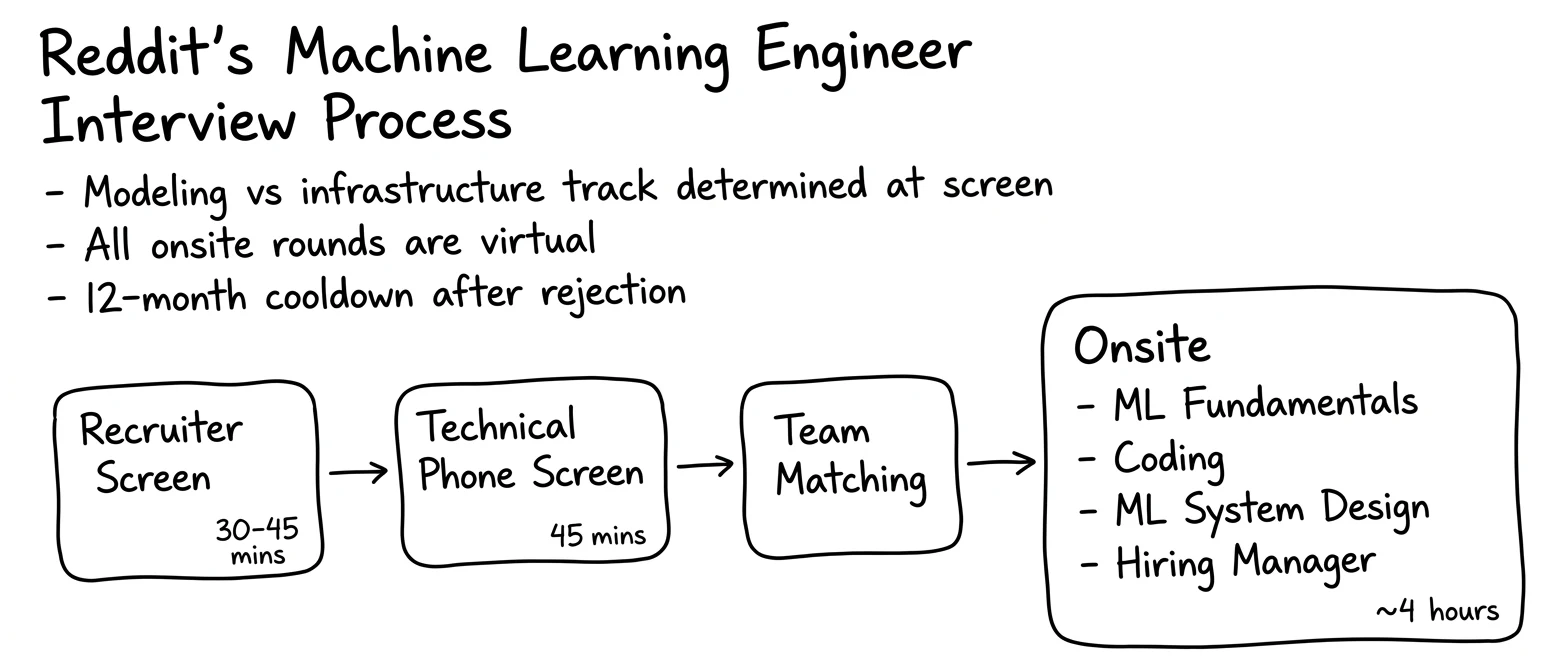
Reddit hires Machine Learning Engineers into teams in its Consumer and Ads organizations, and the loop bends toward the requisition. Recent accounts also describe general MLE hiring, where the team is assigned after interviews. After a recruiter call and one technical screen, the virtual onsite typically runs four hour-long rounds: coding, ML system design, ML fundamentals and a hiring manager conversation. An ML infrastructure loop ran five: two coding rounds, system design, product sense and behavioral. Senior candidates sit the same round types, judged on completion and depth against the senior bar, and the level can change after the onsite.
Here's what the interview process can look like:
- Recruiter screen: A short call on background, target level and which team owns the opening.
- Technical phone screen (about 45 minutes): A live modeling case on a raw dataset for modeling roles, or a multi-part coding problem for platform roles.
- Team matching (some pipelines): Assignment to a specific team between the screen and the onsite.
- Coding interviews (one or two): Hour-long practical data-structure problems with staged follow-ups and no AI assistance.
- ML system design interview: An end-to-end design for a live product surface, from labels to serving, rollout and retraining.
- ML fundamentals interview: Applied modeling on a given dataset plus theory, plot interpretation and cold start.
- Hiring manager and behavioral interview: Projects, a failure and a success, conflict and collaboration; infrastructure loops add product sense.
Tip: Ask the recruiter which team and level the opening maps to before preparing. It decides whether your screen is a notebook case or a coding problem, and whether design leans toward ranking models or feature and serving infrastructure.
Technical phone screen
For modeling roles the screen is a single 45-minute working case. One version turned a raw nested JSON dataset into a modeling-ready dataframe, then built and compared a dummy baseline, logistic regression, random forest and XGBoost on interpretability, training speed and performance. Another explored a click log with per-category dwell-hour columns, a current tag and a binary click label, compared CTR models including SVM, and ended in the objectives, optimization and hyperparameters of logistic regression and XGBoost. A third set an F1 target above 0.97 on data with missing values and only 20% positive labels, probing imbalance handling and per-user normalization of time spent.
Platform roles get coding instead: one ML Platform candidate implemented tennis scoring with deuce and tie-breaks, and a recent account describes a screen with two data-structure rounds. One interviewer allowed web lookups for syntax; that session stayed on modeling and evaluation, with nothing on deployment.
Interviewers evaluate:
- Data-to-model fluency: Parsing, missing values and feature engineering without stalling on one step.
- Justified model choice: Why boosted trees beat logistic regression on categorical-heavy click data, and what interpretability you give up.
- Metric reasoning: Metrics for imbalanced labels and how a precision-recall target changes thresholds and sampling.
- Algorithm internals: The loss each model optimizes, how it is fitted and which hyperparameters matter.
- Pacing: Covering data, models, evaluation and improvement ideas inside 45 minutes.
Rehearse a full pipeline from raw JSON to a four-model comparison in under 40 minutes, narrating each choice.
Note: Documentation lookup does not lower the bar. The scope is broad enough that pacing, not syntax, is the constraint, and the interviewer wants a reason for each model rather than working code alone.
Sample questions for the technical phone screen
Here are some questions reported by recent candidates:
-
Turn a nested JSON dataset into a clean dataframe, then train and compare a dummy classifier, logistic regression, random forest and XGBoost.
-
Explore a click log with dwell hours per category, build a CTR model, and explain how logistic regression and XGBoost are optimized.
-
Reach an F1 above 0.97 with 20% positives and missing values, explaining imbalance handling.
-
Implement tennis scoring for points, games and sets, including deuce and tie-breaks.
Coding interviews
Every reported onsite had at least one hour of pure coding, with AI assistance and external tools not permitted. Problems match what software engineers get: a moderator list for location-based communities with add, remove and query; a sliding-window rate limiter with constant-time eviction and thread safety; billing-status logic with edge cases; shortest palindrome; and regrouping a linked list's odd and even nodes in place. Follow-ups extend the same structure, and how much you finish is graded.
Interviewers evaluate:
- Completion under time: Reaching the follow-up; one and a half parts fell short of the senior bar.
- Data-structure choice: Keeping add, remove and query efficient as constraints grow.
- Concurrency awareness: Thread safety and constant-time eviction raised without prompting.
- Edge cases: Invalid billing transitions and boundary inputs handled and tested.
- Clarity: Confirming requirements early; a candidate who felt a communication gap here was rejected.
Practice medium problems with two or three staged follow-ups on a 45-minute timer, in plain code.
Note: This is the round that has cost offers on this track. Candidates rehearse modeling and are graded on data-structure fluency, and a post-onsite downlevel can become no offer when the lower level has no headcount.
Sample questions for the coding interviews
Here are some questions reported by recent candidates:
-
Maintain moderators for location-based communities with efficient add, remove and query, then extend it in a follow-up.
-
Build a sliding-window rate limiter that evicts expired timestamps in constant time and is thread-safe.
-
Implement billing-status transitions, rejecting every invalid one.
ML system design interview
The design round is an hour on a live Reddit surface: predict whether a user will comment on a post and serve it; predict whether a user will upvote, reply to or ignore each comment and rank a personalized feed; build video recommendation from scratch; design feature serving and inference; rank post comments; or design a feature store. Expected coverage spans target and label, signals at inference time (user history, content, temporal context, social graph), batch-plus-streaming features, retraining, low-latency serving, cold start, interaction logging and A/B infrastructure.
The operational half separates answers. A feature-store round spent most of its hour on deployment, CI/CD, testing, caching and reliability under load. For ranking, a pointwise scorer plus a lightweight reranker balancing engagement, recency and diversity landed well, as did sharding, replication and micro-batching for tail latency. One candidate had to drive the hour with a disengaged interviewer.
Interviewers evaluate:
- Problem framing: A precise target, label and latency budget before architecture.
- Feature consistency: Batch and streaming paths that serve identical features offline and online.
- Production readiness: Rollout, testing, caching and degradation under load, raised by you.
- Model trade-offs: Collaborative filtering versus deep and sequence models, weighed against latency and cost.
- Feedback loops: Logging for retraining and experiments, plus a cold-start plan.
Prepare one ranking-feed design and one prediction-serving design, each with a rollout, testing and caching section.
Tip: Treat the happy-path diagram as the first third of the answer. Candidates who stopped at ingestion, training and serving were pushed into how the model ships and how the feature store is tested, and that part appeared to carry the grade.
Sample questions for the ML system design interview
Here are some questions reported by recent candidates:
-
Estimate the likelihood a user comments on a post, with real-time and batch features, low-latency inference and cold start.
-
Rank comments for a personalized feed from predicted upvote, reply or ignore, balancing engagement, recency and diversity.
-
Design a feature store, then explain its deployment, CI/CD, testing and reliability.
ML fundamentals interview
This round mixes applied modeling with theory. One version gave features X and a target y for a full modeling approach, showed two overlapping probability distributions to interpret, then covered bias-variance, regularization and cold start for new users and items. Another was a conversion-rate model from framing to evaluation, and a recent account describes a deep dive on position bias in ranking. Models discussed are mostly logistic regression, SVM, random forests and boosted trees.
Interviewers evaluate:
- Structured approach: Target, baseline, features, validation and metric, in order.
- Reading plots: What distribution overlap says about separability, calibration or leakage.
- Applied theory: Bias-variance and regularization tied to the model you proposed.
- Cold start and logged-data bias: New-user and new-item strategies, and position bias in click labels.
Prepare spoken walkthroughs of a CTR model, a conversion model and a position-bias correction.
Sample questions for the ML fundamentals interview
Here are some questions reported by recent candidates:
-
Given features X and target y, describe your modeling approach, then interpret a plot of two overlapping distributions.
-
Build a conversion-rate prediction model from framing through evaluation.
Hiring manager and behavioral interview
The manager round covers past projects, collaboration and alignment with the team's goals; behavioral rounds add conflict resolution and cross-team work. One senior loop centered on a significant failure and a major success. ML infrastructure loops added product sense: improve new-user onboarding and define the metrics that show a healthy flow.
Interviewers evaluate:
- Ownership: Your decisions on a shipped model, not a team summary.
- Failure analysis: What went wrong, the signal you missed and what you changed.
- Cross-functional work: Launching with product, data science and infrastructure partners.
- Product sense: Turning a user problem into a measurable experiment.
Prepare a failure and a success story with metrics, plus one product proposal with its success metric.
Sample questions for the hiring manager and behavioral interview
Here are some questions reported by recent candidates:
-
Describe a significant professional failure and a major success.
-
How would you improve Reddit's onboarding, and which metrics show it is working?
How Reddit levels and evaluates Machine Learning Engineer candidates
Feedback from all rounds is pooled, and strong ML rounds do not offset a short coding round. Postings say the final level is set during interviews, and it can move after the onsite: the downleveled senior candidate got no offer because the lower level had no open headcount. One rejected candidate felt the whole loop had gone adequately, so a good feeling is a weak predictor.
Team matching can sit between screen and onsite. One referred ads candidate passed the screen, the initial team assignment fell through, the recruiter stopped responding and the opening appeared frozen. Rescheduled rounds kept the same panel.
Tip: After a passed screen, ask which team you are matched to, follow up if it stalls, and keep other processes running.
How to prepare for the Reddit Machine Learning Engineer interview
- Confirm team and screen format: Ads modeling, relevance and ML platform roles screen differently.
- Train coding as an engineer: Solve multi-part data-structure problems on a timer, including a rate limiter and a state machine.
- Rehearse a 45-minute modeling case: Raw JSON to four compared models, with metrics for imbalanced labels.
- Know model internals: State the objective, optimization and key hyperparameters of logistic regression and boosted trees.
- Add the operational half to every design: Rollout, CI/CD, testing, caching and offline-online consistency belong in your default answer.
- Design for Reddit surfaces: Comment prediction, comment ranking, feed recommendation and a feature store, each with cold start and logging.
- Prepare stories with numbers: A failure, a success, a cross-team conflict and one product proposal.
About the Reddit Machine Learning Engineer role
Reddit MLEs build the models and systems behind feeds, search, notifications, ads and safety. Interest-based communities produce text-heavy, strongly structured signals, which is why comment prediction and ranking recur in interviews. Ads MLEs work on ranking, targeting and retrieval, and on auction, bidding and budget pacing across CPC, CPA and ROAS objectives.
| Level | Primary focus | Impact scope |
|---|---|---|
| IC3 | Owns scoped projects, ships models and services, contributes to experimentation | A component of one team's ML stack |
| IC4 | Leads multi-quarter initiatives, sets technical direction, mentors while hands-on | A team's modeling or serving systems |
Reddit hires Machine Learning Engineers across its Consumer and Ads organizations. Teams include:
- Feed Relevance: Candidate retrieval and ranking for personalized feeds.
- Search and Answers Relevance: Ranking for search and question-answering surfaces.
- Ads Ranking and Ads Targeting and Retrieval: Ad relevance models, embeddings and language-model representations.
- Ads Marketplace Quality: Auction, bidding and budget pacing.
- Safety ML: Language-model systems that detect harmful content and support rule enforcement.
- ML platform and AI serving: Feature infrastructure and GPU inference for search, ranking and language models.
Machine Learning Engineer experience and education requirements
Postings ask for three to five or more years of building and operating production ML systems, typically five or more for IC4 and senior titles, with Python, Java or Go. Deep learning roles add PyTorch, TensorFlow or Hugging Face and distributed training. A bachelor's in computer science or a related field, or equivalent experience, is accepted.
FAQs about the Reddit Machine Learning Engineer interview
How long does the Reddit Machine Learning Engineer interview process take?
Reports do not pin a consistent timeline. The process is a recruiter call, one technical screen and a virtual onsite of four or five hour-long rounds; the largest delay is team matching, which stalled one candidacy indefinitely.
What is the hardest round of the Reddit Machine Learning Engineer interview?
By outcome, coding, since it applies the general engineering bar and is the round that ended loops. By preparation, ML system design, because its operational half is what most ML preparation skips.
Is there an online assessment?
No reported Machine Learning Engineer pipeline used one; the first technical step is a live screen.
How much does a Reddit Machine Learning Engineer make?
Reddit posts base pay ranges on United States openings. Recent ranges were roughly $186K to $303K for Senior Machine Learning Engineer, $230K to $322K for Staff, and $266K to $372K for Senior Staff in Ads Ranking. Packages add restricted stock units to base salary.
Is the process remote?
Every reported onsite was virtual, and many postings are remote within the United States, with some in Canada and the United Kingdom.