Study
Recommendation System Design Interview: 57 Reported Prompts
TrueInterview
October 16, 2026 · 19 min read
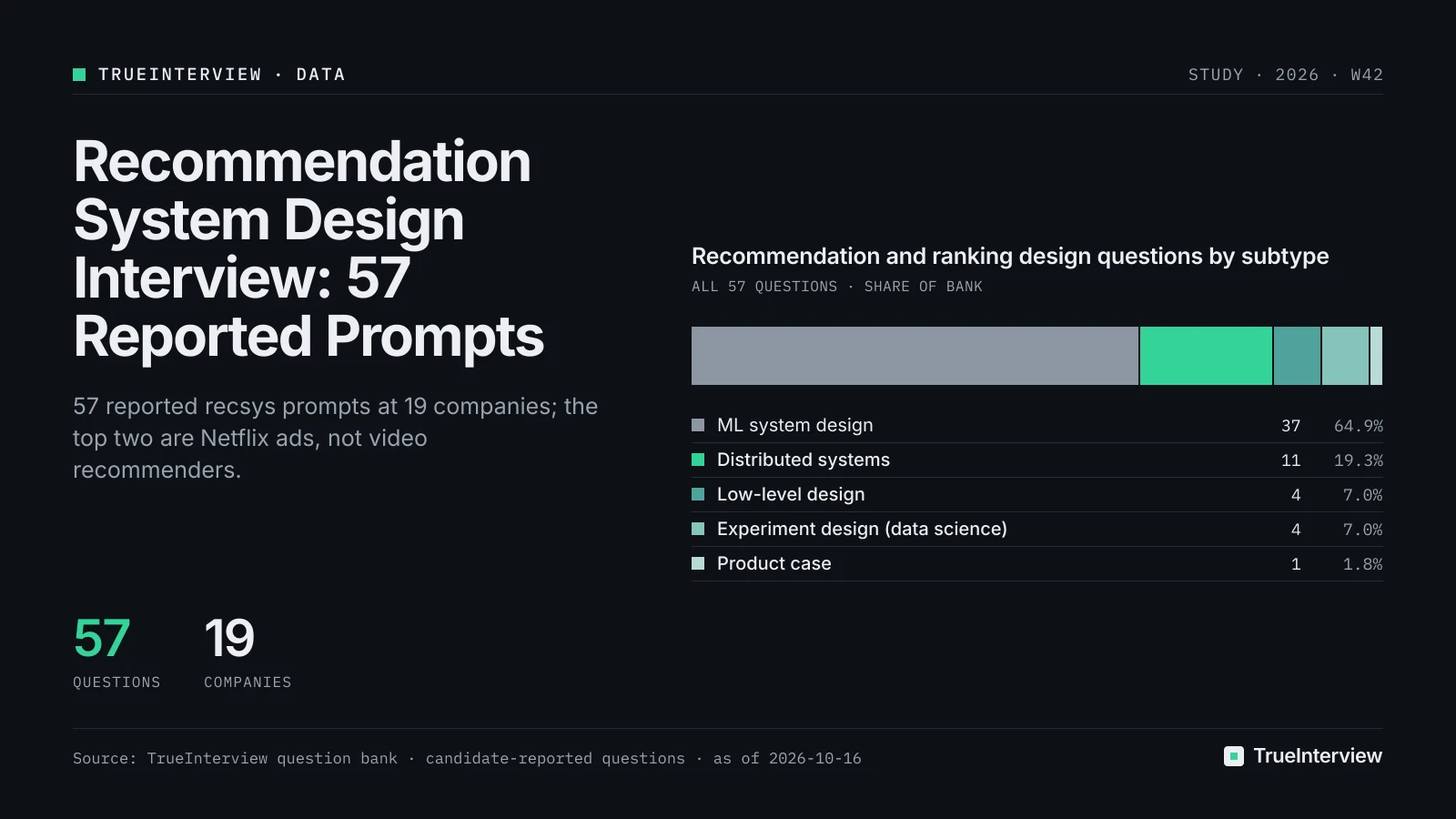
As of 2026-10-16, the TrueInterview bank holds 57 recommendation and ranking design questions reported at 19 big-tech companies, and 49 of them were last reported in the 12 months before that date. They arrive as product prompts tied to what each company ranks, such as Netflix ads frequency caps, DoorDash nearby restaurants and Meta Reels, and they are reported in phone screens 17 times as well as in onsites 43 times. Some reported prompts are generic recommenders, but in our view rehearsing one canonical YouTube-style video recommender leaves most of them uncovered; prepare your target company's own surfaces, and lead every answer with the objective.
Disclosure: TrueInterview is an interview-preparation product and publishes this article. Facts about other products come from their public pages on the dates listed under Sources.
Our recommendation: walk the funnel below in this order, objective first as PracHub's guide also advises, which is the order an interviewer can follow most easily: objective and label, candidate generation, ranking under a latency budget, cold start, then evaluation and serving. Each stage is anchored to a prompt that candidates actually filed, with its company, round and month, so you can practise the stage on the question most likely to test it.
What recommendation and ranking prompts do big-tech candidates report?
The most-linked prompts are product-specific, and the top two are both Netflix ads questions. The table ranks prompts by how many candidate write-ups link them, with one reported round and month where the bank records it; four recently dated prompts follow it as a separate list. Treat the ranking as a map of what candidates wrote up, not as a forecast of what your interviewer will choose.
| # | Prompt | Company in the bank | Reported round and month | Write-ups linking it | Practice |
|---|---|---|---|---|---|
| 1 | Design an Ads Frequency Cap System | Netflix | Onsite, 2026-08 | 13 | Practise the frequency cap |
| 2 | Design the Data Model for an Ads Demand Platform | Netflix | Not recorded | 12 | Practise the ads data model |
| 3 | Design News Feed | Snapchat, Lyft, Amazon, Meta, Pinterest (links) | Amazon phone screen, 2026-07 | 11 | Practise Design News Feed |
| 4 | Design A Nearby Restaurant Recommendation System | DoorDash, Uber | DoorDash onsite, 2026-07 | 7 | Practise nearby restaurants |
| 5 | Design a News Aggregation Feed | Snapchat | Phone screen, 2026-06 | 7 | Practise the aggregation feed |
| 6 | Design A Feed Recommendation System | Onsite, 2026-04 | 6 | Practise Pinterest's feed | |
| 7 | Reels / Short Video Recommendation | Meta | Onsite, 2026-06 | 6 | Practise Reels |
| 8 | Nearby Place Recommendation | Meta | Not recorded | 5 | Practise nearby places |
| 9 | Short Video Recommendation & Ranking | Not recorded | Not recorded | 5, all from ML-side candidates | Practise short video ranking |
| 10 | Design An Online Ads Ranking System | Pinterest, DoorDash, Instacart | Not recorded | 4 | Practise ads ranking |
| 11 | Search / Ranking / Experimentation | 2 big-tech companies | Not recorded | 3 | Practise search ranking |
Recently dated prompts outside the top of the ranking, worth a look if the company is on your list:
- Short-Video Recommendation System, ByteDance among 2 companies: ByteDance onsite, 2026-08. Practise ByteDance's short video
- Design a Personalized Feed and Compare Ranking Objectives, LinkedIn: Phone screen, 2026-09. Practise comparing objectives
- Design a Product or Video Recommendation System, Google: Phone screen, 2026-08. Practise Google's prompt
- ML System Design (Recommendation / Feed Ranking / ETA), Uber: Onsite, 2026-03. Practise Uber's round
Three readings change how you spend prep time. The top two rows are ads systems at one company, so an ads loop has a narrower target than the general topic suggests. Feeds recur down the table, from Design News Feed to Snapchat's aggregation feed, so, in our view, fan-out and freshness deserve as much preparation as model choice. Video recommenders do appear, but as company-specific prompts such as Meta's Reels and ByteDance's short video; the generic title Design A Video Recommendation System is linked from a single write-up even though it is filed under LinkedIn, Instacart and Pinterest.
For the top prompts, these are the decisions a senior interviewer is likely to push on, stated as standard engineering practice rather than as reported interview content:
- Ads frequency cap: where the per-user impression counter lives, how it stays correct when ad servers in several regions serve the same user, and whether an over-cap impression is acceptable for a few seconds. This is a counting and consistency problem first.
- Ads demand data model: the entities (advertiser, campaign, line item, creative, targeting, budget) and which of them change on the serving path. Get the schema and its write pattern right before any model appears.
- Design News Feed: fan-out on write against fan-out on read, and the hybrid for accounts with very large followings. Ranking sits on top of whichever store you choose.
- Nearby restaurant recommendation: a geographic candidate source plus eligibility filters such as open hours and delivery radius, then a ranker that blends relevance with delivery time.
Which companies file which prompt families?
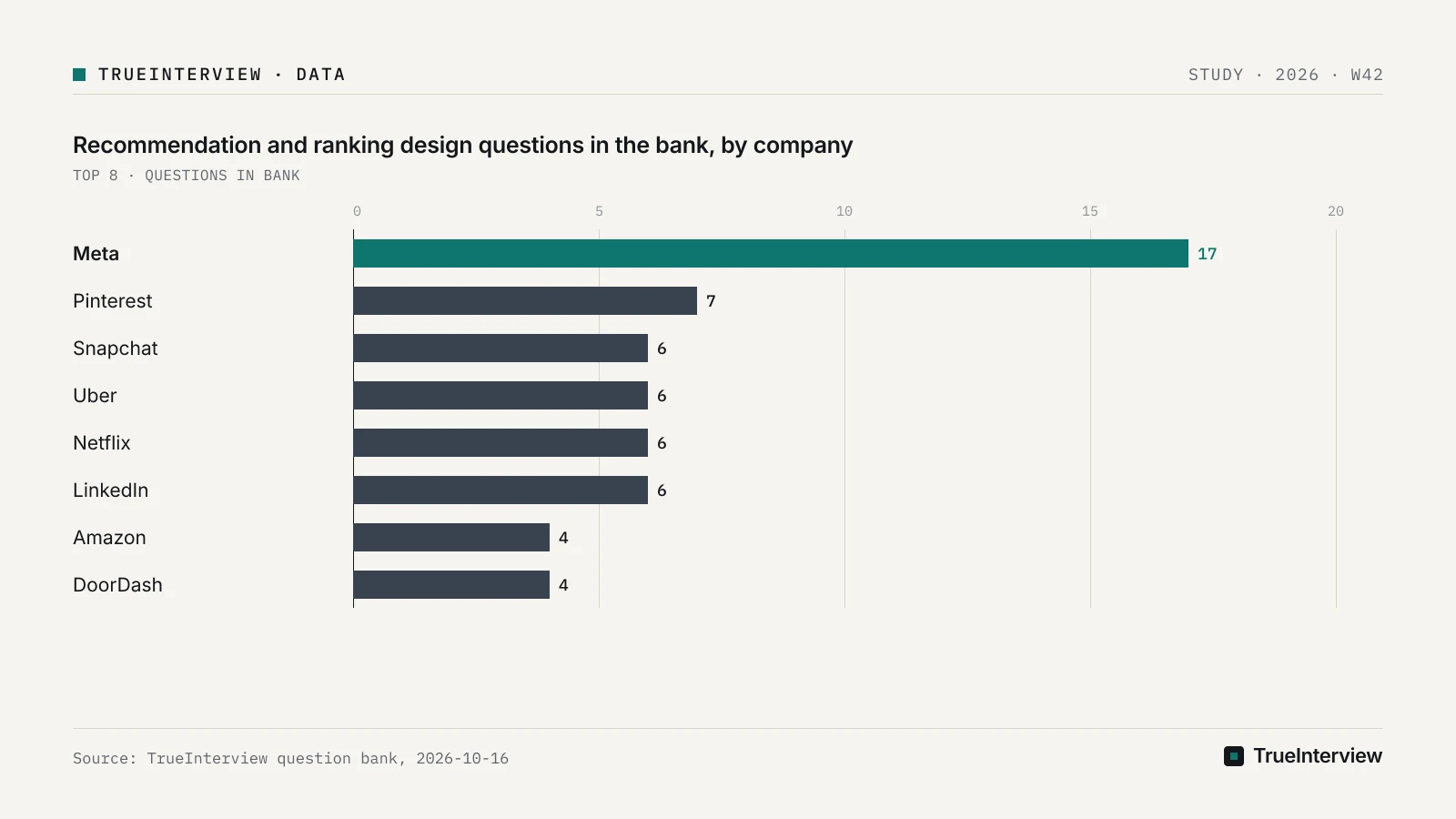
Meta files the most prompts (17), followed by Pinterest (7) and four companies at 6 each, and across all 57 questions 49 sit in the ads, recommendation and ranking family. Read the table across your target's row: it tells you which shared prompts and which company-specific prompts to rehearse first.
| Company | Questions filed | Design News Feed | Personalized Search Ranking | Online Ads Ranking | Video Recommendation | Company-specific prompt to rehearse |
|---|---|---|---|---|---|---|
| Meta | 17 | ● | Reels, Nearby Place | |||
| 7 | ● | ● | ● | Feed Recommendation | ||
| Snapchat | 6 | ● | News Aggregation Feed | |||
| Uber | 6 | ● | ● | Nearby Restaurant | ||
| Netflix | 6 | Ads Frequency Cap, Ads data model | ||||
| 6 | ● | Compare Ranking Objectives | ||||
| Amazon | 4 | ● | Design News Feed | |||
| DoorDash | 4 | ● | ● | Nearby Restaurant | ||
| Robinhood | 3 | ● | ● | Personalized Search Ranking | ||
| Instacart | 3 | ● | ● | ● | Online Ads Ranking | |
| ● | Product or Video Recommendation | |||||
| Airbnb | ● | Personalized Search Ranking |
The shared columns show where one rehearsal pays off across loops. Design News Feed covers nine companies' filings and Personalized Search Ranking covers five, so either is a better second prompt than a generic video recommender. Personalized Search Ranking is linked from only 2 write-ups, both by senior-or-above candidates, so its reach comes from how widely it is filed rather than from volume.
Worked example, Meta. Of Meta's 17 filed questions, 13 sit in the ads, recommendation and ranking family and 3 in news feed and social graph. That reduces an open topic to three rehearsals: Reels for objective choice and the retrieval-to-ranking funnel, Nearby Place for location-constrained candidate sources, and Design News Feed for the serving and fan-out side. Reels has been reported onsite as recently as 2026-06, so it is the one to rehearse end to end first.
Stage 1: what objective and label should you choose?
Choose the objective before anything else, as the guides advise; the LinkedIn prompt reported in a 2026-09 phone screen, which asks you to compare ranking objectives directly, is one example. PracHub's guide advises: "Spend the first ten minutes on the objective and the training label, not the architecture." In a phone screen, in our view, compress that to a few minutes, but keep the order.
In our view, every candidate objective has a known way to fail, and naming it unprompted is where seniority shows. Hello Interview's guide says click-through rate "can lead to greedy behaviors that harm the business overall." The same guide warns that pure watch-time optimization can promote addictive, low-quality content and bias the model toward longer videos. ByteByteGo's chapter adds that optimising completed videos may favour shorter videos, and it picks relevance as the ML objective because that gives more control over the signals used.
For the reported prompts, the objective question takes a different shape on each surface:
- Netflix ads frequency cap: the objective is a constraint, not a score. The system enforces a cap, and ranking happens inside it.
- DoorDash or Uber nearby restaurants: a click is cheap and an order is the outcome, so you need a label that survives delivery time and availability.
- Meta Reels or ByteDance short video: watch time is the obvious label, and its bias toward length is the follow-up you should raise yourself.
- LinkedIn personalised feed: the prompt itself names the comparison, so prepare two objectives with their failure modes and say which you would ship.
Hello Interview's guide also says most interviewers accept any good objective, while longer-term thinking is what stands out.
Stage 2: how should candidate generation work for a filed prompt?
Candidate generation narrows the catalog with cheap, recall-oriented sources, and it should use several of them. PracHub's guide calls a single source "the classic junior answer". Nearby Restaurant, linked from 7 write-ups at DoorDash and Uber, is the clearest filed prompt for this stage. Location decides eligibility there before any model runs.
Eugene Yan describes retrieval as trading precision for efficiency to narrow the search space quickly for downstream ranking. Meta's Instagram Explore post says retrieval sources can be real-time, capturing recent interactions, or pre-generated, capturing long-term interests. Hello Interview's guide describes a design that runs several candidate generators in parallel, possibly hundreds in practice, and notes that generators with limited context are cacheable and can be pre-computed.
The two-tower model is where candidates over-commit. Meta's post says its main advantage is that user and item embeddings can be cached, but the model cannot consume user-item interaction features without losing those cacheable embeddings. PracHub's guide lists over-engineering retrieval, such as online retraining of the two-tower model or ranking 50,000 candidates, as a common mistake.
Applied to the filed prompts, a defensible source mix looks like this, as our view:
| Prompt | Sources to name | What the interviewer will probe |
|---|---|---|
| Nearby Restaurant (DoorDash, Uber) | Geo-cell lookup, past orders, cuisine embeddings, trending in area | Eligibility filters before scoring; empty results in sparse areas |
| Reels (Meta) | Followed creators, embedding retrieval, recent-engagement source, trending | Freshness of the real-time source; dedup across sources |
| News Aggregation Feed (Snapchat) | Publisher subscriptions, topic match, breaking stories | How a story only minutes old enters the pool |
| Feed Recommendation (Pinterest) | Board and topic graph, embedding neighbours, recent saves | Balancing graph neighbours against embedding neighbours |
Stage 3: how do you fit ranking inside the latency budget?
Eugene Yan's discovery-system post says ranking processes fewer items, so it can add features that were infeasible at retrieval. In our view, short-video prompts stress this stage most; the counts show they are senior- and ML-heavy: Meta Reels is linked from 6 senior-or-above write-ups, and Short Video Recommendation & Ranking is linked from 5 ML-side write-ups and none from software engineers.
Quote budgets as example assumptions, not facts about any interview. PracHub's guide suggests retrieving roughly 1,000 to 5,000 candidates in about 10 to 20ms of a budget near 200ms. Hello Interview's guide describes a lightweight ranker that cuts O(10k) candidates to O(100) and is optimised for recall. Meta's Explore post describes a heavier second-stage ranker that works on the 100 best candidates from the first stage.
Two details separate a staged answer from a box diagram. Meta's Instagram Explore post says Meta trains the first-stage ranker to predict the second stage's output, which it frames as distilling knowledge into a lighter model. Eugene Yan's discovery-system post says ranking can be modeled as learning-to-rank or classification, with classification more commonly seen. If you interview for an ML role, PracHub's guide says calibration follow-ups come up in MLE loops because theory-only preparation skips them. PracHub's guide also recommends logging position as a training feature and fixing it at serving time to handle position bias.
What gets pushed on, our view: for Reels, expect the question of where the budget goes if the heavy ranker runs late. Have a degradation path ready, such as serving the first-stage order, rather than a bigger model.
Stage 4: how do you answer cold start for new users and new items?
Treat cold start as two separate answers, one for new users and one for new items. PracHub's guide reports it as an explicit Snapchat follow-up asked that way. In our view, Snapchat's News Aggregation Feed, reported in a 2026-06 phone screen, is a good prompt to rehearse cold start on, because new items arrive constantly; the PracHub report above is about a different prompt.
ByteByteGo's chapter describes collaborative filtering's cold-start problem as limited data for a new video or user, and it says companies usually use sequential hybrid filtering in practice.
As our view, the strongest answers name a mechanism per side. For new items, use content features and a small exploration budget so a fresh story or restaurant gathers signal. For new users, use context such as location and time of day, plus popular-in-segment candidates, until the first interactions arrive. For a nearby-restaurant prompt, the new-item case is a newly listed restaurant, and you should say how it earns impressions without hurting order rates.
Stage 5: how do you evaluate and serve the recommender?
Offline metrics pick a launch candidate and an online test decides the launch. PracHub's guide puts it this way: "only an A/B test on the business metric gets you to a launch." The bank also holds 4 experiment-design questions among the 57, so be ready to lay out the test plan in detail.
Search / Ranking / Experimentation, filed under 2 companies and linked from 3 write-ups, is the prompt to rehearse if your loop pairs ranking with testing. On the serving side, Eugene Yan's discovery-system post says to use the same feature store in offline training and online serving to minimize train-serve skew. Meta's Explore post describes continual online training that fine-tunes models every hour as new data arrives.
For software engineers, serving is where the reported prompts get specific. The Amazon phone-screen version of Design News Feed is, in our view, a fan-out and storage problem, and the Netflix frequency cap is a distributed-counter problem; the ranker is the smaller part of both answers.
Why do ads prompts need their own preparation?
Ads hold the top two rows of the ranked table, both at Netflix, and both are linked only from senior-or-above write-ups (13 and 12). One of them is a data-model problem rather than a model problem. If your loop is ads-heavy, practise frequency capping and the ads data model as systems problems first, then layer ranking on top.
Hello Interview's guide uses YouTube's up-next recommendations as its worked example. In our view, ads prompts such as frequency capping need separate rehearsal. Design An Online Ads Ranking System is filed under Pinterest, DoorDash and Instacart, and it is linked from 4 write-ups, 3 of them by senior-or-above candidates. All 4 come from machine-learning, AI, research or data-science candidates and none from software engineers.
Our take: split ads preparation by role. A software engineer should be able to design the frequency counter, its consistency model and the campaign schema without a model in sight. An ML engineer should add the auction-facing piece: calibrated click or conversion probabilities, because a bid multiplied by a miscalibrated probability misprices every impression.
Phone screen or onsite: how long should your answer be?
Prepare two lengths of the same answer. These questions are reported in phone screens as well as onsites, and 14 of the 17 phone-screen design questions are in the ads, recommendation and ranking family. Onsites follow the same pattern: 37 of the 43 onsite questions fall in that family, with 5 more in news feed and social graph.
The phone-screen examples are concrete: Google's product or video recommender in 2026-08, Snapchat's aggregation feed in 2026-06 and Amazon's Design News Feed in 2026-07, next to the LinkedIn prompt from Stage 1. ByteByteGo's chapter says no one expects a perfect system in a 45-minute interview. Our assumption is that a phone screen leaves less design time once introductions and questions are taken out, so the compressed answer has to show judgement early.
As our view, the phone-screen version has four parts: the objective and its logged label, at least two candidate sources, the ranker and its main features, and one latency budget with a fallback. Keep cold start, calibration and the evaluation plan as deep dives you offer when asked; in an onsite, you raise them yourself.
Will you get the SWE or the MLE version of the round?
Most of these prompts are ML system design, and the rest are mostly systems questions about the same kinds of products. Of the 57 questions, 37 are ML system design, 11 distributed systems, 4 low-level design and 1 product case. Write-up links come from software engineers 74 times and machine learning engineers 47 times, so this is not an MLE-only topic. Our view is that the systems questions are the software-engineer version of the same product surfaces.
The prompts split by role in a useful way. Notification Ranking (Multi-source) is linked from 3 ML-side write-ups and none from software engineers. Nearby Restaurant is mixed, with 4 ML-side and 3 software-engineer links, which makes it the best single prompt to rehearse in both versions. Reels and Feed Recommendation each draw 4 ML-side and 2 software-engineer links.
| If you are | Expect | Rehearse first | Depth to add |
|---|---|---|---|
| Software engineer | Distributed-systems or low-level design versions of feeds and ads | Design News Feed, Ads Frequency Cap | Fan-out, caching, counters, schema |
| ML engineer | ML system design on the company's surface | Reels, Online Ads Ranking, Notification Ranking | Objective, label, calibration, evaluation |
| Either, one prompt only | A product prompt that crosses both versions | Nearby Restaurant | Geo retrieval plus the ranker |
What changes at senior and staff level?
The level skew is large. Write-ups link these questions 118 times from candidates who reported a senior, staff-plus or manager level, against 13 times from junior, new-grad or intern candidates. Levels are self-reported on each write-up, and the skew may also reflect who writes up interviews, so it does not show that juniors never get this round.
Several prompts are linked only from senior-or-above write-ups, including the two Netflix ads prompts, Reels, Feed Recommendation, Nearby Place, Recommendation System Design (4), Notification Ranking (3) and Leaderboard / Category Ranking (3). Design News Feed is the main exception, with 9 senior-or-above links and 2 junior links. Staff-plus or manager write-ups include objective-framed and product-framed prompts such as Design Linkedin Learning Recommendation System and AI-Powered Personalized Recruiter Message Generation.
Hello Interview's guide says more senior engineers can make assumptions about some constraints and confirm them instead of asking. The same guide says a purer business objective leaves room for creativity and depth, which "becomes more important for senior+ candidates".
What interviewers push on at senior level (our view)
The table is our view of the questioning, built on the reported prompts and the cited guides; it is not a record of what any interviewer asked. It covers the objective, candidate generation, ranking latency and cold start, plus the systems side of feeds and ads.
| Stage | What a senior interviewer pushes on (our view) | Prompt to rehearse it on |
|---|---|---|
| Objective | Two objectives compared aloud, each with its failure mode, and which one you ship | LinkedIn Compare Ranking Objectives |
| Candidate generation | Why each source exists, how sources are deduplicated, and what is cached | Nearby Restaurant, Reels |
| Ranking latency | Where the budget goes, what happens when the heavy ranker is late | Reels, Short-Video Recommendation |
| Cold start | Separate answers for new users and new items, and how new items earn impressions | News Aggregation Feed |
| Systems side | Counter consistency, schema, fan-out | Ads Frequency Cap, Ads data model, Design News Feed |
Down-leveling note, our view: in this round the level signal sits in the objective argument and the trade-off calls, not in the number of boxes. A candidate who draws a correct funnel but lets the interviewer pick the objective, the label and the budget is showing mid-level behaviour. If your loop also has a project deep dive, use it to show one recommender decision you owned end to end.
Our take: the objective separates senior candidates more than the diagram
Spend the opening on the objective, because the funnel itself is assumed. Hello Interview's guide says interviewers will treat some aspects of multi-stage architecture as "table stakes". If the diagram is taken for granted, it earns little credit, and the minutes it would take are better spent on what the model predicts, which label stands in for it, and how that label can mislead.
As our view, the ordering fits the reported prompts: one staff-plus-linked prompt, LinkedIn's Design a Personalized Feed and Compare Ranking Objectives, names the objective comparison in its title. ByteByteGo's chapter says the interviewer is primarily interested in thought process, communication, ML design ability and trade-off discussion. Hello Interview's guide adds that the objective discussion "signals experience to your interviewer".
So draw the funnel quickly once the objective is settled, and spend the saved time on the one stage the prompt makes hard: eligibility for nearby restaurants, consistency for the frequency cap, freshness for the aggregation feed.
How we counted
The counts come from TrueInterview's question bank as of 2026-10-16: 57 recommendation and ranking design questions, with problem families assigned from question titles rather than hand-labelled. TrueInterview says its questions are written up by candidates right after the interview and checked against other reports of the same round. These are candidate-reported questions reconstructed for practice, not any company's official list, and a write-up link count measures how many reports mention a question, not how often a company asks it.
FAQ
What recommendation system design questions do big tech companies ask?
The prompts candidates report are tied to products: ads frequency capping and an ads data model at Netflix, Reels and nearby places at Meta, nearby restaurants at DoorDash and Uber, and feeds at Pinterest, Snapchat and Amazon. The ranked table above lists them with round, month and write-up counts. Use it to pick the two or three prompts closest to your target company's surfaces, then rehearse the full funnel on each one rather than on a generic recommender.
Which companies ask recommendation system design questions most?
The bank can say which companies have the most filed prompts, not which ask most. Meta leads the filings, followed by Pinterest and four companies tied at six, as the heatmap shows. Those numbers reflect what candidates reported and wrote up. If your target is outside that list, use the shared prompts, Design News Feed and Personalized Search Ranking, as your first rehearsals because they are filed under the most companies.
Are recommendation design questions asked in phone screens?
Yes. The bank records them in phone screens as well as onsites, and most phone-screen design questions in this set belong to the ads, recommendation and ranking family. Recent phone-screen examples include Google, LinkedIn, Snapchat and Amazon. Prepare the four-part short version described in the phone-screen section above, and keep the deep dives for the onsite.
How do you design an ad recommendation system in an interview?
Start with the systems pieces the reported prompts emphasise: the per-user frequency counter, its consistency across servers, and the campaign and budget schema. Then add ranking: a calibrated click or conversion model whose output can be combined with the bid. If you are a software engineer, the counter and schema may be the whole round; if you are an ML engineer, expect the Online Ads Ranking version, which in the bank draws only ML-side write-ups.
How do you handle cold start in a recommendation system interview?
ByteByteGo's chapter frames cold start as limited data for a new video or user, so give one answer per side and name where each one's first signal comes from. As our view, rehearse them on a prompt where new items arrive constantly, such as Snapchat's aggregation feed, or on a restaurant that has just been listed in a nearby-restaurant system.
Is the round different for software engineers and ML engineers?
Yes, by flavor rather than by topic. Alongside 37 ML system design questions, the set holds 11 distributed-systems and 4 low-level design questions, and some ranking prompts draw only ML-side write-ups. Our view is that these are the software-engineer versions of the same product surfaces. Software engineers should rehearse fan-out, caching, counters and schemas; ML engineers should add objective choice, label failure modes, calibration and the offline-to-online evaluation path.
Your practice plan
A three-week plan for someone working full time, at roughly one long session and two short ones per week:
- Week 1, day 1: write down the two or three surfaces your target company ranks, and match each one to a prompt filed under that company in the table above.
- Week 1: rehearse one company-surface prompt end to end, objective first, choosing from prompts reported onsite in 2026. Pick the Netflix ads frequency cap, Meta's Reels prompt or the DoorDash and Uber nearby-restaurant prompt.
- Week 2, software engineers: do Design News Feed as a fan-out and storage problem, then the ads demand data model, linked from 12 write-ups, as a schema problem.
- Week 2, ML engineers: do Design a Personalized Feed and Compare Ranking Objectives aloud, two objectives with their failure modes, then Online Ads Ranking, an ML-side prompt, with a calibration follow-up.
- Week 2, everyone: deliver a phone-screen-length version of your week-1 prompt, since most phone-screen design questions in this set are in the ads, recommendation and ranking family.
- Week 3: add a cross-company prompt, Personalized Search Ranking, whose 2 write-ups both come from senior-or-above candidates; then answer cold start for new users and new items separately on the news aggregation feed.
- Week 3, last session: run one full mock on a whiteboard, the format TrueInterview's site says its system design rounds use, and finish with the offline-metric to A/B-test launch path.
Sources
- TrueInterview question bank — recommendation and ranking design at big-tech companies — counted 2026-10-16
- Recommendation System Design Interview: The Funnel, Stage by Stage, from Real Asks | PracHub Knowledge Hub — checked 2026-10-16
- Video Recommendation System Design | ML System Design in a Hurry — checked 2026-10-16
- ByteByteGo | Technical Interview Prep — checked 2026-10-16
- System Design for Recommendations and Search — checked 2026-10-16
- Scaling the Instagram Explore recommendations system - Engineering at Meta — checked 2026-10-16
- Real FAANG Interview Questions by Company · TrueInterview — checked 2026-10-16
- Interview prep compared: your application, end to end · TrueInterview — checked 2026-10-16
Last reviewed: 2026-10-16.