Study
Project Deep Dive Questions for Senior Engineers: 88 Reported
TrueInterview
October 11, 2026 · 18 min read
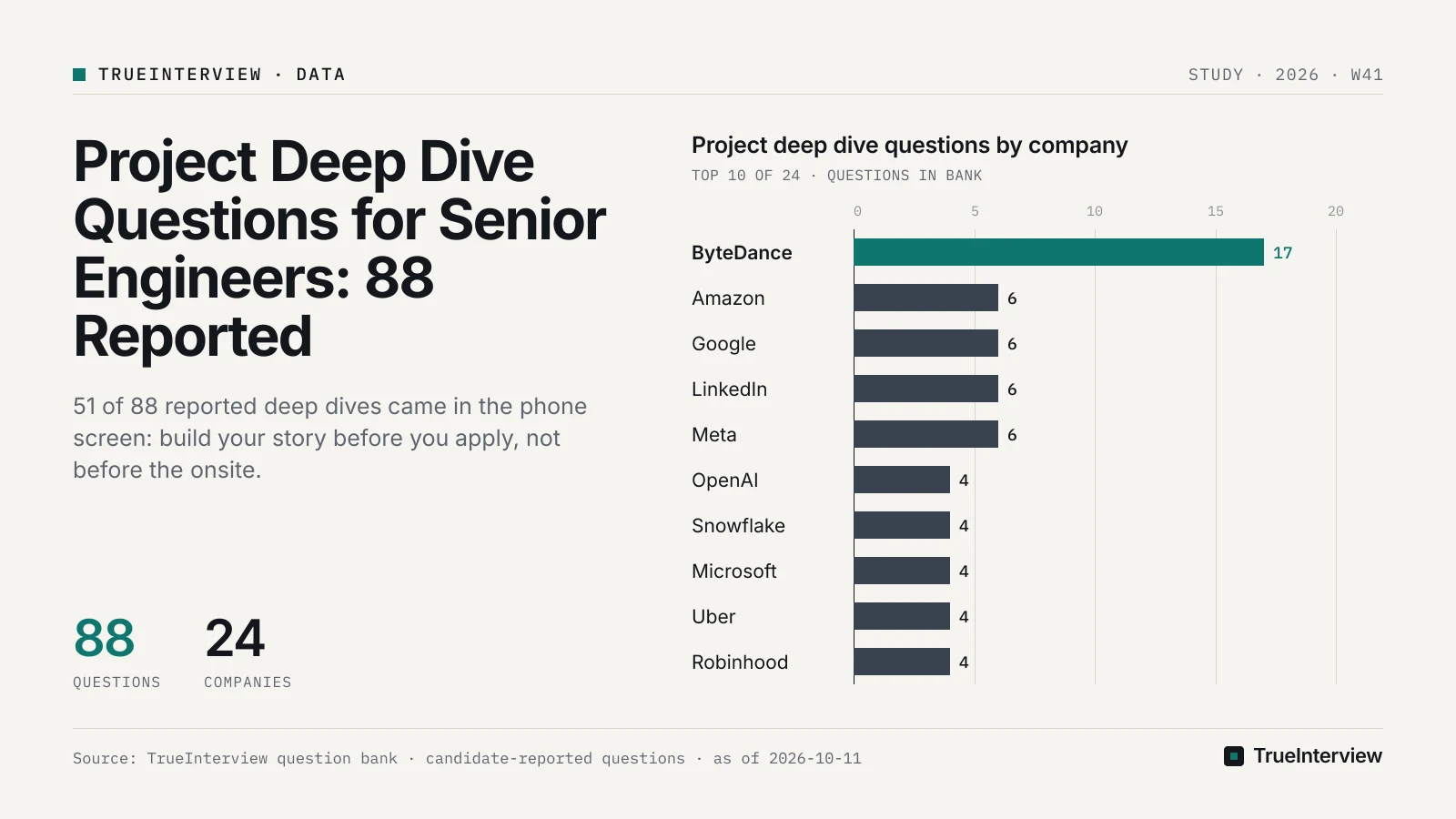
Treat a big-tech project deep dive as a decision-reconstruction interview: you take one piece of work you owned and defend why each decision was made, what broke and what you would change, while the interviewer checks that the decisions were yours. As of 2026-10-11, TrueInterview's bank holds 88 candidate-reported project deep dive questions from 24 big-tech companies, and more of them were reported in phone screens than in onsites. Treat it as a first-screen filter: build the artifact your target company's format calls for before you apply, not after you clear the loop.
Disclosure: TrueInterview is an interview-preparation product and publishes this article. Facts about other products come from their public pages on the dates listed under Sources.
What does a project deep dive actually score?
It scores ownership under questioning, not presentation polish. Refery's guide to running the round says "An engineering project deep dive should reconstruct a decision, not reward a presentation." The candidate explains one piece of work from the original problem through implementation and operation, then separates their own contribution from the team's, in the format Refery's guide describes.
The bank files all 88 questions under a single subtype, project deep dive, so the round is defined by its format rather than by a topic list. For most candidates the material is work already done, which is the useful part for an experienced hire: no syllabus to learn, only work you have to be able to explain two or three layers down.
Coditioning's OpenAI guide puts the test plainly: the round is meant to verify "whether you genuinely owned and deeply understood a complex engineering system." A VP of engineering writing on From the Trenches says depth is "one of my primary recruitment criteria" and that the goal of the conversation is to assess "depth rather than breadth".
Our take: most published advice treats the deep dive as a storytelling exercise, and the reports above say the story is only the entry ticket. Senior candidates who prepare the narrative and stop there are preparing the part of the round that carries the least signal.
Where does the deep dive appear: phone screen or onsite?
It appears earlier than most senior candidates plan for. In TrueInterview's bank, 51 of the 88 questions were reported in a phone screen, 41 onsite and 1 in an online assessment, and a question can be reported in more than one round. 75 were last reported in the 12 months before 2026-10-11, so this is a current format, not a legacy one.
Recent phone-screen examples include ByteDance, LinkedIn, Oracle and DoorDash, four of the companies behind those 51 reports, all last reported in 2026-08 or 2026-09. Oracle's reported title, "Resume / Project Deep Dive (HM or Tech Screen Opener)", names the trap: the deep dive is the opener of a screen, which is exactly the slot candidates treat as small talk.
PracHub's guide to Discord's interviews gives this as general advice, not as a Discord rule: "every candidate should prepare at least two project stories because recruiter, hiring-manager, behavioral, and technical conversations can probe ownership." Read that alongside the phone-screen share and the order of preparation changes.
Our take: a senior candidate who spends three weeks on system design and twenty minutes on 'walk me through your resume' has the weighting backwards for any loop that opens with a resume drill. Write your two stories in the same week you update your resume, because the resume is now the question list.
Which deep dive format does your target company use?
The three most-linked formats each need a different artifact: ByteDance's resume drill, Uber's hiring-manager onsite that bundles behavioral questions with the deep dive, and OpenAI's slide-based technical deep dive. Microsoft, Robinhood, Anthropic, Airbnb and LinkedIn form a close second tier, and LinkedIn's version adds a scoring rubric to the walkthrough. Rehearse the format your loop reports instead of polishing one generic story.
| Reported format | Company | Write-ups linking it | Round, last reported | Artifact to build | Practise |
|---|---|---|---|---|---|
| Project Deep Dive (Resume Drill) | ByteDance | 47 | Phone screen, 2026-09 | Two-minute verbal spine for each resume line | ByteDance resume drill |
| Onsite BQ + Hiring Manager + Project Deep-Dive | Uber | 32 | Onsite, 2026-08 | Deep dive plus a team-scope and influence story | Uber combined onsite |
| Technical Deep Dive (slide-based) | OpenAI | 22 | Onsite, 2026-08 | Short deck, internals of every named technology ready | OpenAI technical deep dive |
| Project Deep Dive | Microsoft | 18 | Onsite, 2026-09 | Conversational walkthrough of one system | Microsoft project deep dive |
| Project Deep Dive | Robinhood | 18 | Onsite, 2026-05 | Conversational walkthrough, failure story ready | Robinhood project deep dive |
| Describe your most impactful project | Anthropic | 18 | Onsite, 2026-07 | Deck or structured document, impact first | Anthropic impactful project |
| Experience / Project Deep-Dive Round | Airbnb | 17 | Onsite, 2026-06 | Walkthrough with cross-functional scope | Airbnb experience round |
| Project Deep-Dive (Four-Axis Rubric) | 17 | Phone screen, 2026-09 | Story that can be scored on separate dimensions | LinkedIn four-axis deep dive | |
| Describe a Project End-to-End | DoorDash | Not in the top links | Phone screen, 2026-08 | End-to-end verbal spine | DoorDash end-to-end project |
Write-up counts measure how many candidate reports link a format, not how often a company runs it. Our rule of thumb: treat a format with 40 or more linked write-ups, like ByteDance's, as that company's default, and treat a count in the high teens as a lead to confirm with your recruiter.
ByteDance: the resume drill
The title suggests the mechanics: the drill starts from your resume, so treat any line on it as a possible entry point. Prepare each line you would be willing to defend as a short spine, and delete any line you would not. Our view, inferred from the title rather than from a ByteDance report: expect the drill to test the boundary of your contribution, as ownership-focused rounds generally do: what you chose, what the team chose, and why the obvious alternative lost.
OpenAI: the slide-based technical deep dive
Coditioning's OpenAI guide says senior candidates are "typically expected to prepare a short slide deck for a 45-60 minute structured technical presentation" and advises 15 to 20 minutes of slides with 30 to 40 minutes left for questions. The same guide warns of "Scale Probing": name Kafka or Kubernetes and the interviewer will probe its internals. Put a technology on a slide only if you can explain how it fails at your scale, and cut the rest.
One OpenAI candidate's write-up on Top Tech Transition says the interviewers "really tried to cut through the BS and ask what I actually did." The same write-up says "For behavioral and project deep dive, know your projects cold."
Uber and Airbnb: the hiring-manager and experience rounds
Uber's onsite bundles the deep dive with a hiring manager and behavioral questions, and Airbnb's experience round is linked almost entirely by senior-or-above candidates, so both read your work for scope as well as design. Prepare the architecture, then prepare who you had to convince, which team's roadmap changed because of your work, and what you gave up to ship. Our view: expect the hiring manager to push on prioritisation, meaning why this work and what did not get built because of it.
Anthropic: the impactful-project presentation
Coditioning's Anthropic guide describes a formal presentation round: a slide deck or structured document, around 20 minutes of presenting, then technical interrogation from a panel. An AI engineering field guide on GitHub reports a 25-minute presentation followed by 15 to 20 minutes of follow-up questions. The two guides disagree by five minutes, so build a talk you can deliver in twenty and compress to fifteen without losing the failure section.
LinkedIn: the four-axis rubric
The reported title says a rubric with four axes scores the walkthrough, and it is reported in the phone screen. The claims available do not say what the axes are, so ask your recruiter for them and rehearse the story so that each dimension has its own clear moment rather than blending into one narrative.
What do interviewers ask once the summary is over?
The follow-ups target four layers: what you personally did, why the work existed, what failed, and which decision breaks when a constraint changes. Coditioning's OpenAI guide says "Three lines of questioning dominate: what you built, what failed, and what the scaling limits were". Prepare an answer for each layer, because the summary itself is scored lightly.
These are the probes the sources record verbatim, with what each one is testing:
- "What did you actually do versus the rest of the team?" reported by the OpenAI candidate on Top Tech Transition. It tests the ownership boundary. Coditioning's OpenAI guide names shallow explanations and defaulting to 'we' as consistent failure modes, so rehearse the sentences where 'I' is accurate.
- "Why did you do that project in the first place?" reported in the same write-up. It tests whether you understood the business problem or received a ticket. Answer with the user problem and the cost of not doing the work.
- "Which decision turned out to be wrong, and how did you find out?" listed in PracHub's deep dive guide. It tests honest self-assessment and how you detect problems in production. Pick one real wrong decision and the signal that exposed it.
- "If the main constraint had been different, such as half the time or ten times the traffic, which decision would change first?" also from PracHub's guide. Refery's guide describes the same move with fewer users, a smaller team, stricter reliability or a shorter delivery window. For every major decision, write down the constraint it depends on.
Coditioning's OpenAI guide names the most common failure: "Candidates who can describe what was built but cannot explain the specific decisions they made, the tradeoffs they weighed, or what broke in production are usually not advancing." The OpenAI candidate on Top Tech Transition writes "A normal polished STAR answer wasn't enough here." Coditioning's Anthropic guide calls a polished success story with no answer for "what would you do differently?" a red flag.
Our take: STAR is a fine opening and a poor answer. The reports do not say STAR is useless; they say the interviewer keeps going after it ends. Spend most of your rehearsal time on the layer below the summary: the wrong decision, the production incident and the constraint that would flip your design.
What changes at senior and staff level?
The level skew in the reports is real but depends on the format. Candidate write-ups link these questions 243 times from candidates who self-reported a senior, staff-plus or manager level, against 103 times from junior, new-grad or intern candidates. Onsite formats with slides or a hiring manager skew hardest toward senior, while ByteDance's resume drill skews the other way.
| Reported format | Links from senior-or-above candidates | Links from junior, new-grad or intern candidates |
|---|---|---|
| Technical Deep Dive (slide-based), OpenAI | 21 | 1 |
| Onsite BQ + Hiring Manager + Project Deep-Dive, Uber | 26 (2 staff-plus or manager) | 6 |
| Project Deep-Dive (Four-Axis Rubric), LinkedIn | 15 (2 staff-plus or manager) | 2 |
| Experience / Project Deep-Dive Round, Airbnb | 15 | 2 |
| Answer project deep dive and cross-functional questions | 14 | 1 |
| Resume / Project Deep Dive (HM or Tech Screen Opener), Oracle | 13 | 4 |
| Project Deep Dive (Resume Drill), ByteDance | 19 | 28 |
Levels are what candidates reported about themselves, so read the table as a tendency in the reports, not a rule about who gets which round. The practical reading: if you are senior and your loop includes slides, a hiring manager or a cross-functional question, prepare scope as carefully as architecture. If you are mid-level, the resume drill is the format most reported for you, so do it first.
Staff-plus and manager write-ups add formats that are not walkthroughs at all. The bank's staff-plus links include "Paper Read Round (FAR / Premium Loops)", "Impactful Project Experience: Goals, Role, Challenges, Outcomes" and an applied-science manager phone screen that pairs the deep dive with leadership behavioral questions. A commenter on a Taro thread says the difference between senior and staff deep dives is "the scope of the project, it's complexity, the impact it had, and the skills it took to drive the project to successful completion." Another commenter in the same Taro thread says "Projects that span multiple teams (and sometimes even multiple orgs) are strong candidates to talk about."
| Level you are targeting (our view) | What the story has to show | What the interviewer will push on |
|---|---|---|
| Mid-level moving to senior | A system whose core you designed and shipped yourself | Your contribution versus the team's, and one alternative you rejected |
| Senior | End-to-end ownership of a system, including how it ran in production | The decision that turned out wrong, what broke and the constraint each choice depends on |
| Staff | Direction set across several teams, with a result measured in business terms | Who you had to convince, what you chose not to build, and how the work outlasted your involvement |
Our take: at staff level the work is the vehicle for showing how you carried other people, which is why a single-team technical story stops scaling. A Taro commenter says "The skills necessary to operate successfully at the Staff+ level are heavily weighted toward relational and leadership, in additional to technical."
Where does the deep dive set your level?
Our take: the deep dive is the round most likely to set your level, because it is the only round where your scope is evidence rather than a hypothetical. Coding and system design show what you can do in an hour; the deep dive shows what you have done over a year, and the level decision follows that evidence.
The clearest reports come from AceOffer's Robinhood page, which says one candidate had strong-hire ratings in both system design and coding and a NO HIRE overall decided in this round, with a six-month cooldown. The same AceOffer page reports another candidate who was "downgraded from Senior to L4 after failing this round". These are two reports from one third-party page, but they show the round can override the rest of the loop.
What reads as senior versus staff, in our view:
- Reads as senior: you can name the decisions you made, the alternative each one beat, the production failure and your fix. The story stays inside one team and that is fine at this level.
- Reads as staff: the important decision crossed team boundaries, you can name whom you had to persuade and what you deferred, and the result is stated in money, time or velocity. A Taro commenter says impact "is best measured in $ earned/saved or speedup in engineering velocity or other measurable process improvements."
- Reads as a down-level: 'we' throughout, a story where someone else made the core decisions, or technology names offered in place of reasons. The AI engineering field guide on GitHub lists "Choosing a project where you weren't the primary decision-maker" among the common mistakes.
If you are interviewing for staff, test your story with one question: would it still be impressive with all the technology names removed? If not, it will probably be read as senior.
How should you choose and structure your two stories?
Choose two pieces of work you personally led and can defend below the summary, not the five most impressive things your team shipped. Ashby's guide to its own deep dive says "The project you present should be one that you led and made critical decisions for." Coditioning's OpenAI guide says recency matters less than depth of ownership and engineering complexity.
Pick for coverage, not prestige. One story should show depth in a system you built, for the technical drill and the slide-based formats. The second should show scope across teams, for the hiring-manager and cross-functional formats. If you are targeting senior, lead with the depth story; if you are targeting staff, lead with the scope story and keep the depth story for the technical panel.
Ashby's page also lists what it is less interested in: "A project that is primarily CRUD without interesting abstractions, data model decisions, or technology decisions." If your strongest candidate story is mostly CRUD, find the one data model or technology decision inside it and build the story around that decision.
Structure each story in two layers:
- The spine. PracHub's guide to Discord's interviews, as general advice, recommends opening with a two-minute spine of "user problem, constraints, your role, architecture, hardest decision, result, and lesson." Rehearse it until it fits.
- The layers below. Coditioning's Anthropic guide defines provable ownership as explaining "why every significant decision was made, what alternatives were considered, what failed, what you would do differently, and what the system's actual failure modes are under production conditions." The same guide says the "What went wrong and what you learned" section is the one candidates most commonly omit. Write a paragraph for each.
List the parts you did not own, such as deployment, on-call or the data model, and prepare a plain answer for each. Refery's guide tells interviewers that a candidate who did not own deployment should be recorded as having untested operational ownership, and warns "do not invent a failure." An honest gap costs less than an invented answer that collapses on the next follow-up.
If your work is under NDA
Refery's guide says interviewers should "not ask for private repositories, internal dashboards, or customer records." The AI engineering field guide on GitHub notes the deep dive "usually covers a past project you actually built, but it can also be a hypothetical scenario". Rename internal systems, express metrics as ratios rather than absolute figures, and keep the decisions intact, because the decisions are what is scored.
Worked example: one story, two artifacts
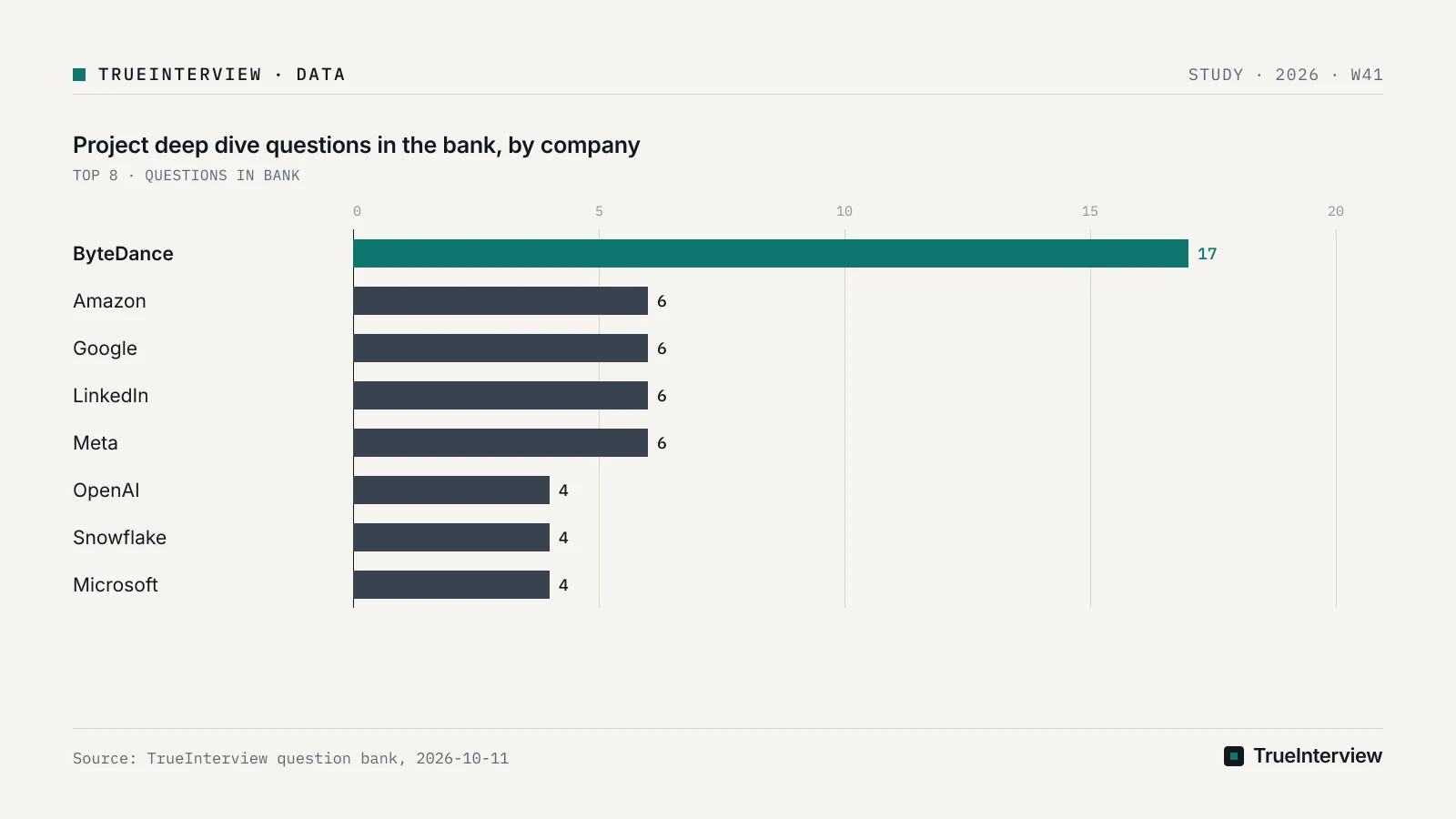
Take one piece of work you carried from milestone to production and build it twice, once for a phone-screen resume drill and once for an onsite deck. ByteDance holds the largest company block in the bank with 17 project deep dive questions, and OpenAI's slide-based round sits at the opposite end of the level table, so a candidate with both on a list needs both artifacts.
Use the prompt TrueInterview's site lists under Snowflake, "Explain a Technical Project from Milestone to Production", as the rehearsal question.
- Artifact one, for the resume drill. The two-minute spine, said aloud without notes, then five minutes of answers to the four probes above. No slides. The test is whether you can start from any resume line about this work and reach the hardest decision within a minute.
- Artifact two, for the slide-based round. A short deck built from the same spine: problem and constraints, architecture, the hardest decision with the alternatives you rejected, what failed in production, results, and what you would change. Remove every technology name you cannot explain at the level of internals.
Same work, two artifacts: a verbal spine for the screen and one deck for the onsite. Build the verbal version first, because the deck is easier to write once the spine survives a drill.
How we counted
All counts come from TrueInterview's bank on 2026-10-11. These are candidate-reported questions reconstructed for practice; they are not any company's official question list. A write-up count is how many candidate write-ups link a format, not how often a company asks it, and level splits rely on the level each candidate reported. TrueInterview's site says write-ups are "checked against other reports of the same round."
FAQ
How long is a project deep dive interview?
An AI engineering field guide on GitHub says the round typically runs 30 to 60 minutes, and that at senior levels it can focus on a single project for a whole hour. Ashby's page says its final-round version lasts 30 or 45 minutes depending on experience and seniority. Plan for an hour at senior level and keep your opening short, because the questions after the spine are where the time goes.
What is the Robinhood project deep dive?
AceOffer's Robinhood page says it is Robinhood's second most-reported round and "appears on almost every onsite". In TrueInterview's bank, Robinhood's Project Deep Dive is an onsite round linked from 18 write-ups (see the format table above). Prepare a conversational walkthrough of one system with the failure and the wrong decision ready, then rehearse it against the Robinhood practice page.
Is the project deep dive only for staff-plus candidates?
No. A Taro commenter reports seeing it "predominantly for Staff+ positions", and PracHub's Discord guide says Discord's 2020 guide reserved its formal version for management candidates and very senior engineers. PracHub's guide adds that the Discord guide dates to 2020 and that Discord's careers page does not publish a replacement loop, so treat it as history. In the bank, ByteDance's resume drill draws more junior links than senior ones, so mid-level candidates should prepare too.
Do I need slides for a project deep dive?
Only if your target's format asks for them. Refery's guide says "Slides are optional. A verbal explanation or a simple diagram should be sufficient." Ashby's page says no slides or formal prep are required. Coditioning's guides describe the OpenAI and Anthropic rounds as presentations with a deck or structured document. Build a deck for those two formats and a verbal spine for everything else.
How is a project deep dive different from a system design interview?
A Taro commenter describes it as "a blend of a behavioral and a system design interview." The same commenter says "The difference is that it's for a system that you have already designed, and you will need to explore and defend all the decisions you made." In system design you can choose the clean answer; in the deep dive you defend the compromises you actually shipped, so prepare those compromises as deliberately as the architecture.
Your practice plan
Three weeks at a few evenings a week is enough, because the material is work you have already done. A Pragmatic Engineer newsletter post says "If you're going to spend 80 to 100 hours preparing for an interview cycle, spending a single weekend on your stories might be the highest-leverage investment you make."
- Week one, first evening. Pick your two stories, one for depth and one for scope, and list the parts of each you did not own. Find your target companies in the format table and note which artifact each needs.
- Week one. Write the spine for each story and the paragraph for each layer below it: decisions, alternatives, what failed, what you would change. Rehearse the depth story against the ByteDance resume drill or the DoorDash end-to-end prompt.
- Week two. Ask a colleague to run the four probes on each story, interrupting at least twice per answer. Rewrite any answer where you said 'we' about a decision you made, or 'I' about one you did not.
- Week two, if a slide-based round is on your list. Build the deck from the spine and rehearse it against the OpenAI technical deep dive or the Anthropic impactful-project round, stopping at twenty minutes of slides.
- Week three, if you are targeting senior or staff. Rehearse the scope story against the Uber combined onsite or the LinkedIn four-axis deep dive, and answer who you persuaded, what you deferred and how the result was measured.
- Week three, final evenings. Run each story once more with every constraint changed: half the time, a smaller team, stricter reliability. If a decision would not change, be ready to say why.
Sources
- TrueInterview question bank — project deep dive at big-tech companies — counted 2026-10-11
- An engineering project deep-dive interview for startup hiring | Refery — checked 2026-10-11
- OpenAI SWE Interview: Project Deep Dive Guide | Coditioning — checked 2026-10-11
- Why I Hire for Depth (as a VP of Engineering). — checked 2026-10-11
- Discord Software Engineer Interview Guide 2026: Coding, Real-Time Systems, Project Deep Dive, and Timeline | PracHub Knowledge Hub — checked 2026-10-11
- OpenAI Software Engineer, Applied AI Interview Experience (Oct 2025) — checked 2026-10-11
- Anthropic SWE Onsite: Project Deep Dive Guide | Coditioning — checked 2026-10-11
- ai-engineering-field-guide/interview/questions/03-project-deep-dive.md at main · alexeygrigorev/ai-engineering-field-guide · GitHub — checked 2026-10-11
- Apple: Project Deep Dive: End-to-End Walkthrough, Trade-offs and Communicating Decisions — checked 2026-10-11
- Project Deep Dive interviews — checked 2026-10-11
- Project Deep Dive — Robinhood Interview Question, 17 reports | AceOffer — checked 2026-10-11
- Engineer Past Projects Deep Dive | Ashby — checked 2026-10-11
- Real FAANG Interview Questions by Company · TrueInterview — checked 2026-10-11
- Learnings from conducting ~1,000 interviews at Amazon — checked 2026-10-11
Last reviewed: 2026-10-11.