Study
How to Prepare from Candidate-Reported Interview Questions
TrueInterview
October 11, 2026 · 15 min read
Disclosure: TrueInterview is an interview-preparation product and publishes this article. Facts about other products come from their public pages on the dates listed under Sources.
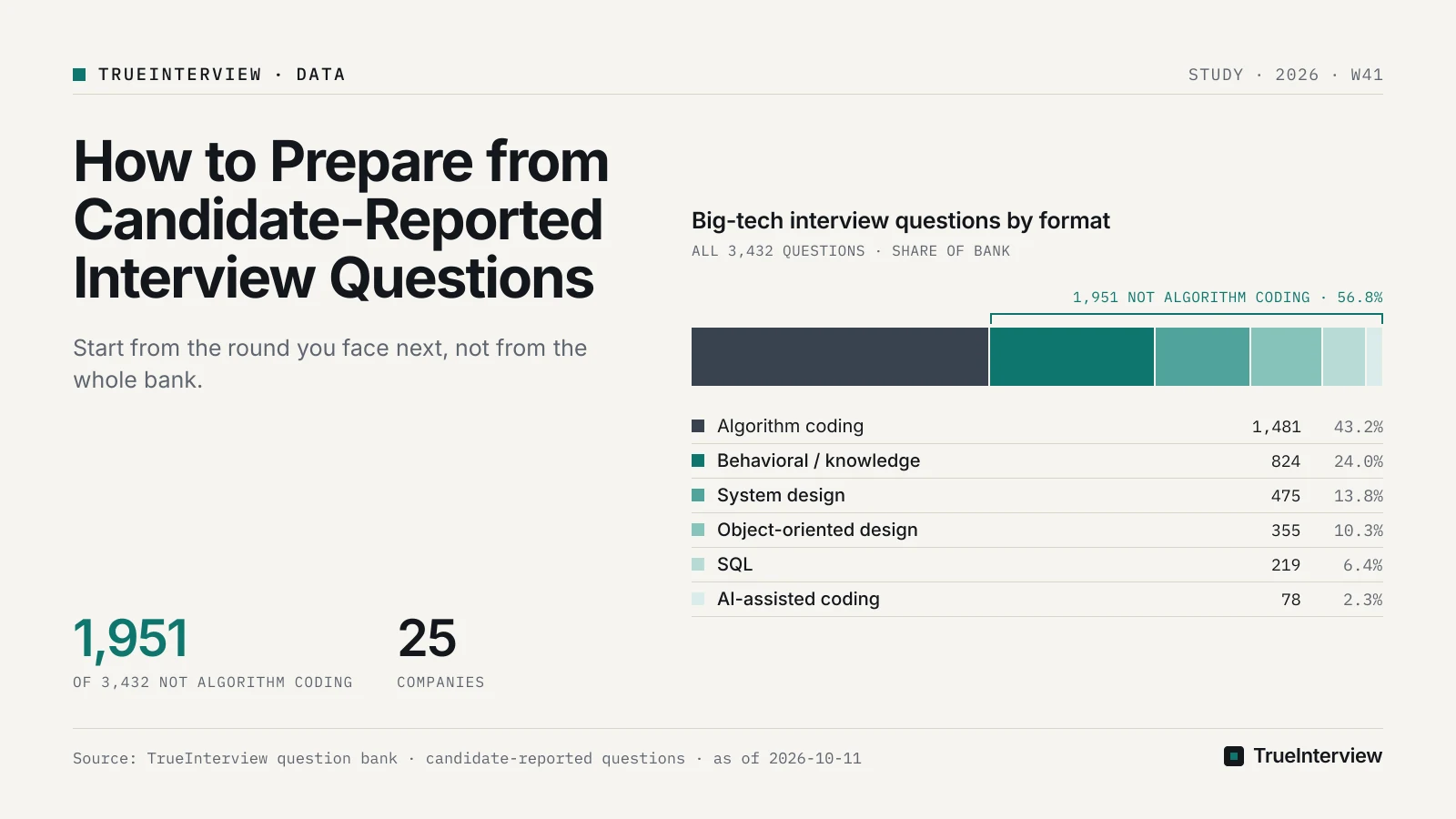
Split your hours by the counts before you pick problems. Of the 3,432 candidate-reported big-tech questions in TrueInterview's bank at 25 companies as of 2026-10-11, coding (algorithm) is 1,481, about 43%, followed by behavioral/knowledge 824, system design 475, object-oriented design 355, SQL 219 and AI-assisted coding 78. A coding-only plan covers less than half of what candidates reported. Then fix the round you face next: reported rounds are phone screen 1,789, onsite 1,557, OA 347 and take-home 5, and one question can be reported in more than one round.
How we counted
TrueInterview's counts describe what candidates reported and how those reports were filed by company, round, format and topic, as of 2026-10-11. They are not how often a company asks anything, and they are not official question lists. A question filed under several companies was reported at each of them.
Which algorithm topics should you drill first?
Drill graphs, hashing, strings and arrays first, then greedy, trees and dynamic programming. Across the 1,481 coding questions, the leading tags are graphs 227, hashing 203, strings 198 and arrays 185, followed by greedy 118, trees 113, dynamic programming 110, math 93, sorting 93, backtracking 89, two-pointers 80 and binary search 78.
The four leaders carry 813 tags between them, more than the next eight tags combined (774). Tags overlap, so that is not a share of questions; as a rule of thumb, give the top four about half your coding hours. On a four-week runway with ten coding hours a week, that is roughly twenty hours on the top four and twenty on greedy, trees, dynamic programming and the rest. On a two-week runway, spend the first week on the top four only. For graphs, practise breadth-first and depth-first traversal, cycle detection and topological ordering until each comes out of a blank file without hesitation.
An interviewer quoted in a codingcareer.de guide says most real questions they ran or sat in on were array and string problems with two-pointer or sliding-window thinking. Build the arrays and strings block around those two patterns. The same codingcareer.de guide calls LeetCode hard over-preparation, which is a good reason to leave hard dynamic-programming sets until the top seven tags feel routine.
Does the topic priority change between OA, phone screen and onsite?
Yes, so reorder by the round you face next. Among the 258 coding questions reported for the OA round, the leading tags are arrays 54, strings 40, hashing 40 and greedy 25. Among the 907 reported for the phone screen, they are graphs 155, hashing 119, strings 116 and arrays 86. Among the 463 reported for the onsite, they are graphs 97, strings 73, hashing 72 and arrays 61.
Graphs do not make the OA top four, so if the OA is next, open with arrays, strings, hashing and greedy and leave graph-heavy sets until after you pass it. The phone-screen and onsite orders are close enough that one plan covers both: open with graph traversal, then hashing and strings. The OA is the outlier.
If you do not know which round comes next, ask. Amazon's interview prep page advises connecting with your recruiting point of contact to understand the subjects and skills you will most likely discuss. Until you hear back, start with hashing, strings and arrays, the three tags that sit in the top four of all three rounds.
How should your prep differ by target company?
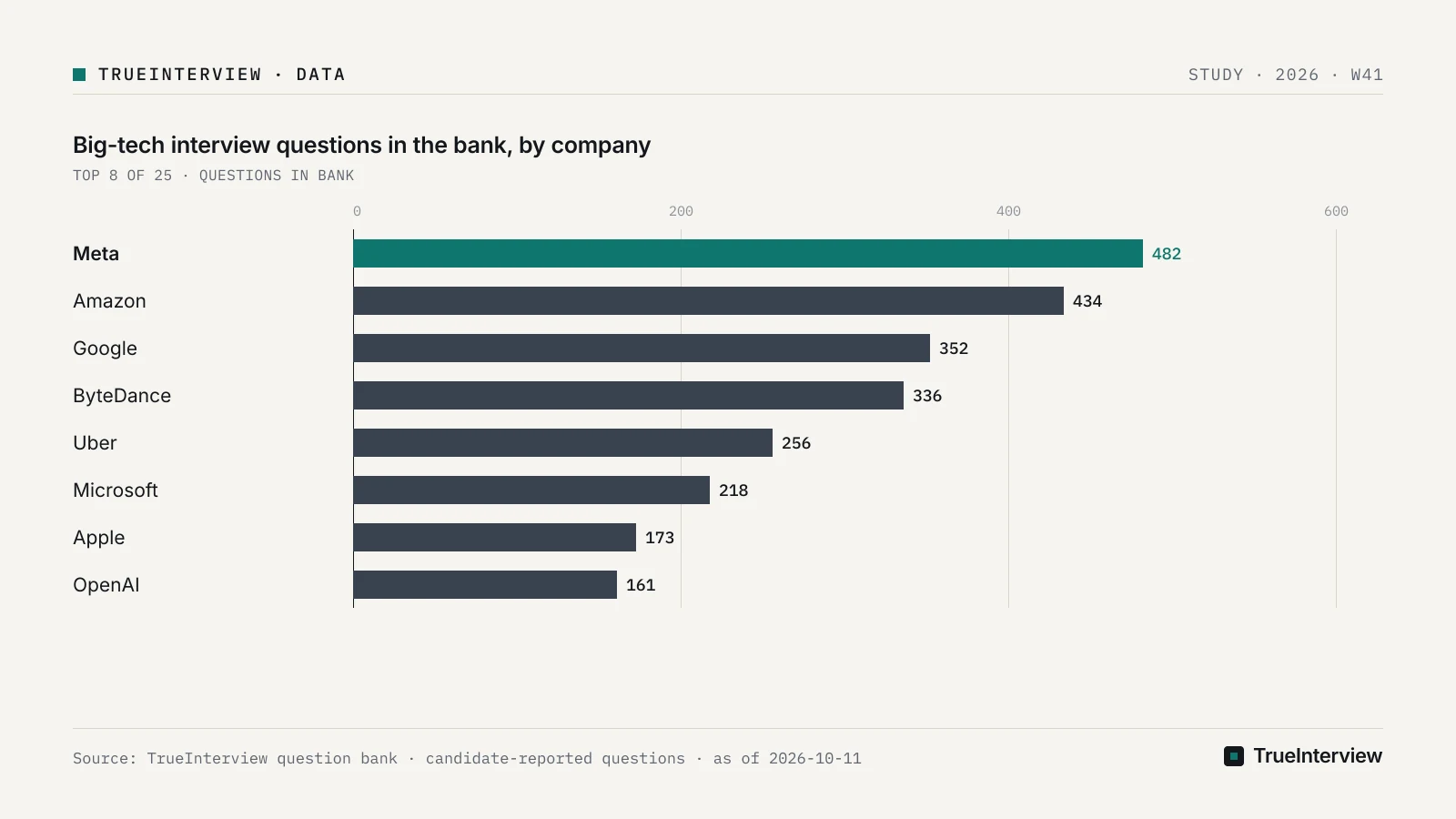
Use your target's own topic mix, not its question total. Meta has 482 questions in the bank and Google 352, but those totals reflect how much candidates reported, not difficulty or how often each company asks. The useful signal is the order inside each company's file.
| Company | Coding skew (of N coding questions) | Other-format skew (of N other-format questions) | First change to the global plan |
|---|---|---|---|
| graphs 41, arrays 27, hashing 23 (of 189) | behavioral 39, OOD 26, statistics 24 (of 124) | Arrays move ahead of hashing; budget a behavioral block | |
| Uber | graphs 39, arrays 28, strings 15 (of 154) | OOD 21, statistics 20, behavioral 7 (of 68) | Graphs first by a wide margin; OOD and statistics over stories |
| Amazon | hashing 35, arrays 27, graphs 26 (of 195) | behavioral 53, OOD 38, ML fundamentals 26 (of 189) | Open on hashing, not graphs; behavioral is the largest block |
| Meta | graphs 24, strings 22, trees 20 (of 171) | SQL 62, statistics 58, behavioral 39 (of 236) | Add trees to week one; SQL and statistics before OOD |
| ByteDance | graphs 33, arrays 24, strings 23 (of 174) | SQL 22, ML fundamentals 19, OOD 18 (of 125) | Global coding order holds; add SQL and ML fundamentals |
| Microsoft | graphs 21, strings 20, arrays 17 (of 119) | OOD 25, behavioral 11, ML fundamentals 7 (of 69) | Coding tags are flat, so keep the global order; OOD is the main extra |
The coding column mostly keeps the global top four, with two exceptions: at Meta, trees reach the top three while arrays and hashing do not, and Amazon is the only file in the table that opens on hashing. The other-format column changes the kind of preparation, not just the order: Meta's file is led by SQL and statistics, while Amazon's is led by behavioral, so a candidate interviewing at both needs two separate non-coding blocks.
How do you budget the non-coding half by round?
Read the other-format split for your next round and block hours to match. Onsite other-format is led by object-oriented design (197 of 758) and behavioral (130), with statistics (93) and SQL (61) behind them. Phone-screen other-format is led by SQL (132 of 720) and statistics (113), with behavioral (105) and OOD (95) behind them. OA other-format is SQL (30 of 81) and OOD (27), with behavioral (5) and motivation (3) barely registering.
For an OA, practise SQL and class design and leave story preparation for later. For a phone screen, SQL and statistics are the gap a coding-only plan leaves widest. For an onsite, write and rehearse your behavioral stories at least a week before the loop, and give object-oriented design its own sessions rather than folding it into coding practice.
AI-assisted coding is its own format with 78 questions, about 2% of the bank, and reported examples include LRU Cache at Apple's phone screen and Maze Solver at Meta's onsite, both last reported 2026-09. A frequency-only plan would drop it. Keep one timed sitting if Apple or Meta is on your list, because directing a model under time pressure is a skill none of your other drills practise. TrueInterview says coding, SQL, system design, object design and AI pairing are each practised in their own workspace, so treat them as separate tracks rather than coding variants.
Which system design problem families appear most often?
Ads and recommendation ML leads the design questions, followed by LLM infrastructure. Across the 475 design questions, the families are ads, recommendation and ranking ML (59), LLM, RAG and AI infrastructure (42), metrics, logging and data pipelines (32), A/B testing and experiment design (30), booking, inventory and ticketing (28), maps, ride-hailing and delivery (28), payments, ledgers and money movement (23), prediction and classification ML (19), chat, messaging and comments (18) and storage, caching and key-value stores (17); 41 titles match no family.
The round changes the mix. Among the 162 design questions reported for the phone screen, A/B testing leads with 24, then LLM/RAG 16, ads 16 and metrics 10, so measurement problems account for 34 of the 162. Among the 336 reported for the onsite, ads leads with 45, then LLM/RAG 28, booking 24 and metrics 23. With one phone-screen design round and time for one family, prepare A/B testing. For an onsite, prepare ads and recommendation first and booking second.
Company files differ, and some are thin. Meta's 75 design questions skew ads (14), A/B testing (9) and news feed (5); Amazon's 50 skew metrics (7), maps (6) and LLM/RAG (5). Google's 39 skew news feed (4), chat/messaging (3) and A/B testing (3); ByteDance's 37 skew ads (6), video/media (4) and metrics (4). Uber's 34 skew maps (7), ads (5) and A/B testing (5); Microsoft's 30 skew LLM/RAG (4) and booking (3). Among these files, only Meta's ads lead is large enough to plan a week around; a family with three or four titles deserves one timed drill, not a week.
Named titles to drill in each family: ads and recommendation includes "Design an Ads Frequency Cap System" (Netflix), "Design A Nearby Restaurant Recommendation System" (DoorDash, Uber) and "Reels / Short Video Recommendation" (Meta). LLM infrastructure includes "Design GPU Inference Serving System" and "Design AI Prompt Playground", both Anthropic. Metrics includes "Design Metrics System" (Amazon, DoorDash) and "Metrics & Monitoring Platform" (LinkedIn). A/B testing includes "Design a switchback and choose block length" (Uber) and "Design an A/B Testing Platform" (Airbnb). Booking includes "Design Hotel Booking System" (Airbnb, Amazon).
Drill two or three titles from one family rather than one title from many. As general engineering advice, not something the reports record, a payments answer should cover idempotency (what happens when the same request arrives twice) and a ledger whose balances are derived from immutable entries. A metrics or pipeline answer should cover the time-series store and the aggregation window.
Which specific questions recur across the most companies?
Start with named questions that are filed under many companies or linked from many write-ups. Rate Limiter is linked from 25 candidate write-ups across six companies: Snowflake, Pinterest, Google, Amazon, Snapchat and Microsoft. Design Payment System is linked from 27 write-ups across OpenAI and ByteDance.
Merge Intervals and Merge Two Interval Lists are each filed under the same 12 companies, so drill them as a pair. Design Job Scheduler is also filed under 12 companies, Course Schedule under 10 and Durable Key-Value Store Serialization under 9. Breadth across companies is the better signal if you are applying widely. Write-up count matters more when your target is one of the companies named.
Check the format before you drill an anchor. In TrueInterview's Stripe onsite example, Rate Limiter is filed as an object-oriented design question, so practise it as a class with a clean interface as well as a distributed design. TrueInterview's compare page quotes one candidate report that shows how a follow-up can escalate: "Sliding window at first, then he asked what happens across three app servers and made me redo it with a shared store". For any design-flavoured anchor, prepare the scale-out follow-up before the interviewer asks it.
The coding anchor with the heaviest write-up coverage among these is Infection Spread Simulation, linked from 34 write-ups at OpenAI and Anthropic and filed as a coding (algorithm) question at OpenAI's phone screen, last reported 2026-06.
Behavioral and knowledge anchors: Project Deep Dive is linked from 47 write-ups (ByteDance), Culture & Behavioral Interview Questions from 43 (Anthropic, DoorDash), Onsite BQ + Hiring Manager + Project Deep-Dive from 32 (Uber), Leadership Principles Standard Set from 30 (Amazon) and GenAI Usage (How / Failure / Tradeoff) from 29 (Amazon). Two of the five include a project deep dive, so one rehearsed walkthrough of your strongest project covers more anchor ground than a long list of short stories. For Amazon, prepare a Leadership Principles story set and a separate answer on how you use GenAI tools, including a failure and a trade-off.
A worked drill list for one company
Take a Google phone screen three weeks out. The bank has no Google-by-round split, so combine Google's company file with the phone-screen round file. Google's 189 coding questions lead with graphs 41, arrays 27 and hashing 23. Google's 124 other-format questions lead with behavioral 39, then OOD 26 and statistics 24, while phone-screen other-format leads with SQL and statistics. Statistics is the overlap, so it takes the first non-coding block, with behavioral second.
Week one: graph traversal, then arrays and hashing, plus two experiment-design sessions. Week two: Rate Limiter, which counts Google among its six companies, and Googliness Themes, a behavioral question last reported at Google's phone screen in 2026-08. Week three: Google's design file is thin, so give news feed, chat/messaging and A/B testing one timed drill each and spend the rest of the week on mixed timed sets.
A single ninety-minute session looks like this. Spend ten minutes reading the report and restating the constraints aloud. Solve in a blank editor on a thirty-five-minute timer while narrating. Run the hidden tests and study the first failing case for fifteen minutes. Use the remaining time to re-solve the failed part from scratch and write down the edge case you missed.
How recent is the data, and how do you vet a report?
2,729 of the 3,432 questions, about 80%, were last reported within the 12 months before 2026-10-11. That share says the bank is fresh, not that the question in front of you is, so read each question's own last-reported month before you drill it.
LeakCode's guide to recent questions says a single unusual report is weak signal, while multiple recent reports of the same category from different candidates indicate active rotation. LeakCode also says a 6-12 month filter balances recency with sample size, and that recency matters most for online assessments because they rotate fastest. Amazon's OA prep page says Amazon, not online discussions, is the source of truth for OA topics.
Turn that into a rule. Prefer questions reported by several candidates within the last six to twelve months. Treat a single report as a sample of the format, not a question to memorise. Before an OA, skip anything last reported more than about six months ago. When a company publishes its own topic list, as Amazon does for its OA, let it overrule the reports.
TrueInterview says each question in the bank was asked at the company it is filed under, and that reports are written up right after the interview and checked against other reports of the same round. The site says reports are dated when the report gave a month, with recent, often-reported questions shown first, so weigh an undated question lower. TrueInterview also says an engineer who has worked at this kind of company reviews each question before it is filed.
How should you practise once the list is built?
Do each coding and SQL drill in a workspace that grades you, because a failing test case shows the edge you missed; for design and OOD prompts, work on a whiteboard and check yourself against the decisions the prompt forces. TrueInterview says every question has a reference solution and that coding and SQL answers are judged on hidden tests that show the case you failed. System design rounds get a whiteboard and SQL runs on Postgres, according to the site.
One timed attempt with the failing case reviewed teaches more than three reference solutions read. Read the reference only after your attempt. Narrate as you go: Simplify's Google new-grad guide says silent correct code is penalized, and an interviewer quoted in a codingcareer.de guide says candidates who pass openly say when an approach does not work and back up.
The site says it does not sell mock interviews with human engineers and advises booking one or two elsewhere before an onsite. For a first sitting, open the practice question bank, filter by your round, and build the list from the anchors above.
FAQ
Are candidate-reported questions accurate?
Treat them as reconstructions, not transcripts. They are candidate-reported questions rebuilt for practice, not any company's official question list. LeakCode states that accuracy improves when the same question is reported multiple times from different sources and time periods. Jane Street says much of the information about its interviews floating around the internet is outdated or wrong. The practical test is corroboration: a question several candidates reported recently is worth drilling, while a single old report tells you more about the format than about the exact prompt.
Should I memorise the reported solutions?
No. Use reported questions to learn the pattern and the follow-ups, then solve fresh variants. Amazon's software development interview prep page says interviewers will not evaluate the ability to memorize topic details and instead look for the ability to apply knowledge to solve problems. An interviewer quoted in a codingcareer.de guide says some people solve four hundred problems but fall apart on a medium because they pattern-match instead of thinking. If you recognise a question in the room, still clarify the constraints and talk through your approach before coding.
What if my target company has only a few reports?
Fall back on the round file instead of the company file, because the round-level mixes cover far more questions than a small company's file. Use the topic order for your next round, then add named questions filed under many companies, such as Merge Intervals, which is filed under 12 companies across the bank. Read whatever write-ups exist for your company on the interview board to learn the round structure, and ask your recruiter which subjects to expect before you lock the plan.
Does system design matter at my level?
It depends on level, so check before you spend design hours. Simplify's Google new-grad guide says system design is generally not asked for new grad L3, starts at L4 and becomes a full round at L5. A lambrospetrou.com article on big-tech interviews says system design architecture interviews occur 1-2 times for Senior+ levels. A new grad can move most design hours to coding and behavioral, while a senior candidate should treat the design-family work above as a core block.
How long should preparation take?
There is no standard figure, so plan from your runway. One engineer writing on lambrospetrou.com reported needing about 1 month of near-daily problem-solving practice after five years at Amazon/AWS, and about 2 weeks on a later switch, mostly refreshing past material. That is one person's account. With four weeks, follow the full drill list above. With two, keep the top four coding tags, your round's two largest non-coding blocks and one design family.
Your practice plan
- Name your next round. If you do not know it, ask your recruiter, and start with hashing, strings and arrays, which sit in the top four tags of every round.
- Set your coding order from that round's tags and give the top four about half your coding hours. When time runs short, cut the tags below binary search first, then any design family that does not match your target.
- Apply your target's row from the company table: hashing first for Amazon, trees in week one for Meta, the global order for Microsoft.
- Block the non-coding half by round: SQL and statistics before a phone screen, object-oriented design and behavioral before an onsite. Rehearse one project walkthrough against Project Deep Dive.
- Drill the cross-company anchors: Rate Limiter as both a class design and a distributed design, Merge Intervals with Merge Two Interval Lists, Infection Spread Simulation for OpenAI or Anthropic, and Leadership Principles Standard Set for Amazon.
- Pick one design family matched to your company and round, and drill two or three titles from it on a timed whiteboard.
- Before drilling any report, check its last-reported month and how many candidates reported it. Skip single, older reports before an OA.
- Read one candidate's full round on the interview write-ups board, then do one timed sitting per format and review every failing case.
Sources
- TrueInterview question bank — big-tech interview at big-tech companies — counted 2026-10-11
- FAANG Interview Insights: A Conversation with Ihab A. (Ex-Google, Ex-Meta) - Guides - codingcareer — checked 2026-10-11
- Amazon Software Development Interview Topics — checked 2026-10-11
- Real FAANG Interview Questions by Company · TrueInterview — checked 2026-10-11
- Interview prep compared: your application, end to end · TrueInterview — checked 2026-10-11
- Recent Interview Questions from Top Tech Companies (2026) | LeakCode — checked 2026-10-11
- Online Assessment Prep: Software Development Engineer II — checked 2026-10-11
- Google New Grad SWE Interview 2027 Prep Guide | Simplify Blog — checked 2026-10-11
- Real Interview Questions (2026): 51,000+ Verified Reports | LeakCode — checked 2026-10-11
- Preparing for a Software Engineering Interview :: Jane Street — checked 2026-10-11
- How to pass the interview for software engineering roles in Big Tech | Lambros Petrou — checked 2026-10-11
Last reviewed: 2026-10-11.