Perplexity · Study
Perplexity Software Engineer Interview Process
TrueInterview
July 24, 2026 · 14 min read
Perplexity's Software Engineer loop is built around one kind of problem: a small stateful system, such as a file system, a credit ledger with expiries or a task list with dependencies, written from scratch in a shared editor in about 45 minutes and then extended. Approach is rarely what fails. Rejections come from a single unguarded edge case the interviewer's test exposes, or a recursive solution that times out on one large hidden input. Every stage is graded, including the recruiter call and a take-home with a generous timer, and the final conversation is with a founder or senior leader.
This guide breaks down each stage of the Perplexity Software Engineer interview, what interviewers evaluate in each round, and how to prepare, with questions candidates were actually asked.
Verified: Based on 22 candidate-reported interview experiences, primarily from 2025 Q3 through 2026 Q2, cross-checked against recent public accounts.
Perplexity Software Engineer interview process
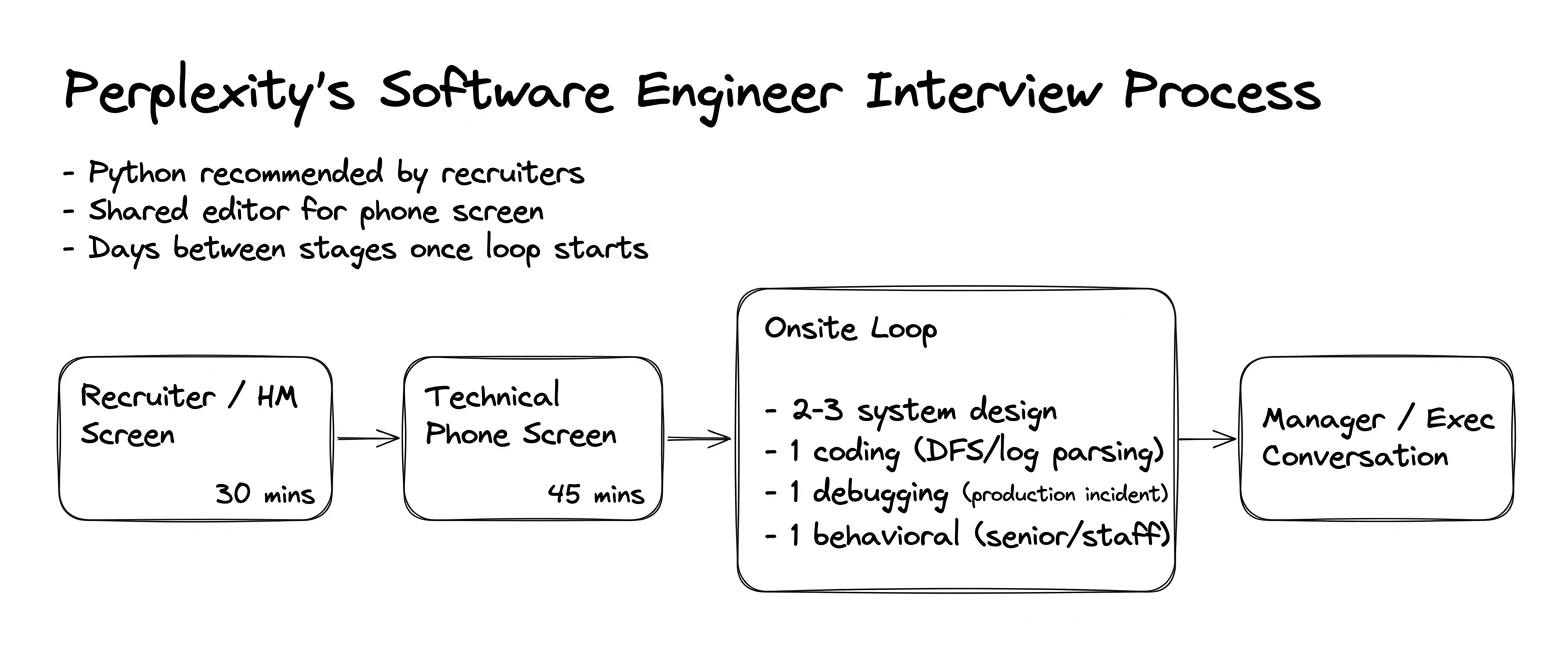
Every engineer holds the same title, Member of Technical Staff, and engineering leadership assembles each role's loop from a published set of round types (practical assessment, hands-on coding, system design, core expertise, agentic coding and a self-steered project round); substitution requests are not accepted, and new formats appear as the company experiments.
Most candidates see a recruiter call, one technical screen or online assessment, and an onsite of about four or five interviews ending with a founder or leader. At staff level the screen can fuse coding with a design discussion and add a standalone behavioral round; early-career candidates may get a core-expertise round in a discipline they choose.
Here's what the interview process can look like:
- Recruiter phone screen: About 30 minutes on motivation, your proudest or hardest project, its tech stack and compensation expectations.
- Practical assessment (some pipelines): An at-home coding exercise in a runnable editor, designed for 45 to 90 minutes but usually given a two- or four-hour timer.
- Hands-on coding screen: A 45-minute live build of a small in-memory system in Python, verified part by part with the interviewer.
- Onsite coding and debugging rounds: Practical coding such as log processing, dependency graphs and diagnosing a failing production system.
- System design interview: 45 to 60 minutes on a product-shaped service such as a discovery feed, trending queries or abuse prevention.
- Hiring manager and founder interviews: A deep dive on past work and behavioral judgment, then a closing conversation with a founder or senior leader.
Tip: Every round grades the last ten percent: build the smallest working version, state the error behavior aloud, and keep five minutes for the cases the interviewer will run.
Recruiter phone screen
The first call runs about 30 minutes with a recruiter or HR partner. Candidates are asked why Perplexity, what kind of team workflow and collaboration they want, their background, and in nearly every account the project they are proudest of or found hardest: their role, the obstacles, and the technologies they chose and why. Compensation expectations come up in the same call, followed by an outline of the remaining stages. Recruiters have volunteered that the coding interview is 45 minutes, that Python is recommended, and that the bar is high in exchange for unusual autonomy once hired.
The call is a screen, not logistics: one candidate was rejected after it alone, having been asked only about the project, the stack and motivation. AI-adjacent openings have had unannounced technical questions in this call.
Interviewers evaluate:
- Project ownership: Your specific decisions on one hard project, not a summary of the team's work.
- Stack reasoning: Why you chose each technology and what you would change now.
- Product motivation: A concrete reason for Perplexity grounded in its products, not generic interest in AI.
- Fit with the pace: Comfort with high autonomy, fast shipping and in-office work at least four days a week near an office.
Prepare a five-minute account of one project with its obstacles, stack choices and result, and use the products first.
Sample questions for the recruiter phone screen
Here are some questions reported by recent candidates:
- Why do you want to join Perplexity, and how do you like your team to work day to day?
- Describe the project you are proudest of: your role, the hardest obstacle and the impact.
- What tech stack did that project use, and why did you choose it?
- What are your compensation expectations?
Practical assessment
Some pipelines replace or precede the live screen with a self-scheduled practical assessment in a runnable, CoderPad-style editor. Perplexity designs these for 45 to 90 minutes but usually sets a two- or four-hour timer and gives no credit for submitting early. Online language documentation and asking a search or AI tool about library usage are allowed; having a tool write a significant part of the solution is an integrity violation.
Reported variants: an in-memory file system with mkdir, ls, file creation, append and read, sorted listings and errors for invalid operations, matching a well-known public problem, with platform-supplied test cases; a four-hour take-home in three parts (summarize an unfamiliar codebase in English, reimplement its tokenize function with identical output using a priority queue and a linked list so all tests pass within 10 seconds, then build a token-count estimator graded by hidden tests); a fast byte tokenizer that must match a slow reference exactly, plus a sampled token-count estimate for a huge corpus; and a timestamped key-value store.
Interviewers evaluate:
- Correctness against provided and hidden tests: Run the supplied tests early and often; hidden tests include performance limits.
- Pace against the design length: The recruiter's remark that most finish in about an hour is the real bar.
- Reading before writing: The tokenizer tasks fail on silent mismatches when a merge-priority or special-character rule was missed.
- Clean tree modeling: A trie or nested node structure that distinguishes files from directories beats a flat path map.
Practice building a trie-backed file system and reimplementing an unfamiliar function to exact output parity, each inside an hour.
Note: The long timer is a trap. A candidate who used well over an hour of a four-hour take-home was rejected after being told most candidates finish in about one; the timer is a buffer, not the target.
Sample questions for the practical assessment
Here are some questions reported by recent candidates:
-
Implement an in-memory file system where creating a file builds missing directories, appending extends content, and listing a directory returns sorted names.
-
Read a supplied codebase, summarize it in English, then reimplement its tokenize function so every test produces identical output within 10 seconds.
-
Use the tokenizer you built to estimate the token count of new inputs, scored against hidden cases.
Hands-on coding screen
The technical screen is 45 minutes with one or two engineers in a shared CoderPad session where code runs; virtual candidates share their full screen. Python is strongly recommended, C++, Go and TypeScript are accepted, and Java is strongly discouraged. Several interviewers skip introductions entirely and some stay silent for the whole round, while others hint about stack depth or performance. Exercises are written in-house as multi-part builds, and after each part you and the interviewer verify it together, often with the interviewer's own test cases.
Reported problems: a Unix-style file system with touch, mkdir, ls, rm and rmdir on absolute paths where touch requires an existing parent; a credit tracker whose deductions consume the earliest-expiring credits first while grants arrive out of time order; a timestamped key-value store with get, set, delete and a restore to an earlier point in time; returning the text before the first stop word, then redoing it for a character stream that does not fit in memory; and a generator that yields stop-word-free lines from a multi-gigabyte file. Some screens open with a short buggy function to diagnose before the main problem, one followed with DFS plus memoization over a state space, and a staff screen paired a coordinate problem (escape a premium region from a starting point) with designing fraud and API-abuse defenses.
Interviewers evaluate:
- Complete, bug-free parts: You need not finish every part, but a finished part with a bug costs the round.
- Data-structure choice up front: A min-heap keyed on expiry with lazy cleanup, a trie or n-ary tree for paths, interval-aware versions for time.
- Stated error contract: Missing parents, files where directories exist, non-empty directories, expired credits.
- Streaming instincts: Generators, constant-memory buffers and set lookups once the input stops fitting in memory.
Practice 40-minute in-memory builds in a runnable editor, ending with your own adversarial tests.
Note: Most reported rejections at this stage came from candidates with the right approach. An rmdir that deleted a non-empty directory, a file-overwrite bug still open at the end, and an unfinished restore on the time-based store each ended a candidacy.
Sample questions for the hands-on coding screen
Here are some questions reported by recent candidates:
-
Build an in-memory Unix file system supporting touch, mkdir, ls, rm and rmdir, where rmdir must refuse a non-empty directory.
-
Track credits that each expire, deduct from the earliest expiry first, and report the unexpired balance when inputs arrive out of time order.
-
Return the text before the first stop word, then process an unbounded character stream in constant memory.
-
Decide whether a starting coordinate lies inside a premium region and return a path or point outside it.
Onsite coding and debugging rounds
The onsite usually carries one or two more practical coding sessions, and sometimes a debugging session. The most frequent problem is a to-do list for an AI assistant: CRUD for tasks, then parent and child dependencies, where completing a task moves blocked dependents to ready and a failure cascades through every descendant; variants block completion until prerequisites finish, prevent cycles, and ask how to add persistence and concurrency. Other sessions aggregated raw server logs per endpoint despite malformed lines, ran a DFS problem with complexity analysis, or traced an intermittently failing production system from its logs to a root cause and fix.
Some loops instead use an agentic coding round (three hours at home, or 60 to 120 minutes live) where frontier coding agents are required and the bar for scope and quality is higher, or a self-steered project built from idea to implementation; the recruiter says which apply.
Interviewers evaluate:
- Scalability on the hidden input: Two candidates' recursive cascades passed the examples and timed out on a deep dependency graph.
- Bidirectional modeling from the start: Parent and child references stored before the cascade logic arrives.
- Robust parsing: Malformed lines and ordering edge cases handled without loading everything into memory.
- Root-cause reasoning: In debugging, a chain of events from symptom to fix, not a list of guesses.
Practice cascading state changes over dependency graphs with an explicit stack, and parsing messy logs into aggregates.
Tip: Write the failure cascade iteratively from the first version. Neither rejected candidate had time to work out whether recursion depth or repeated subtree traversal caused the timeout; an explicit stack with a visited set removes both.
Sample questions for the onsite coding and debugging rounds
Here are some questions reported by recent candidates:
-
Build a to-do list where completing a task unblocks dependents and failing one fails every descendant, then pass a large deeply nested test.
-
Parse a sample of server logs and compute request counts per endpoint and error rates, tolerating malformed lines.
-
Given a description of a system failing intermittently under load and its logs, find the root cause and propose a fix.
System design interview
System design runs 45 to 60 minutes, live, on a physical or virtual whiteboard, sometimes with documentation handed over in the room; you may be asked to design a system or refine an existing one. One reported onsite gave two of its three sessions to design. Prompts lean on Perplexity's product: a personalized discovery feed (content sources, freshness, personalization signals, scale), a trending-queries module for the home page that later gains personalization (real-time aggregation and ranking), and a personal-finance backend (data model, APIs, bank-feed integration, transaction categorization, millions of users), and a staff screen covered fraud and API-abuse prevention.
Interviewers evaluate:
- Problem framing and prioritization: Choosing the two or three parts that matter and going deep only there.
- Fit over template: An architecture shaped to this product, not a memorized diagram.
- Quantitative scaling: Numbers behind bottlenecks, freshness windows and aggregation cost.
- Adapting to new requirements: Folding in personalization or a new abuse vector without restarting.
- Layered defenses: Rate limits, authentication, anomaly signals and adaptive rules before any single mechanism.
Practice feed, trending and abuse-prevention designs with explicit freshness and latency numbers.
Sample questions for the system design interview
Here are some questions reported by recent candidates:
-
Design a personalized discovery feed, covering sources, freshness, personalization signals and scale.
-
Design trending queries for the home page that can gain personalization later.
-
Design safeguards against fraud and API abuse that do not hurt legitimate users.
-
Design the backend of a personal-finance app with bank-feed integration and transaction categorization.
Hiring manager and founder interviews
The onsite includes a deep dive with the hiring manager on past work, and team matching happens here: the manager describes the teams with openings and looks for a fit. Staff candidates reported a standalone behavioral screen on cross-team conflict, decisions they knew would be unpopular, and requirements that shifted late. The loop closes with a founder or senior leader on product thinking, engineering philosophy and why Perplexity; every role, management included, is expected to be hands-on, so technical questions can surface here too.
Interviewers evaluate:
- Depth on your own work: Precise answers about systems you built, down to the trade-offs you rejected.
- Conflict resolved through action: How you drove a cross-team disagreement to a decision.
- Standing behind hard calls: How you communicated an unpopular decision and what followed.
- Absorbing change: Keeping delivery on track when requirements moved late.
Prepare three or four detailed stories on conflict, unpopular decisions and late pivots, plus a clear view of which product surface you want to work on.
Sample questions for the hiring manager and founder interviews
Here are some questions reported by recent candidates:
-
Describe a cross-team project that hit a serious disagreement and how you resolved it.
-
Tell me about a decision you knew would meet resistance and how you stood behind it.
-
How did you keep a project on track when key requirements changed late?
How Perplexity levels and evaluates Software Engineer candidates
Perplexity publishes no level ladder; postings accept a range of experience, and level is set from the screen, design rounds and the manager's deep dive. Staff loops add combined coding-and-design screens and a standalone behavioral round. Interviewers grade rigorous thinking, control of complexity, principled trade-offs, fast learning and clear communication in words and code. A single failed coding round has ended most reported candidacies. Team matching happens during the onsite and continues after the offer, which typically comes within a week of the final interview.
How to prepare for the Perplexity Software Engineer interview
- Drill four small systems end to end: An in-memory file system, an expiring-credit tracker, a timestamped key-value store with restore, and a dependency-aware to-do list, each in under 40 minutes.
- Test like the interviewer: Before declaring a part done, run the empty-directory, out-of-order, duplicate and deepest-chain cases yourself.
- Make cascades iterative: Use an explicit stack and visited set for any propagation over a graph so a large hidden test cannot time you out.
- Get fluent in Python streaming: Generators, constant-memory buffers, heaps and sets come up repeatedly; Java is discouraged.
- Respect the design length of take-homes: Aim to finish in about an hour even when the timer says four.
- Practice reading unfamiliar code: Summarize a small codebase in plain English and reimplement one function to exact output parity.
- Design for an answer engine: Feeds, trending queries and abuse prevention, with freshness, ranking and quantitative scaling.
About the Perplexity Software Engineer role
Perplexity builds an AI answer engine and the products around it, including the Comet browser, the Computer agent product, the Sonar search API and enterprise offerings. Engineers own features from idea to production in small teams with little process, and the company describes the job as fully hands-on at every level. People near an office are expected on site at least four days a week; remote candidates are considered case by case.
Perplexity hires Software Engineers across product, platform and infrastructure. Teams include:
- Comet and native apps: The agentic browser and mobile and desktop apps, spanning Chromium, Rust, Kotlin, Swift and TypeScript.
- Computer and agents: The agentic product launched in 2026 and the agent infrastructure behind it.
- Sonar API: The developer search API, one of the company's fastest-growing revenue lines.
- Search, Discover and ranking: Retrieval, ranking and the feeds and trending surfaces on the home page.
- Enterprise and platform: Platform and infrastructure for enterprise adoption of Perplexity's tools and agents.
- Growth and acceleration: Full-stack growth work and teams blending AI product development, platform engineering and developer experience.
Software Engineer experience and education requirements
Postings typically ask for four or more years of industry experience and strong programming across the full stack, with a stack that includes Python, Go, Rust, TypeScript, React, FastAPI, PostgreSQL and Redis. No degree is required; Perplexity encourages applicants who miss some requirements and runs a residency program for nontraditional backgrounds.
FAQs about the Perplexity Software Engineer interview
How long does the Perplexity Software Engineer interview process take?
Usually three to four weeks from first contact to offer: application review can take up to two weeks, later stages are scheduled within days, and offers follow within about a week of the onsite.
What is the hardest round of the Perplexity Software Engineer interview?
The 45-minute hands-on coding screen: the most reported rejections, little warm-up and a strict clock, where one unhandled edge case or a large-test timeout ends otherwise solid attempts.
What language should I use?
Python is strongly recommended and used in nearly every reported round. C++, Go and TypeScript are accepted if you are exceptionally fluent; Java is strongly discouraged. Confirm your choice with the recruiter.
Can you use AI tools during the interview?
Only where a round says so. Assessments and live coding allow language documentation and asking a tool about library usage, but not having it produce a significant part of the solution; the agentic coding round requires frontier coding agents. Cheating tools, second monitors and outside help can end a candidacy.
How much does a Perplexity Software Engineer make?
Recent United States postings list base salary ranges of about $210K to $385K for full-stack engineers and about $220K to $405K for Member of Technical Staff and staff-level roles, plus equity. Final offers depend on experience and location, and equity is a large share of the total package.