Perplexity · Study
Perplexity Machine Learning Engineer Interview Process
TrueInterview
July 24, 2026 · 11 min read
Perplexity tests machine learning theory from the first conversation: recruiter calls on this track have included unannounced transformer questions, and one candidate was rejected on that call alone. Later rounds ask you to derive and implement the mechanics of production models (decoding, long-context attention, numerically stable softmax, batched inference) rather than discuss research. The loop is short, so a weak answer to a second follow-up has ended candidacies.
This guide breaks down each stage of the Perplexity Machine Learning Engineer interview, what interviewers evaluate in each round, and how to prepare, with questions candidates were actually asked.
Verified: Based on 5 candidate-reported interview experiences, primarily from 2025 Q2 through 2025 Q4, cross-checked against recent public accounts.
Perplexity Machine Learning Engineer interview process
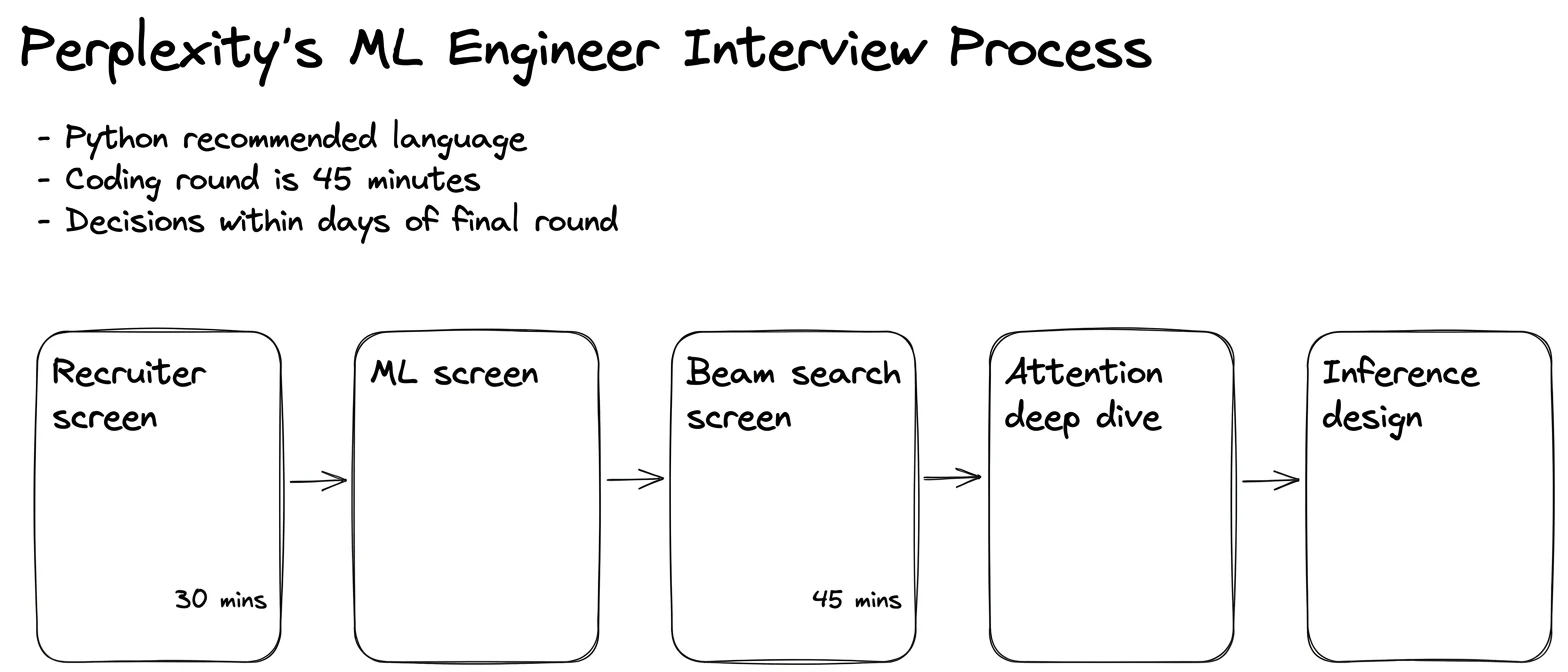
Machine learning hiring is team-shaped: inference, query understanding, personalization and agent teams run their own loops, so one candidate gets a classical modeling exercise and another a decoding algorithm or a serving design. Candidates applied online and heard back a few weeks later, or were contacted by a recruiter; once started, stages are usually days apart.
The skeleton is a recruiter call, one technical phone screen and an onsite of several technical sessions plus a closing conversation with a manager or senior technical leader. Inference-focused roles weight serving design more heavily.
Here's what the interview process can look like:
- Recruiter screen (about 30 minutes): Background, motivation and compensation, sometimes with a machine learning theory question.
- Technical phone screen (45 minutes): Applied modeling in scikit-learn or a model-stack algorithm such as beam search, with your own tests.
- Distributed attention deep dive (onsite): One extended session from MapReduce up to block-wise attention and an online softmax.
- ML system design interview (onsite): Serving and retrieval design under hard constraints, such as batching embedding requests.
- Project deep dive and leadership conversation: One project defended end to end, then product judgment with a manager or senior leader.
Tip: Refresh transformer fundamentals before the recruiter call, not the night before the technical round, and at the level of equations: the sinusoidal positional encoding with its frequency rationale, and the running-maximum softmax update.
Recruiter screen
The first call runs about 30 minutes: why Perplexity, your background, the hardest project you have shipped, compensation expectations and an outline of the remaining rounds. Recruiters have said the coding interview lasts 45 minutes, Python is recommended, and the high bar comes with high autonomy once hired.
On this track the call can turn technical without warning. Halfway through one call, the recruiter asked how positional encoding works in transformers, then probed the sinusoidal formulation, why sine and cosine at different frequencies, and learned embeddings as an alternative. The candidate gave only the high-level answer, and a rejection email arrived a few days later.
Interviewers evaluate:
- Theory past the definition: Saying that transformers need order information gets no credit without the formula and its reasoning, such as relative offsets and extrapolation.
- Motivation specific to the product: Why an answer engine, and which part of retrieval, ranking or inference you want to work on.
- A concrete hardest project: The specific obstacle, the decision you made and the result, with no team-level summary.
Review attention, positional encoding, tokenization and decoding before this call.
Note: A screen that looks like a logistics call is scored like a technical round. One of the two reported rejections on this track happened here, with no other technical stage reached.
Sample questions for the recruiter screen
Here are some questions reported by recent candidates:
- Explain how positional encoding works in transformers, why sine and cosine are used at different frequencies, and how learned embeddings compare.
- Describe the most challenging project you have worked on, the specific obstacles and how you handled them.
- Why Perplexity, and what do you expect the team's day-to-day work and collaboration to look like?
Technical phone screen
The screen is one 45-minute call in a shared coding environment, in Python. Two team-dependent variants are reported. The applied variant opens with conversational fundamentals, then asks for a scikit-learn binary classifier on a supplied toy dataset; once the baseline works, the interviewer asks you to improve its metrics through tuning or feature changes. The algorithm variant hands you a signature, such as beam search over initial states, a scorer, a beam width and a step limit; you fill in the logic, write unit tests on the spot, then discuss complexity and optimizations.
Related engineering screens use similar practical problems, such as near-duplicate detection over a stream or a fast tokenizer that must match a slow reference token for token. Interviewers add a follow-up while time remains, so finishing early matters.
Interviewers evaluate:
- A disciplined improvement loop: A clean train and validation split, a metric that suits the class balance, and one controlled change at a time, with each gain measured.
- A complete decoder: Expanding, scoring and pruning to the beam width each step, with a clear stopping rule for finished sequences and the step limit.
- Tests you write yourself: Empty inputs, ties at the beam boundary, the step cutoff and a dataset with only one class.
Practice classification end to end in scikit-learn and decoding algorithms from a bare signature, each within 30 minutes including tests.
Note: A candidate who prepared MLP, RNN and transformer implementations found none of it asked in the applied screen. That round tested baseline diagnosis, feature adjustment and tuning, and the candidate was rejected.
Sample questions for the technical phone screen
Here are some questions reported by recent candidates:
-
Build a binary classifier on a provided toy dataset with scikit-learn, then improve its evaluation metrics through tuning or feature changes.
-
Implement beam search from a given signature, write unit tests for simple cases, then discuss time complexity and optimizations.
Distributed attention deep dive
The most distinctive round is one extended conversation with little or no coding, built from four linked topics where each answer becomes the premise of the next. It starts with MapReduce for element-wise addition of two enormous vectors: aligned chunks, one mapper per chunk pair, a trivial shuffle, and re-running failed map tasks.
It moves to context parallelism (splitting Q, K and V along the sequence dimension when a context exceeds one device), then to block-wise attention, since every query must still meet every key: each device keeps its Q block, streams in remote K-V blocks and accumulates the softmax numerator and denominator. It ends on numerical stability. Subtracting the maximum before exponentiating is the easy half; the hard half is doing it online, keeping a running maximum and running sum and rescaling whenever a new block raises the maximum, so the result matches a single-device softmax.
Interviewers evaluate:
- A solid base case: A shaky explanation of MapReduce weakens every later step, because each one builds on it.
- Partitioning and communication: Which device holds which tensor, and what moves between devices at each step.
- Update equations written out: The running maximum, the running sum and the rescaling factor, written explicitly.
- Numerical reasoning: Why naive exponentiation overflows, and why the maximum must be tracked across all blocks rather than within one.
Practice explaining the progression from start to finish, sketching how tensors flow between devices and writing the online softmax update by hand.
Sample questions for the distributed attention deep dive
Here are some questions reported by recent candidates:
-
Distribute element-wise addition of two enormous vectors with MapReduce, including the shuffle and fault tolerance.
-
Split Q, K and V across devices when the sequence is too long for one device.
-
Compute attention block by block across devices, then make the softmax numerically stable as blocks arrive.
ML system design interview
Design prompts come from production serving and retrieval. In the reported inference prompt, embedding requests stream in with known token counts, and a forward pass accepts a batch only under a maximum request count and a maximum total token count; you design a concurrent architecture that maximizes throughput. The discussion covered a producer-consumer queue, greedy FIFO assembly that stops at whichever limit binds first, locks versus lock-free structures, and a dedicated batching thread feeding an inference pool versus workers building their own batches.
The interviewer then walks failure cases one at a time: a request larger than the token limit, starvation of waiting requests, and a growing queue that needs load shedding. A coding version asks for an embedding server with batched inference and graceful shutdown. Product prompts such as a discovery feed or long-running query handling push on freshness, ranking signals and latency budgets.
Interviewers evaluate:
- Interacting constraints: Seeing that the request limit and the token limit bind at different times and designing for both.
- Concurrency choices with reasons: Why one batching thread reduces contention, and where backpressure applies.
- Failure handling you raise yourself: Oversized requests, starvation, queue growth and draining pending work on shutdown.
- Serving vocabulary: Continuous batching, padding waste from requests of different lengths, and the trade-off between throughput and latency.
Practice one batching design and one retrieval-backed product design, starting each with the constraints and the metric you are optimizing.
Tip: Get the simple FIFO batcher correct first. The reported discussion went smoothly by starting with greedy assembly and adding a dedicated batching thread, a fairness timeout and load shedding as each failure case was raised.
Sample questions for the ML system design interview
Here are some questions reported by recent candidates:
-
Batch a stream of embedding requests under a maximum request count and a maximum token count to maximize throughput.
-
Handle a single request larger than the token limit, prevent starvation and shed load when the queue grows.
-
Design a personalized discovery feed with freshness and ranking signals.
Project deep dive and leadership conversation
The onsite ends with a project discussion and a meeting with a manager or senior technical leader. You defend one machine learning project: objective, data, evaluation, deployment constraints, what underperformed and what you changed. The leadership conversation covers product judgment, shipping speed and why Perplexity.
Interviewers evaluate:
- Measurement story: Offline and online evaluation, and how you knew the model helped users.
- Personal decisions: Choices you made, alternatives you rejected and the trade-off behind each.
- Failure analysis: What broke and what you changed, not just a polished summary.
- Product sense: Latency, cost and quality trade-offs seen from the user's side of an answer engine.
Prepare one project you can explain at the level of individual experiments and one failure with its fix.
Sample questions for the project deep dive and leadership conversation
Here are some questions reported by recent candidates:
-
Walk through your hardest machine learning project: the objective, the evaluation and what you changed when it underperformed.
-
What is the hardest thing you have shipped, and which obstacles did you personally clear?
How Perplexity levels and evaluates Machine Learning Engineer candidates
With few rounds, each one can end a candidacy: a single weak answer did so at both the recruiter and phone-screen stages. Perplexity publishes no formal level ladder; titles are broad (engineer, senior, staff, or member of technical staff), and the hiring team sets level from relevant experience and the depth shown in the deep-dive and design rounds. Rejections arrive by email within a few days, usually without detailed feedback.
How to prepare for the Perplexity Machine Learning Engineer interview
- Treat the recruiter call as technical: Be ready to explain positional encoding, attention and tokenization in formulas before the first call.
- Derive instead of describing: Write the sinusoidal encoding, block-wise attention accumulation and online softmax rescaling by hand until you can produce them without notes.
- Rehearse the improvement loop in scikit-learn: Build a baseline, choose a metric suited to the class balance, then tune and engineer features one change at a time.
- Implement decoding from a signature: Write beam search and similar algorithms in Python in 30 minutes, including your own unit tests and a complexity statement.
- Design one batching server thoroughly: Cover dual limits, a dedicated batching thread, starvation timeouts, oversized requests, load shedding and graceful shutdown.
- Prepare both styles of machine learning: The team decides whether you get classical modeling or LLM internals, so prepare for both.
About the Perplexity Machine Learning Engineer role
Machine learning engineers at Perplexity build the models and systems behind an answer engine: query understanding, retrieval and ranking, personalization, agents and low-latency inference. Teams are small, ship quickly and own work from experiment to production.
Perplexity hires Machine Learning Engineers across several teams. Teams include:
- AI inference: Large-scale real-time model serving in Python, Rust and C++, using PyTorch, Triton, CUDA and Kubernetes, with continuous batching and quantization.
- Query understanding: Intent classification, query rewriting, agentic task decomposition and function calling.
- Personalization: LLM memory, context summarization, and retrieval and ranking evaluated offline and online.
- Agent products: Applied research and engineering for agentic features in the product.
Machine Learning Engineer experience and education requirements
Postings ask for hands-on experience with large language models and deep learning, some for training transformer models. Query understanding roles have asked for two to four or more years in search, information retrieval, recommendation, applied machine learning or NLP; a PhD is a nice-to-have, not a requirement. Inference roles ask for PyTorch or a comparable framework, knowledge of LLM inference optimizations and real-time serving at scale; CUDA kernel work is optional. Posted cash ranges for machine learning engineer roles in San Francisco have been about $200K to $280K, plus equity.
FAQs about the Perplexity Machine Learning Engineer interview
How long does the Perplexity Machine Learning Engineer interview process take?
Usually a few weeks once a recruiter engages. Candidates who applied online waited a few weeks for the first call. After that, stages were days apart, and decisions came within days of each round.
What is the hardest round of the Perplexity Machine Learning Engineer interview?
The distributed attention deep dive: one long session of four linked topics, no code to lean on, ending with the online softmax rescaling update. Because each question builds on the previous answer, a memorized final step does not carry the round.