Perplexity · Study
Perplexity Interview Process & Questions
TrueInterview
July 24, 2026 · 11 min read
Perplexity rarely asks puzzle algorithms. The typical technical round is a small stateful system built from scratch in about 45 minutes, such as an in-memory file system, a task list with dependency cascades or a credit ledger with expiry. The interviewer then runs their own tests, including a large hidden case. Most reported rejections came from candidates whose design was sound but who left one bug or one timeout. No call is treated as a formality. Candidates have been rejected after the recruiter call alone, and machine-learning content such as tokenizers, beam search and transformer internals turns up in screens well before any onsite.
This guide breaks down each stage of the Perplexity interview, what interviewers evaluate in each round, and how to prepare, with questions candidates were actually asked.
Verified: Based on 27 candidate-reported interview experiences, cross-checked against recent public accounts.
Perplexity interview process
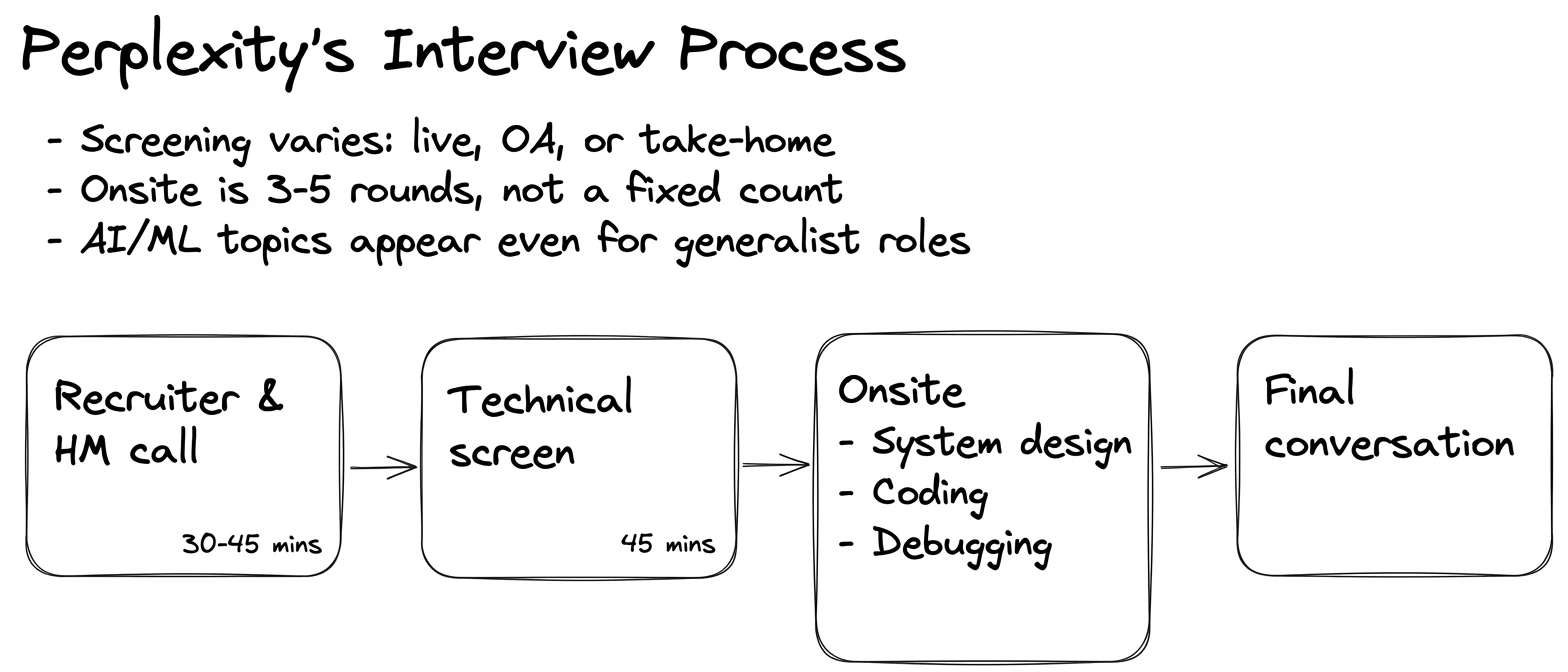
The loop is not standardized across teams. Depending on the team, the first technical step can be a live phone screen, a one-problem online assessment or a timed take-home. Final rounds range from one deep technical session to three or more back-to-back sessions. After the first call, the process usually takes one to three weeks.
Software Engineer loops center on practical builds, debugging and product-shaped system design. Machine Learning Engineer loops replace part of that with applied modeling, decoding algorithms, distributed attention and inference-serving design. At staff level, candidates have had a combined coding and design screen plus a standalone behavioral round.
Here's what the interview process can look like:
- Recruiter screen: A call of about 30 minutes on motivation, your proudest project, compensation and the rounds ahead.
- Online assessment or take-home (some pipelines): One practical problem with provided tests, or a timed take-home built around reading and reimplementing code.
- Technical phone screen: A 45-minute live build in Python that escalates to streaming, scale or a hidden large test.
- Onsite coding and debugging: Log parsing, tracing a production failure from logs, or graph traversal with memoization.
- System design interview: Product-shaped services such as a discovery feed, trending queries or abuse prevention.
- ML depth interview (Machine Learning Engineer track): Distributed attention, numerical stability and batched inference serving.
- Behavioral and leadership conversation: A project deep dive and a meeting with a manager or senior technical leader.
Tip: Recruiters state the coding round length (45 minutes) and recommend Python. Rehearse in Python with that clock, and aim to have a working baseline by minute 25, leaving the rest for the follow-up and your own edge-case tests.
Recruiter screen
The first call runs about 30 minutes. Candidates are asked why Perplexity and how they like to collaborate, and above all to describe their most challenging project: their role, the obstacles, and why they chose that stack. Compensation and the remaining stages close the call. Recruiters describe the bar as high and point to unusual autonomy once hired.
Interviewers evaluate:
- Project ownership: Specific obstacles you personally resolved and the reasons behind your stack choices.
- Motivation fit: A concrete reason to work on an answer engine, beyond the company being well known.
- Technical floor (ML roles): Whether you can go past a definition into the mechanics when probed.
Prepare one project story at full technical depth, and for ML roles, refresh transformer fundamentals before this call.
Note: Two reported rejections came at this stage. In one, an ML candidate was asked mid-call to explain positional encoding, then probed on the sinusoidal formulation and learned embeddings. The rejection followed within days.
Sample questions for the recruiter screen
Here are some questions reported by recent candidates:
- Why Perplexity, and how do you like to collaborate with a team day to day?
- Walk through your most challenging project, the specific obstacles, and why you chose that stack.
- Explain how positional encoding works in transformers and why it uses sine and cosine at different frequencies.
Online assessment
Some pipelines add an assessment before or instead of the live screen. In 2026 the most common variant was a single problem: an in-memory file system with directory creation, file append and read, and sorted listing. The platform supplied the test cases, so the work was the trie design. One take-home had a 4-hour limit and three escalating parts. Candidates summarized a supplied codebase in English, then reimplemented its tokenize function to match the output exactly within a 10-second test budget, then built a token-count estimator graded by hidden tests.
Interviewers evaluate:
- Structure choice: A trie of directory and file nodes, not a flat map keyed by full path.
- Exact behavior: The fast output must match the reference token for token. Nearly right counts as wrong.
- Code reading: Whether your written summary shows you understood unfamiliar code before changing it.
- Speed: Total time spent, not just whether the work is correct.
Practice reimplementing a slow reference function at speed, with a quick test that compares your output to the reference on random inputs.
Note: The recruiter told the take-home candidate that most people finish in about an hour. The candidate took well beyond that inside the 4-hour window and was rejected, so treat the stated typical time as the real budget.
Sample questions for the online assessment
Here are some questions reported by recent candidates:
-
Build an in-memory file system with
mkdir, file append and read, andlsthat returns a directory's sorted children. -
Reimplement a tokenizer to match its reference output exactly within 10 seconds, then estimate token counts.
Technical phone screen
The screen is 45 minutes in a shared editor, usually with one problem. Several interviewers skipped introductions, and some stayed silent with no hints for the whole round. The recurring problems are a Unix-style file system, a to-do list for an AI assistant where a failed task fails all its descendants, a credit tracker that spends the earliest-expiring credits first, and a timestamped key-value store with restore. Stop-word filtering also appears, with a follow-up on a stream too large for memory.
ML candidates have implemented beam search from a given signature and written their own unit tests, or built a scikit-learn classifier and then improved its metrics. Staff candidates had a premium-region exit problem and a fraud and API-abuse design discussion in one screen.
Interviewers evaluate:
- Completeness: Every operation working by the end, including the destructive and error paths.
- Error behavior: Missing parents, non-empty directories and similar cases defined before coding.
- Worst-case scale: Whether recursion depth or repeated traversal will break on the hidden large test.
- Narration: Stating assumptions and debugging steps out loud, especially when the interviewer stays silent.
Build the smallest working version fast, then spend the remaining minutes trying to break your own code.
Tip: Two candidates wrote recursive DFS to cascade failures through the to-do list. It passed the visible cases and then timed out on a deep dependency graph. Use an explicit stack and store parent and child links in both directions.
Sample questions for the technical phone screen
Here are some questions reported by recent candidates:
-
Implement
touch,mkdir,ls,rmandrmdiron absolute paths. One rejection came from anrmdirthat deleted a non-empty directory. -
Model task dependencies so a success unblocks children and a failure cascades through the whole subtree.
-
Track credits whose expiry times arrive out of order, and spend the earliest-expiring credits first, allowing partial deductions.
Onsite coding and debugging
Software Engineer onsites mix practical coding with debugging. One loop began with a short buggy function to fix, then DFS with memoization. Its onsite then asked candidates to parse server logs into per-endpoint counts and error rates, and to trace an intermittent production failure from log excerpts to a fix. Another onsite included a DFS graph-traversal round alongside two design sessions.
Interviewers evaluate:
- Robust parsing: Handling malformed lines, out-of-order timestamps and memory limits without being asked.
- Root-cause reasoning: Explaining the full chain from symptom to cause before proposing a fix.
- Recursion to memoization: Turning an exponential recursion into a memoized one and stating the complexity.
Practice reading other people's code quickly and diagnosing production failures from logs.
Sample questions for the onsite coding and debugging
Here are some questions reported by recent candidates:
-
Parse server logs and compute per-endpoint request counts and error rates, handling malformed lines.
-
Trace the root cause of a system that fails intermittently under load, using its log excerpts.
System design interview
Design prompts come from Perplexity's own product. One onsite spent two of its three sessions on design: a personalized discovery feed, and a trending-queries module for the home page that adds personalization later. Another loop asked for a personal-finance backend similar to Mint, with bank feed integration and data consistency. At staff level the topic was fraud and API abuse. Interviewers quickly push into specific components.
Interviewers evaluate:
- Freshness versus cost: How quickly new content and query trends appear, and what that costs to compute.
- Real-time aggregation: Windowed counting and ranking for trends, with personalization added later.
- Layered defenses: Rate limits, anomaly detection and auth working together without hurting legitimate users.
Practice a feed or trending system end to end, and be ready to explain what degrades first under load.
Sample questions for the system design interview
Here are some questions reported by recent candidates:
-
Design a personalized discovery feed recommender covering sources, freshness, signals and scale.
-
Design a trending-queries system for the home page that can add personalization later.
ML depth interview
Machine Learning Engineer onsites have been run as one extended session of four chained topics with little code. It runs from MapReduce for vector addition to splitting Q, K and V across devices, then block-wise attention, then online softmax that tracks a running maximum and sum. Inference-focused roles instead design batching for streamed embedding requests under per-batch request and token limits.
Interviewers evaluate:
- Mechanics, not names: Writing the rescaling update yourself instead of just naming the trick.
- Constraint handling: Greedy batch assembly when two limits interact, plus a plan for oversized requests.
- Concurrency judgment: A dedicated batching thread versus each worker building its own batch.
Write the attention and online-softmax equations out by hand until you can explain them without notes.
Sample questions for the ML depth interview
Here are some questions reported by recent candidates:
-
Partition Q, K and V when the sequence exceeds one device, then compute attention block by block.
-
Batch streamed embedding requests under request and token caps without starving small requests.
Behavioral and leadership conversation
The final stage pairs technical rounds with a meeting with a manager or senior technical leader. It covers your best work, your view of the product and how fast you ship. Staff candidates had a dedicated behavioral round on cross-team disagreement, unpopular decisions and late requirement changes.
Interviewers evaluate:
- Individual decisions: What you decided and changed, with the trade-off you accepted.
- Product opinion: Clear views on answer quality, citations, latency and freshness.
- Autonomy: Evidence you can own a problem end to end with little process.
Prepare four or five stories with measurable outcomes, including one about a late requirement change.
Sample questions for the behavioral and leadership conversation
Here are some questions reported by recent candidates:
-
Describe a cross-team project that hit a serious disagreement and how you resolved it.
-
Tell me about a decision you knew would be unpopular and how you communicated it.
How Perplexity makes hiring decisions
Candidates report little about the decision mechanics, and no separate committee has been reported. Each screen acts as a gate. One failed hidden test, one unfixed bug or a slow take-home ended candidacies regardless of how well the rest went. Staff candidates saw a different screen format and an extra behavioral round. Rejections usually arrive within days. No cooldown period has been reported consistently.
How to prepare for the Perplexity interview
- Drill four builds: In-memory file system, dependency-cascading task list, expiring-credit ledger and timestamped key-value store, each in 45 minutes of Python.
- Test destructive paths first:
rmdiron a non-empty directory, overwriting a file and restoring to an earlier timestamp have each ended a candidacy. - Default to iterative traversal: Use an explicit stack for dependency graphs, and assume a deep hidden test.
- Practice streaming conversions: Redo string and log problems as Python generators over input too large for memory.
- Rehearse exact-match rewrites: Optimize a slow tokenizer and prove the fast version matches, within the time the recruiter quotes.
- Treat the first call as technical: Rehearse your hardest project in depth, and for ML roles, derive positional encoding and online softmax by hand.
About working at Perplexity
Perplexity builds an AI answer engine that combines live web retrieval and ranking with large language models. It has since added a browser, agent products and enterprise offerings. Teams are small, engineers own a slice of the stack end to end, and recent accounts describe long hours. Engineers generally hold the Member of Technical Staff title, and there is no public level ladder.
Perplexity hires engineers across its consumer and enterprise products. Teams include:
- Search and answer engine: Retrieval, ranking, citations and core query latency.
- Discovery: User and content signals for the feed, recommendations and query understanding.
- Agent platform and browser: Agent products and a browser that acts for the user.
- Enterprise: Integrations, multi-tenancy and admin controls.
- AI platform: Data infrastructure on Spark, Flink and Iceberg.
- Inference and applied ML: Model serving and embedding pipelines.
Experience and education requirements
Postings ask for experience more than degrees: two or more years for full-stack roles, four or more for enterprise roles. Applied AI roles prefer five years shipping AI products. Common stacks are Python, TypeScript and Next.js on AWS and Kubernetes, and LLM API experience is often required. Roles are based in San Francisco, Palo Alto and New York. Posted base ranges run from roughly $160K–$240K for full-stack work to $210K–$385K for AI platform roles.
FAQs about the Perplexity interview
How long does the Perplexity interview process take?
The first call can come a few weeks after applying. After that, stages are typically days apart, and most processes finish within one to three weeks.
What is the hardest round of the Perplexity interview?
For Software Engineers, the 45-minute technical screen, which has the most rejections and a strict clock. For Machine Learning Engineers, the chained distributed-attention session.
Is there an online assessment?
Only in some pipelines. Others go straight to a live screen.
What language should I use?
Python. Recruiters recommend it for the coding round.
Is the Perplexity interview remote?
Screens are remote. Final rounds are called onsites but are often virtual, so confirm the format with your recruiter.