PayPal · Study
PayPal Interview Process & Questions
TrueInterview
August 22, 2026 · 9 min read
PayPal rarely rejects candidates over hard algorithms. Offers are lost on pacing and payment-shaped detail. The first screen is often an outsourced set of separately timed segments, where finishing every part beats polishing one. Engineer-led rounds build small pieces of a ledger, and a dedicated API round on HTTP status codes has cost candidates a level before it cost them the offer.
This guide breaks down each stage of the PayPal interview, what interviewers evaluate in each round, and how to prepare, with questions candidates were actually asked.
Verified: Based on 6 candidate-reported interview experiences, cross-checked against recent public accounts.
PayPal interview process
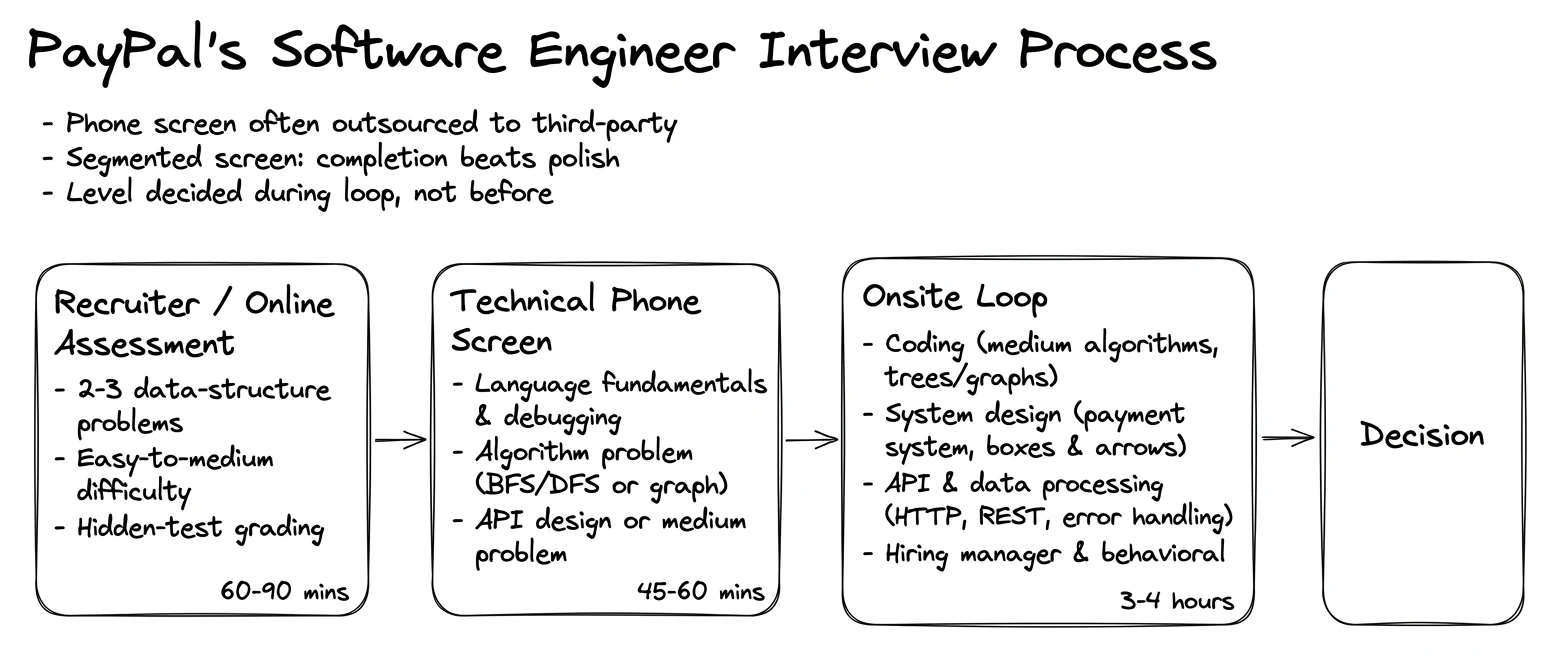
Each team hires for itself, so the opening steps vary. Some candidates sit the outsourced technical screen before speaking to a recruiter, and early-career applicants typically get a timed online assessment. Reported loops have one or two phone screens, then a final round of about four interviews of 45–60 minutes each. The process typically takes a few weeks.
Experienced candidates get a component-level system design round. Staff candidates have reported two design rounds plus a short director conversation in a pooled loop, with team matching afterwards. Offices outside the US add English self-introductions.
Here's what the interview process can look like:
- Recruiter screen: A short call about background, level and location, sometimes held after the technical screen.
- Online assessment (early career, some teams): Typically two or three easy-to-medium problems against hidden tests.
- Technical phone screen (one or two): A one-hour outsourced screen in timed segments, or a 45-minute engineer-led practical problem.
- Coding interview: Medium problems on trees, graphs, grids and intervals.
- System design interview (experienced hires): A component-level design of a payment system or an agent-style service.
- API and data-processing interview: API calls, processing results, HTTP status codes and error handling.
- Hiring manager and behavioral interview: Past projects, team fit and motivation.
Tip: Ask the recruiter whether your screen is outsourced or engineer-led. The outsourced screen rewards abandoning a stuck segment; the engineer-led screen rewards getting the follow-up's data structure right.
Recruiter screen
The call is short and non-technical: background, target level, location and the rounds ahead. One candidate sat the technical screen first, with the recruiter call booked afterwards. Recruiters for offices outside the US also ask why you want to join a foreign company. Some candidates never received a promised screen link, so follow up within a week.
Interviewers evaluate:
- Level fit: Recent scope, which decides whether you are slotted at T23, T24 or higher.
- Motivation: A specific reason for PayPal and, abroad, for the location.
- Communication: Clear spoken English, which some international loops check in every round.
- Logistics: Location, timing and hybrid expectations (typically three office days a week).
Prepare a two-minute introduction and a "Why PayPal?" answer that names a product area.
Sample questions for the recruiter screen
Here are some questions reported by recent candidates:
- Tell me about yourself and the projects you are proudest of.
- Why PayPal, and why a company based in another country?
Technical phone screen
The most common screen is outsourced to a third-party interviewing service: one hour, weekend slots available, separately timed segments. One version asked about Python's assignment, equality and identity operators, then a snippet with a planted bug, then a graph exploration with BFS or DFS and its complexity. Another went from an easy simulation (colored balls into matching holes) to an HTTP API design with client-side caching and TTL-based expiry, then a medium problem the candidate did not finish.
Engineer-led screens center on one practical problem. A 45-minute screen in late 2025, camera off throughout, asked for a banking system: create account, deposit, transfer with balance checks, and top N accounts by outgoing volume, tested along the way. The stretch goal added scheduling and cancelling future payments. Some candidates get a second screen; one loop had lowest common ancestor and a maximum-interval problem, then an LRU cache.
Interviewers evaluate:
- Completion per segment: The outsourced format states that a working answer to each part outranks an elegant answer to one.
- Language semantics: Aliasing, identity and the execution model, not just syntax.
- Debugging by reading: Finding the faulty line in unfamiliar code and explaining it.
- Follow-up data structures: A min-heap keyed on execution time, not a FIFO queue, for payments at arbitrary future times.
- Testing as you go: Small tests after each operation.
Rehearse a 60-minute block of an easy problem, an API design and a medium problem, abandoning any segment that stalls.
Note: In the banking-system rejection, the core operations worked and were tested. What sank it was defending a plain queue for future timestamps. Naming a shortcut's limitation is safer than defending it.
Sample questions for the technical phone screen
Here are some questions reported by recent candidates:
-
Explain
=,==andisin Python, then find the bug in a short snippet. -
Find the minimum moves to place colored balls into holes of the same color.
-
Implement a banking system with transfers and top spenders, then add scheduled and cancellable payments.
Coding interview
The final round typically has one 45–60 minute coding interview with standard medium problems. Reported families are binary trees (lowest common ancestor, pruning a binary search tree, counting distinct tree shapes with n nodes), grid and graph search, and interval scans. Runnable code, a traced example and unprompted complexity are expected. A Data and AI loop abroad paired these problems with ML depth, such as why LoRA weights are not all initialized to zero.
Interviewers evaluate:
- Edge cases: Empty trees, nodes missing from the tree, interval boundaries.
- Pattern fluency: Tree recursion, BFS and DFS, and Catalan-style counting.
- Complexity: Time and space stated and justified.
- Language command: One rejected candidate's takeaway was weak Python, not weak algorithms.
Solve medium tree and graph problems in 25 minutes, out loud.
Sample questions for the coding interview
Here are some questions reported by recent candidates:
-
Find the lowest common ancestor of two nodes in a binary tree.
-
Prune a binary search tree to a value range.
-
Count the structurally distinct binary trees with n nodes and explain the recurrence.
System design interview
Reported prompts were a payment system (a T24 loop) and an online shopping agent (late 2025). Evaluation stayed high-level: components, data flow and basic scalability, with no deep dive into storage internals. Because money moves, idempotent retries, reconciliation and an audit trail typically belong in the picture even unprompted.
Interviewers evaluate:
- Completeness: Every component a payment touches, from gateway to ledger to notification.
- Money-safe flows: Idempotency keys and handling a downstream processor timeout.
- Scalability basics: Partitioning, caching and async processing where load lands.
- External calls: For an agent, how it calls third-party APIs and handles bad results.
Prepare one payment design and one API-orchestrating service, each explainable in ten minutes.
Sample questions for the system design interview
Here are some questions reported by recent candidates:
-
Design a payment system, focusing on components and scalability.
-
Design an online shopping agent.
API and data-processing interview
A T24 onsite included a full session on calling APIs, processing returned data, HTTP status codes such as 401 versus 402, how error codes differ, and maintainable code. The candidate called it the weakest round. It contributed to a down-level to T23, and the candidate was then rejected. Some teams instead ask for a small REST service with persistence, judged on exception handling and production readiness.
Interviewers evaluate:
- Status-code precision: Correct use of 400, 401, 402, 403, 404, 409, 429 and 5xx.
- Error handling: Retries, timeouts and partial failures handled explicitly.
- Data processing: Parsing and aggregating a response cleanly.
- Maintainability: Naming and separation of concerns.
Build a small client for a paginated API that handles every error class, and explain each status code.
Note: Strong algorithm rounds did not protect the candidate who struggled here. Treat HTTP fluency as its own preparation track.
Sample questions for the API and data-processing interview
Here are some questions reported by recent candidates:
-
Explain 401 versus 402 and when to return each.
-
Call an API, process the records and keep the code maintainable.
Hiring manager and behavioral interview
A manager-led conversation on past projects, deadlines, cross-team dependencies and motivation. In one international loop, every round opened with an English self-introduction, and the last was a relaxed talk about career choices and why PayPal, ending with the candidate's questions.
Interviewers evaluate:
- Project depth: Your decisions, trade-offs and measured results.
- Collaboration: Handling dependencies and disagreement across teams.
- Career narrative: A coherent reason for each move.
- Your questions: Specific questions about the team's domain.
Prepare two project walkthroughs and four stories on deadlines, conflict and ownership.
Sample questions for the hiring manager and behavioral interview
Here are some questions reported by recent candidates:
-
Walk through a recent project: your role, the hardest decision and the outcome.
-
Why did you make your last career move?
How PayPal makes hiring decisions
The hiring team decides, and level is assessed during the loop rather than locked beforehand: one T24 applicant was down-leveled to T23 after the API round, then rejected. Some staff loops are pooled, with team matching after the decision. A request for a second chance went unanswered, so treat the result as final. Cooldown periods were not reported.
How to prepare for the PayPal interview
- Rehearse the segmented screen: Time an easy problem, an API design and a medium problem in one hour.
- Review language semantics: Identity, mutability and aliasing, and find planted bugs by reading.
- Build the banking class: Transfers, top-N spenders, then scheduled payments in a min-heap, with tests.
- Learn HTTP properly: Status codes, idempotent retries and structured error responses.
- Drill tree and graph mediums: Lowest common ancestor, BST pruning, Catalan counting, grid BFS.
- Prepare a money-safe design: Idempotency, a ledger, reconciliation and TTL caching.
About working at PayPal
PayPal runs branded checkout, Braintree processing, Venmo and crypto services. In April 2026 it reorganized into three business units and announced large cost cuts, including technology and product layoffs. Engineering is mostly Java and Spring Boot microservices, with React and Node.js on the front end, and work is typically hybrid with three office days a week.
| Level | Primary focus | Impact scope |
|---|---|---|
| T22–T23 (Software Engineer) | Delivering well-defined features | Tasks within one team |
| T24 (Senior Software Engineer) | Owning services end to end | One team's systems |
| T25 (Staff Software Engineer) | Leading designs across teams | Several teams |
| T26 (Senior Staff) | Technical direction for an area | A product area |
PayPal hires engineers across its business units. Teams include:
- Checkout Solutions and PayPal: Branded checkout and merchant operations.
- Consumer Financial Services and Venmo: Venmo and consumer financial products.
- Payment Services and Crypto: Processing, platform services and digital assets.
Experience and education requirements
Postings ask for a bachelor's degree in computer science or a related field. US senior postings list a master's plus two years or a bachelor's plus five. Common requirements are Java, Spring Boot, RESTful microservices and CI/CD; full-stack roles add React and TypeScript.
FAQs about the PayPal interview
How long does the PayPal interview process take?
Typically a few weeks from the first screen to a decision, though recruiter response times vary.
What is the hardest round of the PayPal interview?
Recent rejections point to the engineer-led screen, where the follow-up decides the round, and the API round, which has cost candidates a level.
Is there an online assessment?
Sometimes. Early-career applicants typically get two or three timed easy-to-medium problems; experienced candidates usually start with a live screen.
How much does a PayPal software engineer make?
Posted San Jose base ranges in 2026 ran from about $120K to $243K depending on level, and packages add an annual bonus and stock.