Oscar Health · Study
Oscar Health Interview Process & Questions
TrueInterview
October 13, 2026 · 8 min read
Oscar Health builds its technical rounds around its own insurance business. The onsite coding round asks you to find members who lack an in-network provider within a travel distance, which is network adequacy in miniature, and the design round is set in Oscar's operations: a telehealth queue limited by physician state licenses, or an outreach campaign tool. Design prompts arrive with little framing, so choosing the level of detail is part of the test.
This guide breaks down each stage of the Oscar Health interview, what interviewers evaluate in each round, and how to prepare, with questions candidates were actually asked.
Verified: Based on 4 candidate-reported interview experiences, cross-checked against recent public accounts.
Oscar Health interview process
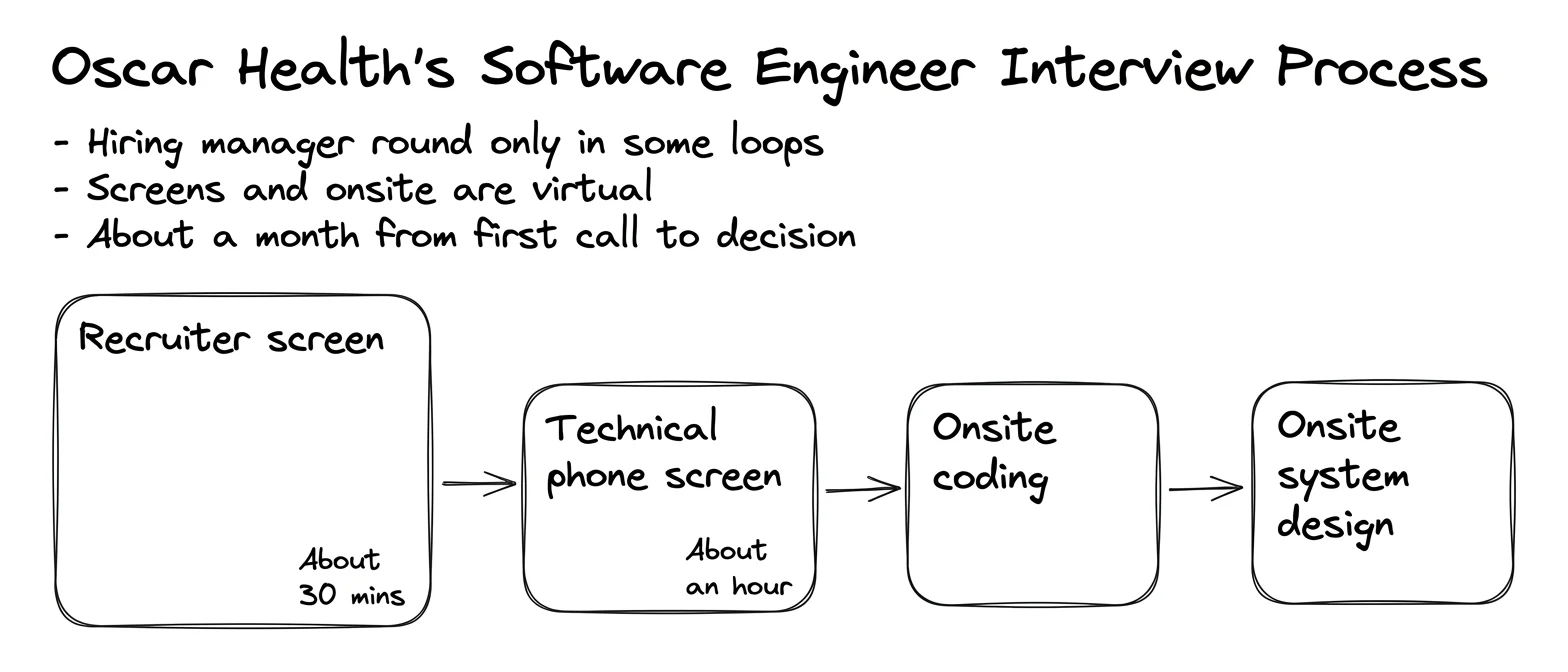
Recent reports describe one screening round followed by a virtual onsite with a coding round and a design round, and some public accounts add a hiring-manager conversation. From first call to decision, the process typically takes about a month. The coding is consistently described as medium difficulty. Senior candidates sit the same coding rounds, so design and project depth carry the leveling signal.
Here's what the interview process can look like:
- Recruiter screen: A short call about your background, target level, location and why you want to work in healthcare.
- Technical phone screen: About an hour of live coding on one problem with a follow-up, typically string enumeration or tree traversal.
- Onsite coding interview: A custom, domain-flavored data problem, such as provider coverage for members.
- Onsite system design interview: An Oscar operations scenario, judged as high-level architecture or as low-level design.
- Hiring manager interview: Past projects, collaboration and motivation for healthcare work.
Tip: Practice the phone-screen problem as a pair: encode text into a code, then enumerate every string that could have produced an unseparated encoding. Two of the four reported screens used exactly this pairing.
Recruiter screen
The call typically runs about 30 minutes and is non-technical. It covers your recent work, the target level, and whether you would work remotely or from the New York, Tempe or Los Angeles offices; candidates near an office are typically expected on site at least two days a week. Expect a direct question about why you want to work in health insurance.
Interviewers evaluate:
- Mission fit: A specific reason for wanting to work on healthcare, not just interest in the stack.
- Level fit: Whether your scope matches senior (around five years) or staff (seven or more, with cross-team leadership).
Prepare a two-minute summary of your work and one concrete reason Oscar's mission matters to you.
Sample questions for the recruiter screen
Here are some questions reported by recent candidates:
- Tell me about yourself and a recent project you owned.
- Why healthcare, and why Oscar?
Technical phone screen
The screen is about an hour of live coding with an engineer: one problem and a follow-up that builds on your first function. The most reported prompt gives a letter-to-Morse mapping. Part one converts a lowercase word into an unseparated code string ("gin" becomes one run of dots and dashes). Part two reverses it: given an unseparated string, return every word that could have produced it. Another candidate got a medium tree-traversal problem instead.
Without separators, the reversal is word-break enumeration: try each letter whose code prefixes the remaining string, then recurse, memoizing by position or counting instead of listing.
Interviewers evaluate:
- Problem decomposition: Seeing that part two is prefix matching plus backtracking, not a reversed lookup table.
- Complexity awareness: Explaining why decodings grow exponentially and how memoization or counting helps.
- Testing: Tracing a two-letter word by hand before declaring the decoder done.
Practice prefix-based backtracking with memoization until you can write the decoder in 20 minutes.
Sample questions for the technical phone screen
Here are some questions reported by recent candidates:
-
Convert a lowercase string into Morse code using a provided mapping, with no separators between letters.
-
Given an unseparated Morse string, generate every string of letters that could have produced it.
-
Solve a medium binary-tree traversal problem.
Onsite coding interview
Both reports with onsite detail describe the same prompt. You get providers (an ID, one or more specialties, an x/y location), members (an ID, a location, a list of required specialties) and a maximum distance, and you return the members who lack coverage under straight-line distance. In the worked example, one member's only cardiology provider is about 12 units away against a limit of 5, so that member is returned.
The brute force checks every required specialty against every provider. A stronger answer groups providers by specialty, compares squared distances to avoid square roots, and stops a member's check early. One version adds providers with several specialties and people sharing a location.
Interviewers evaluate:
- Modeling: Clear provider and member types and a specialty index, rather than nested loops over raw lists.
- Requirement precision: Pinning down exactly when a member counts as uncovered before coding.
- Efficiency: The cost of the naive scan, what the index saves, and a spatial grid for large inputs.
Rehearse a domain-modeling problem in which you define the data types aloud before writing loops.
Note: The two write-ups define coverage differently. In one, a member is covered only when every required specialty has a provider in range; in the other, a client is outside coverage only when none of its services does. These rules give different answers on the same data, so confirm the rule against the example first.
Sample questions for the onsite coding interview
Here are some questions reported by recent candidates:
-
Given providers with specialties and coordinates, members with required specialties, and a maximum distance, return the members without adequate in-network access.
-
Handle providers that offer several specialties and members who share a location.
Onsite system design interview
The design round uses Oscar's own operations. In one version, members nationwide request 24/7 virtual care, physicians are licensed only in certain states, and you design a web queue that never shows a physician a patient from a state where they are unlicensed. In another, sales agents launch outreach campaigns: an unanswered email triggers a text after three days, the text is retried after three more, a silent client is marked unresponsive, and any failed send or missing contact information ends that client's campaign at once.
Interviewers vary: one gave little feedback; another shared a brief description and a hard-to-read diagram, would not say whether they wanted architecture, schemas or components, and halfway through revealed they expected a low-level design built around a tree structure.
Interviewers evaluate:
- Scoping: Stating which level you will design at and getting agreement before going deep.
- Domain rules as invariants: License filtering or campaign termination enforced in the data model and assignment logic.
- State modeling: Each campaign target or consultation as a state machine with timed transitions, retries and terminal states.
- Operational realism: Scheduled jobs, idempotent sends, auditability for health data, and a physician going offline mid-queue.
Prepare one healthcare-flavored design at both the box-diagram level and the class-and-state level.
Tip: If the interviewer won't define the level, name the one you're choosing, then sketch the per-client state machine (email sent, text sent, text retried, responded, unresponsive, terminated) within ten minutes. That satisfies either expectation.
Sample questions for the onsite system design interview
Here are some questions reported by recent candidates:
- Design a web queuing application for 24/7 telehealth requests in which physicians only see patients from states where they are licensed.
- Design a campaign tool for sales agents with timed email-then-text follow-ups, an unresponsive state, and immediate termination on a failed send or missing contact information.
Hiring manager interview
Public accounts describe a closing hiring-manager conversation, sometimes with a product-thinking session. It covers a past project in depth, conflict and collaboration, and why healthcare; one senior loop opened with a project walkthrough. Product-style prompts typically take a member-facing process, such as mailing ID cards, and probe edge cases like address changes and returned mail.
Interviewers evaluate:
- Ownership: What you personally decided and delivered, with results.
- Product judgment: Member impact and failure cases, not just the happy path.
- Collaboration: Working with operations, clinical and compliance partners.
- Motivation: A credible, specific interest in fixing parts of US healthcare.
Prepare four or five project stories, including one with a non-engineering partner.
How Oscar Health makes hiring decisions
The reports say little about the decision; all four were pending when written. Typically the hiring manager and recruiter decide offer and level from the interviewers' feedback, with seniority judged mostly from the design and project rounds. Some candidates report long silences after a full loop, so ask the recruiter for a decision date.
How to prepare for the Oscar Health interview
- Pair encode with enumerate: Convert text into a code, then list every source string for an unseparated encoding, with memoization and a counting variant.
- Model the data first: Define entities and an index, such as providers by specialty, aloud before writing loops.
- Pin down the predicate: Confirm "any specialty uncovered" versus "all uncovered" against the example.
- Name your design level: Say whether you're designing architecture, schemas or components before going deep.
- Draw state machines: Practice workflows with timed retries and terminal states, such as campaigns, consultation queues and claim status.
- Know the business: Learn how individual plans, provider networks, claims and virtual care fit together, and why that work matters to you.
About working at Oscar Health
Oscar sells individual and family health plans and builds much of its stack in-house: member apps, claims processing, provider data and virtual care. Its +Oscar business licenses that platform to other plans. Generative AI is in production, including a clinical intake assistant for virtual care and a claims assistant for staff, with a central AI group helping other teams adopt it.
Oscar hires engineers across its member, provider and platform businesses. Teams include:
- Provider and claims: Claims adjudication, payment systems and a migration to a new claims platform.
- Virtual care: Telehealth visits, clinical intake and AI scribing.
- Member experience: The member app, enrollment and broker tools.
- AI and platform: Shared AI tooling and the +Oscar platform for partner plans.
Experience and education requirements
Senior postings ask for five or more years building fault-tolerant, scalable systems; staff postings ask for seven or more plus cross-team technical leadership. Python, Go, Kubernetes and observability tooling are listed as pluses.
FAQs about the Oscar Health interview
How long does the Oscar Health interview process take?
Typically about a month.
What is the hardest round of the Oscar Health interview?
The system design round. Prompts arrive with little framing, and expectations have ranged from architecture to a tree-based low-level design.
Is there an online assessment?
None of the reports mention one. The first technical step is a live coding screen with an engineer.
How much does an Oscar Health software engineer make?
Posted base ranges are about $158K–$208K for senior backend roles and $192K–$252K for staff roles, with equity grants and an annual bonus on top.
Is the Oscar Health interview remote?
Yes. Screens and the onsite are virtual, and many roles are remote or hybrid.