Optiver · Study
Optiver Research Scientist Interview Process
TrueInterview
July 24, 2026 · 14 min read
Optiver screens research candidates mostly on speed. Before anyone reads a publication list, candidates sit a multi-module assessment: probability at 60 to 90 seconds per question, number sequences, likelihood ranking, reaction games and often a betting game. Strong researchers lose most often to the clock or the betting game, and interviewers say outright that a PhD is not a prerequisite. The second half of the loop grades how honestly you evaluate a model: a take-home is defended before a panel, and a closing culture-and-Python conversation still decides the outcome after every technical stage has been passed.
This guide breaks down each stage of the Optiver Research Scientist interview, what interviewers evaluate in each round, and how to prepare, with questions candidates were actually asked.
Verified: Based on 83 candidate-reported interview experiences, primarily from 2025 Q3 through 2026 Q2, cross-checked against recent public accounts.
Optiver Research Scientist interview process
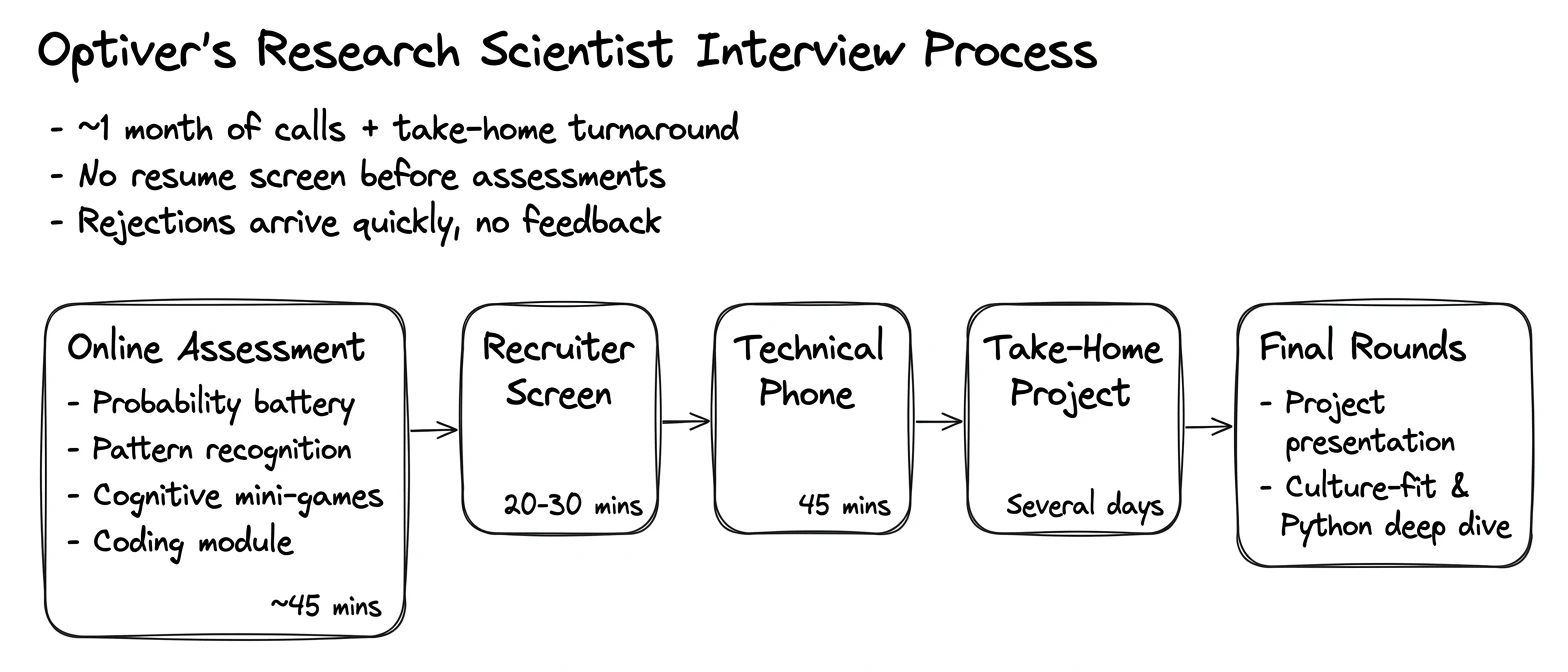
Optiver hires research candidates as Quantitative Researchers, mostly through PhD internship and graduate programs, with separate postings for experienced researchers on named trading teams. The assessment usually arrives within one or two days of applying, so the first filter is automated and identical for everyone.
A full loop has six to eight steps over about three weeks to a month, plus the take-home. Intern and graduate candidates sit every assessment module; experienced hires are judged more on a record of profitable strategies, though few reports describe that loop in detail.
Here's what the interview process can look like:
- Online assessment (all candidates): Timed modules on probability, number sequences, likelihood ranking and cognitive mini-games, often with a betting game, taken in a fixed order.
- Coding assessment (most research candidates): Three finance-flavored programming problems in roughly 90 minutes to two hours.
- Recruiter phone screen: 20 to 30 minutes on motivation, logistics and one project retrospective.
- Technical phone interview (one or two calls): About 45 minutes with a researcher: probability, betting games, market-making, estimation and brainteasers, all spoken aloud.
- Take-home data project and presentation: A pandas or regression analysis returned within days, then defended to a panel by video.
- Final culture-fit and technical interview: Fit, hands-on Python and your research background, sometimes with a head of research or a team head.
Tip: Treat every timed stage as a test of decisions, not derivations. Candidates from research backgrounds report the same weakness again and again: they reach correct answers too slowly. Practice speaking a numeric answer within 60 seconds until you do it without thinking.
Online assessment
The assessment comes in separately timed sections, in some versions taken in a fixed order with no way back. The probability module ("Beat the Odds") is the core: about 30 multiple-choice questions at 60 to 90 seconds each, forward-only. Several versions use five options with a penalty for wrong answers, so a random guess has negative expected value. Content is classic discrete probability: gambler's ruin with fair and biased coins, random walks on hexagons, octagons and decagons, coupon collector, drawing balls until two colors remain, the expected product of three cards, and counting integers up to 10,000 with distinct digits. One PhD version added a regression prediction interval.
The sequence module runs about 25 puzzles in 25 minutes with no calculator, with interleaved sub-sequences, alternating differences and recursive rules. A newer likelihood module asks you to rank statements by probability from tables, box plots and network diagrams. The mini-games rotate: string and code comparison, a water-pouring-style building puzzle, arithmetic paired with shape comparison, an untimed grid rearrangement; one version had nine games. Some research candidates also faced a betting module or an eight-minute, 80-question arithmetic test.
Interviewers evaluate:
- Model recognition on sight: Reaching for first-step analysis, symmetry or linearity of expectation within 20 seconds; deriving from scratch runs out the clock.
- Disciplined guessing: Leaving a question blank unless two of five options can be eliminated.
- Accuracy in sequences: About 15 correct out of 22 to 25 has been enough to advance.
- Submission timing: Likelihood answers locked in at the last instant sometimes failed to register.
- Betting judgment: One PhD candidate cleared probability, sequences, games and coding and was rejected on the betting module alone.
Drill random-walk, gambler's-ruin and coupon-collector problems until each takes under a minute, and treat every game's practice round as your only calibration.
Note: Each module is a separate cut, so a strong probability score does not rescue a weak betting or game result. Use a wired or fully charged mouse; a trackpad is too slow for the reaction games.
Sample questions for the online assessment
Here are some questions reported by recent candidates:
-
A gambler starting with $10 against an opponent with $20 wins each round with probability 2/3; find the probability of winning the opponent's whole stake.
-
A particle on a regular decagon moves clockwise on a die roll of 1 or 2, counterclockwise on 3 or 4, and stays put otherwise; find the expected steps to reach the opposite vertex.
-
Roll a die repeatedly until the running total exceeds a threshold; find the probability that the final roll was a 5.
Coding assessment
Research candidates usually get three problems in a language of their choice, in about 90 minutes to two hours, with hidden tests. Each is a trading rule you must turn into a recurrence or a simulation, and the families repeat: buy-and-sell sequences that never go short (a ballot or Catalan count), ordered order sizes summing to a target (a one-dimensional DP), a backtest reporting the mean and standard deviation of daily log returns, and optimal stopping, buying n units at uniformly random prices under a per-trade fee or a cap on purchases.
Difficulty within a set varies widely; one PhD candidate got two near one-liners and one real dynamic program. Variants swap in currency arbitrage (negative-cycle detection on negative log rates) or a two-heap order book with price-time priority. A candidate rejected straight after this stage concluded that unfinished solutions earn no partial credit.
Interviewers evaluate:
- Choosing the DP immediately: A depth-first search over trade sequences passes the samples and times out on hidden tests.
- Faithful simulation: Applying the allocation rule on exactly the right day, including all-cash days.
- Numerical care: Log returns rather than simple returns, statistics computed as specified, degenerate prices handled.
- Pace: Finishing the easy problems fast so the dynamic program gets most of the time.
Practice turning a paragraph of trading rules into a recurrence in under five minutes, then coding it with your own edge cases.
Sample questions for the coding assessment
Here are some questions reported by recent candidates:
-
Starting with k shares and making exactly m single-share buys or sells, count the sequences that end at n shares without ever going negative.
-
Each day, split capital equally across the stocks whose previous-day return was positive, then report the mean and standard deviation of the portfolio's daily log returns.
-
Buy n units at prices drawn uniformly from an interval, with at most k purchase decisions, and minimize the expected total cost.
Recruiter phone screen
Candidates who pass the assessments get a 20- to 30-minute recruiter call with no technical content: graduation date, visa sponsorship, why Optiver, office preference, then one project — your contribution versus the team's, the hardest part, what you would change and what stopped you then. Other reported questions cover strengths and weaknesses, how peers would describe you, competing processes and a five-year plan. The recruiter also notes how clearly you speak English, because researchers explain results to traders all day.
Interviewers evaluate:
- Specific motivation: A reason tied to trading and fast feedback, not a general interest in finance.
- Personal contribution: Separating your own work from the team's without being prompted.
- Honest retrospection: A real change you would make, and the constraint that prevented it.
- Concise delivery: Two-minute answers with a clear structure.
Prepare one research project at two depths, two minutes and ten, and a short reason for choosing trading.
Sample questions for the recruiter phone screen
Here are some questions reported by recent candidates:
-
Tell me about yourself, and why Optiver specifically?
-
Walk through a project: what did you personally contribute, and what would you do differently now?
-
What is your biggest weakness, and what are you doing about it?
Technical phone interview
Most research candidates have one or two technical calls of about 45 minutes, often with a senior researcher, starting with no warm-up. Some are all probability, each answered aloud in a minute or two. Others are betting games with two to four minutes per scenario: price the bet, take it or not, size the stake. Reported setups include a sum of 7 on two dice at odds of 0.6 to 1, two card ranks whose product exceeds 100 at even money, and a market on the sum of three cards while the interviewer trades against you. Estimation and brainteasers appear too: a stone-pile game, bus waiting times, annual spending on a large streaming service.
Follow-ups move to judgment: the Kelly fraction for a coin that lands heads 60% of the time, how many rolls would show a die is fair, an arbitrage across two bookmakers' odds on a tennis match, and sizing correlated bets so portfolio variance cancels. One call spent its whole length on maximizing expected log wealth over a fixed number of fair-coin flips.
Interviewers evaluate:
- Reasoning aloud: Working silently gives the interviewer nothing to grade, even if the answer is right.
- Decisiveness: One candidate finished with a large profit and was still rejected for hesitating and over-analyzing.
- Sizing from first principles: Kelly was expected in one interview and explicitly ruled out in another, and a guaranteed arbitrage called for going all-in.
- Calm under a neutral manner: Some interviewers stay deliberately expressionless and give no feedback.
Rehearse dice, coin and card expected-value problems aloud against a two-minute timer, always ending with a stake size.
Tip: Check the degenerate case before you reach for a formula. On a fair coin with log utility the optimal bet is zero, and candidates who went straight to the Kelly formula missed the point of the question.
Sample questions for the technical phone interview
Here are some questions reported by recent candidates:
-
You start with $10 and roll a die 10 times, gaining $1 on an even roll and losing $1 on an odd roll; what is the probability of going bankrupt at some point?
-
A coin lands heads 60% of the time and pays even money; what fraction of your bankroll should you bet each flip, and why?
-
Make a two-sided market on the sum of three cards drawn from a deck, and adjust it as cards are revealed and the interviewer trades.
-
Estimate the total annual spending of a large streaming service's subscribers.
Take-home data project and presentation
This stage separates the research track from the trading track. Candidates return an analysis a few days after receiving the data, in one of two reported forms: a pandas time-series analysis of supplied market data, or a linear regression taken through pre-processing, fitting and evaluation, from scratch or with standard libraries.
A video presentation to a panel or a researcher follows, covering approach, code and conclusions, with pandas and time-series knowledge tested live. One candidate's regression performed only moderately because the relationships were not fully linear, and explaining with evidence why it fell short became the substance of the exercise.
Interviewers evaluate:
- Depth of evaluation: Residual plots, error distributions and out-of-sample tests, not a single headline metric.
- Stated assumptions: Where linearity, constant variance or normality of errors fail, and what that does to the conclusions.
- Communication to traders: Results stated as decisions someone could act on.
- Candor about weak results: Owning a mediocre model is graded better than steering around it.
Spend as much time on the evaluation as on the model, and rehearse a ten-minute walkthrough that ends with what you would try next.
Note: A polished fit with no diagnostics gives the panel nothing to question, and the presentation exists to question you. A modest model with a rigorous account of its failures fits what interviewers are looking for better.
Sample questions for the take-home data project and presentation
Here are some questions reported by recent candidates:
-
Fit a linear regression to a supplied dataset, evaluate its predictions, and explain where and why it underperforms.
-
Clean and analyze a market time series in pandas and present the main findings and your code to a panel.
Final culture-fit and technical interview
The last conversation mixes culture fit, live Python and a walk through your doctoral research, in some loops with a head of quantitative research or a team head after a researcher has reviewed your take-home code. It is a real decision round: a PhD candidate who passed a trading game, the recruiter call, a technical call, the take-home and the presentation was rejected here, and warned others not to assume a doctorate proves programming ability. Expect a blunt, fast-moving style.
Interviewers evaluate:
- Hands-on Python: Working through data manipulation quickly in pandas and NumPy without looking up basics.
- Research translated to markets: Explaining a thesis result in terms of signal, noise and what you would test on market data.
- Visible enthusiasm: A candidate rejected after a technically solid call believed weak enthusiasm for quant work was part of the reason.
Prepare a five-minute summary of your research for a trader, and practice pandas group-by, rolling-window and merge operations from memory.
Sample questions for the final culture-fit and technical interview
Here are some questions reported by recent candidates:
- Walk through your PhD research and explain how its methods would apply to market data.
- Answer live Python and pandas questions about the code in your take-home.
- Why quant research, and why Optiver?
How Optiver levels and evaluates Research Scientist candidates
Each stage is a gate and assessment modules are scored separately, so one weak module can end a candidacy. Interviewers grade the decision process rather than the outcome: candidates who finished betting games in profit were rejected for hesitation. After the take-home, a researcher and then a research or team lead make the final call together with fit. Interns and graduates are hired into programs and placed under an experienced researcher; experienced hires apply to a named team and are judged on their track record.
Rejections arrive quickly, sometimes within a day, and generally without feedback. Postings allow one application per role per year, and one PhD internship posting set an eight-month wait before reapplying.
Tip: Assume the closing conversation is scored as heavily as the technical stages. Go in with your take-home code fresh in mind and ready to write Python live, not just to talk about culture.
How to prepare for the Optiver Research Scientist interview
- Drill one-minute probability: Random walks on polygons, gambler's ruin, coupon collector and card-product expectations, timed and answered out loud.
- Practice penalized multiple choice: Answer only when you can eliminate two of five options, and keep a pace that reaches every question.
- Train betting and market-making out loud: Price, decide and size within two to four minutes, check the degenerate case first, and say your stake as a fraction of the bankroll.
- Learn the coding families: Non-negative trade sequences, ordered sums to a target, log-return backtests, optimal stopping with fees, negative-cycle arbitrage and two-heap order books.
- Make evaluation the core of the take-home: Show residuals, out-of-sample tests and broken assumptions, and rehearse defending a mediocre result.
- Prove your Python live: Practice pandas time-series work without references; a doctorate does not count as evidence of coding skill.
- Prepare a trader-facing research story: A five-minute account of your work, plus a specific reason for choosing trading over academia.
About the Optiver Research Scientist role
Optiver is a proprietary trading firm and market maker, and its researchers build the models behind its trading: short-term price prediction, stochastic models for option pricing and volatility, Monte Carlo methods and execution strategies. Recent postings put machine learning at the center of signal extraction and forecasting, with researchers owning the cycle from framing a question to deploying a model. New researchers start with firm-led training in market structure and options theory, then work under an experienced researcher alongside the traders who use their output.
| Level | Primary focus | Impact scope |
|---|---|---|
| Quantitative Research Intern (PhD) | A supervised research project on pricing, risk or signal modelling | One project within a team |
| Graduate Quantitative Researcher | Building, testing and deploying models after structured training | Models used by one trading team |
| Quantitative Researcher (experienced) | Alpha, signal and feature research; improving research workflows | A trading strategy or team |
| Senior Quantitative Researcher | Strategy research and direction for a desk or asset class | A business line |
Optiver hires research candidates across several trading groups. Teams include:
- HFT Futures and Equities (Delta One): Fully automated strategies built on machine learning, with research into alpha, signals and features.
- Systematic Volatility Trading: A fully automated options strategy that depends on volatility modelling.
- Options pricing and market making: Stochastic models for option prices and volatility forecasts used in quoting.
- Execution research: Strategies for executing well in fast-moving markets.
Research Scientist experience and education requirements
Graduate and intern research roles target current or recent PhDs in mathematics, statistics, computer science, physics or a related field, with strong statistics, research ability and Python (R or MATLAB also mentioned), and the ability to explain technical ideas clearly. No trading experience is required, and US sponsorship is supported for the PhD graduate role. Experienced roles ask for at least two years of research on a successful futures or equities trading team, a record of profitable strategies, and C++, C, Python or Java.
FAQs about the Optiver Research Scientist interview
How long does the Optiver Research Scientist interview process take?
Usually about three weeks to a month from application to decision, plus the time you spend on the take-home.
What is the hardest round of the Optiver Research Scientist interview?
By outcomes, the take-home and presentation: days of your own work are questioned live, and a good metric can still fail on thin diagnostics. Minute for minute the probability module is harsher, at 60 to 90 seconds a question with no going back, but it responds well to practice.
Does the interview test machine learning or stochastic calculus?
Recent reports show neither as a dedicated round. Statistical content stayed at regression, diagnostics, log-return statistics and discrete probability, though the job increasingly relies on machine learning and your own methods are probed in the final round.
How much does an Optiver Research Scientist make?
Approximate US pay for PhD research hires in Chicago:
- Quantitative Research Intern (PhD): ~$80K–$100K annualized base
- Graduate Quantitative Researcher (PhD): ~$175K–$200K base, with first-year total compensation commonly ~$200K–$380K
Packages combine base salary with a discretionary bonus tied to individual and firm performance, so total pay varies widely year to year.