OpenAI · Study
OpenAI Infrastructure Engineer Interview Process
TrueInterview
July 24, 2026 · 15 min read
OpenAI's infrastructure loop is built around scarce compute. The signature design prompt hands you a small, unreliable GPU pool you cannot simply grow, so the score comes from queueing, preemption, checkpointing and worker-failure recovery rather than from adding servers. Coding goes lower than at most companies: an allocator with malloc and free, a credit ledger with expiring grants, or a protocol over an asynchronous send primitive, each with runnable tests and follow-ups released one at a time. Team-specific hiring adds a domain interview with an engineer from the hiring team, and at least one candidate who cleared everything else was rejected on that round alone.
This guide breaks down each stage of the OpenAI Infrastructure Engineer interview, what interviewers evaluate in each round, and how to prepare, with questions candidates were actually asked.
Verified: Based on 104 candidate-reported interview experiences, primarily from 2025 Q4 through 2026 Q3, cross-checked against recent public accounts.
OpenAI Infrastructure Engineer interview process
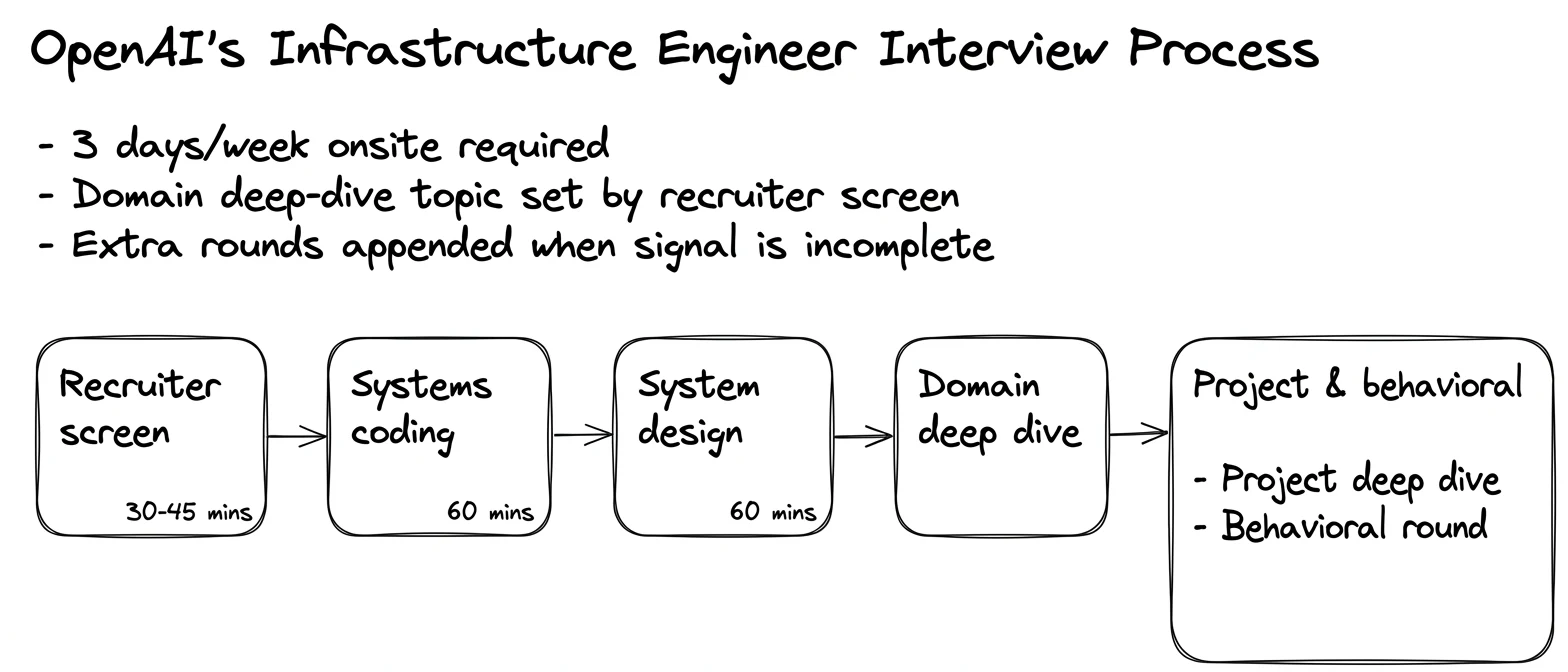
Infrastructure engineers are hired into specific teams such as fleet management, inference platform or research scaling, and the hiring team shapes the loop. Some loops run a single full day of coding and system design after the recruiter call; others start with a phone screen of up to two hours, then a virtual onsite of four or five rounds. AI infrastructure teams have added a 60-minute ML coding round next to a 75-minute systems coding round. The process typically takes three to eight weeks.
Mid-level candidates spend more of the loop on timed coding. Senior and staff candidates get design at the phone-screen stage, a principal-led deep dive and sometimes an extra director conversation. Recruiters confirmed senior-plus calibration on the first call when asked.
Here's what the interview process can look like:
- Recruiter screen (about 30 minutes): Background, level, logistics and motivation, sometimes with a scripted scaling question.
- Technical phone screen (60 to 120 minutes): A multi-part systems coding problem with runnable tests, often followed by a design hour.
- Coding interviews (one or two, 60 to 75 minutes): Queues with retries, durable stores, asynchronous protocols and concurrency primitives.
- System design interview (one or two): Scheduling under a fixed, fluctuating compute pool, or a payments, CI/CD or sandbox platform built around failure handling.
- Infrastructure domain interview (team-dependent): A discussion with a hiring-team engineer of the systems that team owns.
- Technical deep dive: A slide presentation of a system you built, defended down to implementation details.
- Behavioral and hiring manager interview: Mission, AI safety, ownership and cross-functional work.
Tip: Ask the recruiter which team owns the requisition and what its domain round covers. Postings range from GPU fleet health to developer tooling, and the candidate rejected on the domain round was told to align preparation with that team's area.
Recruiter screen
The call runs about 30 minutes and is mostly logistics: the three-days-a-week office expectation, relocation and sponsorship, current level and promotion history, reasons for leaving, competing processes, previous base and equity, compensation expectations and coding language. One recruiter asked whether the candidate preferred product or infrastructure work; another mentioned a second open requisition. Recruiters agreed to space a loop out around other processes without penalty.
A minority of screens turn technical. Recruiters working from a script asked how a candidate would find faults if traffic grew tenfold and what retry strategy they had built; both of those candidates were rejected here.
Interviewers evaluate:
- Concrete motivation: A reason for OpenAI tied to your own work; generic enthusiasm about AI is recorded as such.
- Clear scope of experience: Which clusters, schedulers or pipelines you actually ran, in terms a non-engineer can relay.
- Plain technical answers: Short, jargon-light explanations of monitoring, retries and incidents.
- Level and timeline fit: Promotion history and target level, which set the bar for the loop.
Prepare a two-minute account of the infrastructure you have owned and a jargon-free incident story.
Sample questions for the recruiter screen
Here are some questions reported by recent candidates:
-
Walk through your current project, then explain how you would find what breaks if its traffic grew tenfold.
-
Describe a retry mechanism you built and how it kept the system out of error states.
-
Why OpenAI, and why now?
Technical phone screen
The screen is live coding in a shared editor that runs code, usually 60 minutes and up to 75. One scenario is released in parts, often four or five, and the next part opens only after the current one passes the interviewer's tests. Candidates were told three of five parts was enough. Several screens ran two hours: an hour of coding, a 15-minute break and an hour of system design.
For infrastructure candidates the problem is usually resource-shaped. An inference-team screen was a memory allocator in C: first-fit over an explicit free list with splitting and coalescing, then best-fit. Other versions pushed both operations to logarithmic time. The other recurring families are a GPU credit ledger whose deductions spend the earliest-expiring grant first, and a plant-infection grid simulation that adds immunity, timed recovery, delayed death and finally row or column burning.
Interviewers evaluate:
- Working code under the clock: Each part must pass before the next opens; one candidate lost the later parts to clean-code habits.
- Defensible data structures: For best-fit, a free-block index searchable by address for merging and by size for lookup.
- Exact rule handling: Expiry boundaries, all-or-nothing deductions, simultaneous updates and off-by-one timers.
- Testing on request: Your own cases and, when asked, a test plan for the allocator itself.
Rehearse the allocator, the credit ledger and the infection simulation until the first three parts of each take under 30 minutes.
Note: Language choice costs real time. Two candidates using C++ finished fewer parts than they needed, one because of custom priority-queue comparators; most candidates use Python with sorted containers for the logarithmic follow-ups.
Sample questions for the technical phone screen
Here are some questions reported by recent candidates:
-
Manage a buffer of N bytes with
malloc(k)andfree(ptr), no compaction, first with first-fit and then best-fit in logarithmic time. -
Track GPU credit grants with expiry;
subtractspends the earliest-expiring grants first and changes nothing if the balance is short. -
Simulate infection on a grid with an eight-neighbor threshold, then add immunity, recovery after D days, threshold deaths, and row or column burning to minimize deaths.
Coding interviews
The onsite has one or two coding rounds of 60 to 75 minutes. Problems are small systems components, and follow-ups add failures, persistence or concurrency. Reported prompts: a work queue with reserve, complete and fail, timeouts, retries and a dead-letter queue; a key-value store that rebuilds state from a log after a crash; a durable store whose files may not exceed 1 KB; rebalancing overlapping key ranges across shards with minimal movement; counting machines in a cluster tree over sendAsyncMessage; and a fair shared/exclusive lock.
A newer prompt schedules dependent tool calls for several agents on separate threads, then adds a global concurrency limit; the candidate said thread pools, semaphores and condition variables were what mattered. Some loops add a refactoring exercise instead, such as restructuring a chat application around an event bus.
Interviewers evaluate:
- Failure semantics in code: Timeouts that requeue work, retries that never double count, and a dead-letter path.
- Idempotency and isolation: Request identifiers, cached responses for duplicates and separate state per in-flight request.
- Persistence correctness: What reaches disk before an acknowledgment and how recovery replays the log.
- Concurrency primitives: Condition variables over busy waiting, release on every path, starvation-freedom when fairness is asked.
- Explaining the why: One interviewer ignored a failing test and graded the reasoning instead.
Practice building a queue, a log-backed store and a message protocol from an empty file in under 45 minutes each, then add one failure mode to each.
Tip: Reserve time for your own tests. The async-protocol candidate was asked to test normal operation, node failures and concurrent requests, and candidates who finished only the base implementation never reached the follow-ups that carry most of the signal.
Sample questions for the coding interviews
Here are some questions reported by recent candidates:
-
Count the nodes in a tree of machines that communicate only by asynchronous messages, then add crash retries with request identifiers so nothing is counted twice.
-
Implement a work queue with reserve, complete and fail, visibility timeouts, bounded retries and a dead-letter queue.
-
Persist a key-value store to disk and reload it, then split data across files capped at 1 KB each.
-
Implement an In-Memory Key-Value Store with Write-Ahead Logging for Crash Recovery
System design interview
Most loops have one 60-minute design round; some add a second. The most common infrastructure prompt is a Sora-style video generation service: POST /video starts a job, GET /videos returns status, and a callback notifies an external service on completion. Each worker renders one video at a time, and the GPU pool is external, small and fluctuating, so nodes vanish mid-job. Follow-ups cover pool exhaustion, which jobs to preempt and how to requeue them, checkpoint versus restart, resuming without duplicate work and, later, priority tiers.
The other recurring prompts share that core. A payment system with holds, capture and nightly batch settlement at about 10,000 transactions per second was, in one candidate's words, a job scheduler in disguise. Others include a CI/CD system with build caches, custom image layers and failure-tolerant artifact uploads, and a sandboxed cloud IDE with VM lifecycle and log streaming.
Interviewers evaluate:
- Designing at fixed capacity: Admission control, queue discipline, batching and load shedding when every worker is busy.
- Worker-failure recovery: How a lost worker is detected, what is checkpointed, and how a resumed job is deduplicated.
- Requirements before architecture: A candidate who rushed scoping missed that deduplicating work was the point and fell just short.
- Latency boundaries: A message log inside a synchronous payment confirmation was rejected; asynchronous work belongs after the response.
- Breadth before depth: Candidates who spent the round on one component or tangent were marked down.
Practice two or three scheduling designs end to end, each with an answer to "every GPU is busy and a worker just died".
Note: Design can outweigh coding. A recruiter told one candidate that design counted for more than coding on that team and scheduled an extra coding round instead of rejecting; several other rejections were attributed to design alone.
Sample questions for the system design interview
Here are some questions reported by recent candidates:
-
Design a video generation service where one worker produces one video, the GPU pool grows and shrinks unpredictably, and users are notified on completion.
-
Design a payment system that places holds through an external provider and settles approved transactions in a nightly batch.
-
Add a build cache and custom image layers to a CI/CD system and make artifact uploads to object storage tolerate failures.
Infrastructure domain interview
Teams hiring for a specific platform add a session with one of their engineers, mixing design and technical discussion inside their domain. Reported territory includes GPU infrastructure orchestrated on Kubernetes, CI/CD internals, and recovery for long-running inference jobs; earlier reports also covered GPU memory hierarchy and how batch shape changes a serving design. AI infrastructure teams may add a 60-minute ML coding session.
This round carries more weight than its position suggests. One candidate passed coding, design, deep dive and cross-functional rounds and was rejected because of it, though kept eligible for matching with another team.
Interviewers evaluate:
- First-hand operational detail: What you ran, at what scale, what broke and how you found out.
- Honesty at the edge: Interviewers probe until they reach your limit; naming it beats improvising.
- Hardware-aware reasoning: Why accelerator memory, node health or interconnect limits change a scheduling decision.
- Operational judgment: Monitoring signals, safe rollout and on-call trade-offs.
Map each technology in the team's posting to an incident or design decision from your own work.
Sample questions for the infrastructure domain interview
Here are some questions reported by recent candidates:
-
How would you manage GPU workloads on Kubernetes, and what changes when nodes fail?
-
An inference request has hung on a worker; when do you time it out, restart it or resume it from saved state?
-
Debug a Buggy Distributed Job Scheduler (Concurrency, Deadlocks, Rate Limiting, and Testing)
Technical deep dive
You present a past system, usually with slides; one candidate brought eight. The interviewer, sometimes a principal engineer, reconstructs it: your role and team size, each decision and the rejected alternatives, how success was measured and what you would change. Questions reach the implementation layer, including memory management, serialization formats, backpressure and actual performance numbers.
Interviewers evaluate:
- Decision rationale: Why each choice beat its alternatives on latency, cost or operability.
- Personal ownership: What you designed and built yourself.
- Measured outcomes: Before-and-after numbers and how you obtained them.
- Hindsight: A credible redesign and the failure modes you would now handle.
Choose a project you can explain from architecture down to code, and refresh its numbers beforehand.
Note: One candidate cleared coding, design and behavioral rounds and passed candidate review, then was rejected at final approval because the presentation was judged to lack depth.
Sample questions for the technical deep dive
Here are some questions reported by recent candidates:
-
Present a distributed system you built and defend its consistency model and failure recovery.
-
Explain how your real-time pipeline handled backpressure and why you chose its serialization format.
Behavioral and hiring manager interview
Most loops include one behavioral round, often run by the hiring manager, and some add a 30-minute cross-functional conversation or a product manager session. Beyond conflict, delays and failure, expect why OpenAI, your view on AI safety, how you balance speed against quality and safety, and a project you finished but chose not to release. Stories get technical follow-ups. One manager call lasted 15 minutes and still decided the outcome; another manager explained the 90-day and one-year performance checkpoints.
Interviewers evaluate:
- Mission reasoning: A personal answer to why OpenAI and a considered AI safety position.
- Ownership and agency: Projects you drove to shipping without causing incidents.
- Judgment about not shipping: When you held back a launch and what evidence decided it.
- Initiative in quiet rooms: A candidate who let a near-silent manager lead was rejected for insufficient signal.
Prepare six to eight stories with technical depth behind each.
Sample questions for the behavioral and hiring manager interview
Here are some questions reported by recent candidates:
-
Tell me about a project you completed but chose not to release, and why.
-
How do you balance moving fast against quality and safety?
-
Describe a conflict with a manager and how it was resolved.
How OpenAI levels and evaluates Infrastructure Engineer candidates
Feedback goes through a candidate review and then a separate final approval, and either can stop an offer. One recruiter said a packet needs one or two strong-hire ratings to reach the hiring committee; another loop ended before committee for lack of strong positive signals. Mixed signal often brings an extra coding, design or director round rather than an immediate rejection.
Level is calibrated before the loop; reported bands run through L4, L5 and L6. References follow a positive loop, usually two including a manager. Team-specific hires skip team matching; others match after approval, which can stall when the original team's headcount fills. Offers have come two days after the final round; rejections usually arrive within a week without detailed feedback.
Tip: Line up two references, including a former manager, before the onsite. One candidate with references ready went from a Friday onsite to an offer the following Thursday.
How to prepare for the OpenAI Infrastructure Engineer interview
- Drill the resource-shaped coding families: Allocator, expiring credit ledger and infection simulation, each through three parts in under 30 minutes.
- Build failure into every component: Queues, log-backed stores and async protocols with retries, idempotency keys, timeouts and tests for crashes.
- Rehearse a scheduler at fixed capacity: Defend pool exhaustion, preemption, checkpoint versus restart and deduplicated resume.
- Scope before you draw: Generic templates and single-component fixation were common design rejection causes.
- Pick a fast language: Python with sorted containers handled logarithmic follow-ups; C++ syntax cost candidates whole parts.
- Prepare for the team's domain round: Tie each technology in the posting to your own incidents and decisions.
- Rebuild your deep-dive project from the code up: Numbers, serialization, backpressure and rejected alternatives.
- Make mission answers specific: Why OpenAI, an AI safety position and a time you chose not to ship.
About the OpenAI Infrastructure Engineer role
Infrastructure engineers build and run the compute behind research training, ChatGPT and the API: GPU nodes across dozens of Kubernetes clusters in several regions, job scheduling, snapshot delivery, CI/CD, hardware health and developer tooling. Teams are small relative to the fleet they own, a single hardware fault can stall training, and engineers describe fast-changing direction with more problems than people. Most roles are in San Francisco, three days a week in the office, with relocation offered.
OpenAI hires Infrastructure Engineers across several groups. Teams include:
- Fleet High Performance Computing: Reliability and uptime of the entire compute fleet.
- Fleet Infrastructure and Fleet Management: Job scheduling, cluster management, snapshot delivery, CI/CD and server-level tooling.
- Scaling: Research infrastructure, including bringing training and inference workloads onto new hardware.
- Applied Engineering GPU Platform: Kubernetes clusters, GPU health and interconnect performance behind ChatGPT and the API.
- Model Inference: Scaling the serving stack on a heterogeneous fleet of cloud VMs.
- Engineering Acceleration: Internal developer tooling, builds and CI.
Infrastructure Engineer experience and education requirements
Postings ask for strong software engineering in large-scale infrastructure rather than a specific degree: Kubernetes, CI/CD, Terraform, public clouds, Linux internals, containerization, configuration and firmware management, and hyperscale compute, usually in Python, Go, Rust or C++. Principal platform roles ask for ten or more years including GPU clusters at scale and on-call.
FAQs about the OpenAI Infrastructure Engineer interview
How long does the OpenAI Infrastructure Engineer interview process take?
Typically three to eight weeks. One referral took about four weeks to reach a phone screen and two more to the onsite; a faster loop went from recruiter screen to offer in three to four weeks. Team matching after approval adds time.
What is the hardest round of the OpenAI Infrastructure Engineer interview?
System design, where the fixed GPU pool rules out the usual scaling answer and interviewers keep adding failures. The team's domain interview and the deep dive follow closely; each has sunk otherwise passing loops.
Is there an online assessment or take-home?
Most infrastructure loops go straight from the recruiter to a live technical screen. A recent senior infrastructure loop had no take-home, though some OpenAI teams have used one; confirm with the recruiter.
What programming language should I use?
Any mainstream language. Most candidates use Python; inference-team screens have asked for C, and C++ users lost time to syntax.
How much does an OpenAI Infrastructure Engineer make?
Approximate total annual compensation for software engineers in the United States:
- L4: ~$670K
- L5: ~$1M
Base salary, which one hiring manager capped at about $327K for L5 and $385K for L6, is the smaller part; new offers moved from profit participation units to restricted stock units in early 2026, with no vesting cliff.
What happens after a rejection?
Rejections usually arrive without feedback. Candidates rejected on a team-specific round have stayed eligible for another team's match, and some rejections were attributed to headcount rather than performance.