OpenAI · Study
OpenAI Frontend Engineer Interview Process
TrueInterview
July 31, 2026 · 16 min read
OpenAI's frontend loop is built around the product it ships. Streaming model output comes up at every stage: the first call can go deep on React state for token-by-token rendering, the coding round asks for a working streaming interface, and the design round asks what the client shows when a response fails halfway. Frontend candidates also sit the same multi-part practical coding problems as other engineers, where finishing three of five parts is the usual bar. The final decision is made in a review by people who never met the candidate, and a project deep dive that lacks depth can sink an otherwise clean loop.
This guide breaks down each stage of the OpenAI Frontend Engineer interview, what interviewers evaluate in each round, and how to prepare, with questions candidates were actually asked.
Verified: Based on 104 candidate-reported interview experiences, primarily from 2025 Q4 through 2026 Q3, cross-checked against recent public accounts.
OpenAI Frontend Engineer interview process
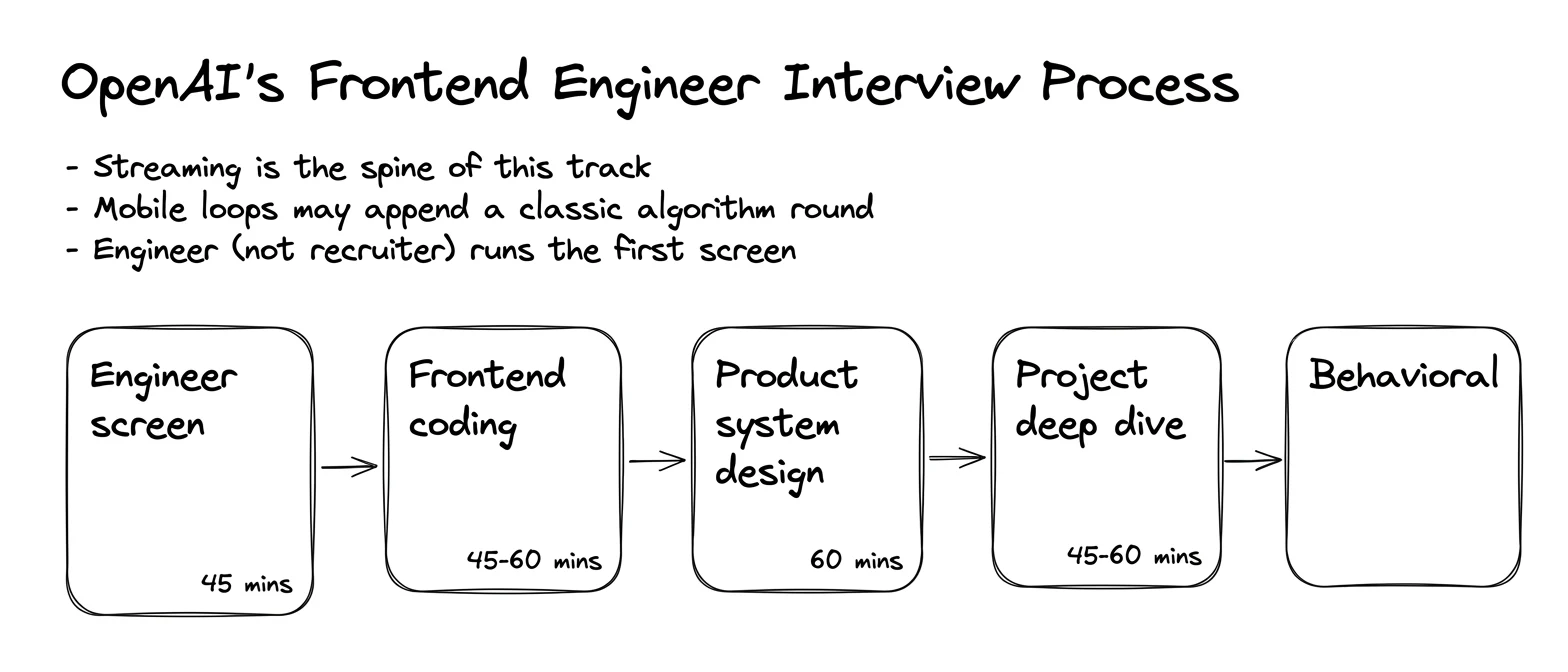
OpenAI hires frontend engineers into specific product teams, such as ChatGPT, Codex, billing and developer platforms, and many hires skip a separate matching step. Web candidates are tested in React and TypeScript; mobile candidates in SwiftUI or UIKit, or in Jetpack Compose. The process typically runs three to six weeks: one applied full-stack candidate went from recruiter call to offer in about three to four weeks, while a referred candidate waited almost a month just to reach the phone screen.
The skeleton is a recruiter or engineer screen, one or two technical screens, and a virtual onsite of four to five rounds. Some teams run the screen as a two-hour block: an hour of coding, a 15-minute break, then an hour of design. Senior candidates get more design and a harder deep dive, and loops that need more signal get extra rounds.
Here's what the interview process can look like:
- Recruiter or engineer screen (30–45 minutes): Logistics, compensation and motivation, often followed by technical questions on real-time state and past incidents.
- Technical phone screen (about 60 minutes, sometimes paired with design): A multi-part practical coding problem or a small UI build in a runnable editor.
- Frontend coding interview (45–60 minutes): A working interface built live, usually a streaming chat surface, a full-stack mini app or a native mobile screen.
- Product system design interview (60 minutes): A model-powered product designed client to server, including streaming, error states and limits.
- Project deep dive (45–60 minutes, often with slides): One past project examined down to rejected alternatives and measured results.
- Behavioral and hiring manager interview: Mission, safety, ownership and collaboration, sometimes with a separate cross-functional session.
Tip: Rehearse one streaming chat client until you can rebuild it from memory in 30 minutes, covering cancellation, retries and error states. The same scenario appears in the screen questions, the coding build and the design prompt.
Recruiter or engineer screen
The first call lasts 30 to 45 minutes. On this track it is often run by an engineer rather than a recruiter. The logistics part is detailed: the share of the past year spent coding hands-on, whether you see yourself as frontend, backend or full stack, daily frameworks, preferred interview language, visa sponsorship, relocation, the three-days-a-week office expectation, competing deadlines, and base and total compensation expectations. Recruiters also ask about promotion history, reasons for leaving and previous equity.
Engineer-led calls then cover a system you owned end to end and a production incident you diagnosed, before moving to real-time features: state for live data streams, keeping streamed tokens from flickering or overwriting each other in React, races between several streaming responses, useRef versus useState, and making a repeated request idempotent. Even some recruiter-run calls asked how to find faults when traffic grows tenfold. Candidates have been rejected at this stage.
Interviewers evaluate:
- Mission clarity: A specific reason for this product area, tied to your own work, is recorded in feedback; general enthusiasm for AI is not.
- Hands-on recency: A low share of recent coding or a vague answer about frameworks raises doubts about the role.
- Real-time state fluency: Explaining where transient stream state lives and why, without reaching for a library first.
- Incident ownership: A clear sequence of what broke, how you diagnosed it and what changed afterward.
Prepare a two-minute project summary, a fully worked incident story and your answer on streaming state before this call.
Tip: Ask which level the role is calibrated at during this call. Candidates who asked got a direct answer, and recruiters also agreed to space out loops for candidates with parallel processes.
Sample questions for the recruiter or engineer screen
Here are some questions reported by recent candidates:
-
How would you manage React state while tokens stream in, so the text neither flickers nor overwrites itself?
-
With several streaming responses in flight, how do you prevent races between them, and when would you use a ref instead of state?
-
How do you guarantee that a duplicated network request is not processed twice?
-
What percentage of the last twelve months did you spend coding, and are you frontend, backend or full stack?
Technical phone screen
The technical screen is about 60 minutes in a shared editor that runs code, and looking up documentation is allowed. Product-track candidates describe a semi-realistic task, such as parsing and processing a stream of structured data, followed by edge cases, complexity and what changes when the input is large or streaming. Many frontend candidates get the multi-part problems used across engineering: a grid infection simulation with up to five parts (immunity, recovery after a set number of days, death above a neighbor threshold, burning a row or column to minimize deaths), IP address iteration, a follow graph with snapshots, and counting chat events in a 15-minute window ending at the latest message. One candidate solved the infection parts in TypeScript.
Each part unlocks only when the previous one passes the interviewer's tests, so you cannot plan ahead. The clock is enforced strictly, and several interviewers said three finished parts is enough. Mobile screens differ: an iOS candidate built a given interface in a sample project and was asked when to choose UIKit over SwiftUI. A weak but not failing screen can lead to an extra coding round instead of a rejection.
Interviewers evaluate:
- Throughput: Working code for each part before the next one unlocks; a polished first part alone scores below three rough parts.
- Rule handling: Reading the scenario exactly, for example infection driven by neighbor counts rather than direction, or when a recovery timer starts.
- Debugging under time pressure: Fixing a failing test quickly while saying what you are doing.
- Language fluency: Using the standard library without hesitating; candidates in C++ lost parts to comparator syntax and boilerplate.
Practice the recurring multi-part problems in your interview language, at about 12 minutes per part.
Note: Rejected candidates often describe the same mistake: twenty minutes on structure, comments or a custom test harness, then the clock ran out on part four. Interviewers would not extend time even when a candidate was close.
Sample questions for the technical phone screen
Here are some questions reported by recent candidates:
-
Simulate infection on a plant grid where a healthy plant is infected once at least K of its eight neighbors are infected, then add immunity, recovery after D days and delayed death.
-
Implement
processEventandgetCountfor chat activity, counting the 15 minutes that end at the latest message for that user and chat. -
Implement follow, unfollow and snapshots for a social graph, then recommend friends of friends ranked by mutual connections.
Frontend coding interview
The onsite coding round is a build, not a puzzle, and runs 45 to 60 minutes. The best-documented web version asks for an input box and submit button that render a model's streaming output, updating smoothly as tokens arrive without blocking the page. An applied full-stack loop instead asked for a small working app with a React frontend, a backend API, shared state and real-time updates, built in the candidate's own environment with web search and AI assistants allowed; the grade depended on what was delivered.
Mobile loops use a Jetpack Compose home screen modeled on a translation app, or a ChatGPT-style chat interface built from a bare Xcode project in about 40 minutes. Some onsites add a refactoring round on a working but poorly structured chatbot codebase, where candidates separate concerns, make it testable and add pieces such as an event bus so bots can read messages without being tied to the sending code.
Interviewers evaluate:
- A working loop first: Something runnable from input to rendered output early, then improved.
- Complete states: Loading, empty, error and cancelled states handled, plus what happens to a partial response.
- Stream handling: Where in-progress data lives, how renders are batched, and how duplicated or out-of-order chunks are handled.
- Component and API structure: Clear component boundaries and a sensible contract with the backend.
- Trade-offs spoken aloud: Saying what you are skipping and why when time runs short.
Build a streaming chat client and a small full-stack app from scratch under a 45-minute timer at least twice before the onsite.
Note: Polish alone does not pass. A senior mobile candidate built a bug-free, highly polished chat UI with basic error handling but skipped login and networking, was rejected within a week, and concluded that a complete flow was the real bar.
Sample questions for the frontend coding interview
Here are some questions reported by recent candidates:
-
Build an input and submit button that streams a model's response into the page token by token, keeping the page responsive.
-
Build a small full-stack tool with a React client, an API and live updates, handling loading, error and empty states.
-
Refactor a chatbot codebase so new bots can be added without touching existing ones, then support several channels with separate state.
-
Implement a ChatGPT-like Chat UI in React (Streaming + Loading + Message Flow)
-
Jetpack Compose: Build a UI Similar to Google Translate Home Screen
Product system design interview
The design round is an hour, with prompts drawn from OpenAI's own products. Reported frontend prompts include the ChatGPT Playground (parameter panel, presets, streaming output, server failure mid-response) and the error flow when a free-tier user hits the message cap: the API contract, how the client reads each error, and how limits apply to text, voice and image messages. Others asked for a WhatsApp-style app from a written requirements document, ChatGPT itself, and an AI feature streaming responses to many users.
Follow-ups go below the diagram: server-sent events versus WebSockets, rate limiting and queuing in front of model calls, caching and token cost, observability, and recovering missed messages with sequence numbers after a reconnect. Some interviewers deliberately say little. Candidates who drove the discussion did well; those who waited to be asked about each scenario did not.
Interviewers evaluate:
- Unprompted coverage: The normal flow, every error state, rate and tier limits, retries and recovery, raised before the interviewer asks.
- Client-server contract: Error codes the client can act on, idempotency keys, and what the client renders for each failure.
- Streaming choices: Transport, back-pressure and cancellation, justified by the product.
- Use of given requirements: When a document is supplied, its constraints should visibly shape the design.
- Focus: Covering the whole system; going deep on one subtopic cost candidates the rest of the round.
Practice three or four OpenAI product surfaces end to end, out loud, without prompts.
Note: Design was the round most often blamed for rejection on this track. A candidate rejected after the message-cap prompt pointed to the API and client error handling; another fell short by applying a memorized framework instead of reasoning about the specific prompt.
Sample questions for the product system design interview
Here are some questions reported by recent candidates:
-
Design the ChatGPT Playground, including presets, streaming output, and what happens when the server fails mid-response.
-
Design how the client and API handle a free-tier user reaching the message cap, across text, voice and image messages.
-
Design a real-time AI feature with streaming responses for a large user base, covering rate limiting, caching, token cost and observability.
Project deep dive
The deep dive lasts 45 to 60 minutes, often as a prepared presentation; one candidate brought eight slides, and another's session was led by a principal engineer. Questions cover the problem, your role, why you rejected alternatives, how you measured success after launch, and what you would change now, sometimes down to memory management or back-pressure. One candidate passed coding, design and behavioral rounds and candidate review, then was rejected at final approval because the deep dive was judged too shallow.
Interviewers evaluate:
- Depth on demand: Moving from architecture to implementation detail and back without losing the thread.
- Decision rationale: For each major choice, the alternatives considered and why they were dropped.
- Measured impact: Numbers for performance, adoption or reliability, and how you got them.
- Self-critique: What you would redesign with hindsight, stated plainly.
Choose a frontend-heavy project with real performance or reliability numbers, and reread its code and design docs beforehand.
Sample questions for the project deep dive
Here are some questions reported by recent candidates:
-
Present a technically challenging project, then explain why you rejected each alternative architecture.
-
How did you measure the project's success after launch, and what would you do differently today?
Behavioral and hiring manager interview
This round is usually run by an engineering manager or a hiring-team member, and some loops add a 30-minute cross-functional session where you may pitch a developer-facing feature and explain how you would measure it. Topics recur: why OpenAI and why this product, views on AI safety and AGI, balancing speed with quality and safety, a project you drove and shipped, disagreements, feedback and failure. Interviewers often follow up on the technical details of your stories.
Hiring-manager calls can be as short as 15 minutes and still decide the outcome: one candidate was rejected two days after such a call. Some managers stay quiet, and a candidate who waited for one to lead was rejected for insufficient signal.
Interviewers evaluate:
- Specific motivation: A reason for OpenAI and this team grounded in your own shipped work.
- Safety judgment: A considered view on moving fast responsibly, illustrated with a real decision.
- Ownership: Projects you started and finished, with your contribution clear.
- Initiative: Driving a quiet conversation with good questions and a clear case for your fit.
Prepare five stories with technical depth behind each, and a personal answer on mission and safety.
Sample questions for the behavioral and hiring manager interview
Here are some questions reported by recent candidates:
-
Why OpenAI rather than another AI company, and what is your view on AI safety?
-
How do you balance shipping fast with quality and safety? Give an example.
-
Tell me about a project you completed but decided not to release.
How OpenAI levels and evaluates Frontend Engineer candidates
Feedback goes through two gates, candidate review and then final approval, run by people who did not interview you. One candidate was told that one or two "strong hire" ratings are needed to reach the hiring committee, and several heard encouraging feedback after every round and were rejected anyway, sometimes because headcount moved. Thin signal triggers an extra coding round, design round or director conversation. Coding performance weighs heavily in the final level even when project and behavioral signals are strong.
References come late and move fast: two letters, one from a manager, plus internal references if referred. In one case, a Friday onsite led to a Monday reference request and a Thursday offer. A candidate approved by committee whose team filled up was sent back to team matching. Rejections usually arrive within about a week, without specific feedback.
Tip: Treat a request for internal references, or a newly added round, as a sign the decision is close. Line up references before the onsite.
How to prepare for the OpenAI Frontend Engineer interview
- Master one streaming client: Rebuild a chat interface that streams tokens, supports cancel and retry, and shows each failure state, until it takes 30 minutes without notes.
- Explain your state choices: Be ready to justify ref versus state, where stream data lives, and how concurrent responses avoid races; engineers ask before any coding.
- Drill the multi-part problems: Practice infection simulations, snapshot graphs and windowed counters in your interview language, aiming for three finished parts in an hour.
- Ship complete flows, not polish: In build rounds, get a running loop first, then loading, error and empty states, then visual refinement.
- Design OpenAI products end to end: Rehearse the Playground, ChatGPT and message-cap errors aloud, covering the API contract, streaming transport, rate limits and recovery unprompted.
- Rehearse a deep-dive deck: Prepare about eight slides on one project with rejected alternatives, measured impact and what you would redo.
- Personalize mission and safety answers: Link why OpenAI and your view on safe deployment to a decision you actually made.
About the OpenAI Frontend Engineer role
Frontend engineers at OpenAI own the interfaces through which most people use the models. Postings describe owning component systems, state management, routing and client performance, building features end to end with backend teams, and improving reliability through testing, instrumentation, accessibility and careful handling of loading, errors and concurrent edits. Hiring is mainly in San Francisco, with roles also in New York and Seattle, on a hybrid schedule of three days a week in the office. Many roles are full-stack in practice.
OpenAI does not publish its ladder, and accounts disagree on where senior ends and staff begins; most external offers land at L4 or L5.
| Level | Primary focus | Impact scope |
|---|---|---|
| L3 | Well-scoped features with guidance; rare for external hires | Parts of a product surface |
| L4 | Owning features end to end; the most common external entry point | A team's product area |
| L5 | Leading architecture and cross-team delivery; often compared to staff elsewhere | Several surfaces or a platform |
| L6 | Technical direction at a senior-staff level | An organization's product area |
OpenAI hires Frontend Engineers across several product groups. Teams include:
- ChatGPT Engineering: The core ChatGPT web experience, including conversation and streaming.
- ChatGPT workspace (Codex Engineering): A shared space where people and AI agents work on documents, sheets and slides, calling for real-time collaboration and rich-text editing.
- Codex Cloud Apps: Agent products, including site building and code review.
- Applied Foundations: Shared layers such as identity and access, safety, and payments across OpenAI's apps.
- Financial Web Platform: Pricing, purchasing and billing interfaces, plus internal tools for finance and sales.
- Developer platform: APIs, SDKs and interfaces for developers who extend ChatGPT and Codex.
Frontend Engineer experience and education requirements
Postings ask for strong production experience with React and TypeScript, a record of shipping UI at scale, and a high bar for interface craft. One listing targets up to six years of experience; senior loops weigh architecture ownership and design depth more heavily. Preferred backgrounds include collaborative or real-time apps, rich-text editors and AI products. Mobile roles expect fluency in both native UI frameworks of their platform.
FAQs about the OpenAI Frontend Engineer interview
How long does the OpenAI Frontend Engineer interview process take?
Typically three to six weeks from first call to decision. Fast cases end in an offer two days to a week after the onsite; slow ones include a month between referral and phone screen, or added rounds and team matching afterward.
What is the hardest round of the OpenAI Frontend Engineer interview?
The product system design round, by outcome: it is open-ended, the interviewer may not steer, and the score depends on failure scenarios you raise yourself. The project deep dive is next, because a shallow one can stop an offer at final approval.
Is there an online assessment or take-home?
Most frontend loops have no automated assessment; the first technical step is a live screen. Some teams use a longer practical build in your own environment with AI tools allowed, so ask your recruiter which format applies.
Which language should I use?
The one you are fastest in, named at the first call. Web candidates generally use TypeScript or JavaScript, and Python is common on the general coding problems. Candidates who chose C++ reported losing subproblems to boilerplate.
How much does an OpenAI Frontend Engineer make?
Approximate total annual compensation by level:
- L4: ~$680K
- L5: ~$1,000K, with a wide spread between roughly $870K and $1.4M
Posted frontend base salaries range from about $230K to $405K, and candidates were told of base caps near $327K at L5 and $385K at L6. Most of the total is equity, granted as profit participation units whose value depends on the company's valuation.