Okx · Study
OKX Interview Process & Questions
TrueInterview
October 13, 2026 · 9 min read
OKX interviews are run by the hiring team, and the bar swings with the team. Some loops are mostly conversations about your past projects with a trivial coding check. Backend and payments loops go deep on exchange infrastructure: cross-region data, reconciliation with payment providers and transactional failure modes. In both, how closely your stack matches the team's weighs more than algorithm performance.
This guide breaks down each stage of the OKX interview, what interviewers evaluate in each round, and how to prepare, with questions candidates were actually asked.
Verified: Based on 4 candidate-reported interview experiences, cross-checked against recent public accounts.
OKX interview process
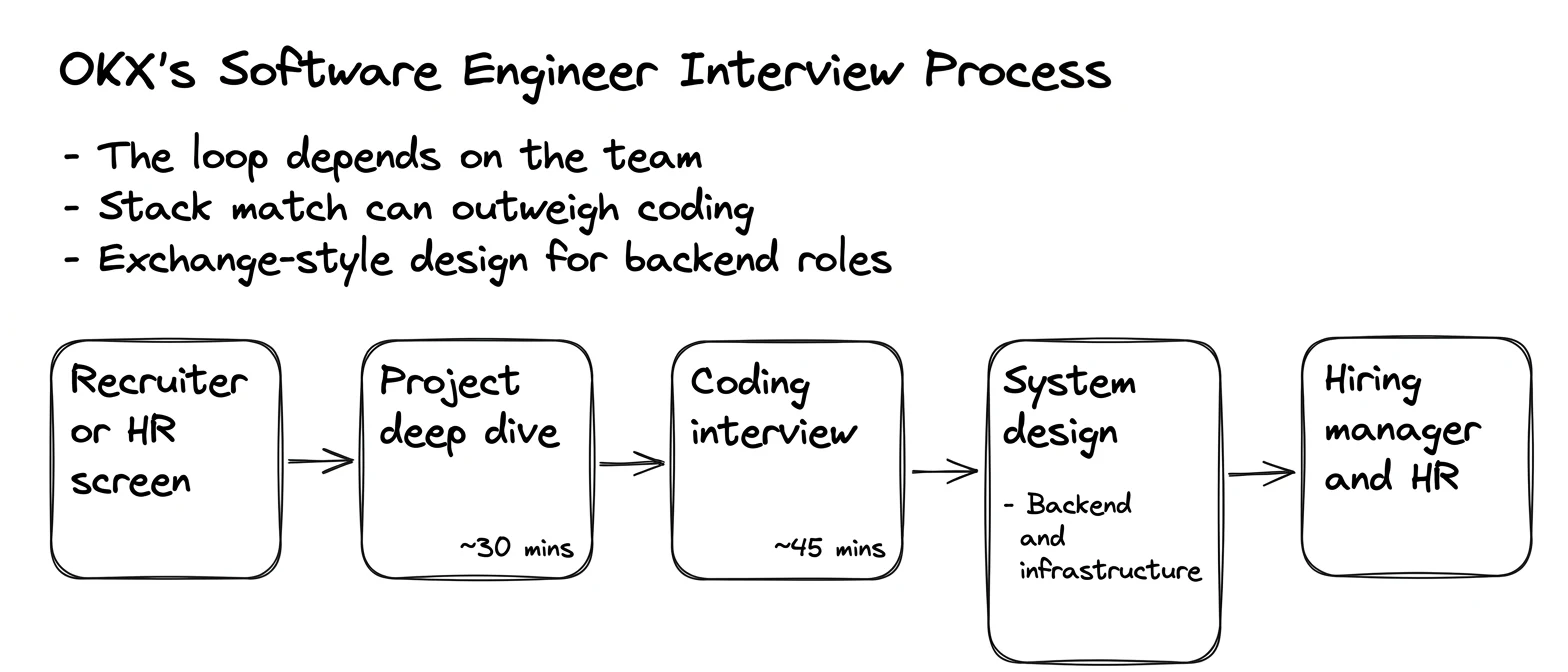
Each team runs its own process, so the number and depth of rounds vary widely. Reports from 2025 and 2026 describe two shapes. The first is one or two chat-style technical rounds, each a project deep dive followed by a very simple coding exercise. The second is a heavier backend session that combines two system design discussions with two coding problems. Recent accounts typically add a recruiter or HR call at the start and a hiring manager or senior leader round near the end, for about four to six conversations in total.
Graduate hires are posted with a Java and Spring backend stack and a general algorithms bar. For senior candidates, the design and leadership rounds typically carry the decision.
Here's what the interview process can look like:
- Recruiter or HR screen: A typically short call on background, motivation and interest in crypto.
- Project deep dive: Often the first 30 minutes of a technical round, testing whether your past work matches the team's stack.
- Coding interview: Anything from a linked-list exercise to two medium problems in about 45 minutes, depending on the team.
- System design interview (backend and infrastructure): Exchange-style problems such as cross-region data movement and payment reconciliation.
- Hiring manager and HR rounds: Open-ended technical and behavioral questions from a team leader, then offer logistics.
Tip: Before the first technical round, find out the team's stack from the posting or the recruiter, and line up a project that used the same tools. One candidate whose coding was trivially easy concluded that matching the team's stack was what the rounds actually tested.
Recruiter or HR screen
The first call typically comes from a recruiter or HR partner and covers your background, what you want next and, often, why you want to work in crypto. Postings ask for genuine interest in the industry and familiarity with trading products such as spot, futures, swaps and options.
Interviewers evaluate:
- Industry motivation: A specific reason to work at an exchange, not just at any fintech.
- Stack alignment: Whether your recent languages and middleware fit the team. Java, Spring, MySQL, Redis and Kafka come up most for backend roles.
- Location and team: Engineering roles are posted for Hong Kong, Singapore, Kuala Lumpur and San Jose.
Prepare a two-minute story that connects your past work to trading or payments.
Sample questions for the recruiter or HR screen
Here are some questions reported by recent candidates:
- Tell me about yourself and the systems you have worked on most recently.
- Why OKX, and why crypto?
Project deep dive
Most reported technical rounds open with your own work. In a 2025 round, the first half hour was a project discussion before any code. A 2026 candidate had two technical rounds that were both mostly project conversation, centered on whether their background matched the team's tech stack. In the backend loop, a design prompt turned into questions about real transactional problems the candidate had hit, so the deep dive can also surface inside the design round.
Interviewers evaluate:
- Stack overlap: Hands-on depth in the frameworks, databases and messaging systems the team runs.
- Production experience: Concrete incidents and data-consistency bugs, and how you fixed them.
- Depth on demand: Following a question two or three levels down without falling back on generalities.
- Ownership: Which decisions were yours and what you would change now.
Prepare one or two projects you can explain from the schema up, including at least one transactional failure you debugged yourself.
Note: A friendly round is not an easy one. Candidates consistently describe the interviewers as approachable, and the one candidate who felt they underperformed did so in that same relaxed setting.
Sample questions for the project deep dive
Here are some questions reported by recent candidates:
- Walk through your most relevant recent project, focusing on the parts built on this team's stack.
- Describe a real problem you hit in a transactional system and how you handled it.
Coding interview
How hard the coding is depends on the team. In the chat-style loops it is a fluency check. One candidate implemented insertion and deletion on a linked list, and another had two exercises that only tested basic syntax and data structures, with no follow-up pressure. In the backend loop, the coding was two standard medium problems, reported as Sort Colors and restoring valid IP addresses from a digit string. Other recent accounts describe the same format, two medium problems in about 45 minutes.
Interviewers evaluate:
- Clean basics: Correct pointer updates and edge cases (empty list, head, tail) in simple data-structure tasks.
- Pace: Two problems in one session leave little room to recover from a slow start.
- In-place partitioning: A single-pass three-way partition for Sort Colors.
- Backtracking with pruning: Segment checks for IP addresses, such as no leading zeros and values up to 255.
Practice pairs of medium problems against a 45-minute clock, even if your team's round turns out to be easy.
Sample questions for the coding interview
Here are some questions reported by recent candidates:
-
Implement insertion and deletion on a linked list.
-
Sort an array of 0s, 1s and 2s in place in a single pass.
-
Return every valid IPv4 address that can be formed by inserting dots into a digit string.
-
Basic coding to validate syntax and data structure familiarity
System design interview
Backend and infrastructure candidates get design problems from exchange operations rather than textbook products. In a 2026 loop, the first prompt had several regions pulling data from a source database in another region. The frontend stayed fixed, and the work was the backend partitioning strategy and the coordination that keeps cross-region reads efficient and consistent. The second prompt was reconciliation with an external payment service provider, which turned into a deep dive on real-world transactional pitfalls. Chat-style team loops reported no design round.
Interviewers evaluate:
- Partitioning and replication: How data is split and copied across regions, and what each region reads locally.
- Consistency trade-offs: Replication lag and how stale reads affect balances or orders.
- Reconciliation design: Matching internal ledgers to provider reports, idempotent retries, and missing or duplicate transactions.
- Practical experience: Pitfalls you have actually hit, not only patterns.
Prepare a cross-region replication design and a payment reconciliation design end to end, each with failure cases from your own work.
Tip: For reconciliation, start from the ledger: name the source of truth, map each external transaction to an internal record, and explain how a mismatch is resolved. The follow-ups go straight to those pitfalls.
Sample questions for the system design interview
Here are some questions reported by recent candidates:
- Several regions read from a source database in one region. Design the backend partitioning and coordination so those reads stay fast and consistent.
- Design reconciliation between OKX and an external payment service provider, then discuss transactional pitfalls you have seen in practice.
Hiring manager and HR rounds
Later rounds are typically led by a hiring manager or a senior engineering leader, followed by HR. Recent accounts describe the leader round as open-ended technical questions that test breadth and depth. It can be mixed with standard behavioral questions and a deep dive into a technology that you and the team both use. The HR call covers the outcome, the offer and next steps.
Interviewers look for:
- Breadth: Comfort across databases, middleware and distributed design for backend roles.
- Fundamentals behind your resume: How each technology you list works internally.
- Ambiguity: Postings ask for comfort working without full specifications.
- Motivation: A credible commitment to the crypto industry.
Refresh the internals of every technology on your resume, and prepare stories about an ambiguous project and a production incident.
How OKX makes hiring decisions
Hiring is team-driven. The interviewers are the team you would join, and stack fit weighs heavily alongside technical performance. Reports describe no central hiring committee or formal leveling rules. Candidates typically describe a few weeks from first contact to decision, and some never heard back after the final round, so following up with the recruiter is reasonable.
How to prepare for the OKX interview
- Match the team's stack: Learn the posting's stack, often Java, Spring, MySQL, Redis and Kafka, and lead with projects that used it.
- Prepare one project from the schema up: Every reported technical round started with past work or spent most of its time on it.
- Keep medium-problem speed: Practice two mediums in 45 minutes, including in-place partitioning and backtracking with pruning.
- Nail the basics anyway: Linked-list and simple data-structure tasks should be quick and free of edge-case slips.
- Prepare exchange-style designs: Cross-region replication and payment reconciliation, with idempotency and mismatch handling.
- Bring real transactional war stories: Interviewers asked about pitfalls candidates had personally hit.
- Have a crypto answer ready: Know why you want an exchange, and know the basics of spot, futures and options.
About working at OKX
OKX started as OKCoin in 2013 and rebranded in 2022. It runs a global crypto exchange for spot and derivatives trading, alongside a self-custody Web3 wallet. It launched its US exchange in April 2025 with a regional headquarters in San Jose. In March 2026, Intercontinental Exchange invested at a valuation of about $25 billion, with plans to give OKX customers access to US futures and tokenized equities. Engineering is spread across Hong Kong, Singapore, Kuala Lumpur and San Jose.
OKX hires engineers across many teams, which include:
- Trading services: The exchange's trading systems, including a Rust-based trading engine.
- Asset and Earn: Java services for customer assets and yield products.
- Payments and cards: OKX Pay, fiat payment rails and card products.
- Risk and compliance: Risk engineering and a compliance data platform.
- Mobile and Web3: The exchange apps and the self-custody wallet.
- AI and agents: Agent infrastructure and chatbot development.
Experience and education requirements
Graduate backend postings ask for a technical bachelor's degree or equivalent self-taught experience. They list Java with Spring Boot and Spring Cloud, Python, microservices, relational databases, Redis and Kafka, and data structures and algorithms. Multithreading, distributed architecture and an interest in crypto are preferred. Some senior and staff postings ask for six or more years of relevant experience.
FAQs about the OKX interview
How long does the OKX interview process take?
Candidates typically describe a few weeks end to end. Chat-style team loops can finish in one or two technical rounds, while backend loops add design and leadership rounds.
What is the hardest round of the OKX interview?
For backend and infrastructure roles, it is system design, with cross-region consistency and payment reconciliation probed through real failure cases. In team-fit loops, the project deep dive carries most of the weight.
Is there an online assessment?
None of the reported loops included one. The first technical step was a live round with the team.
What language should I use?
Backend teams mostly run Java. Any mainstream language is typically accepted for coding, but using the team's language strengthens the stack-fit signal.
How much does an OKX software engineer make?
The posted base range for a graduate backend engineer in San Jose is $125K–$155K. Packages may add a performance bonus and long-term incentives, depending on role and location.