NVIDIA · Study
NVIDIA Machine Learning Engineer Interview Process
TrueInterview
July 24, 2026 · 11 min read
NVIDIA's Machine Learning Engineer loop is assembled by the hiring team, and most teams care less about modeling than about the machine underneath it. In one inference-optimization loop, three of six onsite rounds were C++. Screens are just as specialized: one was 45 minutes of optimization theory with no code, another was quantization math, a third ran from Amdahl's law to the thread limit per block. Candidates who know the APIs but cannot explain why a change made things faster tend to stall in the middle rounds.
This guide breaks down each stage of the NVIDIA Machine Learning Engineer interview, what interviewers evaluate in each round, and how to prepare, with questions candidates were actually asked.
Verified: Based on 9 candidate-reported interview experiences, primarily from 2025 Q3 through 2026 Q3, cross-checked against recent public accounts.
NVIDIA Machine Learning Engineer interview process
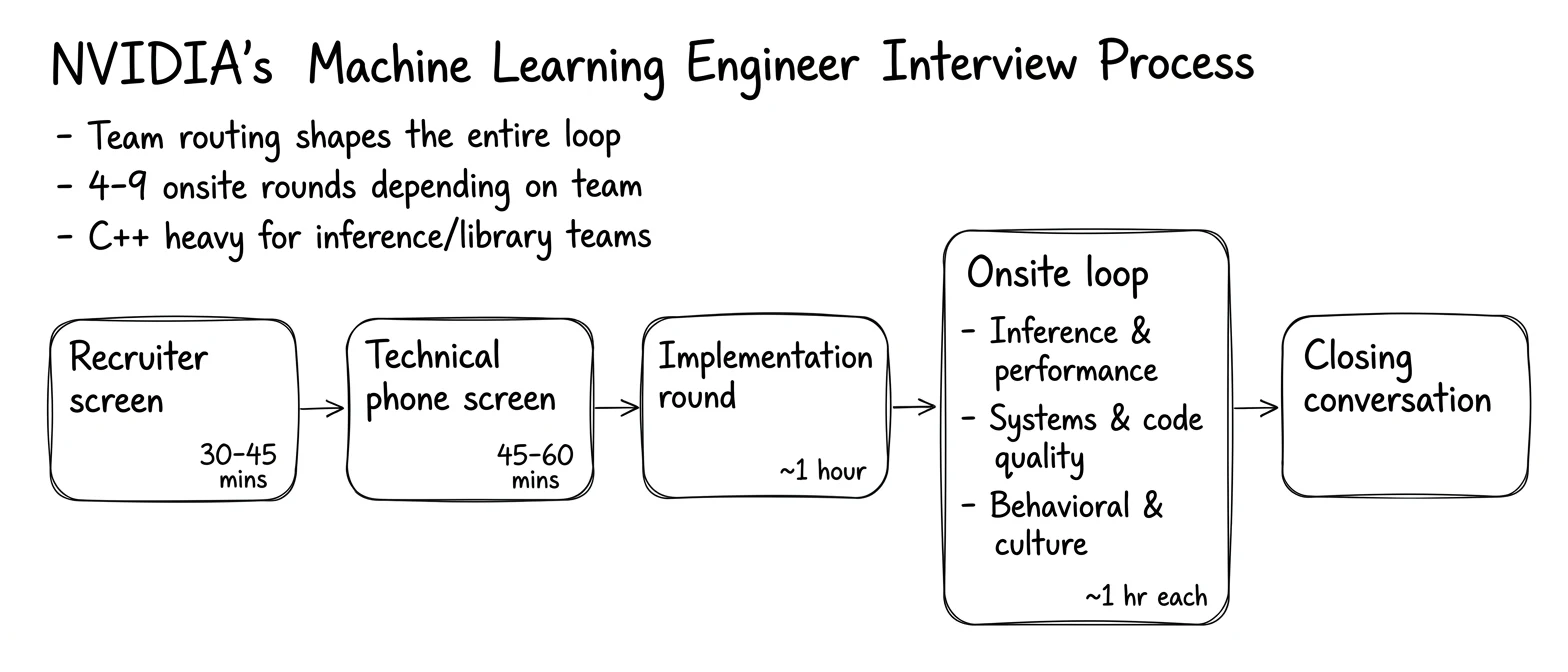
Each team builds its own loop. Reported loops ranged from four phone conversations for an applied role, to a screen plus six onsite rounds for inference optimization, to nine one-hour rounds with nine interviewers for a senior platform role. Decisions typically arrive three to eight weeks after first contact. New-graduate openings, which usually ask for a master's or PhD, lean on implementation and fundamentals; senior openings add a resume deep dive and a design round with hard latency numbers.
Here's what the interview process can look like:
- Recruiter screen: Background, motivation and which side of the training/inference line you work on.
- Technical phone screen (one or two): 45 to 60 minutes of ML theory, hardware-aware questions, or a standard coding problem plus domain discussion.
- ML coding interview: About an hour turning a formula into working tensor code.
- Inference and performance deep dive (one to three rounds): Quantization, pruning, parallelism and your own optimization work.
- C++ and systems coding (inference and library teams): Cache-aware code, graph structures and debugging a large codebase.
- ML system design interview: A serving or platform design under stated latency and throughput limits.
- Behavioral and closing conversation: Motivation, integrity, learning habits and the team's roadmap.
Tip: Ask the recruiter whether the team ships training or inference software. One candidate realized mid-screen that the team was built around inference serving, not training frameworks, and had prepared the wrong half.
Recruiter screen
The recruiter call covers background, location, work authorization and why you are leaving, and it routes you to a team. Logistics do not always come first: in the nine-round loop, visa status, paid time off, retirement matching, the stock purchase plan and salary expectations were covered in a recruiter conversation at the very end.
Interviewers look for:
- Clear domain positioning: Training, inference, kernels or data platforms, stated in one sentence.
- Scale of past systems: Model sizes, cluster sizes and latency targets you actually owned.
- Specific motivation: A reason tied to the team's product, not general interest in AI.
Prepare a two-minute summary of your most performance-critical project, with its numbers.
Sample questions for the recruiter screen
Here are some questions reported by recent candidates:
-
Walk through your current role and the systems you own.
-
Why are you considering leaving your current company?
Technical phone screen
Screens run 45 to 60 minutes with a hiring-team engineer, in four reported shapes. A theory screen covers gradient descent from first principles: convexity and global minima, full-batch versus mini-batch versus stochastic gradients, the bias and variance of each estimate, and how batch size drives sharp versus flat minima. An applied screen covers bias and variance reduction, confidence calibration, drift detection and framing a business problem as a modeling objective. A hardware-aware screen moves from your resume through CUDA kernels, Amdahl's law, SRAM versus HBM, tiled matrix multiplication and MLP shapes, then a logic puzzle and C++ virtual dispatch.
The fourth shape opens with one standard problem, such as unique triplets or merging intervals, then pivots to Transformers, compilation, inference parallelism and benchmark metrics.
Interviewers evaluate:
- Depth past the definition: Follow-ups ask which assumption your answer relies on and what breaks without it.
- Hardware reasoning: Explaining a speedup in terms of bandwidth, locality or the parallel fraction.
- Time management on code: The problem is moderate; one candidate over-polished it and squeezed the discussion that carries most of the signal.
- Measurement discipline: Which GPU, which baseline and how the gain was measured.
Review optimization theory to two levels of "why" and rehearse one optimization story in bandwidth terms.
Note: The theory screen feels conversational because the first answer is usually accepted. The follow-ups, such as the gap between the training gradient and the population gradient, are where prepared definitions run out.
Sample questions for the technical phone screen
Here are some questions reported by recent candidates:
-
Does a convex loss guarantee a global minimum, and how does stochastic gradient noise help escape local minima?
-
Compare SRAM and HBM and explain how tiling changes matrix multiplication on a GPU versus a CPU.
-
Find all unique triplets summing to a target, then explain Q, K and V in attention and how you benchmarked compiled against eager inference.
-
Deep Learning Fundamentals: Optimization, Drift, Calibration
ML coding interview
This hour tests turning math into correct tensor code, and it appears even when the posting does not mention coding. In one version, attention scores carry a bias whose entry at row i, column j is the negative distance between positions; the candidate then had to train the layer with a loss and optimizer and print a falling loss. In another, the task was two-dimensional convolution in NumPy alone, using slicing and broadcasting instead of loops.
Interviewers evaluate:
- Shape correctness: Every intermediate tensor's dimensions, stated before the line is written.
- Vectorized construction: Index-based biases and sliding windows built by broadcasting.
- Softmax axis: Normalizing over the keys, not the queries.
- Training-loop wiring: Gradients zeroed, backward pass and optimizer step in order, with evidence the model learns.
Practice attention variants, convolution and a full training step from a blank file.
Note: The candidate rejected after the attention round noted that one indexing error in the bias or a misplaced softmax dimension derails everything after it, and the hour leaves no time for a second attempt.
Sample questions for the ML coding interview
Here are some questions reported by recent candidates:
-
Implement attention with a decaying positional bias, train it on synthetic data and show the loss decreasing.
-
Implement two-dimensional convolution with NumPy only, without explicit loops.
-
Analyze overfitting, DenseNet, preprocessing, and cross-validation
Inference and performance deep dive
These rounds mix domain questions with your own work. Quantization is a standing topic: FP32 to Int8, choosing a scale factor and zero point, and asymmetric schemes. Other prompts covered pruning channels and choosing kernels at runtime from input shape and pruning mask, serving several models from shared memory pools, and tensor versus pipeline parallelism. Every round returns to your resume: the scale, the bottleneck, how you proved it, and why the fix was worth its complexity.
Platform openings swap kernels for clusters: computing GPU utilization from raw metrics, Spark skew, idempotent ingestion and the cost of a rename in object storage.
Interviewers evaluate:
- Quantitative causality: Why the numbers moved, not just what changed.
- Trade-off selection: When each parallelism strategy wins and what it costs.
- Runtime thinking: Graph metadata, kernel choice and memory reuse in a live engine.
- Ownership: Exactly which decisions were yours.
Prepare one project you made measurably faster, with profiles before and after.
Sample questions for the inference and performance deep dive
Here are some questions reported by recent candidates:
-
Explain asymmetric Int8 quantization and how you would pick a layer's scale factor and zero point.
-
After pruning channels, how do you represent the graph and choose a kernel at runtime?
-
Compare tensor and pipeline parallelism and say when you would choose each.
-
Research Project Deep Dive: Motivation, Training Pipeline, Results, and Takeaways
C++ and systems coding
Inference and library teams test C++, not Python. One round asked for a transpose of a large matrix, then row-major versus column-major access, tiling and prefetching for matrices larger than cache. Another asked for a graph supporting node insertion, edge configuration and validation through cycle detection and dependency ordering. A third handed over a large C++ codebase with a logic error, a memory leak and a race condition; overloading and template specialization also came up.
Interviewers evaluate:
- Memory-hierarchy fluency: Predicting how an access pattern changes performance.
- Data-structure design: Clean interfaces and validation rules stated as invariants.
- Debugging method: Isolating the leak and the race from symptoms.
- Tool judgment: How you direct an AI assistant and verify its fixes.
Practice fixing an unfamiliar multithreaded C++ project and writing a tiled transpose from memory.
Note: One debugging round explicitly allowed an AI coding assistant. The grade covered how the candidate explained each root cause, not whether the assistant produced a patch.
Sample questions for the C++ and systems coding
Here are some questions reported by recent candidates:
-
Transpose a matrix too large for cache in C++ and explain how tiling and prefetching change performance.
-
Build a graph with node insertion and edge configuration, then reject cycles and produce a dependency order.
-
C++ Debugging and Output Prediction (Pointers, Inheritance, Multithreading)
ML system design interview
Design prompts come with operating numbers. One asked for real-time fraud detection at more than 10,000 requests per second within 50 milliseconds, with zero-downtime model swaps and holiday traffic spikes; follow-ups covered head-of-line blocking and a serving node failing mid-update. A platform loop packed three prompts into one hour: a telemetry collector at two resolutions, a dashboard drilling to per-GPU seconds, and a SQL-writing chatbot that must enforce per-user access and block a runaway cross join.
Interviewers evaluate:
- Arithmetic out loud: Throughput, latency budgets and storage sized before components.
- Safe model rollout: Versioned registries, warm-up, canary traffic and rollback.
- Degradation path: What gets shed or buffered at saturation.
- Guardrails for generated queries: Access and cost limits enforced outside the model.
Practice two serving designs and one telemetry design, each opened from a budget.
Sample questions for the ML system design interview
Here are some questions reported by recent candidates:
-
Design real-time fraud scoring under 50 milliseconds at 10,000 requests per second, with zero-downtime model updates.
-
Design an LLM chatbot over a data platform that cannot leak rows across users or crash the query cluster.
Behavioral and closing conversation
Longer loops add a culture round and end with an evaluative talk about the team's roadmap. Topics include integrity, what motivates and demotivates you, and personal inventory: the last engineering book you read, the last unrelated one, and a recent technical article you liked.
Interviewers evaluate:
- Genuine curiosity: Specific titles and what you took from them.
- Integrity: A situation where doing the right thing cost something.
- Self-direction: A plan for the skills the team needs next.
- Clarity with specialists: Interviewers are often long-tenured engineers with electrical engineering backgrounds.
Have real answers ready for the book and article questions.
Sample questions for the behavioral and closing conversation
Here are some questions reported by recent candidates:
-
What motivates you at work, and what demotivates you?
-
Which skills would be most valuable for you to learn in this role?
How NVIDIA levels and evaluates Machine Learning Engineer candidates
The hiring manager and the team's interviewers decide; there is no reported central committee. Postings usually span two numbered levels, such as Level 2 and 3 for new graduates or Level 4 and 5 for senior roles, and the team places you within that band. Rejections arrive without detailed feedback, in one case a week after the final round. NVIDIA publishes no fixed wait before reapplying, and one team's rejection does not bind another.
Tip: NVIDIA asks applicants to target only the three to five roles that fit best. Choose openings whose product matches your training or inference experience.
How to prepare for the NVIDIA Machine Learning Engineer interview
- Identify the team's half of the stack: Training, inference, applied models and data platforms produce different loops.
- Take theory two levels deeper: Gradient noise, batch size, minima sharpness, calibration and drift, with their assumptions.
- Learn the hardware vocabulary: Memory hierarchy, threads and blocks, tiling, Amdahl's law, memory-bound versus compute-bound.
- Write tensor code from a blank file: Attention variants, NumPy convolution and a training step that lowers the loss.
- Master quantization and parallelism math: Scale factors, zero points, and tensor versus pipeline trade-offs.
- Refresh C++ for inference roles: Cache-aware loops, graph validation, virtual dispatch, leaks and races.
- Open every design with numbers: Requests per second, latency budget and rollout plan first.
About the NVIDIA Machine Learning Engineer role
Machine Learning Engineers at NVIDIA work between the model and the silicon: building the libraries, compilers and runtimes that make training and inference fast on NVIDIA hardware, building models for products such as autonomous driving, or running GPU cluster platforms. Many roles are measured on benchmarks, so profiling is daily work.
NVIDIA hires Machine Learning Engineers across many teams. Teams include:
- TensorRT and TensorRT-LLM: Inference optimization libraries and compilers.
- Dynamo: Distributed inference serving integrating vLLM, SGLang and TensorRT-LLM.
- Deep learning frameworks: PyTorch and JAX performance, CUDA kernels and cluster benchmarking.
- NeMo and Megatron: Large-model training frameworks.
- Autonomous vehicles: Deep learning and computer vision for driving perception.
- Data and AI platforms: GPU cluster telemetry and internal data infrastructure.
Machine Learning Engineer experience and education requirements
New-graduate inference postings ask for a master's or PhD (or one in progress) in computer science, computer engineering, AI or a related field, strong C or C++ with Python as a plus, and exposure to CUDA, CUTLASS, Triton or NCCL. Senior deep learning postings commonly ask for a master's, PhD or equivalent and eight or more years of experience, with strong Python and PyTorch.
FAQs about the NVIDIA Machine Learning Engineer interview
How long does the NVIDIA Machine Learning Engineer interview process take?
Typically three to eight weeks from first contact to decision, longer for six- to nine-round loops.
What is the hardest round of the NVIDIA Machine Learning Engineer interview?
The ML coding interview, where one indexing slip leaves a model that silently fails to learn. For inference teams, the C++ debugging round is close behind.
Which programming language should I use?
Python with PyTorch or NumPy for ML coding, and C++ for inference, library and kernel teams, which test the language itself.
How much does an NVIDIA Machine Learning Engineer make?
Recent deep learning postings list these US base salary ranges:
- Level 2: ~$124K to $196K
- Level 3: ~$152K to $242K
- Level 4: ~$184K to $288K
- Level 5: ~$224K to $357K
Base varies with location and experience, and offers add equity and benefits on top.