NVIDIA · Study
NVIDIA Infrastructure Engineer Interview Process
TrueInterview
July 24, 2026 · 12 min read
NVIDIA infrastructure loops are built by the hiring team, so questions follow what the team runs: an HPC fleet, a GPU cluster, telemetry or system software. Nearly every round opens with a resume walkthrough and a behavioral question before a short, moderate coding problem, and candidates who solved every problem were still rejected. The decision turns on how far a past project holds up under questioning and on the failure-handling half of the design round.
This guide breaks down each stage of the NVIDIA Infrastructure Engineer interview, what interviewers evaluate in each round, and how to prepare, with questions candidates were actually asked.
Verified: Based on 9 candidate-reported interview experiences, primarily from 2025 Q3 through 2026 Q3, cross-checked against recent public accounts.
NVIDIA Infrastructure Engineer interview process
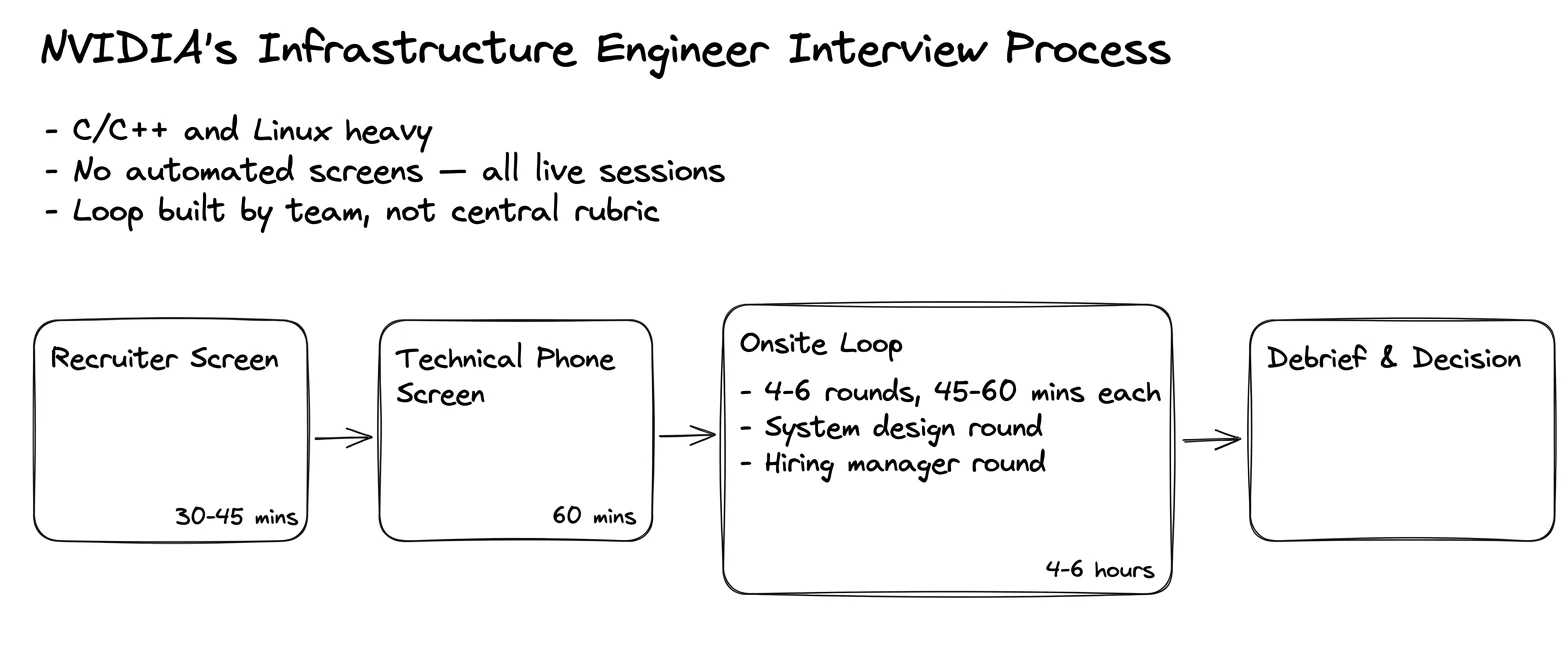
The same title can produce very different loops: one HPC software screen was a full system design, while a system software onsite was six coding-and-resume rounds. The usual skeleton is a recruiter call, one or two technical screens of about an hour, and an onsite of four to six rounds of 45 to 60 minutes, over four to eight weeks. At senior levels the design and hiring manager rounds carry more weight and expect Kubernetes or Slurm operating depth.
Here's what the interview process can look like:
- Recruiter screen: A 30 to 45 minute call that matches your background to a team and covers logistics.
- Technical phone screens (one or two): About an hour with hiring-team engineers, covering a resume walkthrough plus coding, a small design or a full system design.
- Coding interviews (onsite): Several rounds, each opening with resume and behavioral questions and ending with one 15 to 20 minute problem built on operational data.
- Low-level design interview (in some loops): A class or data-structure design with invariants, often in pseudo code.
- System design interview: A 45 to 60 minute distributed-systems discussion drawn from the interviewer's domain.
- Hiring manager and director interviews: A resume interrogation, behavioral scenarios, often a design exercise, and a domain deep dive.
Tip: Prepare three versions of every screen: resume-only, coding, and design. Candidates on this track met all three under the same job title, sometimes with no warning from the recruiter.
Recruiter screen
The 30 to 45 minute call is mainly routing: which cluster, fleet, telemetry or system-software team your history fits, since that team builds the loop. Expect questions on C/C++ and Linux depth, infrastructure scale, location, work authorization and pay expectations. Logistics are uneven: one first call was cancelled without explanation, and in another process the interviewer never joined.
Interviewers evaluate:
- Domain fit: Whether your clusters, schedulers, monitoring or system software match an open team.
- Scale and ownership: Node counts, traffic, and whether you ran the system or only used it.
- Language depth: C/C++, Python or Go at the level the team works in.
- Logistics: Location, visa status and timeline.
Prepare a two-minute summary of the largest system you operated, and ask which round formats you will see.
Sample questions for the recruiter screen
Here are some questions reported by recent candidates:
-
Walk me through your background and the infrastructure you have owned.
-
Why NVIDIA, and why this team?
-
What are your visa status, location preferences and compensation expectations?
Technical phone screens
Screens are live, about an hour, with one or two hiring-team engineers in a shared editor or on a whiteboard; no timed online assessment was reported. Shapes vary: a resume walkthrough then one problem (detect a temperature spike in CPU time and temperature readings); one problem stretched over the hour (length-prefixed string encoding, with follow-ups on fixed-width prefixes and malformed input); or three parts (fix a C pointer bug, transpose a matrix, design a setAll key-value store).
Some screens skip coding. One HPC software screen was entirely a fleet control-plane design, and another wanted only the data structures for a disk-space manager, sketched on a whiteboard. A second screen appears in some loops; one paired Excel column-title conversion with a top-ten build-target tracker. Interviewers often gave no reaction to correct answers.
Interviewers evaluate:
- Clarifying before building: One candidate took disk capacity as an item count when it meant total bytes, which changed the eviction rule.
- Low-level reading: Following C pointer arithmetic and spotting the logic error without running it.
- Robustness: Bounded reads, malformed input, empty strings, a dataset larger than the disk.
- Complexity unprompted: Time and space for each approach, and when lazy updates beat eager ones.
Practice short problems in C or Python without autocomplete, saying aloud what breaks on hostile input.
Note: The problems rarely matched lists tagged with this employer; candidates described them as written for the team. Practice fundamentals on parsing, counting and memory bounds instead of memorizing a list.
Sample questions for the technical phone screens
Here are some questions reported by recent candidates:
-
Encode a list of arbitrary strings, including ones containing the delimiter, into one string using a length prefix, then decode it and make reads robust to a corrupt length.
-
Build a disk-space manager with a byte capacity that evicts the earliest-added datasets until a new one fits and rejects a dataset larger than the disk without changing state.
-
Implement a key-value store whose
setAllassigns every key in constant time while later per-keysetcalls still win. -
Ingest build events and return the ten most frequently built targets, preferring the most recent timestamp on ties.
-
C++ Debugging and Output Prediction (Pointers, Inheritance, Multithreading)
Coding interviews
In the most detailed system software onsite, each of four coding rounds opened with resume and behavioral questions, then gave one easy-to-medium problem of 15 to 20 minutes on operational data: minimum array sum after exactly K increments, bracket matching, aggregating logs by HTTP status code, and planting the most trees on a grid with no two touching. Another loop asked for the weighted-tree node closest in total to three given nodes. The outlier was a screen that escalated from character counting to a constrained subarray selection needing four-dimensional dynamic programming, where greedy fails; that candidate needed hints.
Interviewers evaluate:
- Approach before code: Method and complexity first; candidates said the explanation mattered more than the code.
- Edge cases aloud: Empty input, unbalanced closers, unknown status codes.
- Knowing when greedy fails: Several interacting constraints signal dynamic programming.
- Concise project stories: The resume segment shares the clock with the problem.
Practice 20-minute problems on stacks, hash-map aggregation, greedy choices and grid search, each preceded by a 90-second project story.
Note: Solving every problem is not enough. A candidate who solved all five coding problems in a six-round loop was rejected after a high-pressure hiring manager round; the loop pools its evidence, and resume depth weighs as much as code.
Sample questions for the coding interviews
Here are some questions reported by recent candidates:
-
Given log entries with a status code and response time, report each code's count and average latency.
-
Find the most trees that can be planted on a grid when no two may be adjacent horizontally, vertically or diagonally.
-
Add 1 to array elements exactly K times in total and return the smallest possible final sum.
-
In a weighted tree, find the node that minimizes the sum of distances to three specified nodes.
Low-level design interview
Some loops have a separate software-design round, and design pieces also appear in screens. The interviewer wants classes, data structures and invariants, often in pseudo code: a bank-transfer transaction object that stays atomic if a step fails, a disk-space manager pairing a hash map with an insertion-ordered list, a setAll store resolved lazily with version numbers, and a top-ten tracker on a bounded min-heap. Matrix prompts add memory layout: row-major versus column-major order and cache-friendly tiling.
Interviewers evaluate:
- Invariants under failure: A transfer completes fully or not at all; a rejected insert leaves state unchanged.
- Lazy versus eager work: Versioning a global write instead of touching every entry.
- Interface clarity: Method signatures, missing-key returns and tie-breaking rules.
- Hardware awareness: How access patterns hit the cache.
Rehearse turning a three-sentence prompt into an interface, two or three structures and a check that each invariant holds.
Sample questions for the low-level design interview
Here are some questions reported by recent candidates:
-
Implement a bank-transfer transaction object that preserves atomicity and consistency.
-
Transpose a matrix in place when square and with extra memory when rectangular, then discuss the cache behavior of each.
-
Design a class tracking build counts and timestamps that returns the top ten targets on demand.
System design interview
Design is a 45 to 60 minute discussion shaped by the interviewer: one rate limiter round, run by an engineer with an embedded-systems background, centered on request accounting and storage rather than distributed framing. The most detailed report is an HPC control plane for about 1,000 hosts: 10-second heartbeats, a 30-second down threshold, jitter against synchronized bursts, a schema for metadata and heartbeat history, and an async server. The rest of the hour went to single points of failure: leader election or an advisory lock so one sweeper marks hosts down, replicated storage with failover, fencing tokens against split-brain, and rolling deploys that lose no heartbeats.
Other prompts: a fraud-scoring service above 10,000 requests per second within 50 milliseconds with zero-downtime model swaps, and, in a data-infrastructure loop, a telemetry collector at 30-second and 1-second resolution with a dashboard drilling to per-GPU, per-second detail.
Interviewers evaluate:
- Numbers you derive: 1,000 hosts at 10-second heartbeats is about 100 requests per second, so the hard part is connections and coordination.
- Failure mechanics: Leader election, fencing, failover and deploy safety, raised unprompted.
- Storage reasoning: Relational tables for current state versus time-series or partitioned history.
- Operability: Monitoring, alerting and upgrades without downtime.
Practice heartbeat, scheduler and telemetry designs until the failure-handling half is as detailed as the diagram.
Tip: Rounds are decided in the second half. A correct box diagram without a split-brain story or a rolling-deploy plan loses to a rough sketch that handles both.
Sample questions for the system design interview
Here are some questions reported by recent candidates:
-
Design a central service tracking the health and state of about 1,000 HPC hosts with no single point of failure.
-
Design a rate limiter, including where counters live and how limits hold across several instances.
-
Design a telemetry pipeline that computes GPU utilization from raw metrics and supports per-second drill-down.
-
Design real-time fraud scoring at more than 10,000 requests per second within 50 milliseconds, surviving holiday traffic spikes.
Hiring manager and director interviews
Candidates call the hiring manager round the most pressured: a resume interrogation, behavioral scenarios, a full system design such as a URL shortener, and a domain deep dive in one session. Some loops add a director conversation with more resume discussion and hypotheticals; it feels conversational but is scored. In one long data-infrastructure loop every interviewer was a long-tenured engineer with an electrical engineering background, probing whether candidates understood the hardware beneath their services.
Interviewers evaluate:
- Ownership depth: Topology, what broke, how you measured it, the decision you would reverse.
- Hardware awareness: GPU, memory and network behavior behind your systems.
- Composure: Steady pacing when the manager interrupts or jumps topics.
- Judgment in hypotheticals: Ambiguity, priorities and disagreement.
Choose two infrastructure projects and rehearse them five layers deep, including the metrics and the incident you would handle differently.
Sample questions for the hiring manager and director interviews
Here are some questions reported by recent candidates:
-
Take one project on your resume and explain the architecture, your exact contribution and the hardest problem you solved.
-
Design a URL shortener, covering ID generation, database choice and read-heavy scaling.
-
How would you handle a hypothetical situation where priorities conflict and the right answer is unclear?
How NVIDIA levels and evaluates Infrastructure Engineer candidates
There is no central hiring committee: interviewers file feedback and the hiring manager, sometimes with a tech lead, decides, so a strong day can still end without an offer if the team's needs shift. The target level comes from the requisition and your experience, and sets how much design the loop carries. Rejections usually arrive about a week after the final round without explanation. No fixed wait before reapplying is published, and because each team hires for itself, another team's opening remains a path.
Tip: Do not read meaning into silence. Candidates got no reaction to correct answers, no follow-ups and long gaps between stages, and none of it predicted the outcome.
How to prepare for the NVIDIA Infrastructure Engineer interview
- Make two projects hold up under questioning: Every round starts with your resume, so know the topology, metrics, failures and reversed decisions of two infrastructure systems.
- Drill 20-minute operational problems: Log aggregation, bracket matching, threshold detection, greedy counting and grid search, solved in plain C or Python.
- Practice length-prefixed and lazy-versioned structures, clarifying units first: Encoding and decoding, byte-capacity eviction and constant-time
setAllrecurred, and bytes versus items changed the expected answer. - Design for failure first: For fleet and telemetry designs, prepare leader election, fencing tokens, replica failover and rolling deploys before you need them.
- Read low-level code fluently: Pointer bugs in C, memory layout in matrix transposes and C++ ownership rules come up in screens.
- Learn the team's stack: Slurm or Kubernetes scheduling, GPU telemetry and the team's product, so the domain deep dive has substance.
About the NVIDIA Infrastructure Engineer role
Infrastructure engineers at NVIDIA run the compute behind its products and its own engineering: GPU clusters for AI training and inference, HPC fleets, schedulers, telemetry pipelines and the Linux and system software beneath them. The work stays close to hardware, from GPU utilization to RDMA networking and fleet-scale fault tolerance, and teams own their systems end to end.
| Level | Primary focus | Impact scope |
|---|---|---|
| IC1 | Well-scoped features and operational tasks with guidance | A component of one team's systems |
| IC2 | Independent delivery of services and automation | A team's systems |
| IC3 (Senior) | Design and reliability ownership of major systems | A team and its dependencies |
| IC4 to IC5 (Senior) | Architecture across several systems, mentoring | Several teams |
| IC6 (Principal) | Technical direction for a platform or organization | An organization |
NVIDIA hires Infrastructure Engineers across several groups. Teams include:
- DGX Cloud: GPU cloud services, AI infrastructure and site reliability on Kubernetes and Slurm.
- Internal AI and HPC clusters: Linux administration, scheduler configuration and automation for research and product teams.
- EDA compute: GPU and CPU clusters running electronic design automation for chip design.
- HPC and system software: Fleet management, host control planes and low-level system software.
- Networking: High-performance datacenter networking and RDMA fabrics.
Infrastructure Engineer experience and education requirements
Postings ask for a computer science or related degree or equivalent experience, strong Linux, and programming in Python, Go or C/C++. Senior roles typically ask for five to six or more years with large-scale clusters or distributed systems, preferring experience operating Kubernetes, Slurm or LSF, infrastructure as code such as Terraform or Ansible, RDMA networking and GPU hardware.
FAQs about the NVIDIA Infrastructure Engineer interview
How long does the NVIDIA Infrastructure Engineer interview process take?
Typically four to eight weeks from recruiter call to decision, longer when scheduling slips. Several weeks between stages is common, and rejections usually came about a week after the final round.
What is the hardest round of the NVIDIA Infrastructure Engineer interview?
The hiring manager round, which combines a resume interrogation, behavioral scenarios, a system design and a domain deep dive in one session, with the decision-maker in the room. Close behind is a system design round that turns to fault tolerance.
Is there an online assessment?
No timed online assessment was reported on this track. Every screen was a live session with hiring-team engineers.
How much does an NVIDIA Infrastructure Engineer make?
Recent US postings for senior AI and GPU infrastructure roles list base salaries of roughly $148K to $288K. Some higher-level postings list up to about $357K, and HPC cluster roles list about $144K to $270K. Packages add restricted stock and an employee stock purchase plan, and base pay varies by location and level.