Netflix · Study
Netflix Machine Learning Engineer Interview Process
TrueInterview
July 24, 2026 · 13 min read
Netflix hires Machine Learning Engineers team by team, and each loop is built around that team's work. Modeling teams run a fundamentals round that asks why each technique works the way it does. Platform teams ask you to design GPU scheduling across clusters or a model-monitoring portal, front end included, and then have you talk with a data scientist about their problems. Data-focused teams test SQL and pipeline judgment on a whiteboard, with no code run. The culture memo is assessed from the first recruiter call, and small coding mistakes have ended otherwise strong loops.
This guide breaks down each stage of the Netflix Machine Learning Engineer interview, what interviewers evaluate in each round, and how to prepare, with questions candidates were actually asked.
Verified: Based on 8 candidate-reported interview experiences, primarily from 2025 Q2 through 2026 Q2, cross-checked against recent public accounts.
Netflix Machine Learning Engineer interview process
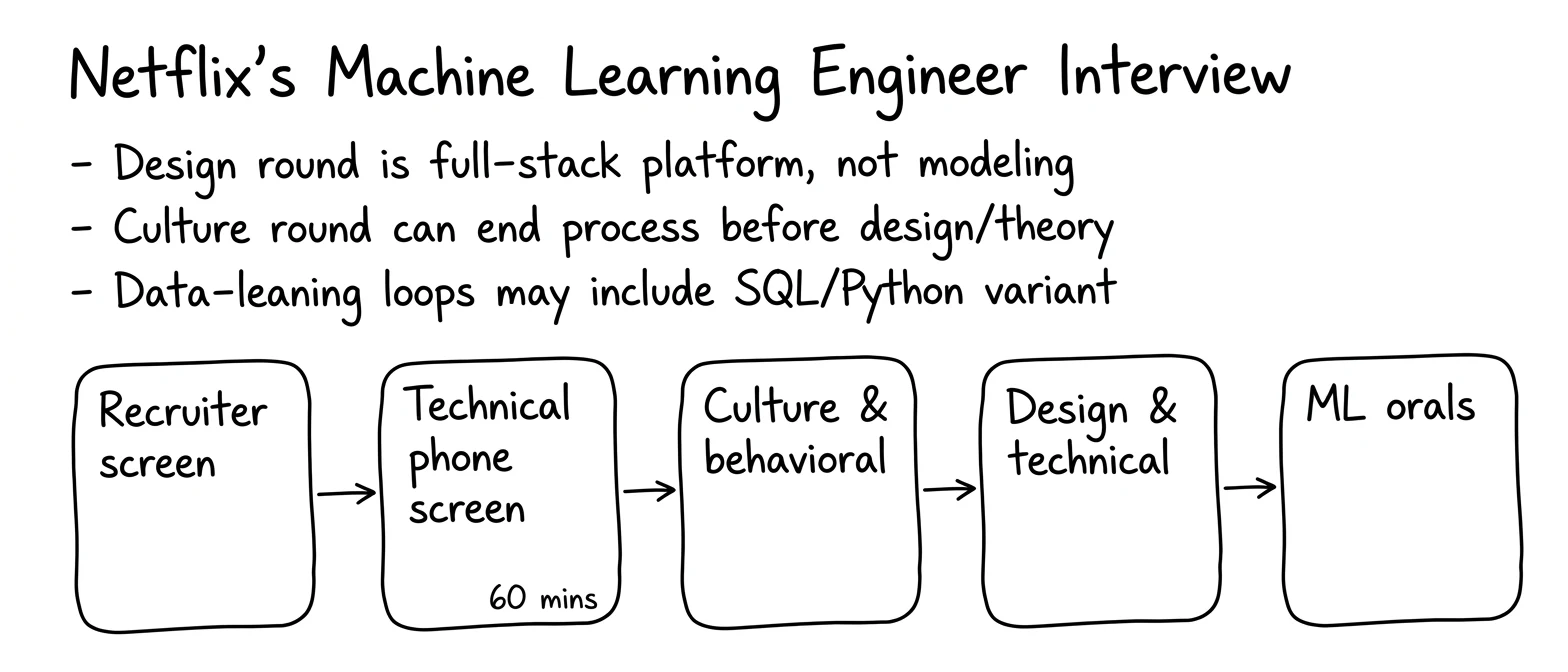
There is no single loop, because each team sets its own rounds. Reported processes range from two calls after the recruiter screen to ten separate calls, mostly an hour each and held online. Most posted roles are L5 (senior), so design and working with partners count as much as code. Intern candidates have reported a timed online assessment, but no reported full-time loop included one.
Here's what the interview process can look like:
- Recruiter screen: About 30 minutes on your background, your motivation and the culture memo.
- Technical phone screen: About an hour of machine learning theory and coding, or SQL and pipeline design, depending on the team.
- Coding and data rounds: Practical problems where exact, bug-free code is expected.
- Machine learning fundamentals interview (modeling teams): Conceptual questions, each followed by a "why" question.
- ML system design interview: Usually infrastructure for machine learning rather than model architecture.
- Stakeholder partnership interview (platform teams): A conversation with a data scientist about what slows their work.
- Culture and behavioral interviews: One or more rounds on the culture memo, conflict and feedback.
- Hiring manager and team match: The team's mission, the scope of the role and its level.
Tip: Ask the recruiter whether the team focuses on modeling, platform or data. That tells you more about the technical rounds than the job title does. One candidate's role changed from infrastructure to full-stack partway through the process.
Recruiter screen
The call takes about 30 minutes: recent projects and impact, why Netflix, and why you are leaving. It can turn behavioral fast; one data-platform candidate got a detailed resume grilling. Recruiters expect you to know the culture memo and have asked what specific values mean to you and for feedback you gave or received. Sponsorship, location and pay expectations are settled in the same call. One cold applicant heard back the same day.
Interviewers evaluate:
- Memo fluency: Linking each value to something you actually did, not repeating slogans.
- Role fit: How well your most relevant work matches the job posting.
- Motivation: A reason for leaving that is not a complaint about your current job.
- Clear communication: One rejected candidate felt their spoken English hurt them more than any technical gap.
Read the current culture memo and prepare one short work story for each value.
Sample questions for the recruiter screen
Here are some questions reported by recent candidates:
-
Walk through your most relevant project and its impact.
-
Why are you leaving your current role, and why Netflix?
-
What does one of the memo's values mean to you in practice?
Technical phone screen
Modeling teams split the hour: fundamentals first (mean squared error versus cross-entropy; whether you have used low-rank adaptation, or LoRA, and how it works), then a shared-editor class that counts words from a text stream and keeps its counts between calls. Platform teams ask you to code a small service, such as a homepage billboard with an upsert method and a get-top method that never returns the same title twice in a row unless it is the only one.
Some data-focused screens ran entirely on a whiteboard: tables and SQL to measure a new movie's performance, data quality checks, partition keys and skew, then grouping users by how much of a title they watched. The interviewer interrupted even small syntax mistakes. Data-platform screens asked for a weighted cache or a locked atomic counter. Passing candidates moved quickly to a hiring manager call.
Interviewers evaluate:
- Reasoning, not memorization: Why cross-entropy suits classification, and why LoRA saves memory.
- Keeping state: Clean use of a dictionary or heap when the same object is called many times.
- Following the rules exactly: The billboard rule only blocks back-to-back repeats, and the highest-scoring title must still come first after scores change.
- Staying calm when interrupted: Taking corrections without losing your line of thought.
Practice small classes that keep state, and practice writing SQL by hand and explaining it aloud without running it.
Sample questions for the technical phone screen
Here are some questions reported by recent candidates:
-
Compare mean squared error and cross-entropy, and say when you would use each.
-
Build a word-frequency counter that reads text in chunks and strips punctuation.
-
Return the top-scored homepage title as scores change, never repeating the previous title when another one exists.
Coding and data rounds
Later coding rounds are practical rather than puzzle-style, and grading is strict. Data-platform onsites paired coding with design: phrase search over an inverted index, wildcard JSON path queries, double-checked locking. A small if-else bug in the JSON task ended one candidate's second attempt. Data-focused loops put SQL and Python on movie data in nearly every round, sometimes two problems back to back; one interviewer would not continue until the code was exactly right, though hints came when stuck.
Interviewers evaluate:
- Exact code: One logic error can outweigh a correct approach.
- Concurrency basics: Where double-checked locking fails, and how a locked counter stays atomic.
- Consistency: Interviewers look for contradictions between your table design, your query and your metric.
- Scaling: What changes when the table or index grows much larger.
Before calling a solution done, walk through it by hand on one edge case.
Note: How strict interviewers are varies. Some note a small mistake and move on, while others stop until every line is correct. Prepare for the strict ones.
Sample questions for the coding and data rounds
Here are some questions reported by recent candidates:
-
Build an inverted index and return the documents that contain an exact phrase.
-
Evaluate path queries with wildcards against nested JSON.
-
Implement a thread-safe counter and explain where double-checked locking fails.
-
Double-Checked Locking / Locking Correctness in Multithreaded Code
-
Bucket Users by Movie Completion Percentage from an Event Stream
Machine learning fundamentals interview
Modeling teams spend a full round on concepts, each with a follow-up past the definition: self-attention, then why scores are divided by the square root of the dimension; LoRA, then why it really saves GPU memory; Adam versus SGD on convergence, generalization and learning-rate sensitivity; vision transformers versus convolutional networks, then what decides patch size. Give the intuition first, then the math.
Interviewers evaluate:
- The reason behind the definition: Why attention scores are scaled (large dot products push the softmax into a range where gradients vanish).
- Where the memory goes: LoRA saves memory because frozen weights need no gradients or optimizer state, not just because it has fewer parameters.
- Practical trade-offs: When SGD beats Adam in large-scale training.
- Built-in assumptions: Why convolutions need less data than attention, and how patch size trades detail against sequence length.
For every technique on your resume, prepare both the intuition and the reasoning behind it.
Sample questions for the machine learning fundamentals interview
Here are some questions reported by recent candidates:
-
Why are attention scores scaled by the square root of the key dimension?
-
Why does LoRA reduce GPU memory by more than its smaller parameter count explains?
-
What decides the patch size in a vision transformer?
ML system design interview
Design rounds focus on the infrastructure around models. One platform candidate shared CPU and GPU capacity across clusters for user-submitted jobs: scheduling policy, fragmentation, multi-tenancy, fairness versus throughput. Another designed a full-stack model portal: lifecycle REST APIs, a schema for model versions and metrics, GraphQL for monitoring queries and the JavaScript front end, then depth on drift detection, the population stability index, alert rules and time-series queries.
Data-platform loops asked for file backup that preserves folder structure, a global config rollout, and ad click aggregation, with interviewers steering toward consistency, throughput and failure recovery rather than class diagrams.
Interviewers evaluate:
- What is different about ML work: How long-running GPU jobs and mixed hardware differ from ordinary services, explained before any architecture.
- Monitoring from the start: Drift metrics, thresholds and alerts planned as part of the design.
- Range across the stack: One candidate with deep monitoring experience lost points on front-end questions.
- Handling failures: Resuming a half-finished backup or rolling back a bad config.
Practice two infrastructure designs from start to finish, and open each by explaining what makes the workload different.
Note: A vague prompt does not mean the interviewer wants an object-oriented design. A rejected data-platform candidate spent the first minutes modeling classes for a backup system when the interviewer wanted the overall architecture.
Sample questions for the ML system design interview
Here are some questions reported by recent candidates:
-
Share CPU and GPU resources across clusters for user-submitted training jobs while keeping the hardware busy.
-
Design a portal to register, version and monitor models, including how drift is measured and alerted on.
-
Design a backup system for a very large file tree that recovers if it fails partway through.
Stakeholder partnership interview
Platform teams test how you support their users. In one round the interviewer played a data scientist with three problems: slow model iteration, models degrading after deployment, and permission issues blocking data access. The candidate was expected to ask questions and propose fixes realistic for production, not just ideal ones.
Interviewers evaluate:
- Diagnosis first: Telling a missing tool apart from a process or permissions problem.
- Understanding users: Explaining infrastructure choices in terms of time saved for a data scientist.
- Realism: A few changes that can ship soon rather than a rebuild of the platform.
Prepare one story where users' frustration led you to change a platform, with a measured result.
Sample questions for the stakeholder partnership interview
Here are some questions reported by recent candidates:
-
A data scientist says model iteration is slow, models get worse after launch, and data access keeps getting blocked. Where do you start?
Culture and behavioral interviews
Expect at least one full culture round. One platform loop opened with culture alone (freedom and responsibility, context over control, candid feedback), which the candidate called demanding, not a formality. A ten-call analytics loop added behavioral rounds with a director, an analyst and a data scientist; a senior data loop covered conflict, a key lesson, priorities and a 90-day plan.
Interviewers evaluate:
- Evidence for each value: A real situation, and the decisions you made, behind each claim.
- Real conflict: One interviewer did not accept a simple disagreement about priorities as a conflict example.
- Feedback both ways: Hard feedback you gave, and feedback you acted on.
- A 90-day plan: How you would learn the team's systems and deliver results early.
Prepare six to eight stories and practice telling them aloud until they sound natural.
Tip: Have a conflict story about a real disagreement on substance, where someone changed their mind. Interviewers asked for a different example when the conflict was only about scheduling.
Sample questions for the culture and behavioral interviews
Here are some questions reported by recent candidates:
-
Describe a conflict that was about more than priorities.
-
How would you spend your first 90 days here?
Hiring manager and team match
The hiring manager may appear twice, as an early fit check and as a closing call, covering the team's mission, the role's scope and mutual fit. Use these calls to confirm the level and the modeling-versus-platform split.
Interviewers evaluate:
- Fit with the team's work: Whether your past work matches the problems the team has now.
- Senior ownership: Projects you started and defined yourself, not only ones you were assigned.
- Clarity: Knowing what you want from the role.
Ask what a strong first six months looks like, and connect your best project to that answer.
How Netflix levels and evaluates Machine Learning Engineer candidates
The hiring team makes the decision. Feedback from every round, including culture, goes to the hiring manager, and one weak culture or design round can end a candidacy even when the other rounds went well. The level is fixed by the opening, which is mostly L5 and sometimes L4 or L6. None of the reported loops ended with an offer at a lower level. The process moves quickly. One rejected candidate was told to wait six months before reapplying. Another candidate reached the onsite twice, once through a referral and once by applying directly, and got different questions each time.
How to prepare for the Netflix Machine Learning Engineer interview
- Find out what kind of team it is: Whether it focuses on modeling, platform or data decides whether you get theory questions, infrastructure design or SQL.
- Know the fundamentals two levels deep: Attention scaling, LoRA memory savings, Adam versus SGD, choosing a loss function, and transformers versus convolutional networks.
- Practice coding without running it: Streaming counters, rotation rules, caches and atomic counters, checked by hand.
- Practice two infrastructure designs: GPU scheduling across clusters, and a model-monitoring platform with drift metrics and alerts.
- Fill gaps in your stack: Platform roles cover APIs, storage, query layers and front-end basics in one hour.
- Prepare a partnership story: A time you fixed slow iteration, declining models or blocked data access for the people using your system.
- Know the culture memo well: One story for each value, including a real conflict and a time you gave hard feedback.
About the Netflix Machine Learning Engineer role
Netflix Machine Learning Engineers either ship production models for recommendations, ads, content and marketing, owning the problem definition, data and serving code, or build the platform other modelers use, centered on Metaflow, which supports hundreds of internal projects. Teams are small and senior, with the autonomy the memo's "people over process" principle implies.
| Level | Primary focus | Impact scope |
|---|---|---|
| L4 | Shipping features and models with guidance | Parts of one team's systems |
| L5 (Senior) | Owning a model or platform area from start to finish | A team's systems and the teams it works with |
| L6 (Staff) | Setting technical direction across teams | An organization's machine learning systems |
Netflix hires Machine Learning Engineers across product and platform organizations. Teams include:
- Machine Learning Platform: Metaflow, infrastructure for training and serving models, and frameworks for building LLM applications.
- AI for Member Systems: Personalization and recommendations.
- Ads: Ad ranking, pacing and fast ad serving.
- Content and Media ML Foundations: Models that understand titles, artwork and video.
- Promo Media and Marketing: Machine learning for trailers and other promotional material.
Machine Learning Engineer experience and education requirements
L5 postings typically ask for five or more years of building and deploying machine learning systems, and some ads roles ask for more. A master's or PhD in computer science, statistics or a related field is common but not required. Postings look for strong Python, often Java or Scala, and experience with workflow tools such as Metaflow or Airflow, cloud infrastructure, and serving models with low latency.
FAQs about the Netflix Machine Learning Engineer interview
How long does the Netflix Machine Learning Engineer interview process take?
Typically three to five weeks. The number of rounds varies more than the total time, from two rounds after the recruiter call up to ten.
What is the hardest round of the Netflix Machine Learning Engineer interview?
For platform roles, the design round, because one hour covers everything from scheduling or APIs to the front end and monitoring. For modeling roles, the fundamentals round, where a memorized definition fails as soon as the interviewer asks why.
Is there an online assessment?
Not in any reported full-time loop. Intern candidates have taken a timed assessment that mixes multiple-choice machine learning questions with coding.
How is a Netflix Machine Learning Engineer paid?
Pay is mostly salary, with no annual bonus. Each year, employees choose how much of their pay to take as stock options instead of cash. Recent L5 postings list pay ranges that start at roughly $100K to $170K and go up to $720K to $750K.
What happens after a rejection?
One candidate rejected after a full loop was told to wait six months before reapplying. Detailed feedback is rare, so write down the questions yourself after each round.