Netflix · Study
Netflix Infrastructure Engineer Interview Process
TrueInterview
July 31, 2026 · 14 min read
Netflix infrastructure loops center on stateful components you implement, run and test live: weighted and expiring caches, percentile trackers, versioned stores, thread-safe maps. Nearly every round ends with a production epilogue: the server crashes, what survives, how cleanup stays off the read path, how you would validate the system after it ships. Candidates whose code passed every test have still been rejected, because a hiring manager weighs role fit and the culture memo alongside technical signal, and some loops ended when the position was filled or hiring froze.
This guide breaks down each stage of the Netflix Infrastructure Engineer interview, what interviewers evaluate in each round, and how to prepare, with questions candidates were actually asked.
Verified: Based on 47 candidate-reported interview experiences, primarily from 2025 Q1 through 2026 Q3, cross-checked against recent public accounts.
Netflix Infrastructure Engineer interview process
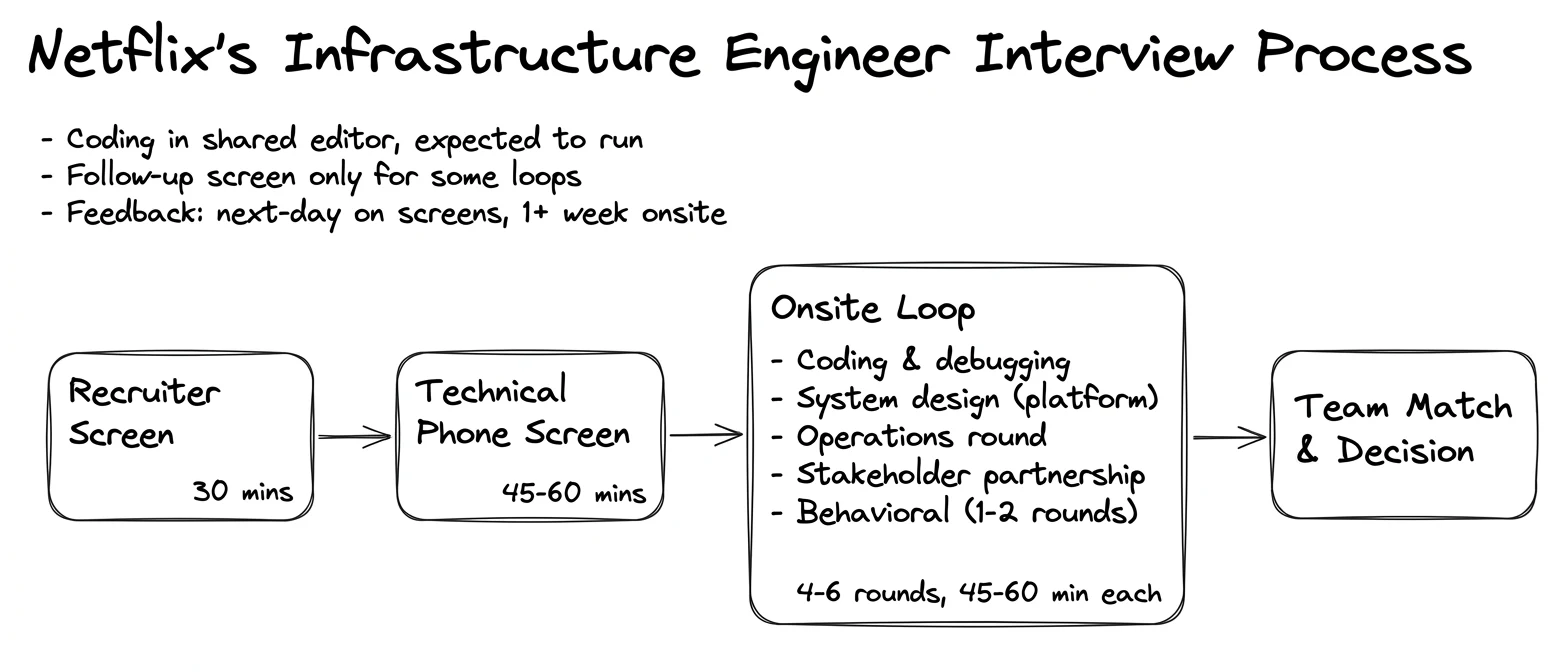
Netflix hires into a specific team, so the loop depends on the organization. Platform, data-platform and machine-learning-infrastructure teams add an operations or stakeholder partnership round; product-facing groups such as advertising add a no-code data modeling round. Most processes take three to five weeks: one or two phone rounds, then a virtual onsite of four to six sessions of 45 to 60 minutes, sometimes over two days.
Hiring is concentrated at L4 and above. Mid-level loops weight coding and component design; senior loops add a second design round and push harder on operability and cross-team influence. Mixed coding results have led to an extra coding round rather than a rejection.
Here's what the interview process can look like:
- Recruiter screen: About 30 minutes on background, motivation, culture-memo values and logistics.
- Technical phone screen (one or two): 45 to 60 minutes building a stateful component or discussing a design, then production readiness.
- Coding interviews (one or two): Medium graph, tree or text-processing problems run live, with chained follow-ups.
- Concurrency interview (platform teams): Building or reasoning about a thread-safe primitive.
- System design interview (one or two): Internal platforms such as config rollout, compute scheduling, backups and event aggregation.
- Stakeholder partnership or operations interview (some teams): A consulting conversation with an internal user, or bottleneck analysis of a running system.
- Behavioral and culture interviews (one or two): Memo-grounded questions on feedback, conflict, ownership and judgment.
- Hiring manager and team match: Charter and fit conversations that often decide the outcome.
Tip: Treat every coding prompt as a production component. Say how state is stored, how expired entries are cleaned up and what happens on a crash before you finish, and end with tests that run. Candidates who stopped once the code worked fared worst.
Recruiter screen
The recruiter call is about 30 minutes and more probing than at most companies: why Netflix, recent work, a significant challenge, why you are leaving, and at least one culture-memo question, such as what selflessness means to you, which memo point resonated most, or recent candid feedback you gave or received. Logistics follow: work authorization, hybrid or remote preference, salary expectations and the languages you used most recently.
Data-platform candidates describe recruiters walking the resume project by project against the posting. A slow first response is not a bad sign: one candidate who waited weeks ended with an offer.
Interviewers evaluate:
- Memo fluency: Using ideas such as context over control and candor inside a real example, not reciting them.
- Role alignment: How directly your recent systems work overlaps the posting, which later rounds check again.
- Reason for moving: A forward-looking answer about scope, not a complaint about your employer.
Read the culture memo and prepare one feedback story and one judgment story before this call.
Sample questions for the recruiter screen
Here are some questions reported by recent candidates:
-
How do you interpret selflessness at work, with an example?
-
Which past project best matches the responsibilities in this posting?
Technical phone screen
Screens run 45 to 60 minutes in a shared editor, in a language you choose, and you are usually expected to compile, run and test; one candidate wrote JUnit tests for eviction at exactly the weight limit and for an item heavier than the whole cache. Passing candidates typically heard back within a day.
The screen is usually a component, not a puzzle: a weight-bounded cache evicting the heaviest entry or the least-frequent, least-recent one; a per-entry TTL cache extended to LRU, with a question on running out of memory; a thread-safe P99 tracker over a sliding window; an in-memory file system with versions; a billboard selector that never repeats a title back to back; a printer that suppresses a key seen in the last 10 or 60 seconds. Design-first screens covered syncing a distributed key-value store with fine-grained locking, a file system that recovers after a crash, and a cache scaled out with partitioning and replication.
Interviewers evaluate:
- Data-structure pairing: A hash map plus a sorted structure or heap for O(log n) eviction, or a plain queue when timestamps only increase.
- Cleanup strategy: Lazy deletion, a size cap or a background sweep, and what each costs under load.
- Durability reasoning: Write-ahead log versus snapshot, partial writes during a crash, detecting corruption on restart.
- Production validation: How you would test and monitor correctness after deployment.
Practice each cache variant from scratch with runnable tests in under 30 minutes, leaving time for the durability discussion.
Note: Correct code does not guarantee a pass. A candidate whose weighted cache passed every test was rejected from a role the interviewer said had drawn more than 3,000 applicants, and another was rejected after a screen spent entirely on cache trade-offs. The precision of the trade-off discussion separates candidates more than the code.
Sample questions for the technical phone screen
Here are some questions reported by recent candidates:
-
Build a cache with a total weight limit that evicts the heaviest entry on overflow, in O(log n) per operation.
-
Record latencies from many threads and return the P99 over the last N milliseconds without readers blocking writers.
-
Print a key's value at most once every 10 seconds, then explain how that state survives a server crash.
Coding interviews
Onsite coding rounds are 45 to 60 minutes of medium problems whose follow-ups change the constraints. The graph family recurs: dependency ordering with cycle detection, every valid ordering, and a parallel-courses variant with task durations where you code the breadth-first answer and explain a depth-first one. Text and structure processing is the other family: an inverted index with phrase search, a JSON path query with wildcards, a simplified jq.
Follow-ups decide rounds. A candidate who wrote a bug-free Dijkstra for the fastest route between cities was asked how to handle continuously changing latencies; the expected direction was dynamic shortest-path updating, and the rejection followed.
Interviewers evaluate:
- Bug-free first passes: A minor if-else bug in a JSON path parser cost one candidate the round.
- Pacing: On a 45-minute problem, code should start by about the 15-minute mark.
- Self-testing: Your own cases for cycles, a single node, skewed trees and empty input.
- Adapting under change: Moving from one ordering to all, or a static graph to a changing one, without restarting.
Drill topological sort with durations, Dijkstra and recursive traversal of nested maps until each runs cleanly the first time.
Sample questions for the coding interviews
Here are some questions reported by recent candidates:
-
Given tasks with durations and dependencies, return the minimum finish time and report any cycle.
-
Build an inverted index that answers exact phrase queries using word positions.
-
Query nested JSON by a wildcard path, falling back to defaults when fields are missing.
-
Minimum Time to Finish All Dependent Tasks with Durations (Detect Cycles)
Concurrency interview
Platform loops test concurrency as its own subject, either a full round or half of a coding round. Reported prompts: a multithreaded map in C++ from scratch, double-checked locking correctness, a high-contention atomic counter (in a second phone screen), a blocking queue, and a concurrent map with TTL. Follow-ups go to the edges: reader-writer lock versus mutex, iterator invalidation, exception safety during a rehash, a thread interrupted while holding a lock.
In the latency-tracker version, the interviewer rejected one sorted structure behind a reader-writer lock because recording must never block a request thread, which led to per-thread buckets merged at query time; a rule that the percentile never undercount then ruled out estimation sketches in favor of exact computation over two rotating snapshot buffers.
Interviewers evaluate:
- Lock granularity: Striped locks versus one global lock, justified by read and write rates.
- Memory visibility: Why double-checked locking needs a volatile or atomic field, and what compare-and-swap guarantees.
- Write and read path separation: Keeping writes cheap when they far outnumber queries.
- Code that compiles: Working code inside the hour, with concurrent tests that run.
Practice a thread-safe map, counter and latch in a plain editor without autocomplete, then test them with real threads.
Note: One infrastructure rejection came down to compilation: missing headers and syntax errors in a C++ multithreaded map ate so much of the hour that most planned tests never ran, though the locking design held up. Use the language you can compile from memory.
Sample questions for the concurrency interview
Here are some questions reported by recent candidates:
-
Implement a thread-safe hash map, then explain how readers behave during a resize.
-
Explain what breaks in double-checked locking and fix it.
-
Implement an atomic counter for very high write throughput, comparing synchronized blocks with compare-and-swap.
-
Double-Checked Locking / Locking Correctness in Multithreaded Code
System design interview
Design rounds are 45 to 60 minutes on internal platforms, not consumer features: a global config deployment system with staged rollout, rollback and access control; CPU and GPU allocation across clusters for submitted machine-learning jobs; a file backup service that mirrors the directory tree exactly, scales to huge file counts and survives failures; ad click event aggregation; a crash-resilient file system. Advertising-infrastructure loops use frequency capping, including a variant that keeps an advertiser's ad away from a competitor's for the same user and title, with questions on sharding and check-to-impression lag.
Interviewers steer the altitude: the backup round waved off class design in favor of consistency, throughput and fault tolerance, and the scheduler round expected an explanation of how ML workloads differ from ordinary services before any architecture.
Interviewers evaluate:
- Constraints first: Workload shape, latency targets and failure assumptions before boxes.
- Depth on one or two components: Log contention, checkpoint overhead and I/O amplification rather than a wide diagram.
- Operability: Rollback, end-to-end checksums, corruption monitoring, rolling upgrades and alerts.
- Multi-tenancy: Fragmentation, quotas, and fairness versus throughput on shared hardware.
Practice four or five internal-platform designs, ending each with a production-readiness pass.
Note: Roles can shift mid-process. One infrastructure candidate's role turned full-stack, and the design round became an ML platform portal with REST and GraphQL APIs, a monitoring schema, drift metrics such as PSI and front-end work; weak front-end knowledge hurt. Confirm each round's scope with the recruiter before the onsite.
Sample questions for the system design interview
Here are some questions reported by recent candidates:
-
Push configuration changes globally in near real time, with rollback and access control.
-
Allocate CPU and GPU capacity across clusters for ML jobs while keeping utilization high and tenants isolated.
-
Design a backup system whose destination mirrors the source tree and survives failures partway through.
Stakeholder partnership interview
Machine-learning-infrastructure and data-platform loops add a round about internal customers. In the partnership version you receive a data scientist's complaints (slow model iteration, models degrading after deployment, data blocked by access-control lists) and hold an open consulting conversation about what to fix first. The operations version is an architecture review: find bottlenecks in a running system and reason about consistency, availability and scaling with CDNs, consistent hashing and sharding.
Interviewers evaluate:
- Empathy for the user's day: How a platform change shortens a scientist's iteration loop.
- Prioritization: Which pain point comes first and what you deliberately do not build.
- Diagnosis before solution: Asking for metrics and failure history before proposing infrastructure.
Prepare one story where you changed a platform after listening to its users, with the metric that moved.
Sample questions for the stakeholder partnership interview
Here are some questions reported by recent candidates:
-
A data scientist says iteration is slow and access requests stall for days; where do you start?
-
Models degrade after deployment; what would you instrument and change?
Behavioral and culture interviews
Most loops have one or two behavioral rounds, some with two managers in one session. The format is often rapid-fire situations: feedback given and received, conflict with another team, a pivot, your biggest mistake, debugging a complex system, defining success without a metric, and recently how you use AI tools. Prompts are specific: one interviewer wanted feedback given across teams, another rejected a prioritization disagreement as a conflict example, and a candidate who over-explained in a culture round was told to be more concise.
Interviewers evaluate:
- Candor in practice: A specific piece of hard feedback, how it was delivered and what changed.
- End-to-end ownership: Systems you designed, operated and debugged, with the trade-off you accepted.
- Judgment without process: Decisions made with context instead of approval.
- Concision: Structured answers that leave room for follow-ups.
Prepare six to eight stories with metrics, each mapped to a memo value and under three minutes.
Tip: Map your experience against the posting line by line. A candidate who received an offer said the behavioral round checked overlap with the job description closely, and several rejection notes cited background fit rather than performance.
Sample questions for the behavioral and culture interviews
Here are some questions reported by recent candidates:
-
Tell me about feedback you gave someone on another team and how it landed.
-
How do you debug a failure that spans systems you do not own?
How Netflix levels and evaluates Infrastructure Engineer candidates
Candidates describe the hiring manager's approval, not a separate committee, as decisive: interviewers report to the manager, who weighs their reads against what the team needs. A strong round does not offset a weak design result or poor fit; a senior candidate rated a strong hire at the phone screen was rejected after a weaker design round, and others were told a closer background match got the role. One or two team-match calls with hiring managers may follow the onsite, sometimes with competing teams.
The team sets the level, which can be below your current title: a staff role elsewhere was described as mapping to senior at Netflix. Decisions take from one or two days per round to over a week after the onsite. Reported loops also ended with the role filled or a hiring freeze.
Tip: Follow up with the recruiter if a week passes without a decision. One candidate told "we may consider you at another level" was rejected two weeks later, so keep other processes active.
How to prepare for the Netflix Infrastructure Engineer interview
- Build the cache family from scratch: Weight-bounded, LFU with LRU tie-breaks, per-entry TTL and size-bounded LRU, each with runnable tests.
- Rehearse the production epilogue: Crash recovery, persistence, cleanup and post-deploy validation for every component you build.
- Write concurrent code without an IDE: Thread-safe map, atomic counter, latch and blocking queue in your strongest language, compiled and run.
- Master the graph and parser families: Topological sort with durations and all orderings, dynamic shortest paths, phrase search and wildcard JSON paths.
- Design internal platforms, not apps: Config rollout, GPU scheduling, backups and event aggregation, each ending with rollback and monitoring.
- Prepare memo-mapped stories: Cross-team feedback, a real conflict, a production debugging story and recent AI tool use, each with numbers.
- Timebox clarification: About five minutes on scope, then code; a complete design with no code still fails.
About the Netflix Infrastructure Engineer role
Infrastructure engineers build and run the platforms that streaming, studio, advertising and machine-learning teams depend on. Teams are small and senior, and engineers own design, implementation, monitoring and on-call for their services, coordinating through shared context rather than approvals. Netflix introduced numbered levels only in recent years, and reported titles at a given level vary.
| Level | Primary focus | Impact scope |
|---|---|---|
| L4 | Well-scoped services and features within a platform | A component of one team's systems |
| L5 | Designing and operating platform systems independently; the most common level | A team's platform and its internal customers |
| L6 | Technical direction across related systems and teams | Several platforms or an organization |
| L7 | Architecture and long-range bets across organizations | Netflix engineering broadly |
Netflix hires Infrastructure Engineers across several platform organizations. Teams include:
- Open Connect: The content delivery network that carries all Netflix video traffic.
- Compute and delivery: Container orchestration (Titus) and continuous delivery (Spinnaker) for thousands of services.
- Data platform: Event pipelines, stream processing and storage such as Keystone, Mantis, EVCache and Cassandra.
- Machine learning platform: Workflow tooling (Metaflow), model serving and GPU scheduling.
- Advertising and commerce infrastructure: Ad decisioning, frequency capping, event aggregation and billing.
Infrastructure Engineer experience and education requirements
L4 postings typically ask for three to four or more years building large-scale distributed systems or high-traffic services; senior postings expect more, with a record of operating production systems. Java is the most common requirement, with Python, Go and C++ on specific teams, and ML-platform postings accept a PhD in place of some experience. A computer science degree is common but not required, and you choose your interview language.
FAQs about the Netflix Infrastructure Engineer interview
How long does the Netflix Infrastructure Engineer interview process take?
Typically three to five weeks. Phone-screen results usually arrive within a day or two; post-onsite decisions range from a few days to more than two weeks when team matching or leveling is involved.
What is the hardest round of the Netflix Infrastructure Engineer interview?
Usually the concurrency round, which combines correct locking with code that must compile and run inside the hour. System design is close behind, since its internal platform prompts fall outside generic preparation.
How much does a Netflix Infrastructure Engineer make?
Netflix posts a broad market range of $100,000 to $720,000 in total compensation for L5 platform, networking and Open Connect roles. Pay is mostly salary with no bonus, and employees choose each year how much to take as stock options.
What happens after a rejection?
Feedback is usually brief or absent. One candidate was told to wait six months before reapplying, and another reached the onsite twice, once by referral and once by direct application.