Study
8 Most-Reported Project Deep Dive Prompts at Big Tech (2026)
TrueInterview
October 26, 2026 · 16 min read
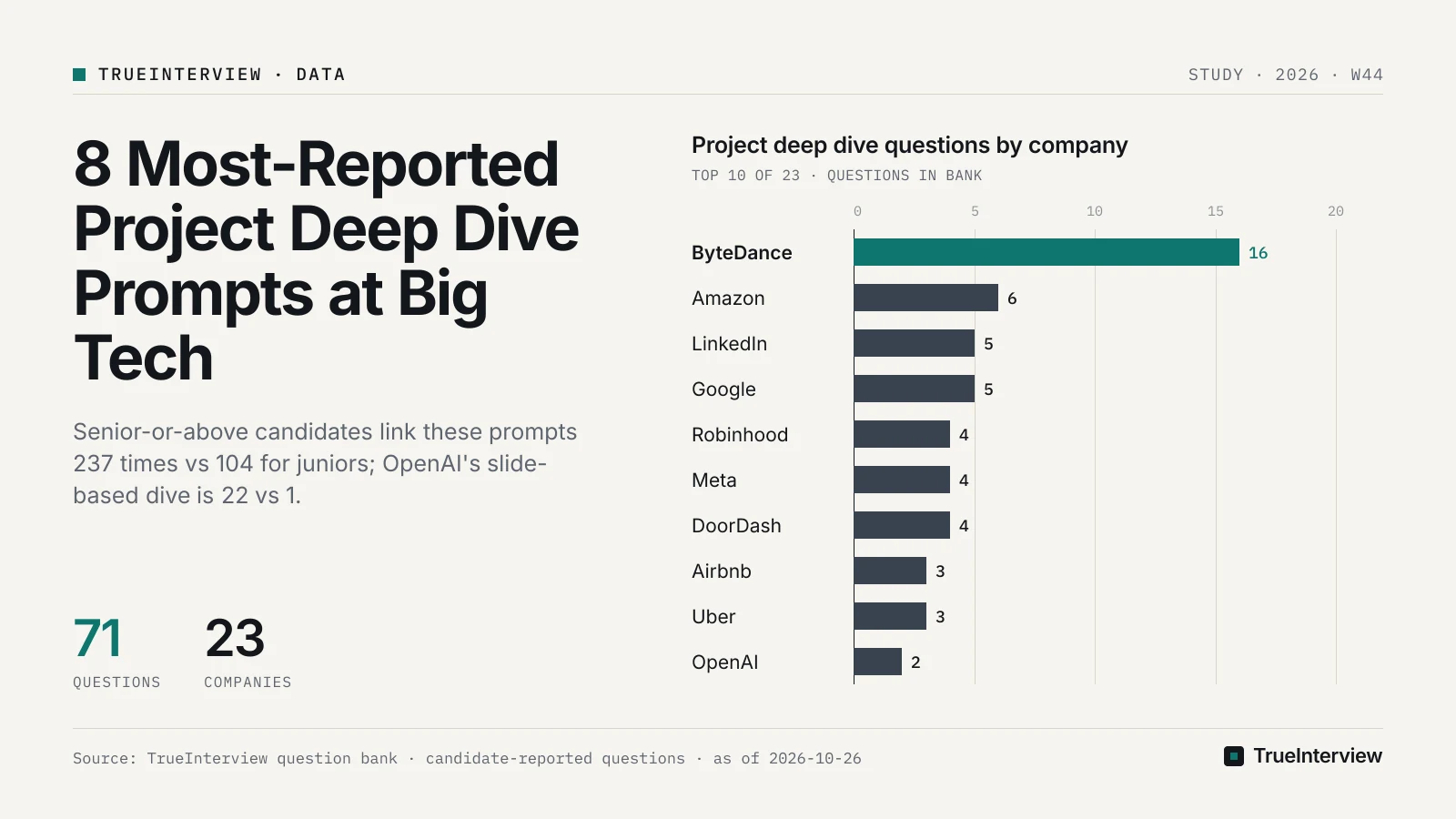
As of 2026-10-26, TrueInterview's bank holds 71 candidate-reported project deep dive questions from 23 big-tech companies, and the prompts linked from the most write-ups are ByteDance's "Project Deep Dive (Resume Drill)" (51), Uber's "Onsite BQ + Hiring Manager + Project Deep-Dive" (32) and OpenAI's "Technical Deep Dive (slide-based)" (23). The round is a phone-screen gate as often as an onsite one: 38 questions have a phone-screen report and 37 an onsite report. Read your target company's format before you read any list of generic prompts, because the format tells a senior candidate how hard the push will be.
Disclosure: TrueInterview is an interview-preparation product and publishes this article. Facts about other products come from their public pages on the dates listed under Sources.
Which project deep dive prompts are reported most?
Eight prompts are each linked from 17 or more candidate write-ups, with Oracle's screen opener at the cut-off. Each sits at one company, and the split by self-reported level separates the junior-leaning resume check from the formats that senior candidates write up almost alone.
| Rank | Reported prompt | Company | Round, last reported | Write-up links | Senior-or-above vs junior-or-below links | Practise |
|---|---|---|---|---|---|---|
| 1 | Project Deep Dive (Resume Drill) | ByteDance | Phone screen, 2026-09 | 51 | 20 vs 31 | Resume drill |
| 2 | Onsite BQ + Hiring Manager + Project Deep-Dive | Uber | Onsite, 2026-08 | 32 | 26 vs 6 | BQ + hiring manager combo |
| 3 | Technical Deep Dive (slide-based) | OpenAI | Onsite, 2026-09 | 23 | 22 vs 1 | Slide-based technical dive |
| 4 | Project Deep Dive | Microsoft | Onsite, 2026-09 | 20 | not split here | Microsoft prompt |
| 5 | Experience / Project Deep-Dive Round | Airbnb | Onsite, 2026-07 | 18 | 16 vs 2 | Experience round |
| 6 | Project Deep Dive | Robinhood | Onsite, 2026-05 | 18 | not split here | Robinhood prompt |
| 7 | Describe your most impactful project | Anthropic | Onsite, 2026-07 | 18 | 18 vs 0 | Most impactful project |
| 8 | Resume / Project Deep Dive (HM or Tech Screen Opener) | Oracle | Phone screen, 2026-09 | 17 | not split here | Screen opener |
Two more phone-screen prompts complete the picture, though this data set gives no total write-up count for them: LinkedIn's "Project Deep-Dive (Four-Axis Rubric)", reported in a phone screen in 2026-09, and DoorDash's "Describe a Project End-to-End", reported in a phone screen in 2026-08. Write-up links count candidate reports, and one write-up can link several questions, so a higher count means more candidates wrote the prompt up, not that the company asks it more often.
Our take: among the rows with a level split, the resume drill is the only prompt where junior-or-below links outnumber senior-or-above ones, 31 to 20. Twenty senior-or-above write-ups still link it, so a senior candidate targeting ByteDance should prepare it, but a senior engineer who prepares only for a fast resume walk is preparing for one format out of several. The Uber, OpenAI, Airbnb and Anthropic rows are the ones linked almost only by senior-or-above candidates, and each of them has a different shape.
Is the project deep dive a phone screen or an onsite round?
Both, almost equally: of the 71 questions, 38 have a phone-screen report and 37 an onsite report, and 61 were last reported within the 12 months before 2026-10-26. The phone-screen prompts are concrete and recent, which means your first technical conversation can already be a deep dive.
ByteDance's resume drill, Oracle's screen opener, LinkedIn's four-axis rubric and DoorDash's end-to-end walkthrough are the dated phone-screen examples among the 38 phone-screen questions, and three of the four were last reported in 2026-09. Oracle's title names the hiring-manager or technical screen as the place the deep dive opens the conversation.
Ashby, a single company describing its own process, gives a useful model of the two-stage pattern: its guide says the first walkthrough happens in the introductory call with an engineering leader and takes "about 10 to 20 minutes", and the final-round deep dive "will last 30 or 45 minutes, depending on your level of experience and seniority". Treat that as one company's stated process, not a big-tech rule.
Our take: with phone-screen and onsite reports this close, do not leave deep dive preparation until the week before the onsite. Have a spoken version of one project ready before your first recruiter or hiring-manager call. PracHub's guide recommends an opening story of "about five to seven minutes, leaving most of the interview for discussion", which fits a round given over to the deep dive. For a resume drill or a screen opener that shares the call with other questions, keep a two-minute cut of the same story as well.
Which format will you face, and how should you prepare for it?
Our classification of the dated example titles gives at least six formats: a resume drill, a slide presentation, a deep dive bundled with behavioral and hiring-manager questions, a rubric-scored walkthrough, an end-to-end walkthrough and a most-impactful-project prompt. The format decides your preparation more than the wording of the opening question does.
| Format | Where it is reported | What to prepare | What the interviewer will push on |
|---|---|---|---|
| Resume drill or screen opener | ByteDance phone screen; Oracle HM or tech screen | A two-minute summary for every project on your resume, plus one you can expand | Whether each line on the resume holds up under a second question |
| Slide-based technical dive | OpenAI onsite | A short deck: problem, architecture, your decisions, outcome | Follow-ups that take most of the slot, on why each decision beat the alternative |
| Bundled with BQ and the hiring manager | Uber onsite | One project that also answers conflict, influence and scope questions | Your scope relative to the team and how you handled disagreement |
| Rubric-scored | LinkedIn phone screen | A story that covers each axis of the rubric explicitly | Gaps in any one axis |
| End-to-end walkthrough | DoorDash phone screen | The full arc from problem to production, in order | Production behaviour and what happened after launch |
| Most impactful project | Anthropic onsite | A measured result with a baseline and your attribution | Whether the impact was yours and how it was measured |
The location column comes from the dated examples above; the preparation and push columns are our view of what each format rewards, not reported interviewer questions.
Slides depend on the company. OpenAI's reported prompt is explicitly slide-based, while Ashby's guide says of slides or diagrams, "We don't expect you to, and you don't get bonus points for doing so (or not doing so)". PracHub's guide says some interviews are conversational and others ask for a short presentation or an architecture diagram. A field guide on GitHub reports Anthropic's presentation format as a 25-minute presentation followed by 15-20 minutes of follow-up questions, which is a different shape from the "Describe your most impactful project" title in our data. StaffEng's guide advises asking "What are the interview formats, including what are they evaluating for?" and preparing materials for any presentation interviews.
Our take: build three versions of the same project rather than three projects. The spoken short version covers ByteDance, Oracle, LinkedIn and DoorDash screens. The deck covers OpenAI. The version that carries a disagreement and a scope change covers Uber's bundled round. The follow-up answers you write for one project, on its data model, its failure at peak load and its metric, carry into all three versions, while three separate projects triple that work.
What changes at senior and staff level?
Senior candidates dominate this round. Write-ups from candidates who reported a senior, staff-plus or manager level link these questions 237 times, against 104 from junior, new-grad or intern candidates, so about 70% of level-tagged links are senior-or-above. Several formats are close to senior-only.
Beyond the table, LinkedIn's four-axis rubric is linked 14 times by senior-or-above candidates and twice by junior-or-below ones, and "Answer project deep dive and cross-functional questions" 14 times against once. Some prompts have no junior-or-below links at all: "Impactful Project Experience: Goals, Role, Challenges, Outcomes" (4), "Project Architecture Deep Dive (AI Engineer / Backend)" (4) and "Explain a Technical Project from Milestone to Production" (3) join Anthropic's most-impactful prompt on that list. Write-ups from staff-plus or manager candidates include "Applied Science Manager Phone Screen — Project Deep-Dive + Leadership BQ", which pairs the deep dive with leadership questions in a screen. Levels are what candidates reported on their own write-ups.
The guides agree on where the push goes. The AI engineering field guide on GitHub frames technical leadership as "Did you drive decisions, or just execute someone else's plan?" and says that at senior levels the deep dive can focus on a single project for a whole hour. PracHub's guide says senior-level ownership includes influence: aligning teams, surfacing risk, changing scope, reviewing a design, mentoring an engineer or handling an incident. Metaview's interviewer assesses whether the candidate prefers to go alone or bring others along, framing it as "Do they prefer to go alone or bring others with them?". StaffEng's guide warns that without "deep-dives into your previous accomplishments" and presentation opportunities, Staff-plus expertise is hard to demonstrate.
Our take: at senior and staff level the push moves from what you built to what you drove. Give the deep dive the preparation time you give system design, and rehearse three things a mid-level answer skips: the decision you owned against a named alternative, the person or team you had to bring along, and the trade-off you would revisit now.
Down-leveling note (our view): in our view, the deep dive carries level signal alongside system design depth and behavioral scope. The GitHub field guide's leadership probe, quoted above, is the test to pass: a strong technical story told entirely as team work, with no decision you can claim as yours, can read as executing someone else's plan. Name at least one decision per project that was yours, with the alternative you rejected.
Which project should you choose?
Choose a shipped project you led over the biggest one on your resume. Ashby's guide says, "The project you present should be one that you led and made critical decisions for", and expects you to remember data-model properties, milestone timelines and customer reactions. PracHub's guide makes the same trade explicit: a smaller system owned deeply often beats a large platform touched only at the edge.
Ashby's guide also says it is less interested in a project you left before release, because "It's hard to know the outcomes of your decisions if you didn't see them firsthand", and in projects that are mainly CRUD without interesting abstractions or data-model decisions. Those are one company's stated preferences. They still give a useful test for Anthropic's most-impactful prompt, since a project whose outcome you saw firsthand is the easier one to defend when asked for impact. One engineer's Medium write-up adds a practical filter, that the project you pick "must be on your resume".
If your best work is under NDA, PracHub's guide warns, "Never invent detail to replace what you cannot disclose". The GitHub field guide notes that a deep dive sometimes becomes a hypothetical scenario when candidates cannot discuss past work for that reason. Rename the customer, round the traffic figures and drop internal system names, but keep the decision, the rejected alternative and the measured result exactly as they happened.
Our take: score two or three candidate projects on three questions: did you own the key decision, did it ship and did you see the result, and can you recall the details a second question will ask for? Keep the one that wins on ownership even if another is bigger.
How do you show impact instead of giving an architecture tour?
Open with the metric that moved. Anthropic's reported prompt is "Describe your most impactful project", so the first minute of your answer should say what changed and for whom. PracHub's guide says a strong impact claim has four parts, baseline, change, outcome and attribution, and that a latency claim needs the baseline, measurement window, bottleneck, change and remaining limit.
The GitHub field guide says the best candidates frame answers around impact rather than technology names. Metaview's interviewer reads a focus on complexity over outcome as a possible sign that the candidate does not focus on the customer. Metaview also describes a strong candidate as one who already knows the project objective when asked, while "A weak candidate tries to work it out on the spot because they've never thought about it before".
Our take: in our view, an architecture tour is an easy way for an experienced engineer to waste the opening of this round. Spend the first minute on the business problem and the metric that moved, then draw only the components that a decision of yours changed.
Which follow-up questions should you rehearse?
Before you polish the opening, write answers for four follow-up threads: the data model, the peak-load failure, the metric and your teammate's share of the work. PracHub's guide describes typical probes: why you chose the data model, what failed at peak load, which metric moved because of your decision and what a teammate owned instead. Ashby's guide expects you to explain technology choices, trade-offs, testing and reliability.
For production behaviour, PracHub's guide lists capacity, backpressure, retries, idempotency, consistency, observability, security, deployment and recovery. The GitHub field guide's probe list includes "What were the trade-offs you made, and are you still comfortable with them?" and, for AI projects, whether there is an actual eval framework or the work is vibes-based. One engineer's Medium write-up gives a technology-choice example, why an in-memory cache was chosen over Redis or Memcache, and says that depending on seniority you should be ready for telemetry, logging, dashboards and alerts.
The GitHub field guide lists the common mistakes as monologuing without pausing, naming technologies instead of decisions and not being able to go deeper when probed. Ashby's guide says it will "stop you for questions along the way" and may go very deep into pieces it finds interesting, so plan for interruptions rather than a clean monologue.
Our take: for every major claim in your story, write the next two questions an interviewer would ask and answer them out loud. For a payments or ledger project those are idempotency and reconciliation; for a data pipeline, backpressure and replay; for an LLM feature, the eval set and the fallback.
How do ML and research deep dives differ?
Most links come from software engineers: by the role on the write-up, links come from Software Engineer (262), Machine Learning Engineer (35), Backend Engineer (12), Research Scientist (7) and Data Scientist (5). A few prompts lean toward ML and research candidates, and those prompts change what you should prepare.
"Applied Science Manager Phone Screen — Project Deep-Dive + Leadership BQ" is linked by 6 machine-learning, AI, research or data-science candidates and 4 software engineers, and "Discuss Research Experience and Challenges" is linked only by ML and research candidates. At the other end, Uber's bundled round is linked by 29 software engineers and 3 ML or research candidates, and OpenAI's slide-based dive by 18 software engineers and 5 ML or research candidates.
Our take: if you are an ML or research candidate, prepare the deep dive around your evaluation method and your research choices, and expect a leadership thread if you are interviewing as a manager. The eval-framework probe from the GitHub guide is the one most likely to separate a research project from a demo.
Worked example: a senior backend engineer targeting Uber and OpenAI
Take a senior backend engineer with loops at Uber and OpenAI. Uber's bundled round is linked from 32 write-ups, 26 of them from senior-or-above candidates, and was last reported in the onsite in 2026-08; OpenAI's slide-based dive is linked from 23 write-ups, 22 senior-or-above, last reported in the onsite in 2026-09.
The engineer picks one shipped project they led and writes the opening story to the length PracHub's guide recommends. For the main latency claim they prepare the five parts PracHub's guide lists: baseline, measurement window, bottleneck, change and remaining limit. They turn the same story into a short deck for OpenAI's slide-based technical dive. For Uber's BQ + hiring manager + deep dive round, they add two behavioral threads, a disagreement and a scope change, using PracHub's list of senior influence signals such as aligning teams and changing scope. Because both prompts are linked mostly by senior candidates, they also rehearse the trade-off they would revisit and the people they brought along.
How we counted
TrueInterview says reports are written up right after the interview and checked against other reports of the same round. Counts cover project deep dive questions filed under big-tech companies; a question can be reported in more than one round, so round tallies overlap, and these are candidate-reported prompts reconstructed for practice, not any company's official format. Write-up links count candidate write-ups that point to a question, split by the level and role each candidate reported, and they measure what candidates wrote about, not how often a company runs the round.
FAQ
What does a Robinhood project deep dive look like?
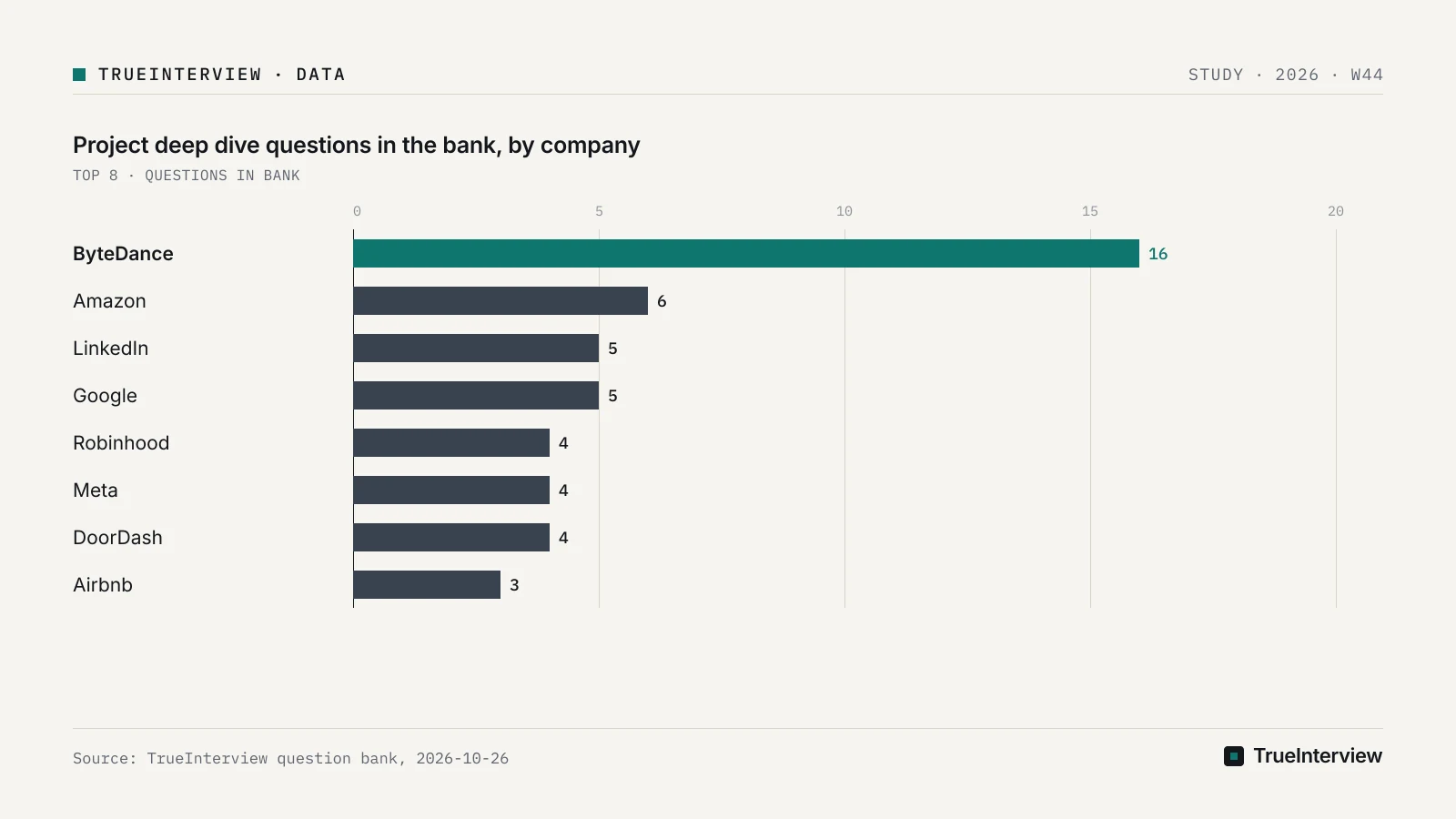
Robinhood's reported prompt is titled "Project Deep Dive", linked from 18 candidate write-ups and last reported in the onsite in 2026-05. The bank holds 4 deep dive questions filed under Robinhood. The title gives no special format, so prepare the conversational version: one project you led, a measured outcome and two rehearsed follow-ups per claim. Read the candidate write-ups for the round before you decide whether to bring a diagram, and practise the Robinhood prompt under a timer.
What does a DoorDash project deep dive look like?
DoorDash's dated example is "Describe a Project End-to-End", reported in a phone screen in 2026-08, and its links come from 11 software engineers and 3 ML or research candidates. End-to-end means the whole arc: the problem, the design, your decisions, launch and what happened after. Because it is a screen, keep the opening short and leave room for production questions on deployment, monitoring and recovery. Practise it on the end-to-end prompt.
How long should the opening story be?
PracHub's guide recommends about five to seven minutes, leaving most of the interview for discussion, and the GitHub field guide says the round typically runs 30 to 60 minutes. In a phone screen such as Oracle's opener, which shares the call with other questions, cut the same story to its problem, your decision and the result. End the opening on the measured result and hand the interviewer the next question; the follow-ups are where the signal comes from, so a long monologue spends time the interviewer wanted for probing.
Should I bring slides?
Only when the format asks for them. OpenAI's reported prompt is slide-based, so build a short deck there; Ashby's guide says slides or diagrams earn no bonus points either way. For a title with no stated format, such as Robinhood's or Microsoft's "Project Deep Dive", prepare one boxes-and-arrows diagram of the system you can redraw from memory in under a minute. If you are not sure which format you will face, ask the recruiter directly, as StaffEng's guide advises, before you spend a weekend on a deck.
What do interviewers evaluate in a project deep dive?
PracHub's guide says the interviewer uses your past work to evaluate technical judgment, ownership, execution, communication and learning. Ashby's guide adds that communication is assessed directly: "You may have an impressive project, but it doesn't matter if we can't understand it". For senior candidates the weight shifts toward ownership of decisions and influence on others, which is why the senior-heavy formats in the table are the ones to over-prepare.
Your practice plan
A three-week plan for someone working full time, about an hour on weekdays:
- Week one, find your format. Look up your target company's prompt in the ranked table and note whether it is a screen or an onsite. Practise the ByteDance resume drill or the Oracle screen opener if your first call is a screen.
- Week one, choose the project. Score two or three candidates on ownership, shipped outcome and recallable detail, then write the four-part impact statement for the winner.
- Week two, build the versions. Write the short spoken version, a short deck if your onsite resembles OpenAI's slide-based dive, and a version with a disagreement and a scope change for a round like Uber's.
- Week two, write the follow-up tree. For each major claim, write the next two questions, including the production-behaviour ones, and answer them aloud.
- Week three, rehearse the senior prompts. Run Describe your most impactful project and Explain a Technical Project from Milestone to Production with someone interrupting you.
- Week three, test it on a human. TrueInterview says it does not sell mock interviews with human engineers and suggests booking one or two elsewhere before an onsite. Read a candidate write-up for your round on the interview board before that mock.
Sources
- TrueInterview question bank — project deep dive at big-tech companies — counted 2026-10-26
- Engineer Past Projects Deep Dive | Ashby — checked 2026-10-26
- Software Engineer Project Deep Dive Interview Guide: Architecture, Impact, and Follow-Ups | PracHub Knowledge Hub — checked 2026-10-26
- ai-engineering-field-guide/interview/questions/03-project-deep-dive.md at main · alexeygrigorev/ai-engineering-field-guide · GitHub — checked 2026-10-26
- Interviewing for Staff-plus roles | Staff Engineer: Leadership beyond the management track — checked 2026-10-26
- How I interview engineers to assess ability to deliver impact. · 10x Recruiting — checked 2026-10-26
- Medium — checked 2026-10-26
- Real FAANG Interview Questions by Company · TrueInterview — checked 2026-10-26
- Interview prep compared: your application, end to end · TrueInterview — checked 2026-10-26
Last reviewed: 2026-10-26.