Study
Most-Reported ML System Design Questions, Mapped to the Funnel
TrueInterview
November 2, 2026 · 20 min read
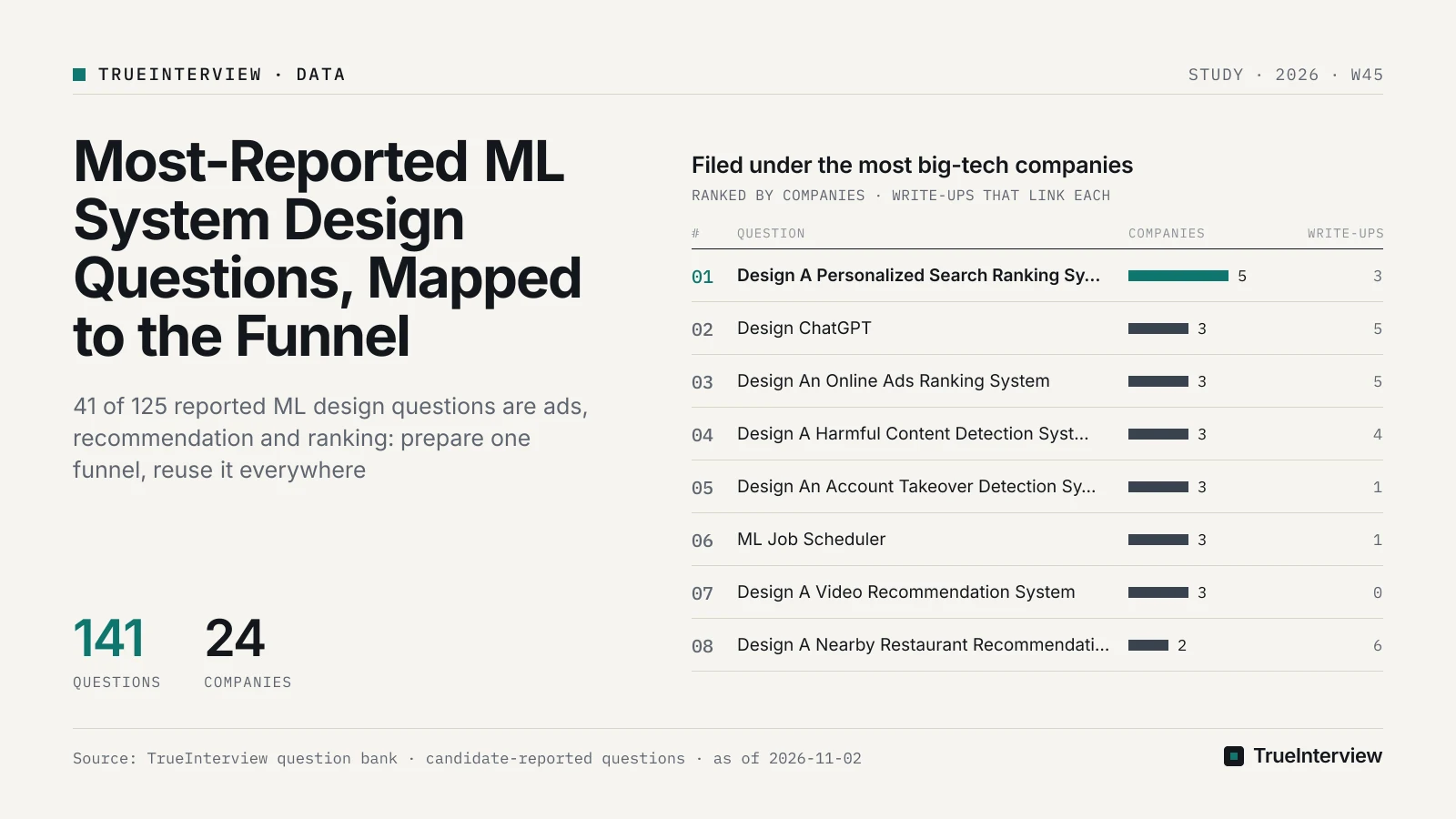
As of 2026-11-02, TrueInterview's bank holds 141 candidate-reported ML system design questions from 24 big-tech companies. The most-linked prompt is Anthropic's Design GPU Inference Serving System, with 26 candidate write-ups, but the largest problem family is ads, recommendation and ranking ML, with 41 of the 125 design questions. That family, about a third of the design questions and the largest single one, is one funnel problem (retrieval, ranking, re-ranking) told through different products. Master that funnel once against reported prompts, then add one LLM design for the phone screen and one trust & safety design, instead of working down a list headed by an inference-infrastructure question.
Disclosure: TrueInterview is an interview-preparation product and publishes this article. Facts about other products come from their public pages on the dates listed under Sources.
What are the most-reported ML system design questions?
Six prompts lead with 6 or more write-up links, and six more have at least 5 links by the available level and role breakdowns, so the table shows all twelve rather than cutting through that group. Across the twelve rows, six are recommendation or ranking designs, four are LLM or inference designs, one is trust & safety and one is an evaluation question. The table ranks them by how many collected candidate write-ups link to each, with the self-reported level of those candidates and one dated report. The bank records prompts, not the follow-up questions interviewers asked, so the per-stage probes later in this article are our view, built from published recommender architectures. Treat the ranking as a map of what candidates wrote up, then read the role split in the next section before you choose what to practise.
| Question | Problem family | Companies | Write-up links | Self-reported level of linking candidates | Example report | Practise |
|---|---|---|---|---|---|---|
| Design GPU Inference Serving System | LLM, RAG and AI infrastructure | Anthropic | 26 | 24 senior-or-above (1 staff-plus or manager), 2 junior-or-below | Phone screen, 2026-09 | GPU inference serving |
| ML System Design (Recsys / Chatbot / Image Classifier) | LLM, RAG and AI infrastructure, with a recommender option | 7 | 6 senior-or-above, 1 junior-or-below | Phone screen, 2026-10 | Google's mixed ML design prompt | |
| Recommendation System Design | Ads, recommendation and ranking | Meta | 7 | 7 senior-or-above (2 staff-plus or manager) | Onsite, 2026-09 | Meta's recommendation design |
| Design A Nearby Restaurant Recommendation System | Ads, recommendation and ranking | DoorDash, Uber | 6 | Not broken out | DoorDash onsite, 2026-07 | Nearby restaurant recommendation |
| Harmful / Weapon-Sales Content Detection | Trust & safety | Meta | 6 | 5 senior-or-above (2 staff-plus or manager), 1 junior-or-below | Not broken out | Harmful content detection at Meta |
| Evaluating Generative AI Use and Accuracy | Behavioral / knowledge | Amazon | 6 | Not broken out | Onsite, 2026-10 | Evaluating generative AI |
| Design An Online Ads Ranking System | Ads, recommendation and ranking | Pinterest, DoorDash | 5 | 3 senior-or-above | Pinterest onsite, 2026-07 | Online ads ranking |
| Design ChatGPT | LLM product design (our reading of the title) | OpenAI linked; also filed under Amazon and Anthropic | 5 | 5 senior-or-above | Not broken out | Design ChatGPT |
| Nearby Place Recommendation | Ads, recommendation and ranking (our reading of the title) | Not broken out | At least 5: 4 from ML-side candidates and 1 from a software engineer | 5 senior-or-above | Not broken out | Nearby place recommendation |
| Reels / Short Video Recommendation | Ads, recommendation and ranking (our reading of the title) | Not broken out | At least 5 | 5 senior-or-above, none junior-or-below | Not broken out | Reels recommendation |
| AI-Enabled System Design — Agent System | LLM, RAG and AI infrastructure | Meta | At least 5 | 5 senior-or-above | Not broken out | Agent system design |
| Short Video Recommendation & Ranking | Ads, recommendation and ranking (our reading of the title) | Snapchat | At least 5: 5 from ML-side candidates, none from software engineers | Not broken out | Phone screen, 2026-04 | Short video ranking |
A write-up link means a collected candidate write-up points to that question; it does not measure how often a company asks it. One write-up can link several questions, so the links do not add up to distinct candidates.
Our take: the ranking flatters the top row. Eight of the twelve rows are recommendation, ranking, moderation or evaluation problems that share one vocabulary of candidate sets, labels, ranking metrics and rollout. A candidate who can run one funnel design end to end has a credible start on most of this table, while a candidate who drills only GPU serving has covered one row.
Why is the most-linked question the wrong first prompt for an MLE?
Because it is an inference-infrastructure question from one company, and software engineers account for most of its links. Of the write-ups linking Design GPU Inference Serving System, 19 come from software-engineer candidates and 7 from machine-learning, AI, research or data-science candidates. Its count says more about how many Anthropic loops were written up than about what an ML onsite at another company asks.
Three funnel prompts are linked only by ML-side candidates, with no software-engineer links at all: Design An Online Ads Ranking System and Short Video Recommendation & Ranking from the table, and Design Linkedin Learning Recommendation System with 4. Meta's Recommendation System Design is linked 6 times by ML-side candidates and once by a software engineer. Across the whole set, links come mostly from Machine Learning Engineers (99) and Software Engineers (67), so a raw ranking blends two populations preparing for different rounds.
Inference work is still on the MLE map. Review and Scale an Inference Service Design is linked by 4 ML-side candidates and no software engineers. The difference is emphasis: that prompt asks you to review and scale a service, which rewards the same capacity and latency reasoning a funnel answer needs.
Our take: rank your practice by problem family and by who linked the question, not by raw link count. If you are an MLE without an Anthropic loop, start with the ML-only funnel prompts above. If you do face GPU serving, the decisions an interviewer will push on are how you batch requests without breaking a latency target and how you share GPU memory across concurrent requests.
Which problem families dominate the reported questions?
Ads, recommendation and ranking ML is the largest family, with 41 of the 125 design questions, followed by LLM, RAG and AI infrastructure with 31, trust & safety and prediction and classification with 15 each, and no other family above 3. Three families cover most of the bank, so a working engineer can prepare one answer per family instead of a prompt list.
| Family | Reported prompts in the bank (company) |
|---|---|
| Ads, recommendation and ranking ML | Recommendation System Design (Meta); Design A Nearby Restaurant Recommendation System (DoorDash, Uber); Design a Product or Video Recommendation System (Google); Design An Online Ads Ranking System (Pinterest, DoorDash) |
| LLM, RAG and AI infrastructure | Design GPU Inference Serving System (Anthropic); AI-Enabled System Design — Agent System (Meta); Route and Batch Inference with Eight GPUs (Anthropic) |
| Trust & safety ML | Harmful / Weapon-Sales Content Detection (Meta); Design Content Moderation System (ByteDance, Meta); Design A Harmful Content Detection System (Databricks, DoorDash); Image Copyright Violation Detection (Meta) |
| Prediction and classification ML | Mining Novel Data from Large Unlabeled Corpus (OpenAI); LinkedIn Skills, Data Mining & ML System Design (LinkedIn); Listing Lifetime Value, Estimation (Airbnb) |
The funnel family travels across companies more than any single prompt does. Design A Personalized Search Ranking System is filed under Instacart, Airbnb, DoorDash, Robinhood and Uber. The architecture behind it is public: Meta's engineering blog on Instagram Explore says "most large-scale recommender systems employ a multi-stage funnel approach", and Google's recommendation systems course describes a common architecture of candidate generation, scoring and re-ranking.
Our take: search ranking, ads ranking, feed ranking and restaurant recommendation are one design with different labels. What changes between them is the objective (click, conversion, order, booking) and the business rule in the last stage. Prepare the shared funnel once, then rehearse how the label and the constraints change for each product.
Do phone screens and onsites ask different families?
Yes, and the order you prepare in should follow your loop. Among the 44 design questions reported in phone screens, LLM, RAG and AI infrastructure leads with 15, ahead of ads, recommendation and ranking with 12. Among the 88 reported in onsites, the order flips: ads, recommendation and ranking leads with 30, and LLM, RAG and AI infrastructure follows with 19.
Onsites carry more of the bank overall: questions were reported in onsites 95 times and in phone screens 53 times, and one question can be reported in more than one round. Funnel prompts do appear early. Snapchat's Short Video Recommendation & Ranking was reported in a phone screen, last in 2026-04. The onsite funnel examples are recent and spread across products: Uber's ML System Design (Recommendation / Feed Ranking / ETA) was last reported in 2026-05, and LinkedIn's Design Linkedin Learning Recommendation System in 2026-10. The ranked table above adds the Meta, DoorDash and Pinterest onsite dates.
Our take: before a phone screen, have one LLM-system design ready and one compact funnel answer you can deliver in a shorter slot. Before an onsite, put most of your hours into funnel designs, because that is where the onsite reports concentrate and where a senior interviewer has time to push past the stage names.
What must the retrieval stage get right?
Retrieval has to cut a very large corpus to a few hundred or thousand candidates fast, and the follow-ups worth preparing for this stage all come from that speed constraint. Google's recommendation course gives YouTube as its example, where candidate generation reduces billions of videos to hundreds or thousands, and says the model must evaluate queries quickly given the size of the corpus.
Real systems use several retrievers, not one. Google's course says a model may provide multiple candidate generators, each nominating a different subset. Meta's Explore post says each retrieval source selects hundreds of relevant items from a pool of billions, that sources can be heuristic, such as trending posts, or ML-based, and that they can be real-time, capturing recent interactions, or pre-generated, capturing long-term interests. Meta's post also describes rule-based filtering that removes poor-quality items from a user's interaction history before it feeds retrieval.
Most retrievers are embedding lookups. Eugene Yan's discovery-systems post says most contemporary retrieval methods embed the item or query and then use approximate nearest neighbor search, and describes Facebook's search retrieval as combining the ANN index with boolean filtering on fields such as name or location. Meta's engineering blog says why the two-tower model dominates here: "user and item embeddings can be cached, making inference for the Two Tower model extremely efficient". The same post says the price is that a two-tower retriever cannot consume user-item interaction features without losing those cacheable embeddings. Google's course adds that a two-tower model predicts one value per query-item pair rather than acting as a softmax model.
Likely follow-ups in retrieval (our view)
Our take: the bank records prompts, not the follow-up questions interviewers asked, so this list is our reading of likely follow-ups, derived from the architecture sources above. Naming the two-tower model earns little; explaining its limit is what shows level.
- Why no interaction features here? Caching depends on each tower seeing only its own side, so the strongest user-item signals have to wait for ranking. Say which signals you deliberately defer.
- How are sources mixed? Give each source a quota, deduplicate across sources, and say how you would detect a source that contributes candidates the ranker never picks.
- Recall against latency. Measure retrieval by how many of the items the ranker would have chosen it actually surfaces, and trade index size and ANN search depth against your latency budget.
- Cold start. New items have no interaction history, so put content features in the item tower and keep a heuristic source, such as fresh or trending items, to give them exposure.
What does the ranking stage add?
Ranking scores far fewer items, so it can afford the features and model weight that retrieval cannot. Eugene Yan writes that at ranking "we have room to add features that would have been infeasible in the retrieval step (due to compute and latency constraints)". Google's course makes the same point from the model side, saying a scoring model that sees a relatively small subset can be more precise.
Eugene Yan's post says ranking can be framed as learning-to-rank or as classification, with classification the more common choice. Google's course notes that "DNNs can easily incorporate query features and item features", which matrix factorization cannot. Meta's Explore post describes the production shape: a lightweight first-stage ranker that can recall thousands of candidates, a heavier second stage operating on the 100 best candidates from the first, and a first stage trained as a distillation of the second. Meta's post also says the team re-trains (fine-tunes) ranking models every hour as new data arrives. Eugene Yan's blog recommends one feature store for offline training and online serving to minimize train-serve skew.
Aced's guide recommends opening with a two-tower or logistic regression baseline and says "Reaching for a state-of-the-art model by default is a common mistake". Open with that baseline, then spend the rest of the ranking discussion on the decisions below.
Likely follow-ups in ranking (our view)
Our take: derived from the same sources rather than from reported follow-ups, the likely senior questions in ranking are about the label, not the network.
- Label and objective. Say what a positive is (click, long view, purchase), how you combine several predicted outcomes into one score, and why the weights are a product decision.
- Calibration. If you multiply or add predicted probabilities, they need to be calibrated, or the combined score drifts whenever one head is retrained.
- Position bias. Logged clicks depend on where an item was shown. Train with position as an input and fix it at serving time, or reweight examples by their display position.
- Distillation and freshness. Explain why the light first stage learns from the heavy second stage, and what breaks if the hourly retrain stalls.
What belongs in re-ranking rather than in the model?
Re-ranking holds the rules you do not want the model to learn implicitly: removing what the user rejected, boosting fresh content, and keeping the slate diverse and fair. Google's course says the re-ranking step may remove items the user explicitly disliked or boost the score of fresher content, and that re-ranking can also help ensure diversity, freshness and fairness.
Our take: at senior level, expect the discussion to turn to which constraints live here and what each one costs. Integrity filters, ad load limits and caps on how many items come from one creator belong in re-ranking, because they change faster than a model retrains and product owners need to adjust them without a training run. A likely follow-up is how you would know a rule is worth it; answer with a holdout that measures the engagement cost of each rule against its goal.
How should you evaluate and roll out a ranking system?
Offline, with ranking metrics against a simple baseline; online, with a staged rollout and guardrail metrics. Aced's guide says evaluation should cover accuracy, bias and group fairness, calibration, stability under small input changes and comparison against simple baselines, and that candidates should be ready to compare precision@k with ndcg@k.
Aced's guide lists the deployment choices as A/B tests, canary deployment, feature flags or shadow deployment, alongside serving and monitoring, and notes that many designs train in batch and serve recent results from a cache refreshed every few hours. Knowledge questions sit beside the design prompts in the bank. Of the 141 questions, 16 are behavioral / knowledge questions, and their share of write-up links rose from 0% in 2025-Q4 to 10% in 2026-Q3, on small numbers: 0, 2, 3 and then 4 links a quarter. Amazon's Evaluating Generative AI Use and Accuracy, in the ranked table above, is one example in that format, and its subject is evaluation.
Our take: prepare one answer for the case where offline metrics improve and the A/B test does not. The usual causes are logged data biased by the old ranker's positions, a feedback loop that rewards what the old model already showed, and a metric that tracks clicks while the product goal is retention. Naming those three and saying which one you would check first is a stronger senior signal than listing metric names.
Why prepare a trust & safety design?
Because it is a sizeable family that appears in onsites and skews toward senior write-ups. Trust & safety ML holds 15 of the 125 design questions, 11 of the 88 onsite design questions, and draws 18 senior-or-above links against 3 junior-or-below. In our view, that combination of onsite presence and senior skew makes trust & safety the family to add right after the funnel.
The reported prompts span moderation, fraud and abuse. Design Content Moderation System was last reported in a ByteDance onsite in 2026-08. Design A Harmful Content Detection System is filed under Databricks, DoorDash and Pinterest, and all 4 of its links come from senior-or-above candidates. Design An Account Takeover Detection System is filed under Stripe, Robinhood and Uber. Meta's Harmful / Weapon-Sales Content Detection, in the ranked table, has the strongest staff-plus signal of the group.
Our take: reuse your funnel vocabulary. A moderation system is a staged filter: cheap rules and hashes first, a heavier classifier on what passes, and human review for the uncertain band. The deciding questions are the precision and recall target per action (remove, demote, send to review), and how you keep labels fresh when adversaries adapt and appeals arrive weeks later.
Where do LLM and inference-serving designs fit?
Treat them as the phone-screen design and as a staff-level signal. LLM, RAG and AI infrastructure is the second-largest family and leads phone screens, as the round section shows, and it has the strongest senior skew of any family: 56 senior-or-above links against 4 junior-or-below. Aced's guide says "Generative AI system design is now part of the ML system design round".
Beyond the ranked table, the family includes Anthropic's Route and Batch Inference with Eight GPUs and Meta's AI-Enabled System Design — Agent System. Both the Meta agent prompt and Design ChatGPT appear in the table with only senior-or-above links. Design ChatGPT is filed under Amazon, Anthropic and OpenAI, which makes it the most portable LLM prompt to rehearse.
Our take: pick one LLM design, such as Design ChatGPT, and take it through evaluation, serving and fallback rather than outlining several prompts. For a product prompt, the decisions interviewers tend to push on are the evaluation set and the fallback when the model is wrong. For a serving prompt, they are batching against per-token latency and how memory for in-flight requests limits concurrency.
What changes at senior and staff level?
By the candidates' self-reported levels, write-ups link these questions 165 times from senior, staff-plus or manager candidates and 37 times from junior, new-grad or intern candidates. Because most links come from senior-or-above candidates, the prompts in this article are largely the senior loop already; in our view, level shows in whether you can explain each stage's constraint, not in which prompt you draw.
Several funnel prompts are linked only by senior-or-above candidates, with no junior links: Recommendation System Design, Nearby Place Recommendation, Reels / Short Video Recommendation and Design A Feed Recommendation System, alongside AI-Powered Personalized Recruiter Message Generation. Staff-plus or manager write-ups link Design Linkedin Learning Recommendation System twice, Harmful / Weapon-Sales Content Detection twice and Recommendation System Design twice, plus Distributed Training Data Pipeline (FAR) once. Aced's guide says "the coding bar and infrastructure depth expected scale with seniority".
Our take: at senior level the funnel answer is judged on why each stage looks the way it does. State each stage's constraint and its consequence: retrieval must be fast, so embeddings are cached and interaction features wait; ranking sees fewer items, so it carries the heavy model and the light stage is distilled from it; re-ranking holds rules that change faster than training. At staff level, we recommend adding the training data pipeline, the evaluation plan and the rollout. One staff-plus write-up links Distributed Training Data Pipeline (FAR), which fits that advice but is a single report.
Down-leveling note
Our take: in ML loops the level signal sits mostly in design depth and in the project deep dive, with behavioral scope third. A design answer that names retrieval, ranking and re-ranking correctly but cannot say what each stage cannot do reads as mid-level. If you are targeting senior or staff, spend your practice time on the tradeoff paragraphs above rather than on adding more prompts.
Worked example: a senior MLE with a Meta onsite
Of the 20 design questions filed under Meta, 10 are ads, recommendation and ranking, 4 are trust & safety and 3 are prediction and classification. For a Meta onsite, that mix argues for about half your design hours on one funnel answer, the next-largest share on one moderation design, and a lighter pass over one prediction prompt.
Start with Recommendation System Design, the Meta onsite prompt from the ranked table, linked 6 times by ML-side candidates. Build the answer from the stage sections above: several retrieval sources, a two-tower retriever whose cached embeddings rule out interaction features, a light first-stage ranker distilled from a heavier second stage, hourly continual training, and a re-ranking step for freshness and diversity. Then rehearse the same answer on Reels / Short Video Recommendation, which the ranked table shows linked only by senior-or-above candidates, changing the label from engagement on a feed item to watch time on a video. Finish with Harmful / Weapon-Sales Content Detection for the trust & safety slot.
Our take: two rehearsals of one funnel answer beat one rehearsal each of two different funnel prompts. On the second run the label changes from feed engagement to watch time, and that change shows whether your ranking stage depends on the label or only on the architecture.
A decision rule for your loop
If your next round is a phone screen, prepare one LLM-system design first and one funnel design second. If it is an onsite, spend most of your time on two or three funnel designs (recommendation, ads ranking, search ranking), then one trust & safety design. If you are interviewing at Anthropic or for an infrastructure-leaning software role, put GPU inference serving first. At Meta, weight recommendation and ranking about half and trust & safety next, following the worked example.
Practise out loud on a whiteboard, drawing the retrieval, ranking and re-ranking boxes for a reported prompt such as Design An Online Ads Ranking System rather than a made-up one. TrueInterview says its system design rounds get a whiteboard in its practice product.
How we counted
The counts come from candidate interview write-ups collected in TrueInterview's bank as of 2026-11-02. They are candidate-reported questions reconstructed for practice, not any company's official question list. Problem families are assigned from question titles, levels and roles are what candidates reported about themselves, and link totals by quarter mostly reflect how many write-ups were collected, so we compare shares rather than totals.
FAQ
Which companies report the most ML system design questions?
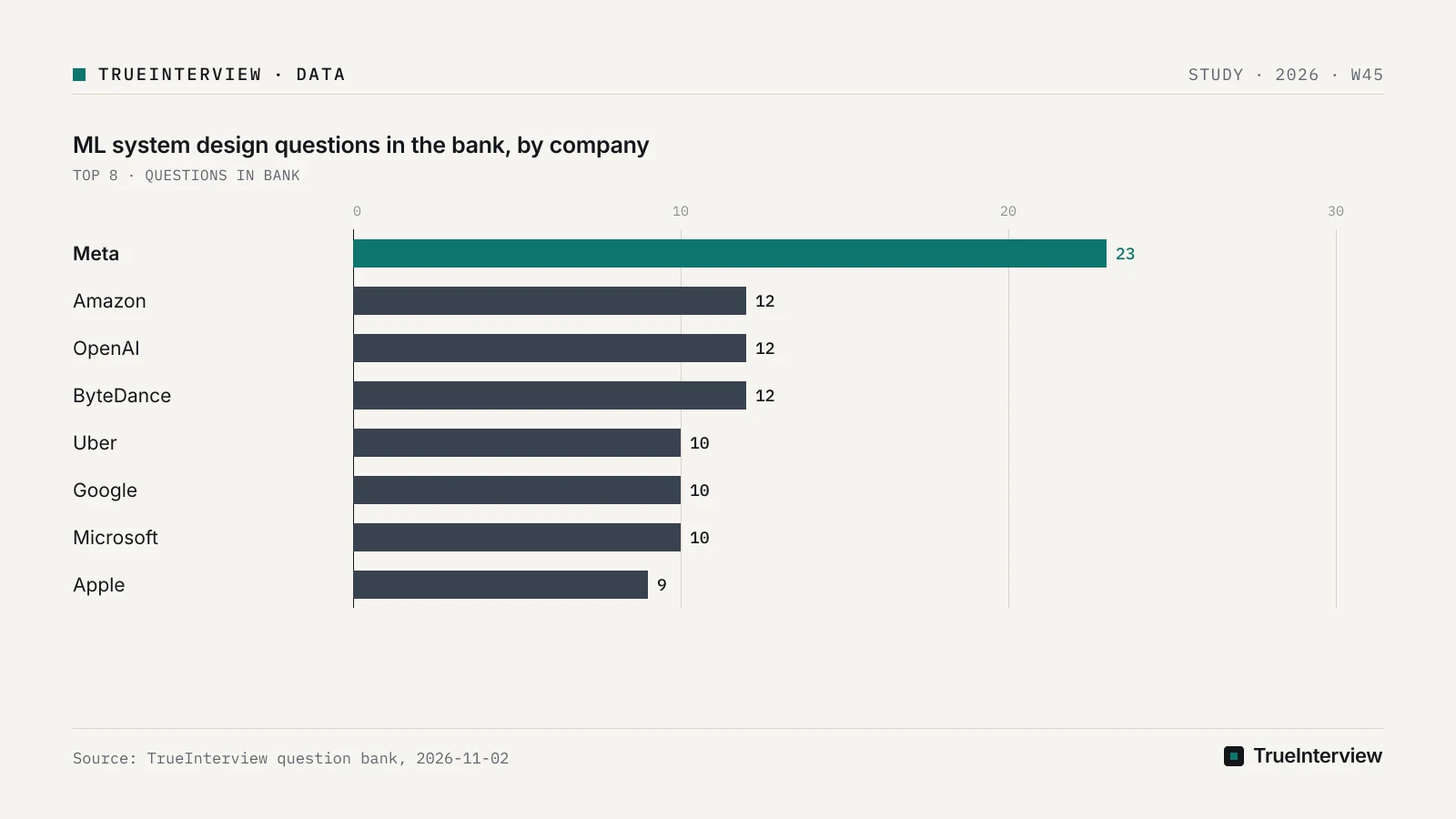
Meta leads with 23 ML system design questions in the bank, followed by Amazon, OpenAI and ByteDance with 12 each, Uber, Google and Microsoft with 10 each, Apple with 9, DoorDash with 8 and Pinterest with 7. These counts measure how many reported questions are filed under each company, not how often each company asks them. Use them to judge how much reported material exists for your target company before you rely on its prompts alone.
How long is the ML system design round?
Aced's guide says the round "usually runs 45 to 55 minutes in a conversational format" and that the interviewer watches how you reason about tradeoffs at each stage. Aced's guide spends about 8 minutes defining the problem and asking clarifying questions. After the definition step, give retrieval, ranking and re-ranking a few minutes each and keep the final minutes for offline metrics, the A/B test and monitoring.
How should you handle Google's mixed recsys, chatbot or image classifier prompt?
Its title names three system types, and it is linked from 6 write-ups by ML-side candidates and 1 by a software engineer. Lead with the recommender version, because your funnel answer covers it, and keep a short outline for the chatbot version built around an evaluation set and a fallback. For the image classifier, reuse the trust & safety structure: a labelled dataset, a precision and recall target, and a review queue for uncertain cases.
How recent are these questions?
Of the 141 questions, 108 were last reported within the 12 months before 2026-11-02. Most of the bank reflects loops from the past year, including the generative AI and inference prompts. If a prompt you find elsewhere has no recent report, give it less practice time than the recent funnel, moderation and LLM prompts in the ranked table.
Your practice plan
- In the first week, write a one-page funnel template with a line per stage stating its constraint and its consequence: retrieval latency and cached embeddings, ranking feature richness and distillation, re-ranking rules, and a shared feature store.
- Say that template aloud against Recommendation System Design in a timed session, then mark every stage where you named a component without giving its reason.
- Rehearse the same funnel on Design An Online Ads Ranking System, changing the label to conversions and adding calibration, because ad scores feed an auction.
- In the second week, run the funnel once more on Design A Personalized Search Ranking System, where the query replaces the user history as the main retrieval input.
- Prepare one trust & safety design with Design A Harmful Content Detection System, framed as a staged filter with a precision and recall target per action.
- In the third week, prepare one LLM design for the phone screen with Design ChatGPT or Google's mixed ML design prompt, covering the evaluation set and the fallback.
- Close with an evaluation answer on Evaluating Generative AI Use and Accuracy: metric choice, comparison to a simple baseline, and rollout by A/B or shadow deployment.
Sources
- TrueInterview question bank — ML system design at big-tech companies — counted 2026-11-02
- Scaling the Instagram Explore recommendations system - Engineering at Meta — checked 2026-11-02
- نمای کلی سیستم های توصیه | Machine Learning | Google for Developers — checked 2026-11-02
- System Design for Recommendations and Search — checked 2026-11-02
- Deep neural network models | Machine Learning | Google for Developers — checked 2026-11-02
- Machine Learning System Design Interview (2026 Guide) - Aced (formerly Exponent) — checked 2026-11-02
- Interview prep compared: your application, end to end · TrueInterview — checked 2026-11-02
Last reviewed: 2026-11-02.