Study
8 Most-Reported LLM Interview Questions at Big Tech (2026)
TrueInterview
October 16, 2026 · 15 min read
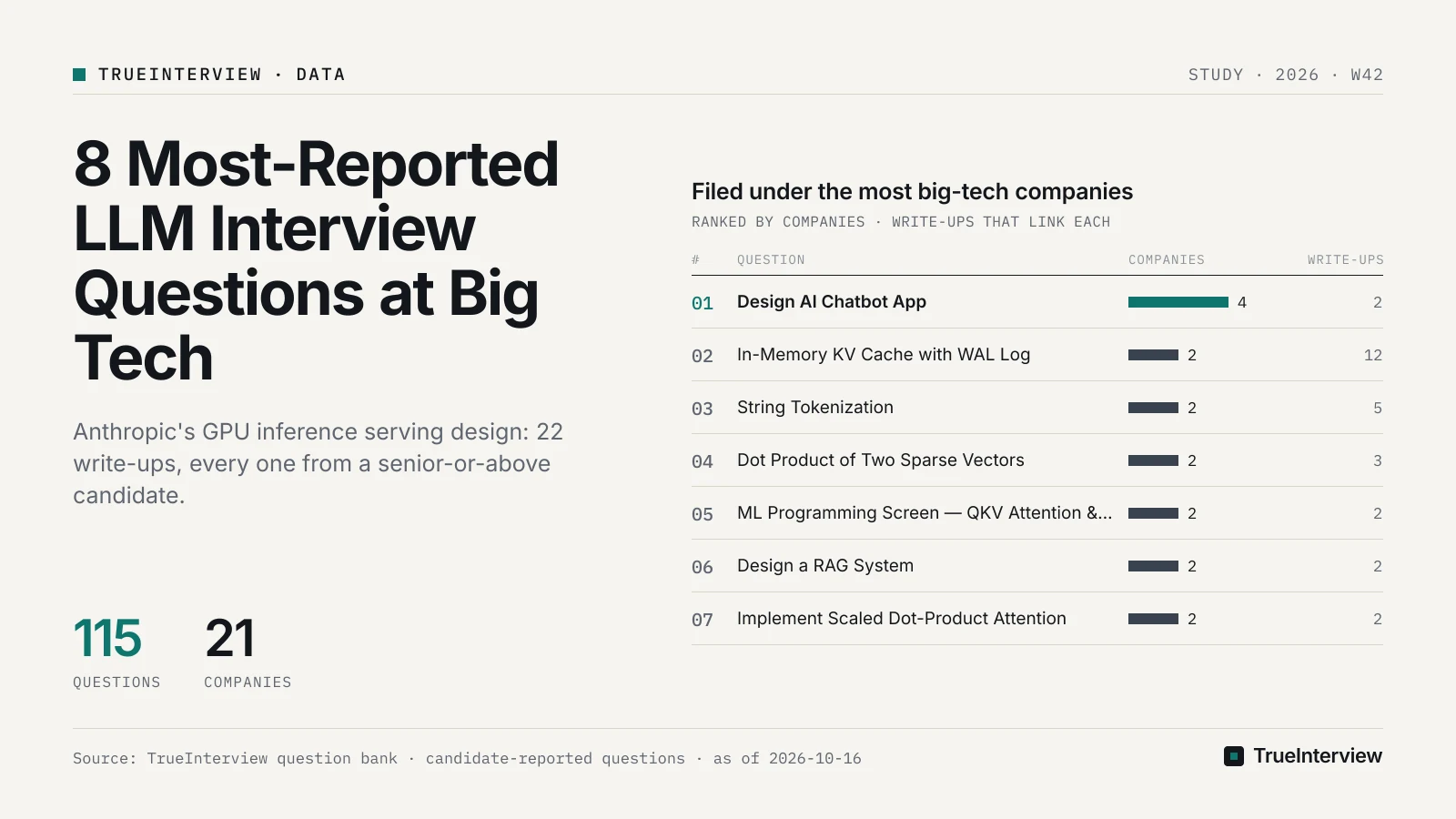
Seven of the eight most-linked LLM questions that candidates report from big tech and AI labs are build, debug or design tasks, not definition quizzes. As of 2026-10-16, TrueInterview's bank holds 115 LLM and AI engineering questions at 21 big-tech companies, 106 of them last reported in the past 12 months. After Amazon's GenAI usage question, the most-linked are Design GPU Inference Serving System, with 22 write-ups, and OpenAI's coffee-shop ordering design, with 16. Prepare for your company and role, not for a generic Q&A list.
Disclosure: TrueInterview is an interview-preparation product and publishes this article. Facts about other products come from their public pages on the dates listed under Sources.
Which LLM questions do candidates report most at big tech?
Eight named questions lead the bank by candidate write-up links, from Amazon's GenAI usage behavioral question at the top to Anthropic's prompt-playground design in eighth place. Only the first is a conversation; the other seven ask you to build, debug or design something. The ranking measures what candidates wrote up, not how often a company asks a question.
| Rank | Question | Filed under | Write-up links | Practise |
|---|---|---|---|---|
| 1 | GenAI Usage (How / Failure / Tradeoff) | Amazon | 29 | GenAI usage drill |
| 2 | Design GPU Inference Serving System | Anthropic | 22 | Inference serving design |
| 3 | Payment / Coffee-Shop Ordering (read the prompt!) | OpenAI | 16 | Coffee-shop ordering |
| 4 | Debug a Transformer and Convert It to a Classifier | OpenAI | 14 | Transformer debugging |
| 5 | In-Memory KV Cache with WAL Log | Databricks | 12 | KV cache with a WAL |
| 6 | Agents / Coding with LLMs | Anthropic | 12 | Agents and LLM coding |
| 7 | Vectorized 1-NN and Neural Network Forward Pass | OpenAI | 11 | Vectorized forward pass |
| 8 | Design AI Prompt Playground | Anthropic | 10 | Prompt playground design |
Three patterns sit behind the list. The labs dominate it, with OpenAI and Anthropic holding six of the eight rows. Two rows are classic stateful engineering with no model in sight. And the level and role splits differ sharply from row to row, which the sections below give question by question, so a single study list cannot fit every candidate.
1. How do you answer Amazon's GenAI usage question?
This is a behavioral question about how you used generative AI, where it failed and which trade-off you chose, and a candidate last reported it in an Amazon phone screen in 2026-09. It sits inside Amazon's behavioral-heavy LLM mix: 10 of the 15 LLM and AI engineering questions filed under Amazon are behavioral or knowledge items.
Amazon's applied scientist prep page says each interviewer "will typically ask two or three behavioral-based questions" tied to its Leadership Principles, and it recommends the STAR method. The same page says, "Amazon is a data-driven company, so your answers should include metrics or data where applicable."
What to prepare for at senior level (our view): the failure half. Expect follow-ups on how you detected that the model output was wrong, what you measured before and after, and why you accepted the cost, latency or review burden of your fix instead of the alternatives.
Our take: generic advice tells you to walk through a system you shipped and its outcome. For this question, lead with the failure. A story where GenAI worked first time gives the interviewer nothing to probe, so pick the project where it broke and you changed course with numbers.
2. How do you design a GPU inference serving system?
Design GPU Inference Serving System is Anthropic's most-linked LLM question, and every one of its write-ups came from a candidate who reported a senior-or-above level, 2 of them staff-plus or manager. One candidate reported it in a phone screen, last in 2026-07, so it may come before the onsite.
It belongs to the LLM, RAG and AI infrastructure family, next to Route and Batch Inference with Eight GPUs, also filed under Anthropic. Practise both together; by its title, the second looks like a focused routing and batching exercise that also sits inside the serving design.
What to prepare for at senior level (our view): two decisions carry this design as standard practice. First, the batching policy against a latency target, including whether you batch continuously as sequences finish. Second, KV-cache memory per in-flight request, which decides admission control and what you do when a GPU fills up mid-stream. PracHub's guide advises you to "examine tail latency, not only the mean" when latency is the problem, which fits this round.
Our take: generic lists phrase this as a concept question about scalable real-time inference, as the GitHub hub does. Treat it as a capacity exercise instead: state requests per second, tokens per request and GPU memory, then let the numbers pick your batching and routing.
3. Why does a coffee-shop ordering prompt rank this high at OpenAI?
Payment / Coffee-Shop Ordering is a payments design question filed under OpenAI, and 15 of its write-ups came from senior-or-above candidates against 1 from junior, new-grad or intern candidates. A candidate last reported it in a phone screen in 2026-06. It is the strongest senior-leaning design family in this subset.
What to prepare for at senior level (our view): an order is a state machine that touches money, so the deciding questions are idempotency (a retried payment request must not charge twice) and where the source of truth for an order's state lives when the payment step fails halfway. The title's own warning, read the prompt, suggests that requirements hidden in the prompt carry the round.
Our take: the conceptual questions sampled below from the GitHub hub and GeeksforGeeks include nothing like this, and that is the gap. At an AI lab, a senior candidate can still be measured on plain transactional design. Keep one payments design rehearsed even if your loop is labelled AI engineering.
4. How do you debug a transformer and convert it to a classifier?
Debug a Transformer and Convert It to a Classifier is filed under OpenAI and is an ML-side question: 13 of its write-ups came from machine-learning, AI, research or data-science candidates and 1 from software-engineer candidates. By level, 10 came from senior-or-above candidates and 4 from junior-or-below, so juniors on the ML track meet it too.
What to prepare for at senior level (our view): the bugs that a transformer still trains through. Check the softmax axis, the scaling by the square root of the key dimension, mask shape and sign, and whether padding leaks into attention. For the classifier half, defend your pooling choice (a first token versus a mean over non-padding positions) and say how you would confirm the fix with a tiny overfitting test.
Our take: the GitHub hub asks you to explain how self-attention is computed step by step. Explaining is not the reported task. Practise reading someone else's attention code under time pressure, which is a different skill from reciting the formula.
5. How do you build an in-memory KV cache with a write-ahead log?
In-Memory KV Cache with WAL Log is a storage design question filed under Databricks, not under an AI lab, and its write-ups split 7 senior-or-above to 5 junior-or-below. A candidate last reported it in a Databricks onsite in 2026-06. It belongs to the storage, caching and key-value stores family.
What to prepare for at senior level (our view): durability against latency. Decide when you flush the log to disk (each write, batched, or on a timer) and what a crash between the append and the in-memory update leaves behind. Then show recovery: replay the log, detect a torn final record with a checksum, and compact the log with snapshots so replay stays bounded.
Our take: the closer split between levels makes this one of the few top items where junior material helps. Senior candidates should still expect the follow-ups on recovery time and compaction, which is where the level shows.
6. What does Agents / Coding with LLMs test at Anthropic?
Agents / Coding with LLMs is filed under Anthropic and draws from both sides: 8 write-ups came from machine-learning, AI, research or data-science candidates and 4 from software-engineer candidates. By level, it splits 7 senior-or-above to 5 junior-or-below, one of the most even splits in the top eight.
What to prepare for at senior level (our view): the title alone does not say whether you build an agent or code alongside one, so prepare for both readings. For a tool-calling loop, the deciding points are the tool schema, a stop condition and budget, and checking a tool's result before trusting it. PracHub's guide makes a related point: verify the outcome in the system of record rather than accept the agent's claim.
Our take: do not assume AI-assisted coding is taking over these loops. Across the LLM subset, AI-assisted coding's share of write-up links went from 14% in 2026-Q1 to 8% in 2026-Q3, on small counts of 13 and 3 links. Prepare this question, but do not let it crowd out plain coding practice.
7. How do you write a vectorized 1-NN and forward pass?
Vectorized 1-NN and Neural Network Forward Pass is filed under OpenAI and is close to ML-only: 10 write-ups came from machine-learning, AI, research or data-science candidates and 1 from software-engineer candidates. Its level split is 9 senior-or-above to 2 junior-or-below.
What to prepare for at senior level (our view): broadcasting without loops. For nearest neighbour, expand the squared distance into the two squared norms minus twice the dot product, then ask what the full distance matrix costs in memory and how you would chunk it. For the forward pass, expect shape checks at each layer and a numerically stable softmax.
Our take: the moderndescartes.com essay on ML engineering interviews, one candidate's write-up, argues that indexing, search, graph, tree and heap problems are the most appropriate for ML engineers. For LLM loops the bank leans a little differently, on a small sample: math is the top algorithm tag on the 32 coding questions, with 8, ahead of strings at 5. If you are on the ML track, keep math-tagged coding problems in your rotation next to graph drills.
8. How do you design an AI prompt playground?
Design AI Prompt Playground is an Anthropic design question in the LLM infrastructure family, with 8 write-ups from senior-or-above candidates and 2 from junior-or-below. As the title suggests, expect a product-shaped design: a tool where users write prompts, run them against models and compare the results.
What to prepare for at senior level (our view): versioning and cost. A run is reproducible only if the prompt, model, parameters and inputs are stored together, so expect questions on that data model. Then expect per-user quotas and streaming responses, since every click in the product spends GPU time.
Our take: the common advice is to prepare a RAG chatbot as your LLM design. Design a RAG System is linked from only 2 candidate write-ups, while this playground design is linked from 10. Prepare the playground and the inference-serving design first; treat RAG as a component inside them.
Does the company or your role decide the mix?
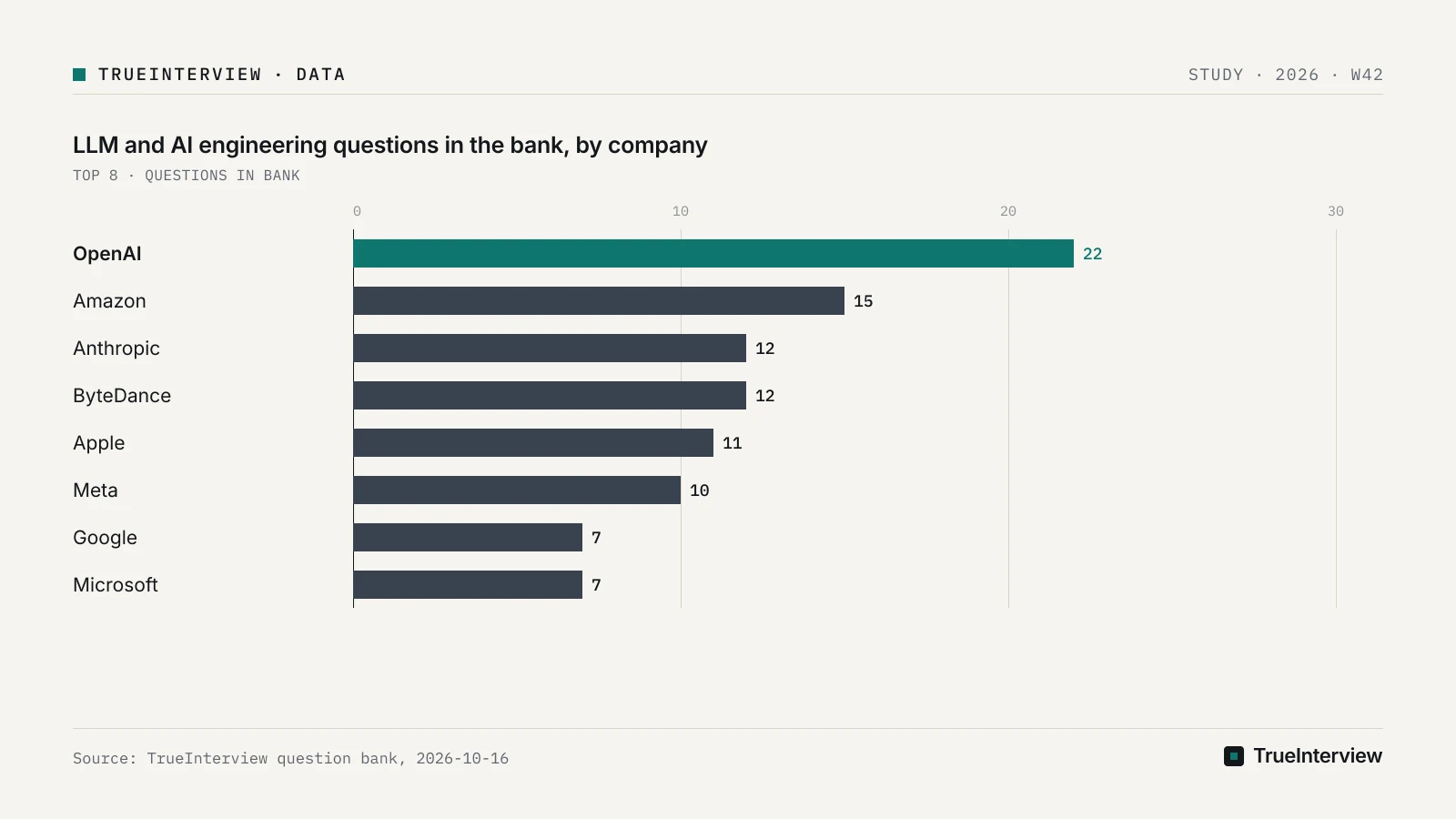
Both do: the format mix differs sharply by company and by role. OpenAI and Anthropic questions in the bank lean to coding and system design, while Amazon's lean to behavioral and knowledge items. Our take: count the company's split first and let it guide your hours, loosely, since each company has only a few dozen questions in this slice.
| Company | LLM questions | Design | Coding | AI-assisted | Behavioral / knowledge |
|---|---|---|---|---|---|
| OpenAI | 22 | 8 | 8 | 4 | 2 |
| Amazon | 15 | 3 | 2 | 0 | 10 |
| Anthropic | 12 | 4 | 6 | 2 | 0 |
| ByteDance | 12 | 2 | 4 | 0 | 6 |
| Apple | 11 | 4 | 5 | 0 | 2 |
| Meta | 10 | 2 | 3 | 1 | 4 |
Question totals in the second column come from the bank's company counts. These are counts within the LLM and AI engineering subset described above, not the bank's whole-company totals.
Role matters as much as company. Machine-learning, AI, research and data-science candidates' links lean to coding (33%) and AI-assisted coding (21%), while software engineers' links lean to system design (54%). Several items appear only on the ML side, including LoRA and PEFT Variants and LLM Inference Timeout and Restart Strategy, each with 4 ML-side write-ups and none from software engineers.
Our take: if you are interviewing as an ML engineer, expect to modify or debug model code and drill LoRA and PEFT variants. If you are a software engineer, put most of your hours on LLM-flavoured system design.
How do phone screens differ from onsites?
LLM-infrastructure design appears in both rounds, so the phone screen is not a lighter version of the onsite. Reported rounds total 72 phone-screen, 60 onsite and 2 OA mentions, and a question can carry more than one round. Of the 17 design questions reported for phone screens, 13 belong to the LLM, RAG and AI infrastructure family.
Onsites keep that family on top, with 16 of 22 design questions, plus ads, recommendation and ranking ML at 3. Phone-screen coding leans to math (7) and strings (5). Non-coding phone screens lean to ML fundamentals, 16 of 31, an example being Snapchat's ML Fundamentals, Transformer & Regularization, last reported in 2026-05.
Our take: have one LLM-infrastructure design ready before your first phone screen. Candidates who save design for the onsite are preparing for a loop that, in these reports, already started.
What changes at senior and staff level?
Senior candidates write up these questions far more than juniors do, and the gap sits in design and coding. Write-ups link the LLM subset 186 times from senior, staff-plus or manager candidates and 75 times from junior, new-grad or intern candidates, with levels self-reported.
By format, system design links run 81 senior-or-above to 12 junior-or-below and coding 48 to 13, while behavioral and knowledge links run 33 to 40. By subtype, AI/ML build leans senior (22 vs 9) and the behavioral subtype leans junior (6 vs 26). Questions seen only in senior-or-above write-ups include RLHF: PPO vs GRPO vs GSPO and Debug a Transformer Implementation and Implement a KV Cache for Decoding, each with 3.
Our take: in senior-or-above write-ups, infrastructure design and RL or inference depth carry the loop, not definitions. Staff-plus reports are too few here (3 links named) to describe staff loops separately. Prepare trade-offs you can defend with numbers, such as batch size against tail latency in the inference design.
Down-leveling note (our view): the level signal sits in design depth and in the scope of your GenAI story. A senior candidate who answers the inference-serving design at component-diagram depth, or tells a usage story with no failure and no metric, gives the panel a reason to offer the level below.
Is the format mix shifting?
Within 2026, coding's share has edged up and AI-assisted coding's has edged down, while design and behavioral shares swing without a clear direction. Compare shares rather than totals, because link totals of 19, 90, 96 and 39 across 2025-Q4 to 2026-Q3 mostly reflect how many write-ups were collected.
Coding's share ran 20%, 24% and 28% across 2026-Q1 to 2026-Q3. System design ran 29%, 40% and 26%, and behavioral and knowledge 34%, 26% and 38%. Both 2025-Q4 and 2026-Q3 rest on small link totals, so read every share as a rough signal.
Our take: do not read this as design fading. Design still leads the top of the ranking. Read it as a reason to keep coding practice in every week of your plan rather than front-loading it.
Which popular LLM questions would we skip?
Do not make definition lists your primary study source. The GitHub hub says it includes 100+ LLM interview questions with answers, and GeeksforGeeks spends space on GANs and how the generator and discriminator interact. The bank's top items ask you to implement, debug and design instead.
Use the GitHub hub's questions on positional embeddings or KV cache speed-ups as a glossary check after your coding drills, not before. The moderndescartes.com essay, one candidate's write-up, places a RAG popularity wave in 2024 and calls it "already obsolete by 2025". That is one person's view. In the bank, the one generic RAG design title trails the prompt playground by a wide margin (section 8), although RAG sits inside the largest design family, which holds 28 of the 36 design questions.
How we counted
The bank holds 115 LLM and AI engineering questions at 21 big-tech companies as of 2026-10-16. TrueInterview says questions are written up after the interview and checked against other reports of the same round. Link counts measure how many candidate write-ups name a question; they are not how often a company asks it, levels and roles are what candidates reported, and these reconstructions are not any company's official list.
FAQ
Where can I find LLM interview questions with answers on GitHub or as a PDF?
Q&A collections such as the GitHub hub covered above are useful for vocabulary, and the hub asks conceptual questions such as how quantization affects inference speed and memory. Use them for a glossary review before your phone screens, where ML fundamentals lead the non-coding questions, but only after you can implement attention and a KV cache yourself, since seven of the eight most-linked questions are build, debug or design tasks. A PDF list cannot tell you which company or round a question came from, which is the part that changes your plan.
What LLM coding questions come up?
Implementation of attention is the recurring theme. Apple's Transformer Attention Mask and Heads Coding was last reported in a phone screen in 2026-06, and ML Programming Screen covering QKV attention and einsum is linked from 2 senior-or-above write-ups. Tokenizer work also appears: Longest-Match Tokenizer is linked from 6 senior-or-above write-ups and 1 junior-or-below. Practise each as a timed coding exercise with tests.
Are LLM interviews mostly coding, system design or ML fundamentals?
It depends on the company and your role, as the company table and role split above show. At OpenAI and Anthropic, coding and design dominate the reported questions; at Amazon, behavioral and knowledge items lead. ML-track candidates should expect more coding and model debugging, and software engineers more LLM system design.
What do interviewers reward in an LLM design answer?
PracHub's guide says a strong answer defines success, isolates failure modes and explains what happens when the AI system is wrong. In practice that means stating your latency and cost targets first, naming where the system fails, and showing the fallback path. Senior candidates are expected to quantify these trade-offs rather than list components.
Your practice plan
Here is a plan in weekly blocks for someone working full time. For a worked case, take a senior software engineer with an Anthropic loop. Anthropic's 12 LLM questions in the bank are 6 coding, 4 design, 2 AI-assisted and none behavioral, so that plan stays narrow: Anthropic's own designs plus coding practice. If you are on the ML track or interviewing at OpenAI, swap in the transformer-debugging and forward-pass items from the ranking; at Amazon, add the GenAI usage story.
- Opening week: implement scaled dot-product attention with masks and multiple heads, then add a KV cache for decoding, in one sitting. Start with Implement Scaled Dot-Product Attention and Transformer Attention Mask and Heads Coding.
- Opening week: work through Agents / Coding with LLMs, preparing both readings of its title: a small tool-calling loop with a stop condition and a budget, and a coding task done alongside an LLM.
- Middle week: rehearse Design GPU Inference Serving System aloud with a capacity estimate, a batching policy, a failure path and a tail-latency breakdown, then extend it with Route and Batch Inference with Eight GPUs.
- Middle week: design the AI prompt playground end to end, with prompt versioning and per-user quotas.
- Final week: add one classic stateful problem, such as the KV cache with a WAL with crash recovery, since not every item at an AI company is LLM-specific.
- Final week: run the two Anthropic designs again under a timer, changing one constraint each time, such as doubling traffic or losing a GPU mid-stream.
Sources
- TrueInterview question bank — LLM and AI engineering at big-tech companies — counted 2026-10-16
- Applied Scientist Interview Prep — checked 2026-10-16
- AI Engineer Interview Questions 2026: RAG, Agents, Evals, and Production Systems | PracHub Knowledge Hub — checked 2026-10-16
- GitHub - KalyanKS-NLP/LLM-Interview-Questions-and-Answers-Hub: 100+ LLM interview questions with answers. · GitHub — checked 2026-10-16
- Interviewing for ML/AI Engineers — checked 2026-10-16
- Generative AI and LLM Interview Question with Answer - GeeksforGeeks — checked 2026-10-16
- Real FAANG Interview Questions by Company · TrueInterview — checked 2026-10-16
Last reviewed: 2026-10-16.