Study
8 Most-Reported Interval Questions at Big Tech (2026)
TrueInterview
October 19, 2026 · 19 min read
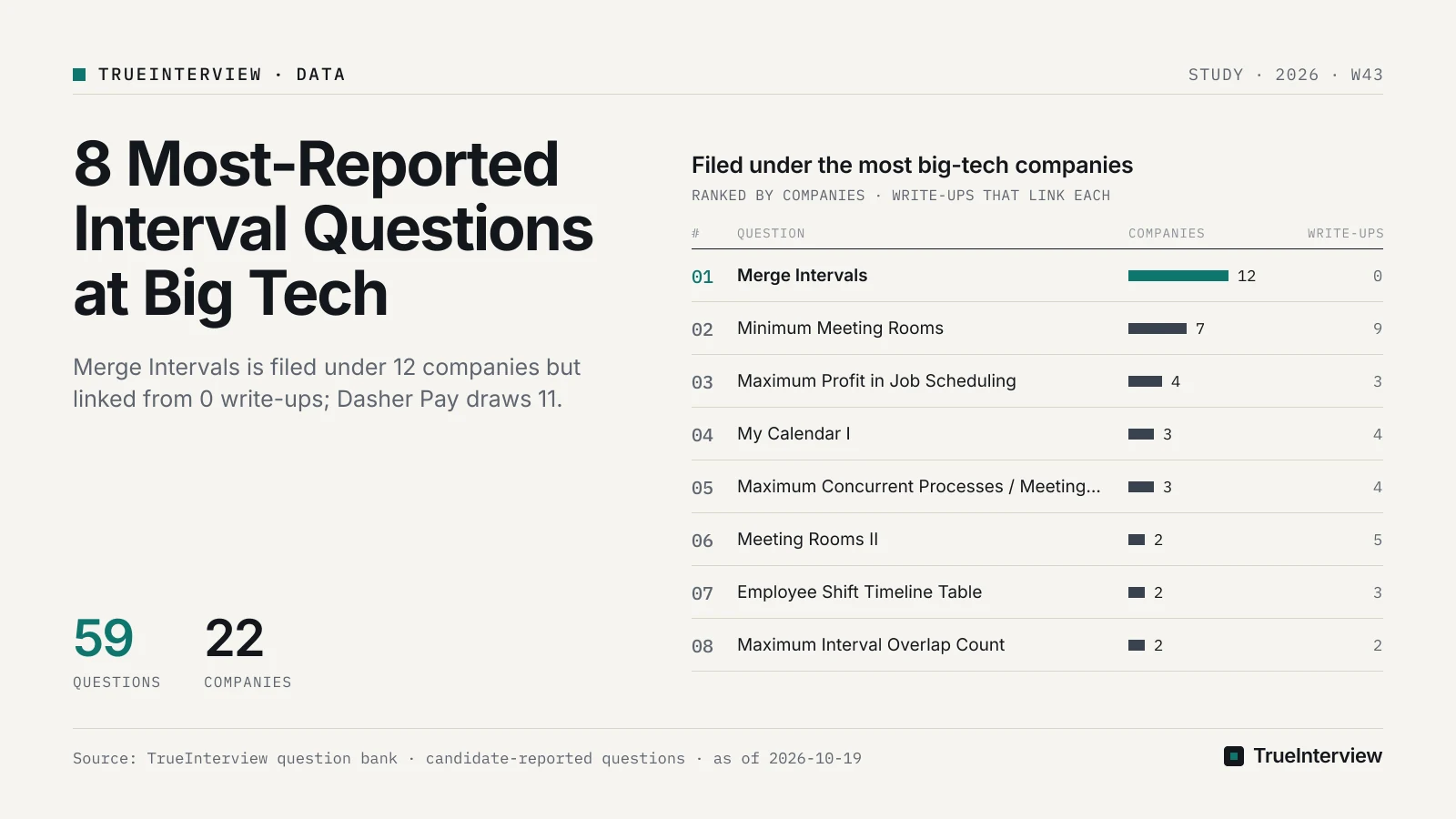
As of 2026-10-19, TrueInterview's bank holds 59 candidate-reported interval questions from 22 big-tech companies, and 53 of them were last reported in the past 12 months. The detailed write-ups centre on meeting-room counting and interval problems wrapped in a business story. DoorDash's Dasher Pay leads with 11 write-up links, while Merge Intervals is filed under 12 companies and linked from none. Our view: build your interval prep around room counting with a boundary contract you state out loud, and keep Merge Intervals as a warm-up.
Disclosure: TrueInterview is an interview-preparation product and publishes this article. Facts about other products come from their public pages on the dates listed under Sources.
Which interval questions do candidates report most?
Eight questions lead the write-up links. Three are meeting-room counting problems, five wrap the interval inside a company-specific story, and plain Merge Intervals is not among them. The ranking counts candidate write-ups that link to each question, which measures what candidates reported, not how often a company asks it. These are candidate-reported questions reconstructed for practice, not any company's official question list.
| Rank | Question | Company | Reported round and month | Write-up links | From senior-or-above candidates | Practise |
|---|---|---|---|---|---|---|
| 1 | Dasher Pay | DoorDash | Phone screen, 2026-09 | 11 | 7 | Dasher Pay |
| 2 | Minimum Meeting Rooms | Uber, Amazon | Amazon phone screen, 2026-08 | 9 | 5, one of them staff-plus or manager | Minimum Meeting Rooms |
| 3 | Firewall CIDR Rules | Databricks | Phone screen, 2026-08 | 9 | 5 | Firewall CIDR Rules |
| 4 | Meeting Rooms / Interval Scheduling Variants | Phone screen, 2026-06 | 9 | 6 | Meeting Rooms variants | |
| 5 | Minimum Cars to Satisfy Rental Requests + Assignment Records | — | 6 | — | Minimum Cars | |
| 6 | Transaction Logs — Trigger / Resolve | Stripe | Phone screen, 2026-09 | 5 | 3 | Transaction Logs |
| 7 | Max Money from K Consecutive Bags | Amazon | — | 5 | — | Max Money from K Consecutive Bags |
| 8 | Meeting Rooms II | — | 5 | — | Meeting Rooms II |
Read the list as two drills. Going by their titles, the meeting-room rows centre on counting how many intervals are open at the same moment, though the Google variants entry may also include the scheduling form covered in the sort-by-end section below. The story rows hide their intervals behind a domain, so the first job is to name them before any code. The middle of the ranking is a tie, so treat the three questions on nine links as one tier and practise all of them.
Which companies report the most interval questions?
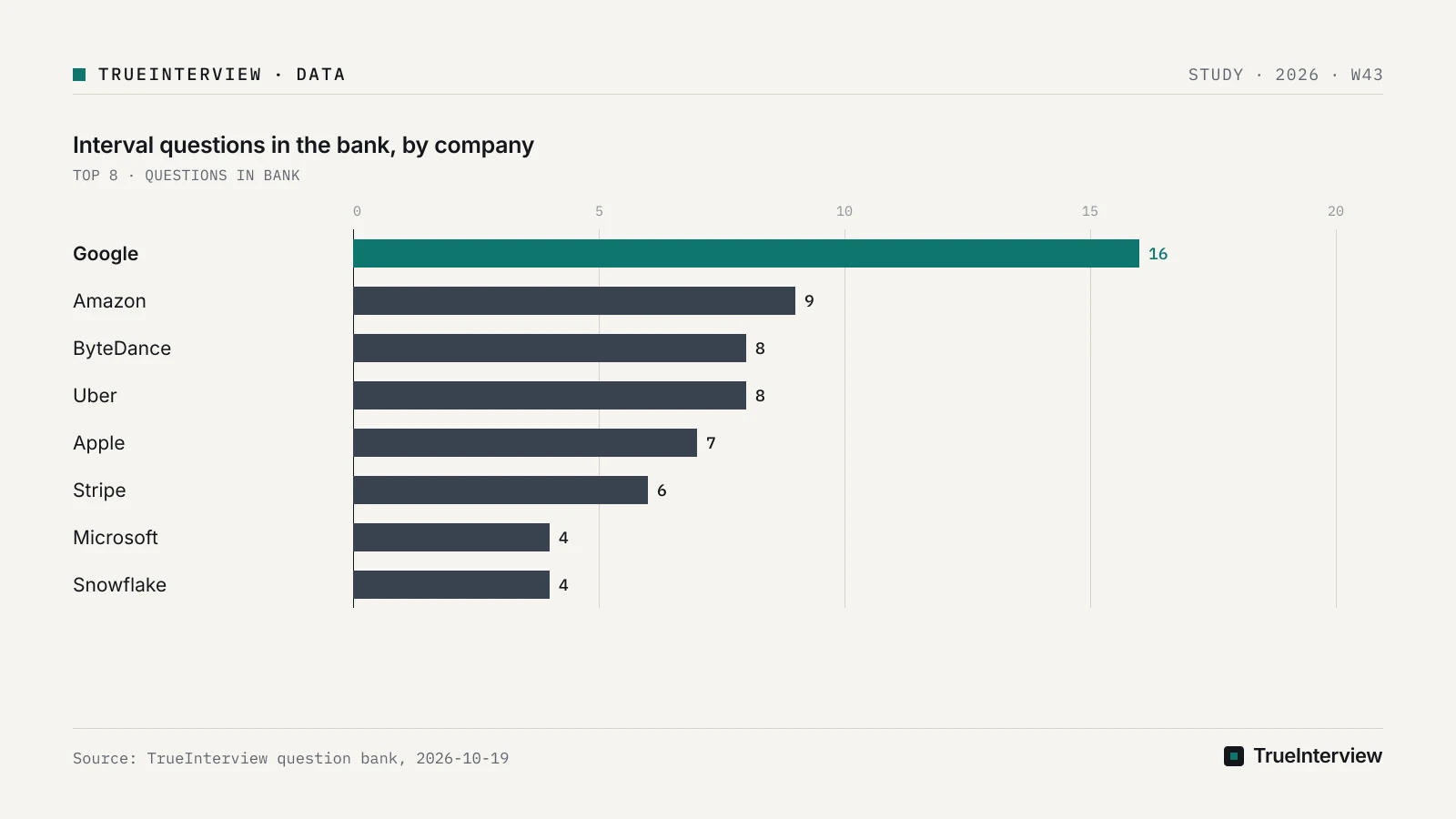
Google files the most interval questions in the bank with 16, followed by Amazon with 9 and ByteDance and Uber with 8 each. Sorting is the leading companion tag at each of the top five companies, so practise the sort and its tie key as part of the answer. Stripe is the exception: none of its six interval questions carries a sorting tag.
| Company | Interval questions in the bank | Most common companion tags |
|---|---|---|
| 16 | Sorting 6, greedy 3, arrays 2 | |
| Amazon | 9 | Sorting 4, arrays 3 |
| ByteDance | 8 | Sorting 3, arrays 2 |
| Uber | 8 | Sorting 3, arrays 2 |
| Apple | 7 | Sorting 3, arrays 2 |
| Stripe | 6 | Arrays 1, greedy 1, no sorting |
| Microsoft, Snowflake | 4 each | — |
| Meta, Airbnb | 3 each | — |
Across all 59 questions, sorting (14), arrays (10) and greedy (6) are the most common companion tags, and heap tags only 2. Keep that small heap number in mind for the senior section, where a heap split rests on two questions.
Our take: if your target is Google, Amazon, ByteDance, Uber or Apple, rehearse the sort as a spoken step, including what breaks ties at equal times. If it is Stripe, spend that time on turning log entries into events instead.
Why practise meeting-room counting before Merge Intervals?
Because meeting-room counting is where the detailed write-ups sit. Merge Intervals is reported at 12 big-tech companies, yet 0 candidate write-ups link to it. Minimum Meeting Rooms is filed under 7 companies, from Amazon to Uber, and linked from 9 write-ups. In our view, depth of reporting is the better guide to which variant you will have to talk through.
Tech Interview Handbook ranks it the other way. Its interval guide at techinterviewhandbook.org names Merge Intervals and Insert Interval as essential questions. The same guide lists Meeting Rooms and Meeting Rooms II, both marked LeetCode Premium, as practice questions.
PracHub's guide makes a narrower point about its own evidence: it notes that its candidate-reported record supports Merge Overlapping Intervals only as a practice problem.
Our take: Merge Intervals is not dead. It is filed widely, and ByteDance's Merge Overlapping Time Windows was reported in a phone screen in 2026-08. But you can probably already write it, and the sort and overlap test it teaches are the first half of every room-counting solution. Give it a ten-minute warm-up, then spend the full session on Minimum Meeting Rooms and Meeting Rooms II.
Two ways to count rooms
Solve Minimum Meeting Rooms twice, with two different mechanisms. PracHub's guide describes the heap version: "Meeting-room allocation uses a min-heap keyed by the earliest room end: release all ends <= next.start under half-open semantics, then assign a room." The same PracHub guide describes the sweep version as creating (+1, start) and (-1, end) events and processing ends before starts at equal times under half-open semantics.
import heapq

def min_rooms_heap(meetings):            # half-open [start, end)
    ends = []                            # min-heap of room end times
    for start, end in sorted(meetings):
        if ends and ends[0] <= start:    # earliest room is free by now
            heapq.heapreplace(ends, end)
        else:
            heapq.heappush(ends, end)
    return len(ends)

def min_rooms_sweep(meetings):
    events = [(s, +1) for s, _ in meetings] + [(e, -1) for _, e in meetings]
    events.sort()                        # (t, -1) sorts before (t, +1)
    open_now = peak = 0
    for _, delta in events:
        open_now += delta
        peak = max(peak, open_now)
    return peak
Python's documentation notes that the smallest element of a min-heap is always the root, and that heapreplace is more efficient than a heappop followed by a heappush. The sweep depends on tuple order, and Python's sorting guide says tuples are compared lexicographically, so an end event (t, -1) sorts before a start event (t, +1) at the same time. Run both functions on two meetings where one ends exactly when the next begins. Under the half-open contract both should report one room, and if they disagree, one of your tie rules is wrong.
Which interview round asks interval questions?
Mostly the phone screen. Of these questions, 47 were reported in a phone screen, against 8 in onsites and 7 in online assessments, and one question can appear in more than one round. In our view, interval questions mainly decide whether you reach the onsite, so rehearse them early in your plan, timed and talking aloud, instead of saving them for the final week.
Phone-screen interval questions most often add sorting (9), arrays (8) and greedy (3) tags. That is a reason to include the sort, with its tie key, in every timed repetition. The ranked table already shows the phone-screen leaders, and two more dated phone-screen reports are OpenAI's Shard Rebalancing from 2026-03 and Snowflake's Maximum Profit in Job Scheduling from 2026-02.
Onsite reports look different. Uber's My Calendar I was reported in an onsite in 2026-06, and Robinhood's Frontend Calendar UI in an onsite in 2026-05. In our reading of those titles, both are booking-style problems: state that accepts intervals over time, rather than a function that returns one count. If your next round is an onsite, practise an interval API with a constructor and a book method, and prepare one extension of it before the day.
How do the story-wrapped questions hide the interval?
Five of the eight most-linked questions say neither "merge" nor "rooms" in the title. Dasher Pay, Firewall CIDR Rules, Minimum Cars to Satisfy Rental Requests + Assignment Records, Stripe's Transaction Logs and Max Money from K Consecutive Bags all sit in the interval bank with between 5 and 11 write-up links. The skill they share is translation: turning the story into start and end events before you write code.
We describe these questions only by their titles. The right-hand column is our reading of each title and the clarifying question we would ask, not a statement of what the question contains.
| Question | What the title gives you | Line to write before coding (our reading) |
|---|---|---|
| Dasher Pay (DoorDash) | Pay for a Dasher, DoorDash's name for a delivery driver | Name what one interval is, and whether overlapping spans are paid once or twice |
| Firewall CIDR Rules (Databricks) | CIDR blocks, which are contiguous ranges of IP addresses | Treat each rule as an interval over the address space, and ask how overlapping rules are resolved |
| Minimum Cars to Satisfy Rental Requests + Assignment Records (Google) | A minimum count plus a record of assignments | The car count reads as the peak number of overlapping rentals, and the records as which car took which request |
| Transaction Logs — Trigger / Resolve (Stripe) | Trigger and resolve entries in a log | A trigger reads as opening an interval and a resolve as closing it; ask what happens to a trigger that never resolves |
For the assignment records, Python's documentation notes that heap elements can be tuples, which lets you attach a comparison value to a record. Push (end time, car id) pairs and the heap returns the car that frees first along with its identity. TrueInterview's problem list also files Shipping Cost Calculator as a Stripe coding question tagged hashmap, interval, python and simulation.
Our take: memorising these titles is less useful than the translation habit. For whichever story question matches your target company, write the one-line translation first, then check it with the interviewer before you sort anything.
Which technique fits which interval variant?
Pick the technique from the output the question wants. An overlap check or a merged list needs a sort by start and one scan, a count of simultaneous intervals needs a min-heap of end times or an event sweep, and the largest set of non-overlapping intervals needs a sort by end. PracHub's guide says complexity is usually O(n log n) for sorting plus output work.
| Output wanted | Example | Technique | Source for the rule |
|---|---|---|---|
| Do any intervals overlap? | Can Attend Meetings | Sort by start; an interval overlaps the previous one if it starts before the previous end | Hello Interview's guide |
| One list with overlaps merged | Merge Intervals, Merge Overlapping Time Windows | Sort by start; set the previous end to the larger of the two ends | Hello Interview's guide |
| How many are open at once? | Minimum Meeting Rooms, Meeting Rooms II, Maximum Concurrent Processes / Meeting Rooms, Maximum Interval Overlap Count | Min-heap of end times, or a start and end event sweep | PracHub's guide |
| Fewest removals to clear all overlaps | Non-Overlapping Intervals | Sort by end, count the intervals that do not overlap the last one kept, return the total minus that count | Hello Interview's guide |
| Best total weight | Maximum Profit in Job Scheduling | Our approach: sort by end, then dynamic programming over the latest compatible job | Wikipedia's interval scheduling article frames it as a maximum-weight independent set in an interval graph |
Going by their titles, the questions in the third row share one technique, though each is a separate entry in the bank. Maximum Concurrent Processes / Meeting Rooms is filed under Amazon, ByteDance and Google, and Maximum Interval Overlap Count under 2 companies with 2 write-up links. In our reading of the titles, counting rooms both ways should prepare you for most of that row, so spend the saved time on the story-wrapped questions.
Is sorting by start time always the first step?
No. Sort by start to merge or to count rooms, but sort by end when you want the most non-overlapping intervals. Wikipedia's interval scheduling article says selecting the intervals that start earliest is not optimal, because a very long early interval would make you reject many shorter ones. The same Wikipedia article says that picking the shortest intervals, or those with the fewest conflicts, is not optimal either.
Wikipedia's article gives the rule that works: select the interval with the earliest finishing time, which is optimal for unweighted single-interval scheduling. Wikipedia adds that the greedy runs in O(n log n) with a preprocessing sort by finishing time. Hello Interview's guide makes the same point for Non-Overlapping Intervals, warning that a sort by start risks adding an interval that starts early but ends late and blocks others. The same Hello Interview guide says a sort by end lets you add the earliest-ending intervals first.
Weights break the greedy. Wikipedia's article says weighted interval scheduling can be solved in polynomial time. The approach we recommend is dynamic programming over intervals sorted by end. Maximum Profit in Job Scheduling, the weighted version, is filed under Snowflake, Airbnb, Google and Pinterest, and linked from 3 write-ups, 2 of them from senior-or-above candidates. Keep one counterexample ready: a short job worth one point that ends first and overlaps a long job worth ten. The earliest-finish rule takes the short job, and the best answer is the long one.
How do you state the boundary contract?
Say it before you sort: whether intervals are half-open or closed, whether touching intervals overlap, and whether start is always less than end. PracHub's guide opens with the warning "Interval coding interview questions fail at the endpoints." The same PracHub guide says to state the contract before sorting, because every later comparison and sweep tie rule depends on it.
Tech Interview Handbook's guide advises asking whether [1, 2] and [2, 3] count as overlapping, because the answer changes your equality checks. The same guide says to confirm whether an interval [a, b] strictly follows a < b. Once you have the answers, every comparison in your code follows from one column of this table.
| Contract item | Half-open [start, end) | Closed [start, end] |
|---|---|---|
| Do touching intervals overlap? | No | Yes |
| Overlap test | a.start < b.end and b.start < a.end | a.start <= b.end and b.start <= a.end |
| Sweep order at equal times | Ends before starts | Starts before ends |
| Heap release before assigning a room | Release ends <= next start | Release ends < next start |
PracHub's guide gives the half-open predicate in the table's first column, and warns against pairing it with start-before-end sweep ordering, which "behaves like closed boundaries at ties". For merges, PracHub suggests testing [1,10) followed by [2,3) to catch a nested interval shortening the union, with the end computed by max. Tech Interview Handbook's guide lists an interval totally consumed within another and exact duplicates as corner cases. PracHub's guide adds zero-length intervals, reversed endpoints, timezone conversion and output ordering as items that need explicit contracts, and says to convert timestamps to a monotonic or UTC timeline before interval arithmetic.
Our take: the contract is the cheapest signal in the round. One sentence before the sort shows the interviewer that your tie rules are chosen, not accidental, and it prevents the off-by-one bug that otherwise surfaces in the last five minutes.
What changes at senior and staff level?
Senior candidates report interval questions about as often as junior ones, and their links lean toward heap allocation and booking APIs. Write-ups link these questions 65 times from candidates who reported a senior, staff-plus or manager level, and 57 times from junior, new-grad or intern candidates. Levels are what candidates reported on their own write-ups.
Heap-tagged links split 9 senior-or-above to 3 junior-or-below and two-pointers 6 to 4, while greedy leans junior at 10 to 13 and arrays at 5 to 8. Because heap tags only two questions in the bank, read that split as a direction. My Calendar I draws 3 of its 4 links from senior-or-above candidates. Questions linked only from senior-or-above write-ups include Frontend Calendar UI, Shard Rebalancing and Find Split Stays for Airbnb Listings, each with 3 links.
Our take: the senior version of an interval question looks like an API or an allocation with identities attached, so practise designing the interface and extending it, not only returning a count. For My Calendar I, be ready to discuss the structure behind the book method: a sorted list with binary search is simple, while a balanced tree or sorted map keeps inserts logarithmic as bookings grow. For heap allocation, be ready to say which room goes to which meeting, and how you break the tie when two rooms free at the same moment.
Down-leveling note (our view): a clean interval answer in a phone screen does not set your level by itself. Since senior-or-above links lean toward heap allocation and booking-style questions, the interval round's share of the level signal comes from the contract you state unprompted and how you extend a working solution.
Do ML and data candidates see a different mix?
The sample is too small to plan around, though it leans toward heap, greedy and sorting tags. By role, links come from software engineers 106 times, machine learning engineers 7, frontend engineers 4, data scientists 3 and backend engineers 2.
ML, AI, research and data-science write-ups show greedy at 40% of links against 17% for software engineers, heap at 30% against 8% and sorting at 30% against 12%, on 10 links against 112. Minimum Cars and the Google Meeting Rooms variants each have 2 links from ML or data candidates. If you are an ML engineer and want a starting point, those two questions are among the ones with ML links, but keep the small-sample caveat in mind.
Are these interval questions recent?
Yes, as the opening count shows, and the quarterly totals do not change that. Links by interview quarter number 16 in 2025-Q4, 29 in 2026-Q1, 28 in 2026-Q2 and 41 in 2026-Q3, but those totals mostly reflect how many write-ups were collected, so they are not a trend.
Tag shares are no steadier. Arrays-tagged questions reached 20% of links in 2026-Q3 on only 8 links, and greedy moved between 7% and 25% across the four quarters. Treat the ranked list as current enough for a three-week plan, and do not reshuffle your preparation around one quarter's tag share.
Which interval questions should you practise first?
Start from your next round and your target company, then add the questions filed under the most companies. The table below is our decision rule, built from the rankings above.
| Your situation | Start with | Why |
|---|---|---|
| Phone screen at Google | Meeting Rooms variants, then Meeting Rooms II and Minimum Cars | Google's most-linked interval questions, with sorting as its leading companion tag |
| Phone screen at Amazon or Uber | Minimum Meeting Rooms, with the sort step spoken | Filed and linked at both companies |
| Stripe | Transaction Logs | No Stripe interval question carries a sorting tag, so model the log events |
| DoorDash or Databricks | Dasher Pay or Firewall CIDR Rules | Each company's entry in the top of the ranking |
| Onsite next | My Calendar I, built as an API | The two dated onsite examples, My Calendar I and Frontend Calendar UI, read as booking-style from their titles (our reading) |
| Senior or above | Heap allocation with room ids, plus My Calendar I | Senior-or-above links lean toward both |
For questions that travel, the ones filed under the most companies after Merge Intervals and Minimum Meeting Rooms are Maximum Profit in Job Scheduling with 4, My Calendar I with 3 and Maximum Concurrent Processes / Meeting Rooms with 3.
Worked example: a senior engineer with a Google phone screen
Google's interval questions lean on sorting, and its three most-linked are Meeting Rooms / Interval Scheduling Variants, Minimum Cars and Meeting Rooms II, as the tables above show. With three weeks, the sessions follow the technique ladder:
- Session one. Meeting Rooms II with a min-heap of end times. State the half-open contract, then release every end at or before the next start before assigning a room.
- Session two. The same count as an event sweep, with ends before starts at equal times, checked against the heap answer on touching meetings.
- Session three. Minimum Cars. In our reading of the title, the count is the peak overlap and the records say which car took which request, so push (end time, car id) pairs onto the heap.
- Session four. The earliest-finish greedy on Non-Overlapping Intervals, then Maximum Profit in Job Scheduling as the weighted version, with the counterexample above.
What would we deprioritise?
Long lists of interval classics that repeat one technique. If your list includes Insert Interval, Employee Free Time and several Merge Intervals variants, keep one problem per row of the technique table and move the saved hours to the story-wrapped questions and the booking API. In our view, a fifth merge problem teaches less than one more translation of a business story into events.
How we counted
Counts come from TrueInterview's question bank as of 2026-10-19 and cover the interval-tagged practice questions described above. A question can be filed under several companies and reported in more than one round, so tallies overlap. Write-up links count candidate write-ups that point to a question, split by the level and role each candidate reported; they show what candidates wrote up, not how often a company asks a question.
FAQ
What are interval questions in coding?
Hello Interview's overview describes them as problems whose input is a list of [start, end] times, and says they typically involve sorting the intervals and then processing each one in sorted order. In interviews they appear as calendars, room counts, booking APIs and ranges hidden inside a domain story, such as address ranges in a firewall rule. The technique table above maps each kind of output to its method, which is the fastest way to recognise one.
Is Merge Intervals still asked?
It is filed under 12 big-tech companies in the bank, from Apple to Uber, so it can come up as a warm-up or as a step inside a larger question. No candidate write-up links to it, though, so it is not where the detailed reports sit. Keep it sharp enough to write in ten minutes, and spend your full sessions on room counting and the story-wrapped questions that candidates do describe.
How should I handle touching endpoints like [1,2] and [2,3]?
Ask the interviewer first, which Tech Interview Handbook's guide recommends because the answer decides your equality checks. If there is no preference, propose half-open intervals: touching meetings do not overlap, a room frees at the moment the next meeting starts, and the sweep processes ends before starts. Then keep that choice consistent across the overlap test, the sort key and the heap release, since a mismatch between them is the usual source of a wrong count.
Should I use a min-heap or a sweep line?
Use the sweep when you only need the peak count, and the heap when you need to know which room or car each interval gets. The sweep needs only a sorted event list and a running counter. The heap keeps one entry per resource, and Python's documentation notes that heap elements can be tuples that carry a comparison value next to a record. In our reading of the title, an assignment-style question such as Minimum Cars would return its records this way, alongside the count.
Do senior engineers get different interval questions?
They get the same families with a different emphasis, as the senior section shows, so keep the same practice list and add extension work on top. If you have only one extra session, spend it building My Calendar I as a class and then changing its rules, because most of that question's write-up links come from senior-or-above candidates. Treat a working first version as the start of the conversation, and have your next change ready before the interviewer asks.
Your practice plan
A three-week plan for someone working full time, at about an hour a day:
- Week one. Warm up on Merge Intervals for ten minutes, then solve Minimum Meeting Rooms twice, once with a min-heap and once with an event sweep. Confirm both report one room for two meetings that touch.
- Week one. Write your boundary contract as one sentence, then solve Meeting Rooms II and Maximum Concurrent Processes / Meeting Rooms, saying the contract aloud before you sort.
- Week two. Pick the story-wrapped question for your target: Dasher Pay, Firewall CIDR Rules, Transaction Logs (Trigger / Resolve) or Minimum Cars to Satisfy Rental Requests + Assignment Records. Write the one-line translation before any code, then solve it as a timed phone screen.
- Week two. Solve Non-Overlapping Intervals by sorting on end time, then Maximum Profit in Job Scheduling as the weighted version, and explain why the greedy fails on it.
- Week three. Build My Calendar I as a class with a book method, then extend it, for example to allow a bounded number of overlaps. If you are senior, add room ids to your heap solution and return the assignment.
- Week three. Run two timed mock phone screens drawn from the ranked table, such as Meeting Rooms / Interval Scheduling Variants for Google. Re-solve any problem where you could not state the contract before you wrote code.
Sources
- TrueInterview question bank — interval at big-tech companies — counted 2026-10-19
- Interval cheatsheet for coding interviews | Tech Interview Handbook — checked 2026-10-19
- Interval Coding Interview Questions: Boundary Rules, Sweeps, and Concurrent Events | PracHub Knowledge Hub — checked 2026-10-19
- heapq — Heap queue algorithm — Python 3.15.0 documentation — checked 2026-10-19
- Sorting Techniques — Python 3.15.0 documentation — checked 2026-10-19
- Coding Interview Questions by Company · TrueInterview — checked 2026-10-19
- Intervals Overview | Hello Interview — checked 2026-10-19
- Interval scheduling - Wikipedia — checked 2026-10-19
Last reviewed: 2026-10-19.