Study
8 Most-Reported Behavioral Question Sets at Big Tech (2026)
TrueInterview
October 16, 2026 · 14 min read
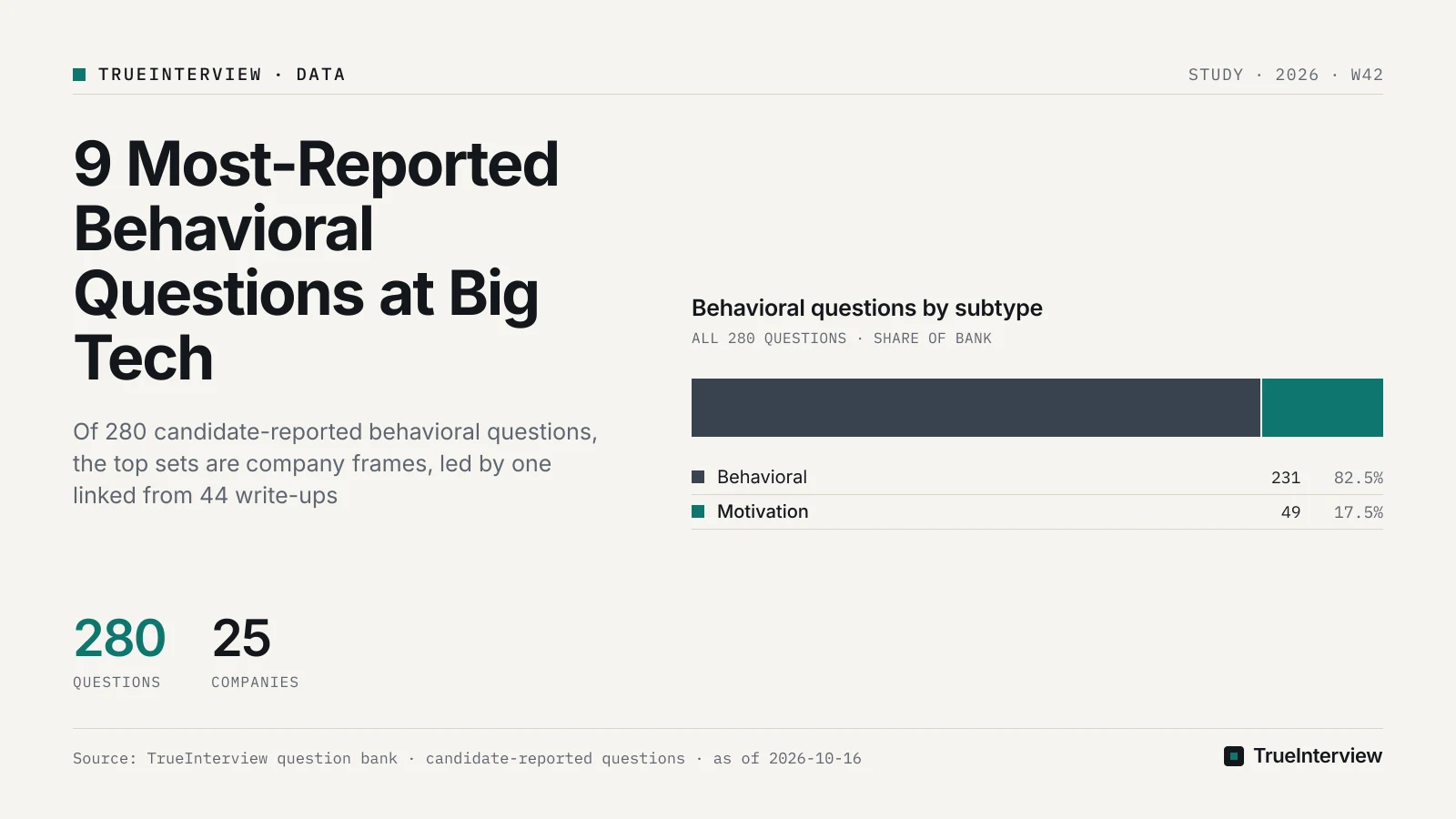
As of 2026-10-16, TrueInterview's bank holds 280 candidate-reported behavioral practice questions from 25 big-tech companies. The most-linked set is Culture & Behavioral, filed at DoorDash and Anthropic (44 write-ups), followed by Amazon's Leadership Principles Standard Set (31 write-ups). Our view: a senior engineer gets more from a small set of stories tagged to the target company's named frame, rehearsed before the phone screen, than from memorizing a long generic question bank.
Disclosure: TrueInterview is an interview-preparation product and publishes this article. Facts about other products come from their public pages on the dates listed under Sources.
Which behavioral questions do candidates report most?
Ranked by the number of candidate write-ups that link them, the top eight behavioral sets are Culture & Behavioral, Amazon's Leadership Principles, Amazon's GenAI Usage, Anthropic's hiring-manager round, Google's Googliness themes, Meta's Traditional Behavioral, LinkedIn's BQ pack and OpenAI's mission and safety round. As the table shows, most of the eight are filed under a single company. Our reading, since the bank files reconstructed sets by company, is a prep rule rather than proof: let the company you target decide which frame you rehearse. Apple, with 8 behavioral questions filed, has no set in the ranking. The ranking therefore covers big tech broadly, including AI labs, not only the FAANG five.
We rank only the sets for which the bank has a company-attributed write-up total, which is eight, and we do not pad the list to a rounder number. Databricks' SWE / MLE round sits under the table because the bank gives only its level split. The level split comes from the level each candidate reported on the write-up.
| # | Question set | Filed by | Write-ups linking it | Senior-or-above vs junior links | Round, last reported | Practice |
|---|---|---|---|---|---|---|
| 1 | Culture & Behavioral Interview Questions | DoorDash, Anthropic | 44 | 40 vs 4 (4 staff-plus or manager) | Anthropic onsite, 2026-09 | Practice |
| 2 | Leadership Principles Standard Set | Amazon | 31 | not split out | Phone screen, 2026-09 | Practice |
| 3 | GenAI Usage (How / Failure / Tradeoff) | Amazon | 29 | not split out | not split out | Practice |
| 4 | Hiring Manager Round — Behavioral & Collaboration | Anthropic | 24 | 22 vs 2 (1 staff-plus or manager) | not split out | Practice |
| 5 | Behavioral Round (Googliness Themes) | 23 | 13 vs 10 (1 staff-plus or manager) | Phone screen, 2026-08 | Practice | |
| 6 | Traditional Behavioral | Meta | 23 | 17 vs 6 (3 staff-plus or manager) | Onsite, 2026-06 | Practice |
| 7 | Behavioral / BQ Question Pack | 22 | 17 vs 5 (10 staff-plus or manager) | Phone screen, 2026-09 | Practice | |
| 8 | HM BQ — Why OpenAI / AI Safety / AGI | OpenAI | 20 | 20 vs none | Onsite, 2026-08 | Practice |
Read the senior column before the totals. Five of the six sets with a level split lean heavily senior, and Google's Googliness set is the only one close to even, which makes it the best starting point for a junior candidate and the weakest signal of what a senior loop will press on.
One set sits just outside the ranking. Databricks' SWE / MLE Behavioral Round, last reported onsite in 2026-08, is linked from 13 senior-or-above write-ups and 2 junior ones; the bank does not give its total.
What does each set test, and what must a senior answer show?
The eight ranked sets, plus the Databricks round, sort into three jobs: company-value frames that check whether your stories match how the company says it works, hiring-manager rounds that check how you collaborate and decide, and AI-era sets that check your judgment about tools and mission. For each set below, the senior-scope bar is our view, built from the titles and the level split above.
Company-value frames
Culture & Behavioral Interview Questions (DoorDash, Anthropic). This is the most-linked set in the bank, and 38 of its links come from software-engineer candidates against 4 from machine-learning, AI, research or data-science candidates. A senior answer has to show values under pressure: a decision where the company's stated value cost you something, and what you chose. Bring one story where you held a line with a peer team, and one where you changed your mind.
Leadership Principles Standard Set (Amazon). Amazon says its 16 Leadership Principles "are the framework of how we evaluate potential candidates for jobs here at Amazon." A senior answer shows ownership beyond your own task: the cross-team gap you closed, the metric you were accountable for, and the principle it maps to. Label each story with the principle it demonstrates before the loop.
Behavioral Round (Googliness Themes) (Google). Our reading of the set: treat it as a collaboration and humility test. At senior level the story needs a moment where you made someone else's work succeed: unblocking a teammate, credit you passed on, a design you dropped for a better one. Google's themes are its own frame, so do not reuse Amazon principle labels here.
Traditional Behavioral (Meta). The title says what it is: classic past-situation questions. A senior answer must carry scope a mid-level answer lacks, such as a conflict that crossed team boundaries or a project you defended with numbers.
Behavioral / BQ Question Pack (LinkedIn). Staff-plus and manager write-ups link this pack more than any other set, and machine-learning and data candidates file it too (6 against 15 from software engineers). If you are interviewing above senior, practise this one first: it is the closest the bank has to a staff-level behavioral benchmark.
Hiring-manager collaboration rounds
Hiring Manager Round, Behavioral & Collaboration (Anthropic). A senior answer shows how you set direction with a manager, disagreed with one, and kept stakeholders informed when plans slipped. Have one story where you escalated early instead of late.
SWE / MLE Behavioral Round (Databricks). This round is shared across software and ML roles, so the stories should show cross-functional work: you and a data, ML or product partner reaching a decision neither could reach alone. The senior bar is that you framed the trade-off, not that you implemented the result.
AI-era judgment and mission
GenAI Usage (How / Failure / Tradeoff) (Amazon). The title names its three parts, and a senior answer covers all three: how you used a GenAI tool on real work, where its output was wrong, and the trade-off you set for your team (review rules, where you stopped using it). A story that only covers productivity gains misses two-thirds of the prompt.
HM BQ, Why OpenAI / AI Safety / AGI (OpenAI). Every one of its links comes from a senior-or-above candidate. A senior answer needs a specific, defensible view on why the mission matters to you and one concrete safety trade-off you would make, stated in your own terms. A generic answer about impact will not survive a hiring manager's second question.
Our take: prepare the company's frame, not a universal list
Generic question lists treat every company as one interviewer, and the bank says otherwise: the reported sets carry each company's own frame. Amazon says its behavioral discussion runs on "using Amazon's Leadership Principles to guide the discussion." Microsoft's reported phone-screen round is filed as Behavioral Round (Growth Mindset / Customer Obsession), last reported 2026-08.
AWS's recruiting page goes further for its own loops, saying candidates are assessed on the principles "regardless of the role or level". Oracle's phone-screen set is filed as Behavioral & Bar Raiser BQ Set, last reported 2026-09. An Amazon Bar Raiser says on Amazon's site that role-specific principles can usually be read from the job description. Do not tag Google or Meta stories with Amazon's principle names; Google's reported round is filed under its own Googliness themes.
The practical move is to write down your target company's frame on one page and tag every story to it before you rehearse.
The bank ranks sets and rounds, not single prompts. For the individual prompts, outside sources are the better guide: the Tech Interview Handbook lists "Tell me about a time when you had a conflict with a co-worker.", a disagreement with your manager, a tight deadline and the most constructive feedback you have received. Our view: map one senior-scope story to each of these four, then tag it to the company frame.
Why does behavioral prep start at the phone screen?
Candidates reported behavioral questions in phone screens almost as often as onsite: 133 questions in the phone-screen round against 149 onsite and 8 in online assessments. Amazon's Leadership Principles set, Google's Googliness round and LinkedIn's BQ pack were all last reported in phone screens. Your core stories need to be ready before the first call.
Motivation questions are a bigger part of the screen than of the onsite: 28 of the 133 phone-screen questions are motivation questions, against 19 of the 149 onsite. Salesforce's set, filed as Hiring Manager + Behavioral Rounds, was last reported in a phone screen in 2026-09. If you have one evening before a recruiter call, spend it on a tight, company-specific why-us answer and two behavioral stories, not on system design notes.
How should a senior engineer structure each answer?
Use STAR as a scaffold, give most of the time to your own actions, add a number, and end with what changed in how you work. Amazon says it uses behavioral interviewing with the STAR method and calls STAR "not something to memorize but rather a tool to communicate your strengths and experiences." AWS recruiters say good STAR answers are concise and clearly structured.
PracHub's guide suggests spending about half of each answer on the Action step and saying "I" rather than "we". An Amazon Bar Raiser puts it directly: "They should focus on actions they personally took in the situation rather than their team." Amazon's interview page says data points show the interviewer the context, risks and visibility of the example.
For the close, PracHub's guide adds a Learnings step because, in its words, STAR "stops one beat too early for senior roles." An Amazon Bar Raiser suggests an Improvement step instead, which makes the method STARI. The two are the same idea; since the Improvement step comes from an Amazon Bar Raiser, it is a reasonable close for Amazon loops. PracHub's guide recommends answers of two to three minutes. An AWS recruiter's advice on the AWS careers page fits the senior case: "Keep it simple and to the point and let the interviewers ask follow-up questions." Short answers leave the interviewer room to probe the parts that show senior scope.
What changes at senior and staff level?
Senior, staff-plus and manager candidates link these behavioral questions 445 times, against 296 from junior, new-grad and intern candidates, and several sets appear only in senior-or-above write-ups. Our view: much of the difference is in the bar rather than the prompt: owned metrics, leading without authority, and a credible mission answer.
These sets are linked only from senior-or-above write-ups, with none from junior-or-below candidates:
| Set reported only by senior-or-above candidates | Write-ups | Practice |
|---|---|---|
| Explain motivation and mission alignment | 6 | Practice |
| Behavioral Deep Dive: Owned Project Metrics, Fast Decisions, Feedback, and Conflict | 5 | Practice |
| How do you give and receive feedback? | 5 | Practice |
| Describe resolving a conflict with a teammate | 4 | Practice |
| Explain Your Motivation and Practical Approach to AI Safety | 4 | Practice |
| Why Anthropic and its values? | 3 | Practice |
Beyond the ranked eight, Netflix's Culture / Domain Manager Rounds are linked from 12 senior-or-above write-ups and 1 junior. Staff-plus and manager write-ups also link Anthropic's Recruiter Screen, Why Anthropic Deep-Dive (2).
PracHub's guide says senior ICs are "expected to lead without formal authority." PracHub's guide also says interviewers at that level expect every experience to have "changed how you operate." Our view is that the Owned Project Metrics deep dive is the clearest senior test in the bank: pick a project you can defend three layers down, as PracHub's guide advises, with a metric you owned and a decision you made fast with incomplete data.
Down-leveling note (our view). We think behavioral scope carries part of the level signal, alongside design depth and the project deep dive. Stories told at task scope, about your own ticket rather than a team or cross-team outcome, risk reading as mid-level.
Behavioral or motivation: where should prep time go?
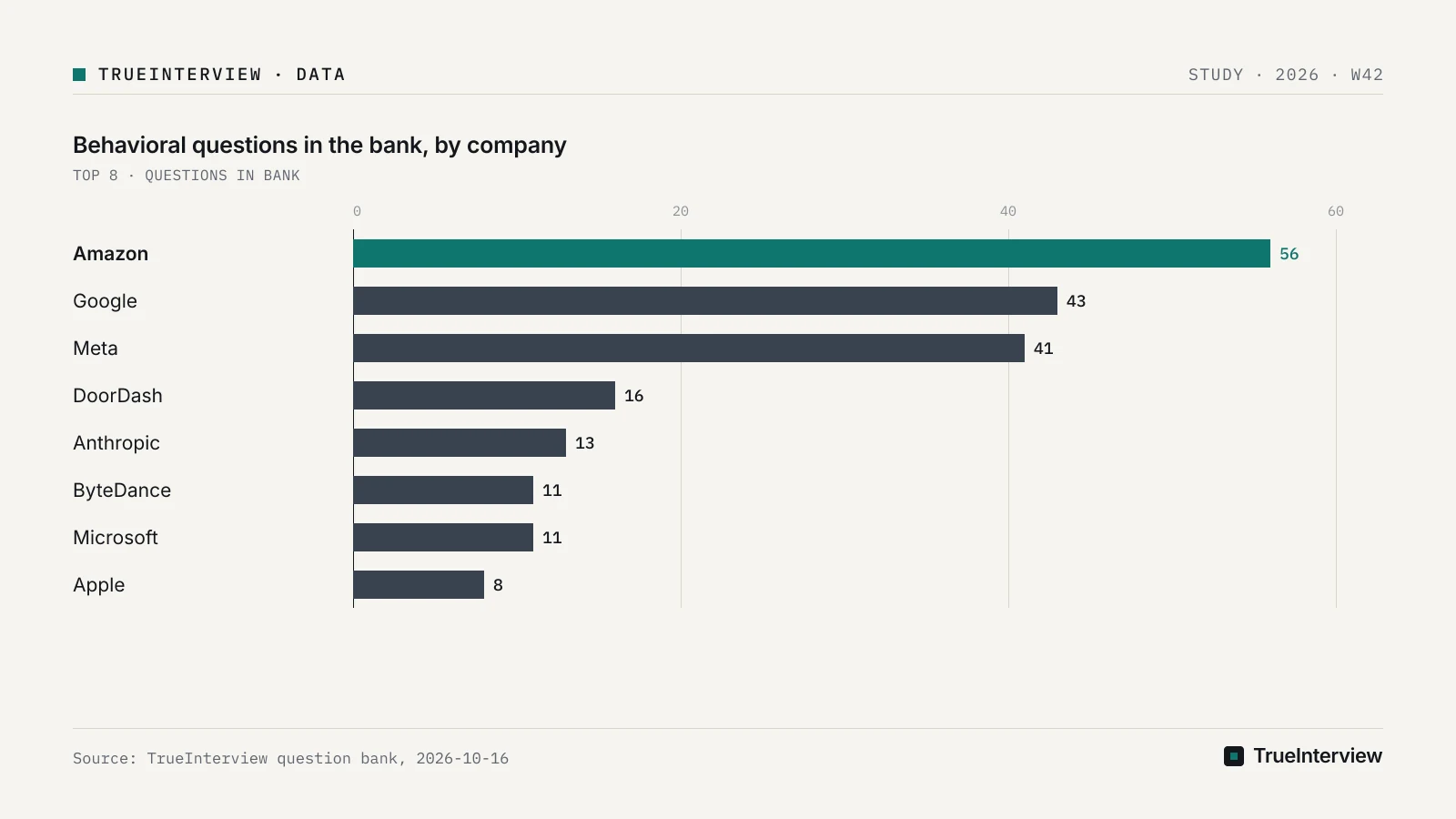
Spend most of your hours on past-situation stories: 231 of the 280 questions are behavioral and 49 are motivation. The split differs by company. Amazon's 56 questions are 53 behavioral and 3 motivation, Google's 43 are 39 and 4, and Meta's 41 include 39 behavioral. DoorDash stands out with 6 motivation questions among its 16.
If DoorDash or an AI lab is on your list, write the motivation answer as carefully as a behavioral story. Do not read a trend into the motivation share: it moved from 29% to 23% to 34% to 18% across the last four quarters, so treat it as quarter-to-quarter movement, not a change in what companies care about.
What would we skip?
Skip the long generic question lists, brain teasers and polished hero stories. Amazon says it avoids brain teasers in its interview process, and the ranked table shows candidates reporting company frames, not puzzles. A long generic list spreads your hours evenly, while candidate reports concentrate on each company's named frame.
Skip the fake weakness too. PracHub's guide warns that a "biggest failure" of working too hard makes the interviewer discount everything else you say. Amazon says it is interested in "genuine experiences and learning moments, not perfect answers." An Amazon Bar Raiser adds that candidates are not expected to score high on every principle. For a missed-deadline story, PracHub's guide puts the real failure in surprising people, not in missing the date. Tell the version where you flagged the slip early.
Worked example: an Amazon story map
Take Amazon, the company with the most behavioral questions filed in the bank: 56, nearly all behavioral. The Leadership Principles set and the GenAI Usage set are the two Amazon sets in the ranked table, so a senior candidate needs stories for both before the phone screen.
Build the map one principle at a time. For Customer Obsession, Amazon's interview page asks for "specific examples of how you've put customers first, even when it wasn't the easiest path." For Ownership, Amazon advises focusing on challenges beyond your role or projects finished despite obstacles. Amazon's page says to prepare multiple examples for each principle. Then add one GenAI story with its three parts: how you used the tool, where it failed and the trade-off you set. Write each story in STAR, put a metric in the Result, keep the Action personal and close with the Improvement step.
How we counted
TrueInterview files each candidate-reported behavioral question by company, round, month and the level the candidate reported; these are reconstructed for practice and are not any company's official question list. Of the 280 questions, 225 were last reported within the 12 months before 2026-10-16. Counts measure what candidates reported, not how often a company asks a question, and link totals by quarter mostly reflect how many write-ups were collected, so compare shares, not totals.
FAQ
Are behavioral questions asked in the phone screen or only onsite?
Both. The bank has almost as many behavioral questions reported in phone screens as onsite, and three of the ranked sets were last reported in phone screens (see the phone-screen section above). Treat the recruiter or phone-screen call as the first behavioral round and have your core stories and a company-specific motivation answer ready before it.
Should I use STAR or STAR-L?
Either works if you keep the Action personal and end with what changed. PracHub's guide adds Learnings to STAR, and an Amazon Bar Raiser adds an Improvement step for Amazon loops. For Amazon, the Improvement framing is a reasonable choice given where it comes from; elsewhere, a short closing line on what you now do differently does the same job.
How many stories should I prepare?
PracHub's guide recommends writing one story per category rather than one per question. For Amazon, the company's own advice is multiple examples per principle, covered in the worked example above. In practice, a senior candidate covers most reported sets with a compact story bank: conflict, failure, influence without authority, an owned metric, a GenAI story and a mission answer, each tagged to the target company's frame.
Are these the questions companies officially use?
No. Every set in the ranked table is a candidate-reported question, reconstructed for practice from interview write-ups (see How we counted). Companies such as Amazon do publish the frame they evaluate against, and that published frame is what you should prepare to, using the reported sets to see how candidates say it shows up in each round.
Do junior or new-grad candidates get the same behavioral questions?
Largely the same sets, with a lower bar. Google's Googliness round is the most even split between senior and junior links in the ranked table, so it is the best starting point for an early-career candidate. Our view: junior candidates can answer at task scope, while senior candidates should show team or cross-team scope and owned results.
Your practice plan
A three-week plan for someone working full time, at a few evenings a week:
- In the first two evenings, write your target company's named frame on one page and list which of the ranked sets it files, starting with Leadership Principles Standard Set for Amazon or Behavioral Round (Googliness Themes) for Google.
- Draft five or six core stories and tag each to an item in that frame; rewrite each so about half is your own action and the Result carries a metric.
- Before your first recruiter or phone-screen call, rehearse two stories aloud plus a company-specific motivation answer using Recruiter / HR Screen.
- In the second week, draft one GenAI story covering how, failure and trade-off, and practise it against GenAI Usage (How / Failure / Tradeoff).
- Pick your strongest project and run it through Behavioral Deep Dive: Owned Project Metrics, Fast Decisions, Feedback, and Conflict until you can defend it several follow-ups deep.
- If you are interviewing at staff level, work through the Behavioral / BQ Question Pack; if an AI lab is on your list, prepare the HM BQ, Why OpenAI / AI Safety / AGI answer.
- In the third week, do timed mock answers of two to three minutes each and cut any story that does not change how you operate by the last line.
Sources
- TrueInterview question bank — behavioral at big-tech companies — counted 2026-10-16
- An interviewer dives deep on Amazon's 16 Leadership Principles — checked 2026-10-16
- Amazon recruiting manager shares tips for a successful interview — checked 2026-10-16
- Interview advice – 10 ways to excel in your AWS in-person interview– Life at AWS — checked 2026-10-16
- The 30 most common Software Engineer behavioral interview questions | Tech Interview Handbook — checked 2026-10-16
- 15 FAANG Behavioral Interview Questions (And How to Actually Answer Them) | PracHub Knowledge Hub — checked 2026-10-16
- Amazon’s Leadership Principles: Interview strategies from a manager — checked 2026-10-16
Last reviewed: 2026-10-16.