Mongodb · Study
MongoDB Interview Process & Questions
TrueInterview
September 4, 2026 · 8 min read
MongoDB's technical screen is usually one problem for the whole call, and the problem looks like a piece of a database: a binary decoder, an iterator over sorted streams, a nested-JSON walk, a predicate-tree evaluator. Grading continues after the code works: interviewers ask you to trace inputs, write your own tests, and extend the solution. The documented rejection came from messy implementation under time pressure, not from the wrong approach.
This guide breaks down each stage of the MongoDB interview, what interviewers evaluate in each round, and how to prepare, with questions candidates were actually asked.
Verified: Based on 6 candidate-reported interview experiences, cross-checked against recent public accounts.
MongoDB interview process
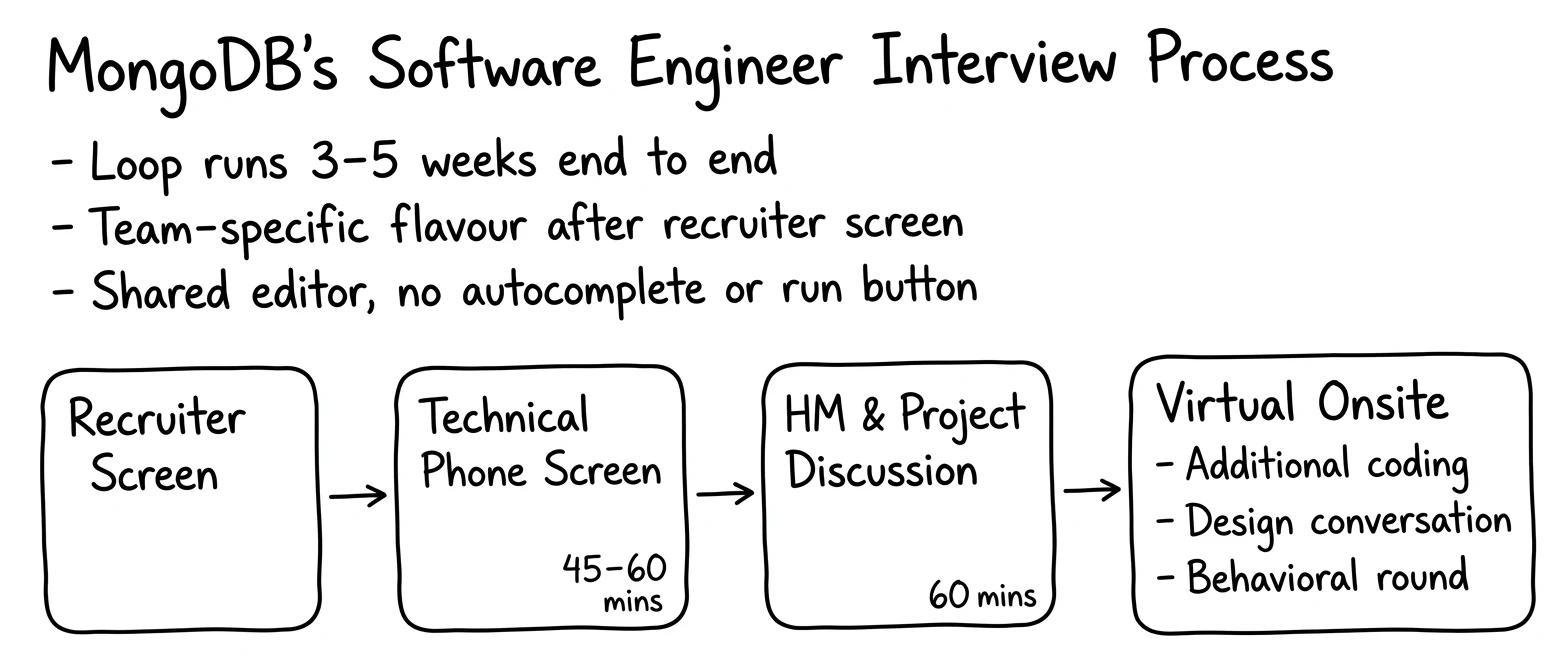
Named engineering teams (server query, storage, Atlas, search) hire directly, and the team shapes the content: core database teams lean toward systems programming and concurrency, cloud teams toward standard service design. The loop typically runs four stages over three to five weeks.
Junior and mid-level candidates are often screened by an outside interviewing service with shorter practical problems; every 2026 report instead describes a MongoDB engineer and one prompt for 45 to 60 minutes. Senior loops typically add system design and may include a director conversation.
Here's what the interview process can look like:
- Recruiter screen: A roughly 30-minute call on background, languages, location and why MongoDB.
- Technical phone screen: A 45–60 minute live coding call, usually one systems-flavored problem with follow-ups and self-written tests.
- Hiring manager interview: A typically hour-long project deep dive that often gates the onsite.
- Onsite coding interviews: Typically two rounds of practical coding, often touching concurrency or streaming.
- System design interview (mid-level and above): Distributed-systems design that rewards knowledge of replication, sharding and storage.
- Behavioral interview: Ownership, conflict and ambiguity, framed around the company's published values.
Tip: Keep the last ten minutes of every coding call for tracing and tests. Interviewers asked for both on completed problems, and the documented rejection ran out of time mid-debug.
Recruiter screen
The recruiter covers background, languages, location and the team behind the requisition. Ask which team it is: server, storage, Atlas or search decides how much systems depth follows. Candidates are also asked to contrast document and relational databases briefly.
Interviewers evaluate:
- Team fit: C++ or Rust for server roles, Java or TypeScript for Atlas and search services.
- Motivation: One specific reason for MongoDB, not databases in general.
- Level signal: Whether your recent scope fits the requisition's level.
Prepare a two-minute summary and one concrete reason for the team.
Sample questions for the recruiter screen
Here are some questions reported by recent candidates:
-
Tell me about yourself. Why MongoDB, and why this team?
-
How does a document database differ from a relational one?
Technical phone screen
Every 2026 report describes a single coding call of 45 or 60 minutes. After brief introductions, sometimes with a few questions about your projects, the interviewer gives one problem in a shared editor and watches, asking clarifying questions. No report mentions a warm-up. The prompts are components: a union iterator over two sorted iterators, a recursive decoder for a binary protocol with nested messages, a search for every value under a key in nested JSON, an evaluator for EQ/GT/AND/OR predicate trees. One round used a classic hard problem instead (bitmask dynamic programming).
Constraints are the point. One iterator round allowed at most one cached element per source and ruled out collecting into a list; another required lazy has_next() and next(). Specs can arrive in stages: the parser candidate got new field types and nesting rules mid-call. Follow-ups extend the same code: an infinite iterator, K iterators (a min-heap, O(log K) per next(), O(K) space), stack overflow on very deep JSON.
Interviewers evaluate:
- Constraint compliance: A merge-then-deduplicate answer ignores the stated memory bound.
- Offset discipline: Each recursive parse returns the node and bytes consumed, with bounds checked before every read.
- Self-testing: Unprompted cases: both inputs empty, one empty, all duplicates, heavy interleaving, keys mapped to null.
- Extension reasoning: Two inputs to K, finite to unbounded, complexity stated aloud.
- Use of hints: On the bitmask problem, step-by-step hints that never became working code still cost the round.
Practice each family as a timed 45-minute build that ends with a walkthrough on a concrete input.
Note: The rejected parser candidate was told the approach was sound. They polished a multi-byte integer helper early, rushed the nesting logic, and ran out of time on an off-by-one in nested offsets. Fix such bugs in place; do not rewrite.
Sample questions for the technical phone screen
Here are some questions reported by recent candidates:
-
Merge two sorted iterators without duplicates, caching one element per source, then handle an infinite input and K inputs.
-
Decode little-endian integers, length-prefixed strings and tagged nested messages from a byte buffer as the format grows mid-call.
-
Return every value stored under a key anywhere in nested JSON objects and arrays.
-
Evaluate a SQL-like condition tree of EQ, GT, AND and OR nodes recursively.
-
Union Iterator for Two Sorted Iterators (Dedup, Streaming, O(1) Extra Space)
Hiring manager interview
Typically an hour on what you built, what you decided, what broke, and how you handled conflict and ambiguity. It usually gates the onsite. In one 2026 screen a project discussion ran straight into the coding prompt, so be ready to switch without a pause.
Interviewers evaluate:
- Decision ownership: The trade-off you chose, what you rejected, and why.
- Failure handling: A specific incident and what you changed afterwards.
- Team relevance: Concurrency, storage, query processing or cloud services, depending on the team.
Pick one project you can explain down to a trade-off and a failure.
Onsite coding interviews
The onsite is typically three to four back-to-back virtual sessions, two of them coding. Problems stay practical: build a component, then extend it. Database teams typically add concurrency, such as a crawler that caps in-flight fetches and never visits a URL twice. Classic hard problems also appear.
Interviewers evaluate:
- Concurrency correctness: Bounded workers, a safely shared visited set, clean shutdown when work runs out.
- Laziness: Yielding results one at a time instead of materializing inputs.
- Code clarity: State and names that survive the interviewer's extension.
Practice one concurrency problem until locking and termination logic is automatic.
Sample questions for the onsite coding interviews
Here are some questions reported by recent candidates:
-
Pair two arrays to minimize the sum of pairwise XORs, using DP over a bitmask of used elements.
-
Crawl from a start URL with a fixed concurrency limit, visiting each URL once.
System design interview
Mid-level and senior loops typically include one round on distributed systems and trade-offs at scale. Replication, sharding, consistency and storage behavior under load pay off; server teams push into storage engines. Candidates have also been asked how they would diagnose a slow database.
Interviewers evaluate:
- Data-model reasoning: Document shape, indexes and shard keys driven by access patterns.
- Failure modes: Primary failover, partitions and replica lag.
- Operational diagnosis: From a slow-query symptom to evidence (plans, locks, resource limits) before fixes.
Review replica sets, sharding and indexing, and rehearse a slow-query diagnosis step by step.
Behavioral interview
This round typically covers ownership, collaboration and conflict, framed by MongoDB's published values: own what you do, think big, embrace differences, build together, make it matter. "Build together" puts commitment ahead of consensus, so disagree-then-commit stories fit well.
Interviewers evaluate:
- Ownership: Problems followed through beyond your assigned scope.
- Collaboration: Cross-team work, such as engineering with security, to fix a customer issue.
- Disagreement: Arguing your case, then committing.
Prepare five or six recent stories, each with a measurable outcome.
How MongoDB makes hiring decisions
Feedback is typically combined after the onsite, and the hiring manager of the owning team makes the call; senior candidates may also meet a director. Level follows the requisition and the scope of your past work. The rejected screen's feedback focused on code cleanliness and debugging under pressure, so execution is scored, not just reaching an answer. The reports do not document cooldowns or decision times.
How to prepare for the MongoDB interview
- Rehearse the full hour on one prompt: Code for 45 minutes, then trace an input and list edge cases unprompted.
- Fix a parser signature early: Buffer and offset in, node and bytes consumed out, bounds checked on every read.
- Write iterators that hold state: One cached element per source, then a K-way heap version.
- Honor the memory constraint literally: If buffering is banned, never build a list, even to deduplicate.
- Keep helpers minimal: Save time to fix off-by-one errors in place.
- Keep bitmask DP warm: Practice turning a hint into code immediately.
- Learn the product: Replication, sharding, indexing and slow-query diagnosis feed the design round.
About working at MongoDB
MongoDB builds a document database and Atlas, the managed cloud service around it, including search and vector search. Each engineering team owns one area, such as the query language, storage or an Atlas service. The server is largely C++; newer storage and search services also use Rust and Java.
| Level | Primary focus | Impact scope |
|---|---|---|
| Software Engineer 2 | Delivering scoped features with guidance | Tasks within one team |
| Software Engineer 3 | Owning components end to end | One team's systems |
| Senior Software Engineer | Leading designs in complex or distributed systems | A team and its neighbors |
| Staff Engineer | Technical direction across a product area | Several teams |
MongoDB hires engineers across its database and cloud products. Teams include:
- Server Query: The query language and each query's path from parsing through plan selection to execution.
- Query Integration: Mainly C++, with JavaScript and Python test infrastructure.
- Storage Layer Services: Multi-tenant cloud storage control-plane services for Atlas.
- Atlas Search: Full-text and vector search query processing and its distributed systems.
Experience and education requirements
Postings ask for a computer science degree or equivalent experience and strong data structures and algorithms. Senior roles typically require five or more years building distributed, concurrent or stateful backend systems. Server teams prefer C++ or Rust, though some say C++ is not required; search and Atlas teams name Java, Go, Rust and TypeScript.
FAQs about the MongoDB interview
How long does the MongoDB interview process take?
Typically three to five weeks from recruiter screen to decision.
What is the hardest round of the MongoDB interview?
The technical phone screen: one problem, no warm-up, a spec that can change mid-call, and tested, clean code due within 45–60 minutes.
Is the MongoDB coding interview LeetCode-style?
Mostly not. Five of six reported coding calls were practical components; one was classic bitmask dynamic programming.
What language should I use?
Any mainstream language works; Python appears in the reports. Server teams work in C++, so byte-level and memory reasoning helps in any language.
Is the MongoDB interview remote?
The phone screens are remote, and the onsite is typically held as a virtual loop.