Microsoft · Study
Microsoft Software Engineer Interview Process
TrueInterview
July 24, 2026 · 14 min read
Microsoft hires Software Engineers into a specific team, and that team writes its own loop: one candidate sat four phone rounds and no onsite, another a five-round onsite with a code review, a principal-level candidate eight rounds including an AI fluency interview. What stays constant is the blend. Most technical hours open with 10 to 15 minutes of behavioral questions, coding problems grow through follow-ups that change the dimension (single-threaded to concurrent, one machine to sharded), and the grade depends on reaching those later parts with running code.
This guide breaks down each stage of the Microsoft Software Engineer interview, what interviewers evaluate in each round, and how to prepare, with questions candidates were actually asked.
Verified: Based on 56 candidate-reported interview experiences, primarily from 2025 Q4 through 2026 Q3, cross-checked against recent public accounts.
Microsoft Software Engineer interview process
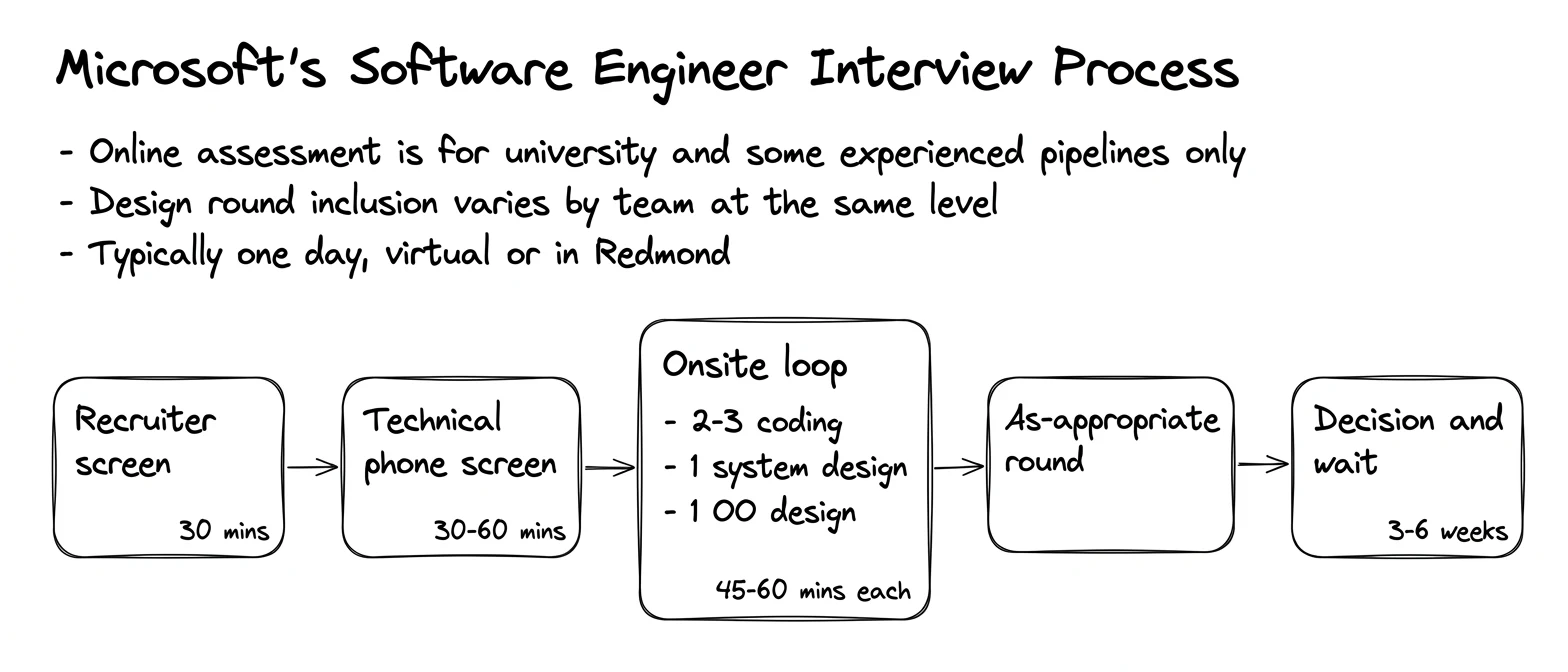
Candidates arrive through a cold application or a referral, then a recruiter or hiring-manager call about level, team and logistics. Some pipelines send an online assessment; others go straight to one to four technical screens. The final loop is usually three to five rounds of 45 to 60 minutes, held virtually on a single day, and some teams skip it entirely.
Early-career loops are mostly coding with behavioral openers, though system design reached several of them. Software Engineer II loops add a low-level design or concurrency round and usually one system design round. Senior loops open with an hour-long hiring-manager deep dive, and a principal loop ran three behavioral rounds, two design rounds and an AI fluency round.
Here's what the interview process can look like:
- Recruiter or hiring-manager screen: A short call on background, team and logistics; some recruiters name a language and focus areas, others give no guidance.
- Online assessment (some pipelines): Two auto-graded problems, each turning on one insight.
- Technical phone screens (one to four): 30 to 60 minutes of resume deep dive plus one or two coding problems, sometimes a design discussion.
- Coding interviews (two or three): A behavioral opener, then a multi-part problem with follow-ups.
- Low-level design and concurrency interview (most mid-level loops): Build a working component, then make it thread-safe or extend it.
- System design interview (one or two): Requirements, API, schema and the concurrency hazard at the center.
- AI-assisted coding round (some teams): Debug or extend a supplied project with an assistant, or review AI-generated code.
- Hiring manager interview: Ownership, judgment and level calibration; it can decide the outcome alone.
Tip: Ask the recruiter, in writing, for each round's focus and whether an AI assistant is allowed. A candidate with no agenda met a 30-minute screen holding both a graph problem and a web-crawler design, and a recruiter's warning that rounds would expect an AI agent turned out not to hold.
Online assessment
Not every pipeline uses one; early-career candidates see it most. It is a timed, auto-graded set of two problems, with one reported sitting at 90 minutes. Problems look modest but hinge on one observation: whether some contiguous block of a permutation is exactly 1 through k (track the span of positions), the next smaller-or-equal price with a monotonic stack, every valid clock time from four digits, or the X below 2^N maximizing (A XOR X) times (B XOR X). Harder sittings added a shortest path where fuel price varies by city.
A failed first attempt is not always final: one candidate got a second attempt and reached interviews about a week later. Some postings on AI teams used a PyTorch build instead: a tiny next-token model trained until its loss fell.
Interviewers evaluate:
- Spotting the reduction: Checking every subarray for every k times out; the span observation is the intended solution.
- Bit manipulation under time: Candidates named the XOR product as the problem that consumed their sitting.
- State design in graphs: Plain shortest path fails the fuel problem; the state must include what you carry.
- Integrity: A candidate who pasted assistant-generated code into a proctored sitting hit a time limit and expected the attempt to be void.
Practice permutations, monotonic stacks, bit manipulation and stateful shortest paths, two problems per 90 minutes.
Sample questions for the online assessment
Here are some questions reported by recent candidates:
-
Given a permutation of 1 to n, report for every k whether some contiguous subarray holds exactly 1 through k.
-
Find the cheapest trip between two cities when each road burns fuel and each city sells fuel at its own price.
Technical phone screens
Screens run 30 to 60 minutes in a shared editor, and the resume block is not a warm-up. One hour-long screen spent 30 minutes questioning every project line, then left about 25 minutes, with a hard stop, for a keyed task executor: same-key tasks in order, at most four running, at most 1,000 queued, and a timed shutdown. The problems are usually classic: top K largest with a heap, cycle detection in a prerequisite graph, reverse level-order printing, a calculator with parentheses.
Teams that skip the onsite run two to four screens as the whole loop. One offer-winning loop had a screen with no new code: how the candidate debugs, handles production errors and refactors during review.
Interviewers evaluate:
- Concise project answers: Tight deep dives bought coding time; long answers silently shrink the problem window.
- Ownership in the resume: Your role, the reasoning behind each choice and how impact was measured.
- A complete baseline: One interviewer said a working longest palindromic subsequence was enough; others wanted the optimal bound.
Rehearse a two-minute version of each project, then solve one medium problem in 25 minutes without a compiler.
Note: One candidate got an org-chart reports-count problem in the first screen and a performance version in the third, sensed the interviewer wanted a specific restructuring rather than caching, and ran out of time. Ask for calibration as soon as an optimization discussion feels off target.
Sample questions for the technical phone screens
Here are some questions reported by recent candidates:
-
Given manager-to-report pairs, count everyone under a person, then keep counts correct as reports are added or reassigned.
-
Count ordered pairs of positive integers whose reciprocals sum to one over N factorial, for N up to a million.
-
Implement a task executor with submit and a timed shutdown under per-key ordering and global limits.
Coding interviews
The loop usually has two or three coding rounds; most open with about 15 minutes on collaboration, a failure or a trade-off. Problems are familiar with the twist in the follow-up: a search-tree lowest common ancestor that must then work on any binary tree, an integer palindrome check without strings followed by the next larger palindrome, a spiral matrix followed by counter-clockwise order. Multi-stage problems are common: a DNA task grew from sorting fragments, to locating them in a reference string, to collecting all non-overlapping occurrences. Parsing recurs: stripping C++ comments around string literals, or a CSV engine with escaped quotes.
Code quality is graded. Extracted helpers and dummy nodes drew explicit praise, and one interviewer asked a candidate who reversed half a linked list to restore it, because callers do not expect their data mutated.
Interviewers evaluate:
- Reaching the last part: A candidate who only described the third DNA stage believed it caused the rejection; another interviewer had five follow-ups the candidate never reached.
- Edge cases stated before coding: Single-row and single-column matrices called out up front were credited as rare.
- Honest complexity: An ordered dictionary proposed for an O(1) cache was challenged on its hidden ordering cost.
- Transferring a solution: Switching from the search-tree property to a general post-order traversal without restarting.
Practice each classic problem with two follow-ups (generalize the input, add concurrency or streaming), finishing the base in 20 minutes.
Note: Time is usually lost in the base version, not the follow-ups. A senior candidate's CSV engine stalled on escaped quotes and never reached aggregation; another explained a max-min path so long that the code went unfinished. Budget each phase aloud.
Sample questions for the coding interviews
Here are some questions reported by recent candidates:
-
Read several character streams and return everything before a stop token that may be split across stream boundaries, without buffering whole streams.
-
Check whether an integer is a palindrome without converting it to a string, then find the smallest larger palindrome.
-
Find the grid path that maximizes its minimum cell value.
Low-level design and concurrency interview
Most mid-level loops include a round where you build a small component in working code, then defend it as constraints pile on: a logger that suppresses messages past a count per window, a sliding-window rate limiter, an LFU cache with frequency ties, an idempotent API keyed by request, a key-value store readable as of any snapshot, a hashmap with chaining and resizing.
Concurrency appears even for candidates outside systems roles: a thread-safe LRU cache (global lock, then segmented locks, and whether it is still strict LRU), striped locking that survives resizing, a lock letting same-type tasks run together while excluding other types, built on a condition variable. One Software Engineer II round ended with reviewing a C++20 producer-consumer queue for races.
Interviewers evaluate:
- Clarifying the rules first: Window size, threshold and tie-breaking settled before choosing data structures.
- Correct invariants: Per-key version lists with binary search for snapshot reads, frequency buckets for LFU.
- Concurrency reasoning: Lock placement, coarse versus fine-grained costs, and fairness against starvation.
- Extensibility: TTL, eviction policy and sharding added without rewriting the class.
Practice LRU, LFU, rate limiter, snapshot store and hashmap until each runs in 25 minutes, then add thread safety to each.
Sample questions for the low-level design and concurrency interview
Here are some questions reported by recent candidates:
-
Implement acquire and release for a lock where same-type tasks run concurrently but different types are mutually exclusive.
-
Build a key-value store whose reads return the value as of any earlier snapshot, then discuss space under heavy writes.
System design interview
Most loops have one design round and senior loops two; it also reached a 30-minute screen and several early-career loops. The standard family centers on one hazard: booking without double-booking, a URL shortener pushed to multi-region routing and a dead-letter queue for write spikes, an ETL job scheduler with exactly-once semantics, a payment system with idempotency and reconciliation, a to-do app probed on authorization, 500 requests per second, stale cache and API versioning.
Teams close to AI products bring product prompts: resuming past chatbot conversations with personalization, re-engaging dormant assistant users by detecting reminders in chat history, a sports news recommender graded mostly on retrieval grounding and hallucination control.
Interviewers evaluate:
- Requirements and assumptions first: Scale, consistency needs and failure model stated before components.
- Trade-offs, not tool names: Naming a cache or queue without saying why was called out as a loss.
- The central hazard: Seat locking, idempotency keys or quorum reads handled explicitly in the data model.
- Breadth before depth: A senior candidate spent too long on reminder detection and shortchanged the data model and scaling.
Practice booking, shortener, scheduler and messaging designs with capacity numbers, plus one product-AI design covering retrieval, latency and safety.
Tip: Know one well-known system's internals deeply. A candidate asked for a Kafka-like log was pushed on leader re-election and exactly-once delivery, and another lost ground comparing queues for hot live-comment streams.
Sample questions for the system design interview
Here are some questions reported by recent candidates:
-
Design a ticket platform where each ticket surfaces the user's related tickets and pulls downstream system state around the incident.
-
Design a re-engagement system for an AI assistant with frequency capping and an experiment framework.
-
Design a High-Concurrency Incident Ticket Correlation Platform
AI-assisted coding round
Some teams now add rounds built around AI tools, and their content varies widely. One loop paired a coding-with-AI round (unpack a project archive, debug it, add disk persistence to an in-memory store, explain the generated code) with a coding-without-AI round building a single-flight component that collapses bursts of identical requests to a model service. Another moved from designing a URL shortener to coding it and then reviewing AI-generated code for it. Elsewhere, rounds titled after AI coding agents were ordinary algorithm problems with a local assistant optional, despite the recruiter saying it was expected.
Interviewers evaluate:
- Code that runs: A rejected candidate traced the outcome to code that did not execute in the AI round.
- Understanding generated code: Explaining every line the assistant wrote and why it is correct.
- Critical review: Finding races, unsafe hash truncation and missing validation in confident-looking code.
- Judgment about AI use: How you verify output and where assistants have failed you.
Rehearse extending a small unfamiliar project with an assistant in under an hour, running tests after every change.
Sample questions for the AI-assisted coding round
Here are some questions reported by recent candidates:
-
Debug a supplied project, then persist its in-memory data store to disk, explaining the assistant's output.
-
Review AI-generated URL-shortener code and list its correctness, security and performance defects.
Hiring manager interview
The manager's round is a behavioral and judgment conversation, sometimes with a light technical segment; at senior level it can open the day as an hour on ownership, ambiguity and influence without authority. Common prompts: the best-designed system you worked on, a design decision you regret, disagreeing with a product manager, ramping up in an unfamiliar domain. Some loops keyed each round to a named competency such as drive for results or influence for impact, and follow-ups probe hands-on detail.
Interviewers evaluate:
- Scope matching the level: A candidate rejected for a team expecting more seniority lacked cross-team impact stories.
- Evidence behind claims: A tech-debt story earned credit by citing quarterly maintenance hours shown to stakeholders.
- Disagreement handled with data: Evidence gathered, a mediator brought in, the compromise reached.
- Pragmatic judgment: A framework for whether a solution is worth building, and a small validation when benefit is unclear.
Prepare six to eight stories with numbers that flex across conflict, failure, ambiguity and regret, plus a pull request you can walk through.
Sample questions for the hiring manager interview
Here are some questions reported by recent candidates:
-
Describe a design decision you later regretted and how you convinced others to fix it.
-
Tell me about a time you moved forward with limited information or vague guidance.
How Microsoft levels and evaluates Software Engineer candidates
The hiring team owns the decision. Interviewers submit feedback, the hiring manager weighs it against the target level, and some loops end with a senior "as appropriate" interviewer whose conversation can decide the outcome. Evidence is pooled: strong coding did not rescue a senior candidate whose design ran short, and a technically sound candidate was turned down because the manager wanted more senior scope. Decisions typically take one to several weeks; reported logistics include a three-week recruiter silence and a hiring-manager interviewer who never showed up.
Tip: Watch the applicant portal. A rejection appeared there about four business days before the email.
How to prepare for the Microsoft Software Engineer interview
- Compress your resume: A two-minute version of each project with decisions and metrics, since deep dives of 15 to 30 minutes come out of coding time.
- Practice problems with follow-ups: Add a generalization, a concurrency version and a streaming version to each classic problem.
- Drill parsers: Comment stripping, quoted CSV, WHERE-clause evaluation and calculators reward a prepared state-machine approach.
- Build thread-safe components: LRU, LFU, rate limiter, snapshot store and a type-keyed lock, with lock-placement trade-offs.
- Confirm the format in writing: Ask about AI use, design rounds and language; one candidate switched from C# to C++ on request.
- Practice reviewing code: Find races and validation gaps in a producer-consumer queue and in AI-generated code.
- Prepare one product-AI design: Retrieval grounding, latency, abuse prevention and notification fatigue, alongside a classic booking design.
- Check your plan with the interviewer: Several rejections followed solutions the interviewer did not have in mind.
About the Microsoft Software Engineer role
Microsoft Software Engineers own features and services end to end inside a product group: design, code, tests, deployment and live-site support. Since late February 2026, employees near Redmond are expected in the office three days a week, with other locations phased in after.
| Level | Primary focus | Impact scope |
|---|---|---|
| 59–60 (Software Engineer) | Well-defined features with guidance | Components within one team |
| 61–62 (Software Engineer II) | Independent feature ownership and design | A team's services |
| 63–64 (Senior Software Engineer) | Technical direction, mentoring, cross-team design | Several services or teams |
| 65–67 (Principal Software Engineer) | Architecture and strategy across groups | An organization |
Microsoft hires Software Engineers across most of the company. Teams include:
- Azure: Compute, storage, networking, databases and the cloud platform.
- Microsoft 365: Office apps, Teams, Outlook and their Copilot features.
- Windows and Devices: The operating system, Surface and device experiences.
- CoreAI – Platform and Tools: Developer tools and the AI platform used across products.
- Consumer Copilot and models: The consumer assistant and in-house model work.
- Gaming: Xbox platform and game services.
Software Engineer experience and education requirements
Postings ask for a bachelor's degree in computer science or a related field, or equivalent experience, plus coding in a language such as C, C++, C#, Java, JavaScript or Python. Software Engineer II asks for about two years of professional experience and senior roles about four or more; preferred qualifications add distributed systems, cloud and AI tooling.
FAQs about the Microsoft Software Engineer interview
How long does the Microsoft Software Engineer interview process take?
Typically several weeks to two months. The onsite is often a single day; recruiter silences and cancelled rounds stretch the rest.
What is the hardest round of the Microsoft Software Engineer interview?
The multi-part coding round, because the grade depends on reaching later follow-ups with running code. For candidates who under-prepared design, system design is a close second, especially estimation and partitioning.
Can I use AI during the interview?
Only when the round says so. Some teams run AI-assisted rounds or allow an optional local assistant, while assessments and standard rounds expect your own work.
How much does a Microsoft Software Engineer make?
Approximate total annual compensation in the United States:
- Level 59: ~$165K
- Level 60: ~$185K
- Level 62: ~$210K
- Level 63: ~$240K
- Level 64: ~$275K
Packages combine base salary, an annual cash bonus and stock awards vesting over several years.