Microsoft · Study
Microsoft Machine Learning Engineer Interview Process
TrueInterview
July 24, 2026 · 12 min read
Microsoft has no single Machine Learning Engineer loop. The recruiter's first call routes each candidate to a loop built by the hiring team, so a pretraining team, a post-training infrastructure team, an ML data team and an applied science group can ask almost nothing in common. The constant is implementation: ML coding rounds are graded like software rounds, and candidates who knew the algorithm were rejected on how they kept state or pruned candidates. Breadth is the second filter: one loop ran five phone rounds and ended in rejection on a multimodal design question.
This guide breaks down each stage of the Microsoft Machine Learning Engineer interview, what interviewers evaluate in each round, and how to prepare, with questions candidates were actually asked.
Verified: Based on 8 candidate-reported interview experiences, primarily from 2026 Q1 through 2026 Q3, cross-checked against recent public accounts.
Microsoft Machine Learning Engineer interview process
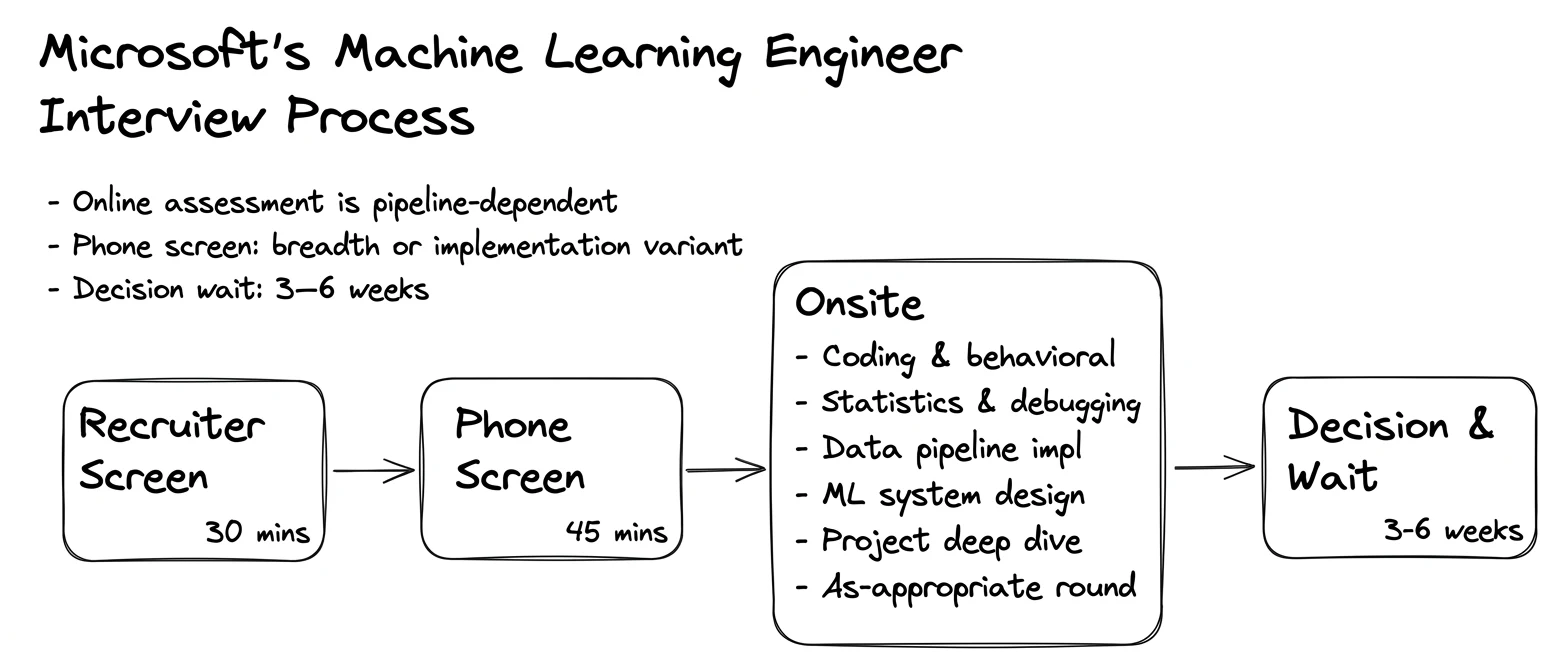
Reported loops ran from a single 45-minute screen to six onsite rounds, and most started with recruiter outreach. Training and inference groups test model code and GPU arithmetic, data teams test pipelines and data quality, and product-facing teams run a conventional mix of algorithms and system design. One pretraining loop held three conversational rounds on background and team fit before a single coding round decided it. Internships lean on ML fundamentals and hand-written classical algorithms; mid-level and senior loops add training-systems depth, end-to-end design and a project deep dive in which scope is judged.
Here's what the interview process can look like:
- Recruiter screen: A short call on background and level that decides which loop the candidate sits.
- ML fundamentals screen (applied loops): 45 to 60 minutes of rapid questions from overfitting to parameter-efficient fine-tuning.
- ML coding interviews (one to three): About 45 minutes each, implementing an algorithm or data component from scratch in Python.
- Coding and statistics rounds (some loops): Standard data-structure problems, or a hypothesis test paired with debugging a script.
- Training systems deep dive (training and inference teams): Transformer code, roofline analysis, CUDA and mixed precision in one session.
- System design interview (one or two): A product system or an ML system such as a video vision-language model.
- Project deep dive and behavioral interview: A self-chosen project turned into a case study, plus motivation, ownership and conflict.
Tip: Ask the recruiter which team and loop you are being routed to. A data loop of pipeline questions and a training loop of CUDA and roofline drills are too different to cover by preparing generically.
Recruiter screen
The first call is short and covers background, current work and level. In one recruiter-initiated loop it existed explicitly to pick which loop fit the candidate, so the description given here decides what follows. Communication afterward is uneven: one candidate learned of a rejection only by checking the applicant portal.
Interviewers evaluate:
- Lifecycle placement: Which part of the ML stack (data, training, inference or modeling) the candidate has owned.
- Level signals: Scope of past projects and decision ownership, which set the target level.
- Team alignment: Interest that matches the hiring group, such as pretraining or data curation.
Prepare a two-minute summary of your ML work organized by lifecycle stage, with one measurable result per stage.
ML fundamentals screen
Applied loops can open with a 45-to-60-minute conceptual sweep and no coding. One intern loop that ended in an offer covered overfitting prevention, precision against recall, bagging against boosting, self-attention, prompt engineering, fine-tuning and parameter-efficient fine-tuning in one call. The candidate rated it moderate but noted that coverage depends heavily on the interviewer's background.
Interviewers evaluate:
- Breadth: Moving cleanly between classical ML, evaluation metrics and language-model techniques.
- Applied judgment: Choosing a metric or regularizer for a stated situation instead of reciting definitions.
- Mechanism-level understanding: Explaining why self-attention or low-rank adapters work, not only what they are.
- Concision: Short, correct answers that leave time for more topics.
Rehearse two-minute answers on about twenty core topics, each tied to a decision from a real project.
Sample questions for the ML fundamentals screen
Here are some questions reported by recent candidates:
-
How do you prevent overfitting, and what would you try first on a small dataset?
-
Explain precision and recall and when you would trade one for the other.
-
Compare bagging and boosting, then explain self-attention and parameter-efficient fine-tuning.
ML coding interviews
This is the most common round in the reports: one problem in about 45 minutes in a shared editor, in Python with NumPy or PyTorch allowed but the core logic written by hand. The most repeated prompt is k-means from scratch, asked on a phone screen and in an onsite round, with follow-ups on vectorized distances, empty clusters, convergence tolerance, complexity, local minima and k-means++ initialization. Other teams ask for pieces of their own stack: greedy decoding extended to top-k beam paths, a data loader that checkpoints and resumes without reprocessing, stop-token detection over streamed output, and SFT sample packing with a correct mask window, answer-token positions and balanced sequences. Interviewers also watch coding style and efficiency.
Interviewers evaluate:
- State management: How candidate sequences, cluster assignments or read offsets are stored, updated and pruned.
- Edge cases: Empty clusters, a stop sequence split across chunks, a resume point mid-batch.
- Vectorization: Array operations instead of Python loops on large data.
- Domain fluency: Knowing why the component exists in a training or serving pipeline.
Implement each reported problem from an empty file and test it on awkward inputs before calling it done.
Note: A post-training infrastructure candidate who knew beam search was rejected on the phone screen: candidates had to be kept and pruned purely by score, with no beam-width parameter to lean on. The round grades the bookkeeping, not recognition of the algorithm.
Sample questions for the ML coding interviews
Here are some questions reported by recent candidates:
-
Implement k-means with NumPy, handle empty clusters, and explain how to escape poor local minima.
-
Write greedy sampling over a fixed vocabulary, then extend it to keep the top-k paths by score.
-
Build a data loader that can be interrupted and resume exactly where it stopped.
-
Detect stop tokens in streamed output, including matches that straddle chunk boundaries.
Coding and statistics rounds
Conventional coding still appears. A six-round ML data loop in Seattle opened with an LRU cache and merge intervals, each with complexity and edge-case follow-ups. A 45-minute Core AI round paired behavioral questions on AI experience with a subsets variant that took a string and required sorted output. Applied science loops can swap algorithms for statistics: one onsite round set up a hypothesis test, asked for its interpretation, then moved to fixing bugs in a short Python script.
Interviewers evaluate:
- Approach alignment: Stating the plan first and confirming it is the approach the interviewer wants.
- Correctness on edges: Touching intervals, duplicate characters, capacity-one caches.
- Statistical setup: Correct null hypothesis, test choice and plain-language interpretation.
- Debugging method: Isolating the fault from the failing behavior before editing.
Keep medium problems on caches, intervals and backtracking current alongside basic test design.
Note: The Core AI candidate finished the subsets variant and its follow-up in about ten minutes and was still rejected, apparently for not using the approach the interviewer expected. Discussing two approaches before coding costs a minute and removes that risk.
Sample questions for the coding and statistics rounds
Here are some questions reported by recent candidates:
-
Implement an LRU cache with constant-time get and put.
-
Merge overlapping intervals, including unsorted and touching inputs.
-
Generate all subsets of a string's characters and return them in sorted order.
Training systems deep dive
Teams that train or serve large models run a quantitative session. One onsite opened with a detailed resume grilling, then packed six tasks into one round: a Transformer from scratch (multi-head attention, feed-forward layers, positional encoding), a roofline analysis classifying a layer as compute- or memory-bound, matrix-multiply runtime from stated bandwidth and throughput, a CUDA kernel with correct thread indexing, the gradient through a residual connection, and FP32-to-FP16 conversion with loss scaling.
Interviewers evaluate:
- Arithmetic intensity: Turning FLOPs and bytes moved into a bound and a runtime estimate.
- Kernel basics: Grid and block indexing, bounds checks and memory movement.
- Gradient and precision reasoning: Why residual paths help, and how loss scaling preserves small FP16 gradients.
- Unassisted coding: Writing model code fluently with no autocomplete.
Work several layers through a roofline numerically and write a vector-add and a tiled matmul kernel by hand.
Tip: The candidate had to share a screen and code in a personal editor. Set up VS Code with a working Python and CUDA toolchain beforehand, then practice with completion and AI assistance switched off.
Sample questions for the training systems deep dive
Here are some questions reported by recent candidates:
-
Implement multi-head attention, the feed-forward block and positional encoding from scratch.
-
Given bandwidth and peak throughput, estimate a matrix multiply's runtime and name the limiting resource.
-
Derive the backward pass through a residual connection and explain the risks of FP16 training.
System design interview
Design questions split by team. A data-team loop ran two product rounds: a team chat platform (message routing, scale, real-time delivery) and an online board-game site (matchmaking, board state). ML-focused loops design models end to end. The five-round phone loop ended with a video vision-language model built from scratch, covering data collection, architecture, training strategy and evaluation, and was rejected. An earlier round in that loop discussed cleaning OCR-sourced text for language-model training: noise, low-quality filtering, deduplication and fitness for use.
Interviewers evaluate:
- End-to-end coverage: Data, model, training, evaluation and serving, with no stage skipped.
- Data quality: Concrete filters, deduplication and checks on what reaches training.
- Evaluation plan: Offline metrics, human review and what would signal a regression.
- Scaling decisions: Partitioning, real-time delivery and state consistency in product designs.
Prepare one product design and one model-system design end to end, each with an explicit evaluation section.
Sample questions for the system design interview
Here are some questions reported by recent candidates:
-
Design a video vision-language model from data collection through evaluation.
-
Design a pipeline to clean and filter OCR-extracted text for language-model training.
-
Design a team chat platform with message routing and real-time delivery.
Project deep dive and behavioral interview
Nearly every reported loop includes a project round, sometimes as the last one. The candidate presents a project of their choice and the interviewer turns it into a case study on design decisions, rejected alternatives and extensions. It feels collaborative, but it is where scope and seniority are judged. Behavioral questions sit in a separate round or inside technical ones and cover motivation, ownership, setbacks and conflict.
Interviewers look for:
- Personal contribution: What the candidate built and decided, separated from the team's work.
- Trade-off reasoning: Alternatives considered and the evidence behind the choice.
- Extension thinking: How the system would change with ten times the data or a new modality.
- Ownership and conflict: Specific situations, actions and outcomes rather than values.
Rehearse one project you can defend at every layer as a 10-minute case study.
Sample questions for the project deep dive and behavioral interview
Here are some questions reported by recent candidates:
-
Present a project of your choice, then explain how you would extend or redesign it.
-
Describe a time you took ownership beyond your assigned scope, and a conflict you resolved.
How Microsoft levels and evaluates Machine Learning Engineer candidates
Decisions are made by the hiring team: interviewers submit feedback and the hiring manager makes the call, sometimes after a final conversation with a senior interviewer from the wider group. The target level is set from the recruiter screen and confirmed in the project and design rounds. Decisions typically take a few weeks; at reporting time half of the loops were still waiting, including a six-round loop with no feedback.
How to prepare for the Microsoft Machine Learning Engineer interview
- Confirm the team first: Weight preparation toward data, training, inference or applied modeling once you know the loop.
- Write the classics from scratch: K-means, beam search, a resumable loader, stop-token detection and sample packing, with tested edge cases.
- Guard the state: Rejections came from pruning and bookkeeping, so trace every data structure by hand on a small input.
- Agree on the approach before coding: A fast, correct solution still failed when it was not the expected one.
- Do the hardware math: For training teams, practice roofline analysis, matmul runtime, CUDA indexing and mixed precision.
- Cover statistics: Hypothesis testing, precision and recall, and ensembles appeared beside attention and fine-tuning.
- Design end to end: Prepare a multimodal model design and a data-cleaning pipeline, each with evaluation.
About the Microsoft Machine Learning Engineer role
Machine Learning Engineers at Microsoft build and run the models behind Copilot, Bing, Microsoft 365 and Azure: pretraining and post-training infrastructure, data curation for language models, inference serving, or applied models inside a product. Some groups use the Applied Scientist title for similar work with more modeling emphasis, and the MAI group uses Member of Technical Staff titles.
| Level | Primary focus | Impact scope |
|---|---|---|
| 59–60 (Machine Learning Engineer) | Implementing features, pipelines and experiments with guidance | Own components |
| 61–62 (Machine Learning Engineer II) | Owning models or pipelines end to end | A feature area |
| 63–64 (Senior) | Leading technical design across a system | A team's ML stack |
| 65–67 (Principal) | Setting technical direction across teams | An organization |
Microsoft hires Machine Learning Engineers across teams including:
- MAI: Consumer Copilot and frontier models, including pretraining and the superintelligence team formed in late 2025.
- CoreAI – Platform and Tools: The AI platform and developer stack, including Azure AI Foundry, AzureML compute and GitHub Copilot.
- Post-training and inference infrastructure: Fine-tuning, decoding and serving systems for large models.
- ML data teams: Curation and quality pipelines for training corpora.
- Bing and Microsoft 365: Ranking, retrieval, image search and Copilot features in productivity products.
Machine Learning Engineer experience and education requirements
Postings typically ask for a bachelor's degree in computer science or a related field plus several years of coding in Python, C++, C# or Java; principal roles state six or more years, with a master's or doctorate counting toward that. Graduate degrees are preferred rather than required. Preferred skills include deploying models in production, working with large language models, and building monitoring and retraining systems. Roles require a background check.
FAQs about the Microsoft Machine Learning Engineer interview
How long does the Microsoft Machine Learning Engineer interview process take?
A single-screen process can end within days; full loops of four to six rounds typically take several weeks from recruiter call to decision, and several candidates were still waiting weeks after the last round.
What is the hardest round of the Microsoft Machine Learning Engineer interview?
The ML coding round, because correctness depends on state handling under a 45-minute clock, and all three reported rejections followed a coding or design round. On training teams, the training systems deep dive is the hardest single session.
Is there an online assessment?
None of the reported Machine Learning Engineer loops used one. They moved from the recruiter call straight to live screens in Python, with CUDA added on training teams.
How much does a Microsoft Machine Learning Engineer make?
Approximate US total compensation by level:
- 59: ~$160K
- 61: ~$215K
- 62: ~$230K
- 63–64: ~$250K–$280K
- 65: ~$410K
Packages combine base salary, an annual cash bonus and stock awards that vest over several years, with higher ranges in high-cost locations.