Microsoft · Study
Microsoft Infrastructure Engineer Interview Process
TrueInterview
July 31, 2026 · 14 min read
Microsoft hires infrastructure engineers team by team, so the hiring team writes the problems and the hiring manager makes the call. Problems follow the team's domain: storage, scheduling, messaging and concurrency, not curated puzzle lists. The defining trait is working systems code on a short clock. One screen spent 30 minutes on the resume and left 25 for a keyed task executor with a concurrency cap, a queue limit and timed shutdown. Follow-ups rarely raise algorithmic difficulty; they change the dimension, from single-threaded to concurrent, in-memory to persistent, one node to many.
This guide breaks down each stage of the Microsoft Infrastructure Engineer interview, what interviewers evaluate in each round, and how to prepare, with questions candidates were actually asked.
Verified: Based on 56 candidate-reported interview experiences, primarily from 2025 Q4 through 2026 Q3, cross-checked against recent public accounts.
Microsoft Infrastructure Engineer interview process
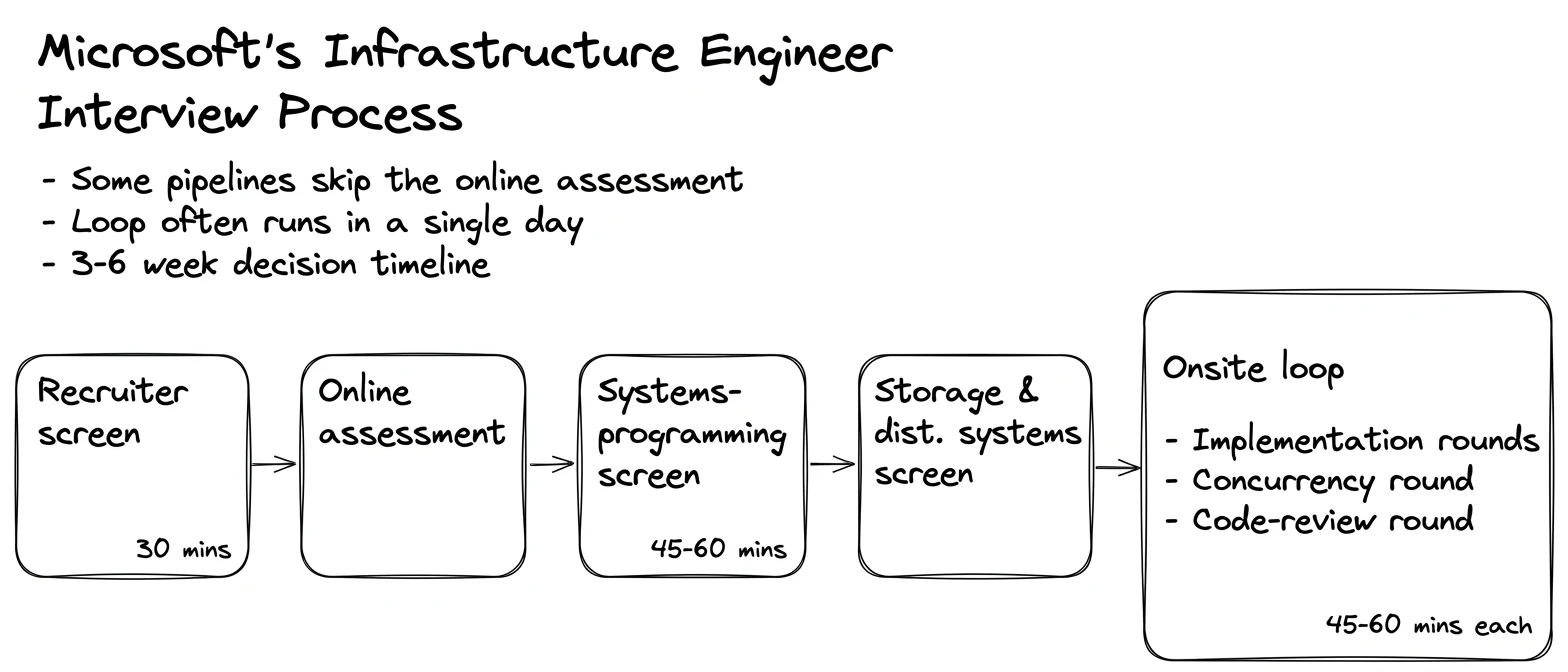
The loop depends heavily on the team. One storage-flavored pipeline ran three phone rounds before a single onsite; others go from one screen to a virtual onsite of three to five rounds of 45 to 60 minutes, and several recruiters required every onsite round to fit into one day. From first contact to a decision typically takes four to ten weeks.
Early-career loops are mostly coding, with design folded into a coding round. At levels 61 and 62 a dedicated design round is standard. Senior loops grow: one principal loop ran a phone screen plus seven onsite rounds, including two design rounds, an AI fluency round and three behavioral rounds.
Here's what the interview process can look like:
- Recruiter call: About 30 minutes on level, location, team, production experience and interview language.
- Online assessment (some pipelines): Two auto-graded problems in roughly 90 minutes, mostly for early-career candidates.
- Technical phone screens (one to three): 30 to 60 minutes, often half resume deep dive and half one hands-on systems problem.
- Coding interviews (two or three): Stream processors, parsers and data structures, usually after 10 to 15 minutes of behavioral questions.
- Concurrency and low-level design interview: Build a cache, map, lock or limiter, make it thread-safe, or review concurrent code for races.
- AI-assisted coding interview (some teams): Extend or debug a small project with an assistant, sometimes beside an AI-off round.
- System design interview (one or two): A partitioned log, a job scheduler, a replicated key-value store.
- Behavioral and hiring manager interview: Ownership, conflict, escalation and judgment.
Tip: Ask the recruiter for the language, the round titles and the AI rules for each round. Several candidates got no agenda at all; one team allowed only C#, while another let a candidate switch from C# to C++ on request.
Online assessment
The assessment is two timed, auto-graded problems in about 90 minutes; experienced candidates usually skip it. Problems are medium to hard and lean toward graphs, bit manipulation and permutation properties: minimum fuel cost between cities when the fuel price varies by city, which needs Dijkstra with fuel carried in the state; choosing X below 2^N to maximize (A XOR X) times (B XOR X); and a strength score for every node of a tree network.
Hidden tests include large inputs, so a correct but slow approach fails. A candidate who pasted an AI-generated solution hit the time limit and expected the attempt to be flagged anyway.
Interviewers evaluate:
- State modeling: Seeing that a shortest path needs extra state, such as fuel on hand.
- Bit-level reasoning: Deciding XOR problems bit by bit from the top instead of searching values.
- Structural insight: A subarray holds exactly 1 to k only when its length and maximum both equal k.
- Performance: Linear or near-linear solutions that survive hidden large inputs.
Practice graph-with-state, bitwise greedy and tree DP problems in timed 45-minute blocks without assistance.
Sample questions for the online assessment
Here are some questions reported by recent candidates:
-
Given roads with fuel costs and a per-city fuel price, find the cheapest trip from A to B when fuel can be bought anywhere.
-
For each k, decide whether some contiguous subarray of a permutation is exactly a permutation of 1 to k.
Technical phone screens
Screens run 30 to 60 minutes with an engineer or manager from the hiring team, and many open with a resume deep dive that can take half the session. The technical half is usually one hands-on systems problem: the bounded keyed executor; a lock where same-type tasks run together but different types exclude each other, built on a mutex and condition variables; a key-value store that reads any key as of any past snapshot; or a SQL-style WHERE filter over rows given as maps.
Storage-flavored screens are closer to design conversations: a two-node redundant store exposing single-byte read and write, compared under mirroring and parity; a distributed key-value store with consistent hashing, quorums and stale-read detection; and verifying coordinates in a huge file of store records with as few calls as possible to an expensive geocoding API.
Interviewers evaluate:
- Stated invariants: Per-key ordering, a global cap, snapshot visibility or type exclusivity, said aloud before coding.
- Primitive choice: Which lock, condition or queue, and why; fairness and starvation follow.
- Trade-off depth: Space overhead of per-key version lists and how reads scale under different write patterns.
- Cost awareness: Grouping by ZIP code and caching by city so the cheapest API call is the one never made.
Rehearse a keyed executor, a type-exclusive lock and a versioned store until each runs correctly in 20 minutes.
Note: The clock is how most candidates fail here. The executor candidate asked whether the problem fit in 20 minutes and got no answer. Keep resume answers to two minutes per project, then propose a time split before coding.
Sample questions for the technical phone screens
Here are some questions reported by recent candidates:
-
Implement submit and shutdown for an executor where same-key tasks run in order, at most 4 run at once, queued plus running tasks never exceed 1000, and shutdown waits for in-flight work up to a timeout.
-
Design a two-node redundant store, then handle a node dying mid-write and rebuilding its replacement.
Coding interviews
The onsite has two or three coding rounds of 45 to 60 minutes, often in one day. Problems are mini-systems: medium in algorithmic content, hard in implementation detail. Reported prompts: bucket an endless timestamped stream into fixed windows and report each window's minimum and maximum; strip comments from C++ source while leaving markers inside string literals alone; return everything before a stop token that may straddle two input streams, without buffering; sort unique integers up to 32,000 from a stream with a bitmap of about 4 KB; and a CSV query engine where quoted fields and escaped quotes ate most of the clock.
Multi-part problems are common. A DNA-fragment problem escalated from chaining fragments by tags to matching in either orientation to finding several independent chains; the candidate only described the last part and was rejected.
Interviewers evaluate:
- State-machine discipline: Explicit code, comment and literal states instead of chained string searches.
- Partial-match handling: Resetting state after a mismatch mid-token, the bug that sank one stop-token round.
- Testing small cases unprompted: Empty input, a token at position zero, a token split exactly at a boundary.
- Side effects: One interviewer asked a candidate to restore a linked list the function had mutated.
Practice parsers and streaming problems under a timer, budgeting 20 minutes for the base case so the follow-ups get time.
Sample questions for the coding interviews
Here are some questions reported by recent candidates:
-
Group timestamped values into five-minute windows and emit each window's minimum and maximum, then handle empty windows and late events.
-
Read unique numbers from 0 to 32,000 through a getter and write them sorted with minimal memory, then allow duplicates or a larger range.
Concurrency and low-level design interview
Most infrastructure loops build a structure and then make it safe. An SDE II loop built a hashmap with chaining and resizing, then made it concurrent with striped locking and discussed what resizing does to the stripes. An LRU cache went from a global lock to segmented locks, and the candidate was credited for admitting that segmented LRU is only approximate; TTL expiry and consistent-hash sharding followed. Other prompts: a logger that suppresses messages over a count per window, a sliding-window limiter, and an idempotent API keyed by request ID.
The round can also be a code review: one candidate found races in a C++20 producer-consumer queue and refactored it, and another discussed API versioning and deprecation after an object-oriented exercise.
Interviewers evaluate:
- Lock granularity: Coarse versus striped versus per-entry locking, and the cost of each.
- Honest trade-offs: Saying when concurrency weakens a guarantee.
- Race spotting: Missed notifications, unlocked reads and shutdown paths in someone else's code.
- Code structure: Small helpers and sentinel nodes; one interviewer explicitly praised extracted helpers.
Take an LRU cache, a hashmap and a rate limiter from single-threaded to striped locking, then review a bounded queue for races.
Sample questions for the concurrency and low-level design interview
Here are some questions reported by recent candidates:
-
Build a hashmap with collision handling and resizing, then support concurrent access with striped locks.
-
Review a C++20 producer-consumer queue for race conditions and explain how to make it correct.
AI-assisted coding interview
Since 2026 some teams add rounds titled around AI coding, and practice varies by team. In one loop the AI round supplied a small project as an archive: debug it, add persistence of its in-memory store to disk, and explain the generated code. The next round was AI-free: a single-flight component collapsing bursts of identical calls to an LLM service, written in a browser-based editor. The code did not run, and the candidate believed that cost the offer. In another loop, two rounds billed as AI-agent rounds were ordinary algorithm problems with an optional assistant, although the recruiter had said AI use was expected.
Interviewers look for:
- Verification habits: Reading and testing generated code before accepting it.
- Ownership: Explaining every generated line as your own.
- Running code: A feature that executes beats a cleverer one that does not.
- Durability reasoning: Atomic writes and crash recovery for persistence tasks.
Rehearse extending an unfamiliar small codebase with an assistant in 45 minutes, narrating what you check.
Note: Do not infer the format from the round title. Ask whether AI is allowed, whose machine you use and whether code must execute, and prepare for both modes.
Sample questions for the AI-assisted coding interview
Here are some questions reported by recent candidates:
-
Without AI, implement a single-flight component so concurrent identical requests share one in-flight call and its result.
-
Review AI-written URL-shortener code for synchronization, hash-truncation and input-validation defects.
System design interview
Loops carry one or two design rounds with infrastructure-shaped prompts: a partitioned-log messaging system, pressed on broker crash, leader election, in-sync replicas and exactly-once delivery; a job scheduler for an ETL pipeline; a payment system spent on idempotency, reconciliation and retries without a distributed lock; a typeahead service with sharding and near-real-time updates; and a rate limiter at 100,000 requests per second. Principal loops asked for a distributed key-value store with rebalancing, plus external sort of a CSV too large for memory.
Operations-flavored prompts also appear: an incident-handling agent with role-based content and abuse controls; a ticket platform that links related tickets and pulls downstream system state for the window around an issue; and a resource-change database that stores diffs and notifies subscribers. Candidates who stated scale, consistency needs and the failure model before drawing had the smoothest sessions.
Interviewers evaluate:
- Failure-first thinking: Worker death mid-job, duplicate payments, a replacement node rejoining, raised by you.
- Internals depth: Knowing one real distributed log well enough to rebuild it, the gap one rejected candidate named.
- Consistency choices: Quorums, idempotency keys and exactly-once semantics tied to stated requirements.
- Balance: A senior candidate who lingered on one component lost the data-model and scaling discussion.
Practice a partitioned log, job scheduler, replicated store, rate limiter and payment ledger end to end, leading with failure modes.
Sample questions for the system design interview
Here are some questions reported by recent candidates:
-
Design a distributed messaging system with partitioned logs and consumer groups, then survive a broker crash with exactly-once delivery.
-
Design a database of resource changes that stores diffs and notifies clients when resources change.
-
Design a High-Concurrency Incident Ticket Correlation Platform
Behavioral and hiring manager interview
Behavioral questions open most rounds, and many loops add a dedicated round with the hiring manager or a senior engineer. Themes repeat: a conflict with a peer or manager and whether you escalated, moving forward with limited information, a design decision you regret, and ramping up in an unfamiliar domain. One screen asked no code, only how the candidate debugs, handles production errors and refactors during review.
The manager round can decide the outcome alone: one candidate passed the coding rounds and was rejected because the manager wanted more senior scope.
Interviewers evaluate:
- Production ownership: Incidents you drove and what you changed afterward.
- Data in disagreements: One candidate won a tech-debt argument by measuring the maintenance hours a component consumed each quarter.
- Scope matching the level: Cross-team impact for senior roles.
- Honest regret: A real misjudgment and how you fixed it.
Prepare six stories (an incident, a conflict, a regretted design, ambiguity, cross-team influence, mentoring) with numbers.
Sample questions for the behavioral and hiring manager interview
Here are some questions reported by recent candidates:
-
Describe the best-designed system you have worked on, then a design decision you regretted and how you convinced others to fix it.
-
Tell me about a disagreement with a peer or manager, whether you escalated, and what you learned.
How Microsoft levels and evaluates Infrastructure Engineer candidates
There is no central hiring committee. Interviewers submit feedback, and the hiring manager and recruiter decide, sometimes after a late senior interviewer meets candidates trending toward hire. The team sets the target level before the loop, and a mismatch can sink sound technical rounds.
Decisions typically take one to three weeks. One rejection appeared in the portal about four business days before the email, and a manager no-show stalled another loop for weeks. There is no published cooldown; candidates have been told three to twelve months for the same team, while other teams sometimes interview sooner.
Tip: If a round feels off target, ask for calibration mid-round. One candidate realized too late that the interviewer wanted a specific restructuring of the data, not general caching ideas.
How to prepare for the Microsoft Infrastructure Engineer interview
- Drill concurrency primitives to 20 minutes: A keyed bounded executor, a type-exclusive lock, a striped-lock hashmap and a thread-safe LRU cache, with shutdown and fairness handled.
- Build state-machine parsers: C++ comment stripping, CSV with quoted and escaped fields, and a WHERE evaluator, tested on boundary inputs first.
- Practice streaming problems: Fixed windows, tokens split across streams and bitmap sorting of bounded integers.
- Prepare each follow-up dimension: Know the concurrent, persistent and distributed version of every structure and the guarantee each weakens.
- Know one distributed log and one replicated store deeply: Leader election, in-sync replicas, quorums, rebalancing and exactly-once delivery.
- Compress your resume: Two minutes per project with decisions and numbers.
- Rehearse both AI modes: Extend a repository with an assistant, then write runnable code without one.
About the Microsoft Infrastructure Engineer role
Infrastructure engineers build and operate the platform layers under Azure and Microsoft's AI products: storage, compute control planes, networking, hardware onboarding and GPU clusters. Storage and compute teams work largely in C and C++, with C# common in control planes.
| Level | Primary focus | Impact scope |
|---|---|---|
| 59–60 (Software Engineer) | Well-scoped features and fixes with guidance | A component of one service |
| 61–62 (Software Engineer II) | Components owned through design, delivery and on-call | A team's service |
| 63–64 (Senior Software Engineer) | Architecture, reliability and mentoring | Several services and neighboring teams |
| 65–67 (Principal Software Engineer) | Technical direction for a platform area | An organization's systems |
Microsoft hires Infrastructure Engineers across several groups. Teams include:
- Azure Compute: Control plane and lifecycle management for virtual machines, scale sets, images and serverless containers.
- Azure Storage: Blob, disk and file services, their control plane and a hyperscale distributed file system.
- Azure networking: Network virtualization beneath compute and storage.
- Azure hardware onboarding: Validating and tracking datacenter hardware from arrival to disposal.
- AI infrastructure: Storage and accelerated-compute platforms for large-scale model training and inference.
Infrastructure Engineer experience and education requirements
Postings typically ask for a bachelor's degree in computer science or a related field, or equivalent experience; senior roles ask for about four or more years and principal roles about eight. Common languages are C, C++, C#, Java and Python. Storage and compute roles prefer C or C++ with multithreading and distributed-systems experience, and some ask for Azure or networking background.
FAQs about the Microsoft Infrastructure Engineer interview
How long does the Microsoft Infrastructure Engineer interview process take?
Typically four to ten weeks. Onsite rounds are often packed into one day, and a decision usually follows in one to three weeks.
What is the hardest round of the Microsoft Infrastructure Engineer interview?
The concurrency round, whether it arrives as a screen or onsite, because designing, writing and testing synchronization code is compressed into 25 to 45 minutes. The partitioned-log or payment design round is a close second for candidates who have not run such systems.
Is there an online assessment?
Only in some pipelines, mostly early-career: two auto-graded problems in about 90 minutes. Experienced candidates usually start with a live screen.
Can you use AI tools during the interview?
Only where a round explicitly allows it. Some loops pair an AI-assisted round with an AI-off round, and assistant use during a proctored assessment is detectable.
How much does a Microsoft Infrastructure Engineer make?
Approximate total annual compensation in the United States:
- Level 59: ~$160K
- Level 61: ~$185K
- Level 62: ~$210K
- Level 63: ~$250K
- Level 64: ~$275K
- Level 65: ~$315K
Packages combine base salary, an annual bonus and stock awards vesting over several years, and vary by location.