Microsoft · Study
Microsoft AI Engineer Interview Process
TrueInterview
July 24, 2026 · 13 min read
Microsoft AI Engineer loops are built by the hiring team, so two candidates with the same title can sit very different interviews: one gets data-loader and decoding code plus an LLM product design, another gets a transformer written from scratch and a CUDA kernel. What stays constant is that the code has to run. Candidates were rejected for a correct idea with an unhandled edge case, for code that did not execute in an AI-assisted round, and for a ten-minute solution that did not match the approach the interviewer wanted.
This guide breaks down each stage of the Microsoft AI Engineer interview, what interviewers evaluate in each round, and how to prepare, with questions candidates were actually asked.
Verified: Based on 8 candidate-reported interview experiences, primarily from 2026 Q1 through 2026 Q3, cross-checked against recent public accounts.
Microsoft AI Engineer interview process
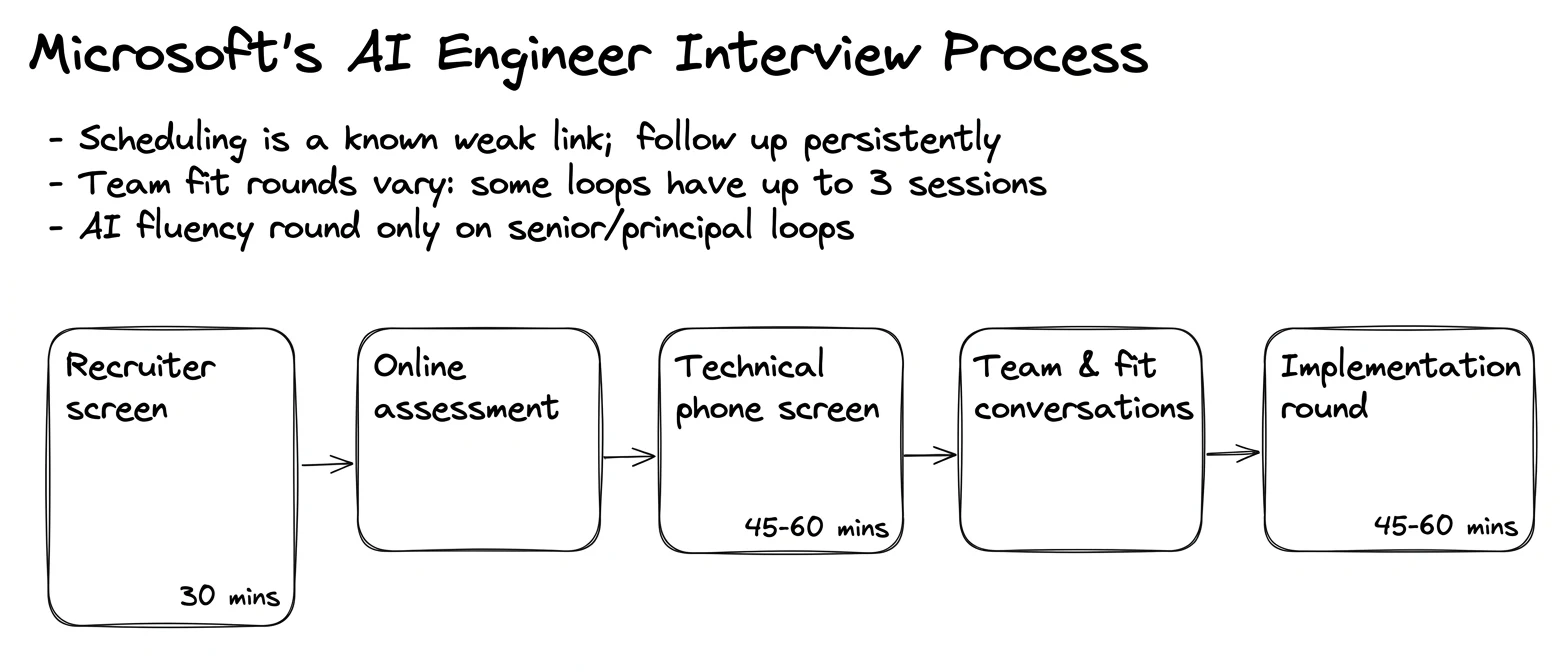
Microsoft hires AI engineers into specific teams: product copilots, the CoreAI platform, and the model training and inference groups in Microsoft AI. The team sets the content. Product teams lean on LLM application design and data plumbing; pretraining and post-training teams test model internals and generation code. Reported loops ran from a single 45-minute screen to eight rounds, usually over several weeks.
Interns and early-career candidates mostly see ML fundamentals and from-scratch implementations; mid-level loops add LLM system design; senior and principal loops add a hiring manager hour, an AI fluency round and more behavioral rounds.
Here's what the interview process can look like:
- Recruiter screen: A short call on background and level that some recruiters use to choose which loop you sit.
- Online assessment (some pipelines): A from-scratch PyTorch build or a timed two-problem coding test.
- Technical phone screens (one to five): 45 to 60 minutes, a short AI-experience conversation followed by an algorithm or a from-scratch ML implementation.
- Applied coding interviews: Data loaders, sample packing, parsers and LLM-serving components written live, with edge cases decisive.
- AI-assisted coding interview (some teams): Debugging or extending a supplied project with an assistant, or reviewing AI-generated code.
- LLM system design interview: A product-shaped design built around retrieval, personalization, latency and hallucination control.
- Project deep dive and hiring manager interview: One or two of your projects in depth, plus ambiguity, ownership and conflict questions.
Tip: Ask the recruiter which team the loop is for and whether an assistant is allowed in each round. The team decides whether you face model internals or product design, and assistant rules differed between teams using the same round names.
Online assessment
Not every pipeline uses one. The AI-specific version is a tiny next-token model in one PyTorch script with no high-level model libraries: a loader with batch size 32 over token IDs, embedding, linear, ReLU and linear layers returning vocabulary logits, inputs and targets shifted by one, then cross-entropy, backward and an optimizer step. It passes only if it runs and the loss falls.
Others got two problems in about 90 minutes: an easy string task and a hard minimum-fuel-cost route with city-dependent prices, which needs Dijkstra over a fuel-level state.
Interviewers evaluate:
- End-to-end execution: The pipeline runs without errors; partial components earn little.
- Sequence shifting: Input and target offset by exactly one position, which is where most index bugs occur.
- API fluency without boilerplate: A dataset, loader and training step written from memory.
Practice writing a complete next-token training script in under 30 minutes with no reference material.
Note: The assessment is proctored. A candidate who pasted an assistant's code into the graph problem got a time-limit failure and believed the use was obvious to reviewers.
Sample questions for the online assessment
Here are some questions reported by recent candidates:
-
Build a next-token prediction model in one PyTorch script, from the data loader to an optimizer step, and show the loss decreasing.
-
Find the cheapest way to travel between two cities when fuel prices differ by city and the tank has no capacity limit.
Technical phone screens
Screens run 45 to 60 minutes in a shared editor. Most open with a few minutes on practical AI work (what you built, how you measured impact) and then move to code. The coding is either a standard algorithm or a from-scratch ML piece. Reported examples include K-means in Python with NumPy or PyTorch allowed, greedy decoding extended to top-k beam selection, sorting candidates by relevance with ties broken by distance, and generating a string's subsets in sorted order. Intern screens can be all concepts: overfitting, precision versus recall, bagging versus boosting, self-attention, and fine-tuning versus parameter-efficient methods.
Some teams replace the onsite with phone rounds: one loop had five calls, covering a resumable data loader, OCR text cleaning for LLM training, streamed stop-token detection and a video vision-language model design.
Interviewers evaluate:
- Matching the intended approach: A candidate who finished the subsets variant in about ten minutes was still rejected; state your plan and confirm it first.
- Edge cases raised unprompted: Empty clusters, convergence tolerance, identical scores and distances, K equal to the list size.
- Algorithm mechanics: In beam search, how candidate sequences are kept and pruned by score; the rejected candidate knew the concept.
- Complexity and limitations: Cost of K-means per iteration, local minima, restarts and better initialization.
Rehearse K-means, top-k decoding and a streaming stop-token matcher until each is clean in 25 minutes.
Sample questions for the technical phone screens
Here are some questions reported by recent candidates:
-
Implement K-means from scratch, handle a cluster that ends up empty, and explain how it can get stuck in a local minimum.
-
Write greedy sampling over a fixed vocabulary, then extend it to top-k beam path selection that prunes sequences purely by score.
-
Detect stop tokens in streamed model output, including matches split across chunks.
Applied coding interviews
Onsite coding is mostly the plumbing around models rather than puzzles, about an hour each with follow-ups layered on. Product and data teams asked for a batch loader with weighted sampling, sample packing for supervised fine-tuning that places the attention mask and answer tokens correctly, a CSV query engine that handles commas inside quoted fields, and a single-flight component that collapses bursts of identical calls to a language model service. Training and infrastructure teams went deeper: multi-head attention, feed-forward layers and positional encoding written from scratch, a CUDA kernel, roofline analysis, and a matrix multiplication runtime estimated from bandwidth and compute specs.
Some loops still include classics such as an LRU cache or merging intervals, and one intern round paired a hypothesis test with a Python debugging task.
Interviewers evaluate:
- The uneven case: Total weight not divisible by the batch size cost one candidate the round despite a correct structure.
- Base first, then follow-ups: A senior candidate lost the aggregation and malformed-row follow-ups to an escape-handling bug in the base parser.
- Concurrency for serving code: Request deduplication, waiter fan-out and error propagation in the single-flight component.
- Hardware reasoning (infrastructure teams): Arithmetic intensity, compute-bound versus memory-bound, and loss scaling when moving from FP32 to FP16.
Practice data and serving components with their awkward inputs, and keep a tested base version working before the first follow-up.
Note: One loop told candidates to share their screen and code in their own editor. Have a working local Python setup ready, and also practice in a plain editor without autocomplete.
Sample questions for the applied coding interviews
Here are some questions reported by recent candidates:
-
Write a batch loader that samples by weight and stays unbiased when total weight does not divide evenly into the batch size.
-
Pack supervised fine-tuning samples into fixed-length sequences with a correct mask window, answer-token positions and balanced lengths.
-
Build a CSV engine that types fields as strings or integers and filters rows by column comparisons, with commas inside quotes.
AI-assisted coding interview
Newer loops add a round with an assistant, and its format varies most by team. In one, the candidate debugged a small project supplied as an archive, added disk persistence to its in-memory store, and explained every AI-generated line. In another, a single round covered a URL shortener's high-level design, class design, working code, and then bug-hunting in AI-generated code for the same service. A principal candidate had an AI fluency round on daily AI use, a metrics ingestion pipeline designed with an assistant, and its failure modes.
Elsewhere the label meant little: a candidate told to expect an agent got two ordinary algorithm rounds with the assistant optional.
Interviewers evaluate:
- Running code: The rejected archive-round candidate traced the outcome to code that did not execute.
- Verification of generated code: Spotting improper synchronization, wrong hash truncation and missing input validation.
- Ownership of the output: Explaining why the generated code works, not just that it does.
Practice adding a small feature to an unfamiliar repository in 45 minutes, running it, and reviewing an assistant's diff line by line.
Sample questions for the AI-assisted coding interview
Here are some questions reported by recent candidates:
-
Fix a small project delivered as an archive, then persist its in-memory key-value store to disk, explaining the assistant's code as you go.
-
Find the bugs in AI-generated URL shortener code, covering concurrency, hashing and validation.
-
Design a metrics ingestion pipeline with an assistant, then walk through how it fails.
-
Implement an LRU Cache (HashMap + Doubly Linked List) and Debug an Existing Implementation
LLM system design interview
Most loops have one design round of 45 to 60 minutes; some have two. Prompts are product-shaped: resuming past chatbot conversations with personalization, re-engaging dormant users of a Copilot-style companion by detecting implicit reminders in chat history, an incident-handling agent with role-based content and abuse controls, and a local sports news recommender. Model-building teams asked for a video vision-language model from data collection to evaluation, or how to clean OCR text for LLM training. One ML data loop instead had two classic designs, a team chat platform and an online chess site.
Follow-ups target LLM production trade-offs: managed versus self-hosted vector search, fine-tuning versus prompting, quantization and distillation for latency, and retrieval grounding, verification layers and red-team-style auditing against hallucination.
Interviewers evaluate:
- Breadth before depth: Data model, serving path and scale first, then one or two deep dives.
- Grounding and safety: A concrete plan against hallucination and abuse, not a mention of it.
- Latency awareness: How scanning conversation context or calling a model stays off the critical path.
- Product judgment: What makes a nudge helpful rather than spammy, and how you would test it.
Practice three LLM product designs end to end, timing yourself so that scaling is covered before the 35-minute mark.
Note: A rejected senior candidate spent too long on reminder detection in the re-engagement design and never reached the data model or scaling. The candidate considered that imbalance the main mistake of the day.
Sample questions for the LLM system design interview
Here are some questions reported by recent candidates:
-
Design a feature that lets users reopen and search past chatbot conversations, personalized to their preferences.
-
Design re-engagement for inactive users of an AI companion, including reminders detected implicitly in chat history.
-
Design a local sports news recommender using retrieval-augmented generation, and explain how you would reduce hallucinations.
Project deep dive and hiring manager interview
Nearly every loop includes a project round. Some interviewers grilled the resume line by line before any code. One asked for pull-request links. An intern presented a project that turned into a case study on extensions and trade-offs. A pretraining team ran three conversation rounds on background, technical fit and collaboration before its single coding round. At senior level the hiring manager may open the day with an hour on signature projects, ambiguity and influencing without authority.
Interviewers evaluate:
- Personal decisions: What you chose, which alternatives you rejected and why.
- Measured impact: Numbers for quality, latency or adoption, and how you got them.
- Handling ambiguity: Moving forward with vague requirements and resolving design conflicts.
Prepare two projects with artifacts (pull requests, metrics, a design document) and a three-minute version of each.
Sample questions for the project deep dive and hiring manager interview
Here are some questions reported by recent candidates:
-
Walk through one or two recent projects, their design trade-offs and the pull requests behind them.
-
Describe a time you moved forward with limited information or vague guidance.
-
What draws you to this team, and how did you handle a conflict over ownership?
How Microsoft levels and evaluates AI Engineer candidates
The hiring team owns the loop, and the hiring manager or a senior interviewer's round can decide it. The level comes from the posting, and senior loops add behavioral and design depth. Execution failures (non-running code, a missed edge case) and approach mismatches ended loops more often than weak design. Outcomes often appear in the applicant portal first: one rejection arrived there with no recruiter contact, another about four business days before the email. Waiting periods after a rejection are reported inconsistently, from none for a different team's posting to several months.
How to prepare for the Microsoft AI Engineer interview
- Pin down the team and the assistant policy: The team decides whether you face model internals or LLM product design, and assistant rules differ by round.
- Write the from-scratch set: K-means, a next-token training script, multi-head attention, greedy and top-k decoding, all without references.
- Drill the uneven data cases: Weighted sampling with remainders, sample packing masks, stop tokens split across chunks, quoted commas in CSV.
- Confirm the approach before coding: Offer two approaches on simple problems and ask which the interviewer wants.
- Practice reviewing generated code: Run it, find synchronization, hashing and validation bugs, and explain each fix.
- Rehearse three LLM product designs: Cover retrieval, latency, hallucination control and abuse handling, with scaling inside the first 35 minutes.
- Bring project artifacts: Pull-request links, metrics and the decisions you personally made.
About the Microsoft AI Engineer role
AI engineers at Microsoft build the software around models: copilots inside products, agent and retrieval platforms, evaluation and data pipelines, and the infrastructure that trains and serves models. Most sit on the software engineering ladder and own their services end to end, including responsible-AI review before launch.
| Level | Primary focus | Impact scope |
|---|---|---|
| 59–60 (Software Engineer) | Well-scoped features with guidance | A component within one team |
| 61–62 (Software Engineer II) | Features owned from design to production | A team's services |
| 63–64 (Senior Software Engineer) | Technical direction for a product area, mentoring | Several services and neighboring teams |
| 65–67 (Principal Software Engineer) | Architecture and strategy across teams | An organization |
Microsoft hires AI Engineers across several organizations. Teams include:
- CoreAI – Platform and Tools: Formed in 2025 to build the AI app and agent stack, including developer tools, the AI platform and agent runtimes.
- Microsoft AI: The consumer Copilot and in-house MAI models, with pretraining and post-training infrastructure teams.
- Microsoft 365 Copilot: Copilot features in Word, Excel, Outlook and Teams, plus the data and evaluation behind them.
- Azure AI infrastructure: The supercomputing and serving layer behind training and inference.
AI Engineer experience and education requirements
Postings ask for a bachelor's degree in computer science or a related field, or equivalent experience. A recent senior AI engineer posting required four or more years of coding experience in languages such as Python, and preferred two to three years with LLMs, retrieval-augmented generation and model serving, plus Azure experience. Many roles also require passing Microsoft Cloud background checks. Python is the default interview language for ML coding.
FAQs about the Microsoft AI Engineer interview
How long does the Microsoft AI Engineer interview process take?
Typically several weeks. Single-screen rejections came quickly; multi-round phone loops and onsites stretched past a month. Phone screens are remote, while some teams held in-person onsites, including a six-round loop in Seattle.
What is the hardest round of the Microsoft AI Engineer interview?
The applied coding round, whether or not an assistant is allowed: working data or model code with the edge cases handled in under an hour. LLM system design is second, mainly for pacing.
Can you use AI tools during the interview?
Only where the round allows it. Some teams run dedicated assistant rounds and others make the assistant optional. Assessments and no-AI rounds forbid it, and use in a proctored assessment can be detected.
How much does a Microsoft AI Engineer make?
Approximate total annual compensation in the United States on the software engineering ladder:
- Level 59: ~$165K
- Level 62: ~$205K
- Level 63: ~$250K
- Level 64: ~$275K
- Level 65: ~$320K
Packages combine base salary, an annual cash bonus and stock awards that vest over several years, with stock a growing share at senior levels.