Study
Meta vs Google vs Amazon Interviews: How Formats Differ (2026)
TrueInterview
October 11, 2026 · 15 min read
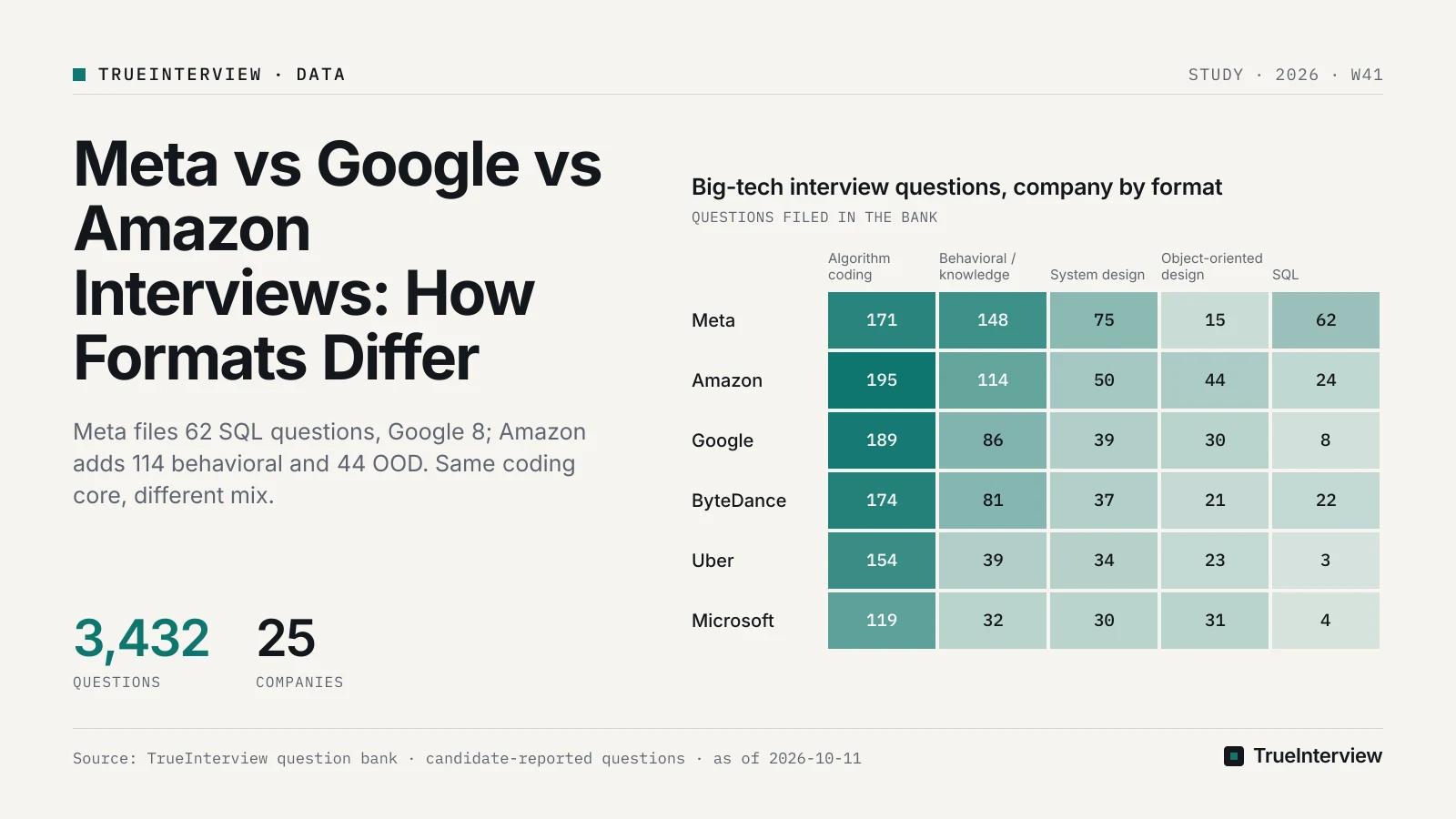
Meta, Google and Amazon differ less in how hard their loops are than in how their reported questions split across formats, so prepare each one as a format mix rather than a shared LeetCode list. As of 2026-10-11, TrueInterview's bank holds 3432 candidate-reported big-tech questions, and the three files diverge sharply: Meta pairs 171 coding questions with 62 SQL, Google files 189 coding and only 8 SQL, and Amazon adds 114 behavioral / knowledge and 44 object-oriented design questions to 195 coding. If two of them are on your calendar, prepare the coding core once and spend the remaining hours on the formats only one company files heavily.
Disclosure: TrueInterview is an interview-preparation product and publishes this article. Facts about other products come from their public pages on the dates listed under Sources.
How do the six largest companies split their questions by format?
Coding is the largest format at each of the six companies with the most filed questions, but its share of the file ranges from about a third at Meta to three fifths at Uber. That spread, more than any difficulty ranking, decides how many of your hours go to SQL, behavioral stories and object-oriented design.
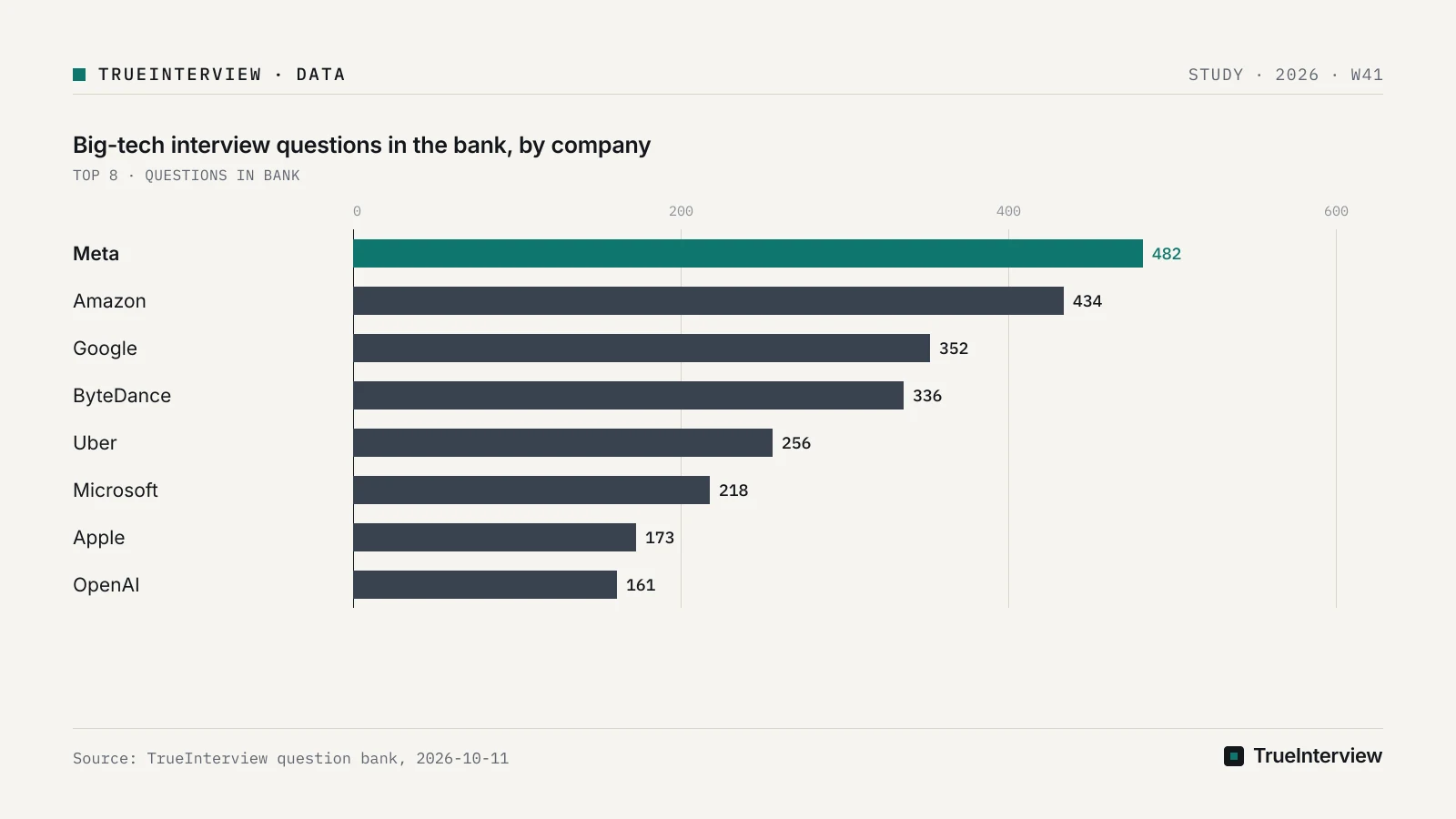
| Company | Questions filed | Coding | Behavioral / knowledge | System design | Object-oriented design | SQL | Coding share |
|---|---|---|---|---|---|---|---|
| Meta | 482 | 171 | 148 | 75 | 15 | 62 | 35% |
| 352 | 189 | 86 | 39 | 30 | 8 | 54% | |
| Amazon | 434 | 195 | 114 | 50 | 44 | 24 | 45% |
| ByteDance | 336 | 174 | 81 | 37 | 21 | 22 | 52% |
| Uber | 256 | 154 | 39 | 34 | 23 | 3 | 60% |
| Microsoft | 218 | 119 | 32 | 30 | 31 | 4 | 55% |
| All 25 companies | 3432 | 1481 | 824 | 475 | 355 | 219 | 43% |
Coding share is our arithmetic: each company's coding count divided by its total filed questions. The format columns do not add up to the total because smaller formats, such as the 78 AI-assisted coding questions in the bank, sit outside these five columns.
Compare each row with the bottom row rather than with its neighbours, because Meta's file is larger than the others and its raw counts run higher for that reason alone. Two columns separate the three leaders more than any other: SQL, where Meta's count is nearly eight times Google's, and object-oriented design, where Amazon files almost three times as many as Meta. Those two columns are where a shared study plan breaks, so they are where your company-specific hours should go.
Our take: the common advice to prepare harder for whichever company has the toughest reputation misreads the data. Meta is the least coding-heavy file of the six and Uber the most, so a Meta loop asks you to buy more non-coding reps per hour of preparation than any other company in the table.
Where does each company depart from the bank-wide mix?
Each of the three leaders leans away from the bank-wide mix in one direction you can name and prepare for. Meta leans toward data formats, meaning SQL, statistics and experiment design. Amazon leans toward Leadership-Principles behavioral and object-oriented design. Google leans toward coding itself, with the thinnest SQL file of the three.
Meta: SQL, statistics and ranking design
Of the 236 other-format questions filed under Meta, SQL (62) and statistics (58) lead, ahead of behavioral at 39. ByteDance is the only other company of the six that puts SQL first among its other formats, and its count of 22 is about a third of Meta's. For a Meta loop, SQL and experiment-design sessions are required reps; for Google they are optional.
Meta's design file points the same way. Of its 75 design questions, the top families are ads, recommendation and ranking ML (14), A/B testing and experiment design (9), and news feed and social graph (5). A filed Meta example of the ranking family is Reels / Short Video Recommendation. In a ranking design, expect the push to land on two decisions: how you split candidate generation from ranking so the expensive model scores only a short list, and which online metric you trust when it disagrees with offline accuracy. In an experiment-design prompt, the deciding questions are the randomization unit and the guardrail metric that would stop a launch.
Meta's coding topics lead with graphs (24), strings (22) and trees (20), so trees is the block to add if you are coming from a Google or Amazon plan. Meta's reports also include Maze Solver as an AI-assisted coding question at the onsite, last reported 2026-09. One candidate's write-up on Medium describes Meta's onsite as two coding rounds, one system design and one behavioral round called Jedi, with code written in CoderPad, which compiles.
Google: the most coding-concentrated loop
Google's non-coding file is the thinnest of the three leaders: of its 124 other-format questions, the top subtypes are behavioral (39), object-oriented design (26) and statistics (24). Its coding file leads with graphs at 41, well ahead of arrays at 27 and hashing at 23. Put the hours you would give SQL at Meta into graph problems taken through follow-ups, where the same traversal returns with one constraint changed.
Google's 39 design questions spread thinly, with news feed and social graph (4), chat, messaging and comments (3), and A/B testing (3) at the top. With families this thin, prepare one feed design and one chat design to depth instead of a catalogue. For a feed, the deciding question is fan-out on write versus fan-out on read for accounts with very large followings; for chat, it is delivery ordering and what happens when the recipient is offline.
Google's reports include Behavioral Round (Googliness Themes) at the phone-screen round, last reported 2026-08. The format is also moving. Business Insider reported that Google is piloting an interview process that lets software engineering candidates use an AI assistant, according to an internal document it reviewed. Business Insider says candidates in the code comprehension round will be expected to "read, debug, and optimize" an existing code database, and that the pilot covers junior to mid-level roles in select US teams.
Amazon: a scored behavioral half and the most OOD
Amazon's non-coding file is the most behavioral-weighted of the three: of its 189 other-format questions, the top subtypes are behavioral (53), object-oriented design (38) and ML fundamentals (26). Amazon's SDE III interview-prep page says of the technical phone screen: "Half of the time will be spent on questions that focus on our Leadership Principles and the other half will be spent on coding problems and system design." Treat behavioral as half the score, not as a closing chat.
The same Amazon page says the loop includes five 55-minute interviews and that each interviewer will typically ask "two or three behavioral-based questions about successes or challenges". Across a full loop, that is ten to fifteen behavioral questions, so a story bank of a dozen or more is the floor. In our bank, the Leadership Principles Standard Set is linked from 30 candidate write-ups, all at Amazon, and was last reported at the phone-screen round in 2026-09. Amazon's file also holds GenAI Usage (How / Failure / Tradeoff), linked from 29 write-ups, all at Amazon. Prepare one story about using a generative AI tool that includes a failure and the trade-off you accepted.
Amazon's coding topics lead with hashing (35), arrays (27) and graphs (26), so open an Amazon plan with frequency maps and array scans before graphs. Rate Limiter is linked from 25 write-ups across six companies, Amazon and Google among them, so one rep serves both loops. TrueInterview's comparison page quotes one candidate's Stripe report on the same problem: "Sliding window at first, then he asked what happens across three app servers and made me redo it with a shared store." The deciding question is where the counter lives once more than one server handles traffic, and how much accuracy you give up to keep the check fast.
Amazon's 50 design questions lead with metrics, logging and data pipelines (7), maps, ride-hailing and delivery (6), and LLM, RAG and AI infrastructure (5). Design Metrics System is filed at Amazon and DoorDash. For a metrics pipeline, the deciding questions are where you pre-aggregate versus keep raw events, and how late-arriving data corrects a number a dashboard has already shown.
ByteDance, Uber and Microsoft
The other three companies show how far the mix can swing, and they matter if one of them is your third loop. Uber files 3 SQL questions and draws its other formats from object-oriented design (21) and statistics (20), with maps, ride-hailing and delivery leading its design file at 7. Microsoft is the only one of the six where object-oriented design (31) outnumbers system design (30). ByteDance's other formats lead with SQL (22), ML fundamentals (19) and object-oriented design (18), and its design file leads with ads, recommendation and ranking ML (6). A ByteDance loop therefore shares more with Meta's data-shaped prep than with Google's.
What if you are interviewing at two or three of them at once?
Prepare one shared core first, then add each company's deviation in the order your interviews arrive. Coding, a behavioral story bank and one or two design families carry across all three loops. SQL and statistics belong to Meta, Leadership-Principles mapping and object-oriented design to Amazon, and deeper graph follow-ups to Google.
Several questions in the bank are filed at all three. Merge Two Interval Lists is filed under 12 big-tech companies, Meta, Amazon and Google among them, and is linked from 20 write-ups. Solve it as a two-pointer sweep over two sorted lists that advances whichever interval ends first. Course Schedule is filed under 10 companies including the same three, and is linked from 22 write-ups. It is a topological sort; Kahn's algorithm with an in-degree queue also detects the cycle that makes the schedule impossible. Design Job Scheduler is filed under 12 companies including Google and Meta, though not Amazon, and 16 of its 21 write-up links come from senior-or-above candidates. Its deciding questions are at-least-once execution with idempotent jobs, and how workers claim a job without two of them running it.
| If your loops are | Prepare once | Add for the first company | Add for the second company |
|---|---|---|---|
| Meta + Google | Graph coding, a story bank, one news feed design and one A/B design | SQL, statistics, ads and ranking design | Graph follow-up chains, chat design |
| Meta + Amazon | Coding, a story bank with your own decisions in it, one metrics or ranking design | SQL, statistics, experiment design | Stories mapped to each Leadership Principle, object-oriented design |
| Google + Amazon | Coding: graphs, arrays and hashing sit in both top threes | Graph follow-ups, feed design | Leadership-Principles stories, object-oriented design, metrics design |
| All three | Coding core, story bank, one feed and one metrics design | Meta: SQL and statistics | Amazon: object-oriented design and principle mapping; Google: follow-up depth |
Our take: schedule the loop whose deviation is smallest first. Google adds the least non-coding work to a shared core, so a Google onsite early in the sequence rehearses the coding you need everywhere; put Amazon last, because its story bank takes the longest to build and keeps improving with each telling.
Which formats come first, by round?
The round you are about to sit changes the format mix as much as the company does. Across the bank, SQL and statistics lead the other formats at the phone screen, while object-oriented design and behavioral lead at the onsite, so order your work by the date of each round. These are bank-wide counts, not per company.
At the OA, the 81 other-format questions lead with SQL (30) and object-oriented design (27). At the phone screen, the 720 other-format questions lead with SQL (132), statistics (113), behavioral (105) and object-oriented design (95). At the onsite, the 758 other-format questions lead with object-oriented design (197), behavioral (130), statistics (93) and SQL (61). Design shifts the same way: A/B testing and experiment design leads the 162 phone-screen design questions at 24, and ads, recommendation and ranking ML leads the 336 onsite design questions at 45.
For a Meta phone screen, have SQL and experiment design warm; for an Amazon onsite, have object-oriented design and the story bank warm. A Google phone screen leans hardest on coding, but Google's Googliness behavioral question was also reported at the phone screen, so keep two stories warm there too.
Is one of these loops harder than the others?
Our bank cannot rank difficulty, and the best-sourced comparison in this research argues no one can. interviewing.io's hiring-process guide calls it a myth that Amazon has the lowest bar and Google the highest, and says "all of their bars are different" in a comparison it calls multidimensional. The guide adds that it is impossible to call one whole process harder than another.
One interviewee quoted by ForumDaily said Google has the most difficult technical problems, while Amazon's are simpler but its behavioral interviews are harder. That single account fits the format split in the first table: the companies spend their difficulty in different formats. A candidate strong in graphs and weak in storytelling will find Google easier than Amazon, and the reverse holds too.
Our take: stop asking which loop is harder and ask which format is your weakest. Then pick the company whose filed mix leans away from that weakness as your first interview, and the one that leans toward it as your last.
What changes at senior and staff level?
At senior level the non-coding formats grow while coding holds steady. In write-up links tagged with candidates' self-reported levels, coding is nearly even at 1196 senior-or-above against 1136 junior-or-below, while system design runs 676 to 132 and behavioral / knowledge 798 to 477. Coding gets you to the debrief; design and behavioral decide the level.
Some questions appear only in senior-or-above write-ups. They include Design GPU Inference Serving System (22 links), Describe your most impactful project (18), Durable Key-Value Store Serialization (13) and Design an Ads Frequency Cap System (13). Staff-plus or manager write-ups cluster on behavioral sets, led by Behavioral / BQ Question Pack at 10 links. For a staff loop, the shift is from solving to narrating: why you chose a design, what you rejected, and what scope you owned.
Each company signals this differently. spacecomplexity.ai's article on hiring committees says "System design interviewers hold disproportionate weight at Meta compared to coding interviewers" and that for E6 and above a candidate cannot be hired without passing both system design rounds. Our filings are consistent with design mattering more at level but do not confirm that pass rule. At Google, Business Insider reports that the Googleyness and Leadership round will now also involve a technical design discussion about a past project. At Amazon, our view is that the Leadership Principles half of the screen is where seniority shows, because a principle story is judged on the scope of the problem you owned.
The down-leveling note
Our view: the level signal sits in design depth, the project deep dive and the scope of your behavioral stories, far more than in coding speed. interviewing.io's guide relays one Facebook interviewer's report of a friend who passed both the Google and Facebook loops and was offered L6 at Google and L4 at Facebook. One report says nothing about rates, but it shows that two passed loops can land two levels apart, so ask each recruiter which rounds carry the level decision.
How we counted
Counts come from TrueInterview's question bank as of 2026-10-11, where 2729 of the 3432 questions were last reported within the previous 12 months. They are candidate-reported questions reconstructed for practice, filed by company, round, month and self-reported level; they are not any company's official question list and do not measure how often a company asks something. Format and subtype labels and the title-based design families are ours, and a link count is the number of write-ups pointing at a question, not a count of separate interviews.
FAQ
Which company has the hardest interview: Meta, Google or Amazon?
None of the evidence here supports a single ranking. interviewing.io's guide says the companies' bars differ along several dimensions, and our counts show each company concentrating its questions in different formats: data formats at Meta, coding at Google, behavioral and object-oriented design at Amazon. The useful question is which of those formats is weakest for you, because that is where a given loop will feel hardest.
Are Meta interviews difficult?
Meta's file asks for the widest spread of formats of the three, so the difficulty is breadth more than any single round. One candidate's write-up on Medium says Meta interviewers will "push you hard on follow-up questions until you break". spacecomplexity.ai's article reports that Meta decides in one to two weeks plus team matching, against five to fourteen days at Amazon and two to six weeks at Google. Plan your preparation window around that timeline.
Which is better to prepare for first, Meta or Google?
If both are on your calendar, prepare Google's coding core first, because it is the larger share of both files and carries straight into Meta. Then add Meta's SQL, statistics and ranking design on top. If Meta's interview comes first, start those data-format sessions in the first week instead of the second, since they are the part a Google plan never builds.
What is the pass rate for Meta interviews?
No source in this research gives a verified pass rate for Meta, Google or Amazon, and our counts cannot stand in for one. The closest evidence is about practice: interviewing.io's guide reports that completing five technical interviews, mock or real, "doubles your chances of passing a subsequent technical interview". Use that as a reason to schedule mocks before your first loop, not as a rate.
Do Meta, Google and Amazon use an online assessment?
Our bank files OA questions across companies without confirming which loops use one. One candidate's write-up on Medium describes Amazon's process as one online assessment with debugging and logic tests, followed by a loop of five to six interviews. Ask your recruiter whether your loop starts with an OA, then weight SQL and object-oriented design if it does, since those lead the bank's OA reports.
Your practice plan
A three-week plan for someone working full time, built from the counts above.
- Today, write a one-page table with a column for each company on your calendar, copy in its row from the first table, and drop any prep resource that does not map to a row.
- Week one, shared core: timed graph, hashing and array problems from the practice question bank, including Course Schedule and Merge Two Interval Lists, plus one Rate Limiter rep where you move the counter into a shared store.
- Week one, story bank: draft stories against the Leadership Principles Standard Set, then retell three of them for the Behavioral / BQ Question Pack so each works outside Amazon.
- Week two, company deviation: for Meta, two SQL sessions and one ranking or A/B design; for Amazon, one object-oriented design a day and one metrics design; for Google, graph follow-up chains, one feed design and the Googliness behavioral round.
- Week two, AI-assisted coding: one session reading, debugging and optimising existing code with an assistant on Maze Solver or LRU Cache.
- Week three, senior signal: record a project deep dive out loud, naming the options you rejected and the scope you owned, and rehearse the version a Google design discussion would probe.
- Week three, rehearse in round order: phone-screen formats first, onsite formats last, using reports from the interview write-ups board for the company you meet next.
Sources
- TrueInterview question bank — big-tech interview at big-tech companies — counted 2026-10-11
- Medium — checked 2026-10-11
- Google Plans to Let Software Engineers Use AI in Job Interviews - Business Insider — checked 2026-10-11
- SDE III Interview Prep — checked 2026-10-11
- Interview prep compared: your application, end to end · TrueInterview — checked 2026-10-11
- A Senior Engineer’s Guide to FAANG Interviews — checked 2026-10-11
- How interviews are conducted at Amazon, Google and Meta: personal experience of IT specialists from Belarus - ForumDaily — checked 2026-10-11
- The Interviewers Liked You. Now the Hiring Committee Decides. · SpaceComplexity — checked 2026-10-11
Last reviewed: 2026-10-11.