Meta · Study
Meta Infrastructure Engineer Interview Process
TrueInterview
July 24, 2026 · 15 min read
Meta scores each infrastructure round as a separate signal, and the one that most often ends a candidacy is the troubleshooting conversation. There is no terminal and no real host: you diagnose an outage out loud while the interviewer releases clues, and the root cause usually sits one layer below the obvious one. A candidate with deep reliability experience finished both coding problems early and was still rejected on that screen alone. A hiring committee that never met you then reviews the packet, and it has declined infrastructure loops that felt strong in every room.
This guide breaks down each stage of the Meta Infrastructure Engineer interview, what interviewers evaluate in each round, and how to prepare, with questions candidates were actually asked.
Verified: Based on 91 candidate-reported interview experiences, primarily from 2025 Q4 through 2026 Q3, cross-checked against recent public accounts.
Meta Infrastructure Engineer interview process
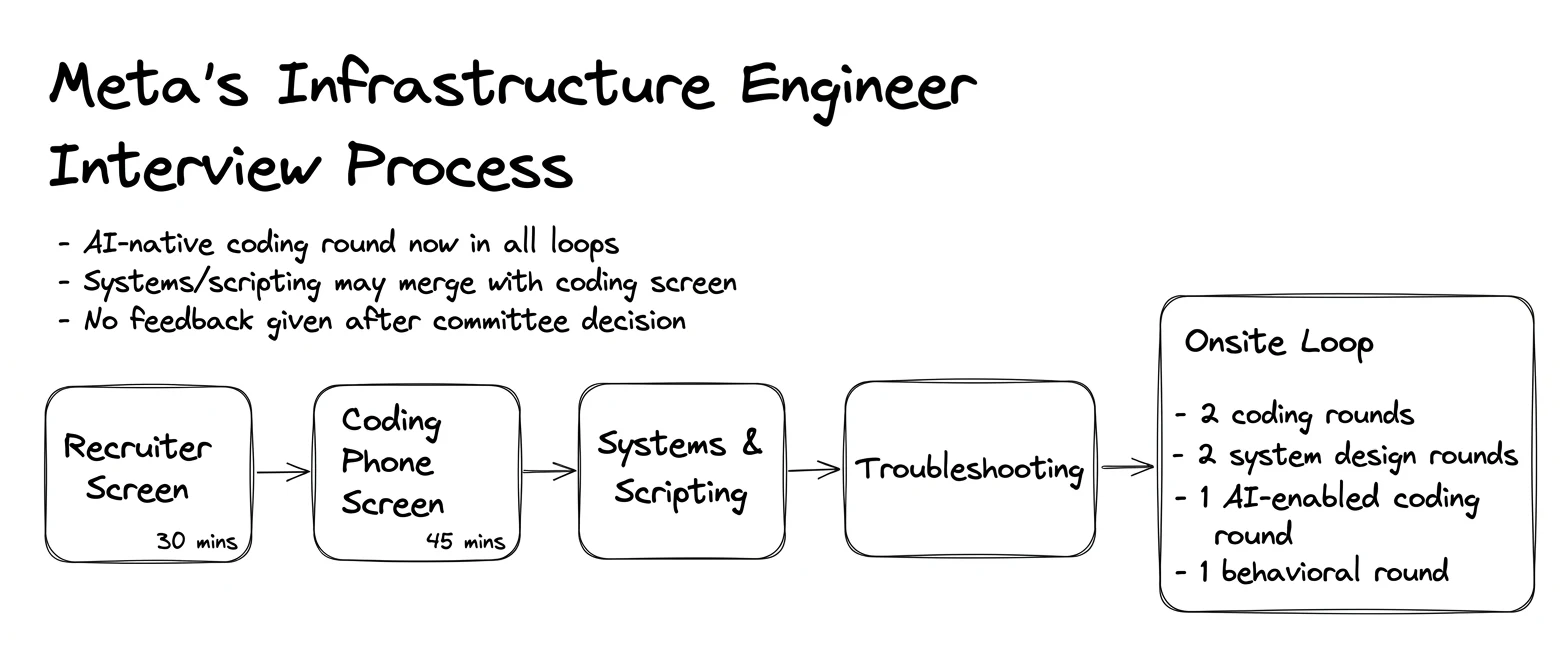
Infrastructure hiring covers two related paths: Software Engineer (Infrastructure), who builds storage, cluster and serving systems, and Production Engineer, who writes software for their reliability, capacity and performance and joins on-call as an escalation point. Both sit the same coding screens and design rounds; the production path adds operational scripting and troubleshooting. Team matching usually follows committee approval.
A typical path is a recruiter call, an optional online assessment, one or two 45-minute screens, and a loop of four to six rounds, over four weeks to two or three months. New-grad and E4 loops are mostly coding, E5 loops usually carry two design rounds, and one E6 infrastructure loop was a coding screen plus five onsite rounds, two of them design.
Here's what the interview process can look like:
- Recruiter screen: About 30 minutes on background, level, loop format and timeline, with no technical questions.
- Online assessment (some pipelines): A 90-minute progressive class-implementation task whose levels unlock one at a time.
- Technical phone screen: 45 to 60 minutes with two coding problems, often plus a troubleshooting segment or a separate systems screen on the production path.
- Coding interviews (one or two): Medium problems with scale follow-ups, plus operational scripting for production engineers.
- AI-enabled coding interview: A staged multi-file project with a built-in assistant, standard since mid-April 2026.
- Troubleshooting interview (Production Engineer): A verbal on-call simulation that works down the stack to a root cause.
- System design interview (one or two): 45 minutes on throughput, aggregation and distribution.
- Behavioral interview: Conflict, ownership, missed commitments and how you use AI tools.
Tip: Ask the recruiter in writing which rounds are AI-native and whether troubleshooting is included. Candidates near the April 16, 2026 cutover got mixed formats, and one was told only that the loop had an "AI-native coding" and an "AI-structured coding" round, with no explanation of the difference.
Online assessment
Some pipelines open with a 90-minute assessment built as one progressive task: implement a class, pass every test at the current level, then see the next. Reported tasks include an in-memory database with add, delete, lock and unlock; a key-value store that adds prefix scans, time-to-live expiry, then backup and restore; a banking system with scheduled transfers and account merges; and a versioned store whose get_when returns a field's value at a past timestamp. The platform gives no line-level errors, so you debug by reading fixed tests that can run to dozens of lines.
Perfection is not required. One candidate reached level 3 of 4 with tests still failing and was sent straight to the full loop; the recruiter said a fail would have meant a one-year wait to reapply. A senior candidate was rejected because the level 1 design could not absorb the versioning required at level 4.
Interviewers evaluate:
- Forward-compatible design: A data model chosen after reading every level, such as an event log kept from level 1.
- Correct expiry handling: Lazy expiration first in every operation; snapshots that store remaining time-to-live, not absolute expiry.
- Reading the spec through the tests: Where the prose is ambiguous, the tests define the behavior.
- Pace: Roughly 15 to 20 minutes per level, submitting each level as soon as it passes.
Practice two or three progressive in-memory store tasks end to end in 90 minutes, reading all levels before writing level 1.
Sample questions for the online assessment
Here are some questions reported by recent candidates:
-
Build an in-memory database where a locked key rejects updates and deletes until unlocked.
-
Add
get_when(key, field, at)to a time-to-live key-value store so each field's history can be read at a past timestamp.
Technical phone screen
An engineer runs the screen in a shared editor, usually 45 minutes and occasionally an hour, with two medium problems. Code often is not executed, and some interviewers say little and expect you to drive. On the production path the screen often adds a troubleshooting segment, or the two are split into separate calls. Follow-ups push toward scale: the file is too large for memory, the function runs millions of times, the tree does not fit in memory.
Reported problems include Friends Of Appropriate Ages; the top N words from a file too large for memory, discussed without runnable code; weighted random selection followed by the alias method; a local minimum in logarithmic time; kth largest pushed to quickselect; lowest common ancestor with parent-pointer and low-memory variants; and arithmetic without parentheses, where one interviewer pressed for an iterative stack over recursion. A pass has become an onsite invitation within two business days.
Interviewers evaluate:
- Optimal solutions with stated complexity: One candidate was rejected for missing the optimal approach to the second problem.
- Independence on edge cases: A candidate who needed one hint on the prefix case of an alien-dictionary problem was rejected.
- Scale reasoning: External merge versus in-memory counting, and what changes when input streams or exceeds one host.
- Self-testing: Empty, single-element and duplicate cases dry-run unprompted.
Drill two mediums in 45 minutes in a plain editor, then add a memory or streaming follow-up to each.
Note: Strong coding does not carry a weak systems screen. The two are scored separately, and the candidate who finished both coding problems with time to spare was rejected on the troubleshooting call.
Sample questions for the technical phone screen
Here are some questions reported by recent candidates:
-
Count valid friend requests among users whose ages follow fixed rules, then remove the quadratic scan.
-
Return the N most frequent words from a file far larger than memory.
-
Pick an item in proportion to its weight, then support millions of calls at constant expected time per pick.
Coding interviews
The loop has one or two traditional coding rounds, usually two problems each. They reuse screen families (calculators, interval merges, island counting, sparse vectors, a round-trip minimum cost reduced from quadratic to linear) and add production-flavored scenarios: a cache with rate limiting, then what changes at higher volume, across machines and under failures; a dependency graph with concurrency follow-ups; a tally service whose bump and range query must stay thread-safe with bounded memory.
Production Engineer loops add operational scripting: parsing vmstat output into CPU, memory and I/O-wait readings and alerting on thresholds, or a full program that takes thresholds as command-line flags, reads a metrics line from standard input and handles malformed fields. One onsite paired that script with a simulation of an endless-runner dinosaur jumping obstacles.
Interviewers evaluate:
- Complete programs: Argument parsing, input validation and clear alert output in scripting tasks.
- Operational judgment: Knowing what normal and alarming readings look like matters more than remembering flags.
- Pushing the bound when asked: A two-pass calculator was taken to a stack and then to constant extra space.
- Concurrency and memory awareness: Locks, bucketing and bounded windows raised before the interviewer asks.
Write two or three small command-line monitoring tools from scratch, and practice each coding family with its scale follow-up.
Sample questions for the coding interviews
Here are some questions reported by recent candidates:
-
Parse a line such as
cpu:90 mem:80 disk:50, compare it with thresholds passed as flags, and print an alert for each breach. -
Design a tally service that records events by timestamp and answers range counts under heavy concurrency with bounded memory.
-
Evaluate an expression with addition and multiplication, then with a stack, then with constant extra space.
AI-enabled coding interview
Loops scheduled on or after April 16, 2026 replace some or all traditional coding with an AI-enabled round, and infrastructure loops include it. You work in a multi-file project with a built-in assistant, and the task grows in stages. The most common is a maze solver: fix a print bug, add a missing visited set, honor one-way < and > cells, add keys and doors with a bitmask in the visited state, then bombs that clear nearby walls. Others are the largest subset of words with no shared letters, a friend recommender with a planted bug, and a card game scoring triples that sum to 15.
The assistant does not lower the bar. Inputs are sized so only the optimal algorithm passes, a test can itself be wrong, and the tool sometimes misbehaves. A candidate who leaned on suggestions in a compiler-optimization task passed four or five hidden tests and was rejected.
Interviewers evaluate:
- Knowing the solution before prompting: Successful candidates planned the algorithm, then prompted for small, single-purpose functions.
- Verifying generated code: Catching the assistant passing an object where an ID was expected.
- State modeling: Visited state that includes collected keys; a 26-bit mask for the word subset.
- Debugging tests as well as code: Recognizing an impossible test case and saying so.
Practice the maze and word-subset tasks with an assistant, writing your own tests for every stage.
Tip: Measure, do not just claim. In the card-game task one candidate wrote a test running 100 games: the greedy strategy scored a perfect game about 20 times, the improved strategy about 60. Evidence like that is what this round rewards.
Sample questions for the AI-enabled coding interview
Here are some questions reported by recent candidates:
-
Extend a buggy maze solver through one-way cells, keys and doors, and a bomb that clears nearby walls.
-
Choose words with no letter in common to maximize total distinct letters, under a strict timeout.
Troubleshooting interview
This is the Production Engineer track's signature round, run inside the phone screen, as a standalone screen, or onsite. The interviewer describes a symptom (the site is unreachable, the web server is down, requests are slow) and you investigate verbally while they reveal what each check shows. Candidates work down the stack: system logs, application logs, then the database. Some versions go deeper into syscalls, kernel behavior and network retransmits, with tools such as strace and tcpdump.
Documented root causes are a full disk and a full database transaction log that blocked every write while disk space looked fine. Other screens asked which processes were consuming a host, how a service behaves under tight CPU or memory, and what operational practices to recommend to a product team.
Interviewers evaluate:
- Hypothesis-driven method: The hypothesis, the exact check (
df,du,top, database logs) and what each result rules out. - Driving the diagnosis: Hints come, but you are expected to lead.
- Going one layer deeper: Not stopping at the first plausible cause when the evidence does not fit.
- Scoping a vague prompt: Early clarifying questions that bound the scenario.
- Remediation and prevention: Mitigation first, then alerting and capacity changes.
Rehearse five or six outage scenarios aloud, narrating each check as if no one could see your screen.
Note: This round grades narration, not knowledge. An experienced reliability engineer reconstructed the rejection as answers that felt intuitive but were never laid out in a structured, almost pedantic sequence.
Sample questions for the troubleshooting interview
Here are some questions reported by recent candidates:
-
A web server is unreachable; work through system, application and database layers to a full transaction log.
-
Users report slow requests; trace the delay from the application to the database logs and the busiest processes on the host.
System design interview
Design rounds last 45 minutes, which candidates find short; E5 loops usually have two. Infrastructure prompts center on throughput and distribution: an ad click counter at 100 million events per second, an ads impression aggregator with heavy writes, top K over a stream with tumbling and sliding windows, trending hashtags surfaced within a minute, a distributed web crawler, ticketing, location-based search, an online auction, post search with AND and OR queries, and live comments fanned out to millions of viewers. One auction design had to move to pessimistic locking when a celebrity listing created extreme contention. Newer loops add an AI-enabled design round, such as a code review agent with a cost per model call.
Interviewers evaluate:
- Scoping first: Volume, latency target and single-machine versus distributed before any boxes; a comprehensive Twitter-style design was flagged for never narrowing the problem.
- Time allocation: One candidate spent too long on requirements and schema and never reached the core architecture.
- Write-path depth: Pre-aggregation versus on-the-fly counting, sharding by term or by document, write amplification.
- Failure handling: What happens when an edge server, consumer or partition dies.
- Senior rigor: At E5 and above, explicit trade-offs, maintainability and production failure modes.
Practice aggregation and fan-out designs in 45 minutes, leaving 15 for the deep dive the interviewer picks.
Sample questions for the system design interview
Here are some questions reported by recent candidates:
-
Count ad clicks at 100 million events per second, with a real-time advertiser dashboard and durable history.
-
Surface trending hashtags within one minute, weighting the last 24 hours and favoring new topics.
-
Design status search with AND and OR queries, then shard the index when it outgrows one machine.
Behavioral interview
The behavioral round, sometimes as short as 35 minutes, presses each answer for what you personally did, what data supported it, and what you would change. Infrastructure candidates report an operations angle: aligning teams on conflicting requirements, your biggest mistake, and committed work that slipped through the cracks. Newer loops ask which AI tools you use, where they misled you and how you check their output. Staff-level sessions focus on cross-team direction and mentoring senior engineers.
Interviewers evaluate:
- Personal ownership: "I wrote the design document and realigned the timeline," not "we discussed and agreed."
- Measurable outcomes: Latency, availability, cost or time saved, in numbers.
- Accountability for misses: How a dropped commitment was discovered and what changed.
- Scope for level: Influence beyond your own team at E6 and above.
Prepare six to eight recent stories, including an incident you led and a commitment you missed, each with metrics.
Sample questions for the behavioral interview
Here are some questions reported by recent candidates:
-
Describe committed work that was missed entirely: how did you discover it and recover?
-
Which AI tools do you use day to day, and when did one give you a wrong answer?
How Meta levels and evaluates Infrastructure Engineer candidates
Each interviewer rates a separate signal, and a hiring committee reviews the packet and sets the level. It can decline a loop that felt positive: an E6 infrastructure candidate was rejected without feedback. Down-leveling is common: an E6 target was offered E5, and a candidate with 13 years of experience was matched at E5 and rejected because most rounds met the bar without exceeding it. Borderline signals can still pass; one offer followed a round flagged as a weak coding signal.
A rejection within about three business days usually means the packet never reached committee. After approval come a further sign-off and team-matching calls (one candidate had four), which freezes have delayed by weeks. An infrastructure rejection carries about a one-year cooldown for the same role, while other Meta roles stay open.
Tip: Aim for one clearly strong round rather than uniform "meets." Packets rated as meeting the bar everywhere have been declined.
How to prepare for the Meta Infrastructure Engineer interview
- Narrate troubleshooting like a runbook: State the hypothesis, the command and what each result rules out, and expect the first likely cause to be wrong.
- Add a scale follow-up to every coding problem: Top N from a huge file, weighted selection at millions of calls, trees that do not fit in memory.
- Write small operational tools from scratch: A metrics parser with command-line thresholds and malformed-input handling, in under 20 minutes.
- Rehearse the staged AI-enabled tasks: Maze, word subset and recommender, prompting for small functions and testing every stage.
- Drill aggregation and fan-out designs: Click counting, streaming top K, trending topics and live comments, scoped in five minutes.
- Read every assessment level before writing level 1: Keep an event log and remaining time-to-live from the start.
- Prepare operations-flavored stories: An incident you led, a missed commitment and an AI tool that misled you, each with numbers.
- Confirm the format in writing: The one-year cooldown makes a surprise round costly.
About the Meta Infrastructure Engineer role
Infrastructure software engineers build the distributed systems behind Meta's apps (data storage, coordination of large server clusters, and the runtime that serves front-end code) for millions of requests per second with sub-second latency. Production Engineers write and review code, build capacity plans, debug live systems and serve as escalation contacts for incidents, which is why their loop simulates an outage. Most work is in C++, Java, Python, PHP and Hack.
| Level | Primary focus | Impact scope |
|---|---|---|
| E3 | Delivering well-defined features with guidance | Tasks within one team |
| E4 | Owning components and on-call work with little oversight | A component or service |
| E5 (Senior) | Owning a system's reliability, performance and roadmap | One team's systems |
| E6 (Staff) | Setting technical direction across teams | Several teams |
| E7 (Senior Staff) | Organization-wide technical strategy | An infrastructure organization |
Meta hires Infrastructure Engineers across its infrastructure organization. Teams include:
- Production Engineering: Reliability, capacity and performance of services, with on-call escalation.
- Storage: Distributed data storage and the systems that keep it available.
- Cluster management: Scheduling and coordinating very large server fleets.
- Serving runtime: The environment that runs front-end and backend code at scale.
- Networking and data centers: Network infrastructure and the physical capacity beneath it.
Infrastructure Engineer experience and education requirements
University-grad postings ask for a bachelor's in computer science or a related field, completed before joining, or equivalent experience. Production Engineer postings require Linux or UNIX fundamentals and list TCP/IP networking, relational databases and load balancing. Software Engineer (Infrastructure) postings ask for about two years of large-scale infrastructure work at mid level, six or more at senior and seven to eight or more at staff, plus scripting in Python or Hack. Any mainstream language is accepted in coding rounds.
FAQs about the Meta Infrastructure Engineer interview
How long does the Meta Infrastructure Engineer interview process take?
Usually four to eight weeks from recruiter call to committee decision. One path ran about six weeks to an offer, two weeks per stage; team matching can add several more.
What is the hardest round of the Meta Infrastructure Engineer interview?
For production engineers, troubleshooting: open-ended, verbal and graded on structure. For infrastructure software engineers, the AI-enabled coding round and, at E5 and above, the design rounds cause most rejections and down-levels.
Is there an online assessment?
In some pipelines: a 90-minute progressive task, and candidates have advanced without passing every level. Others go straight to a technical screen.
How much does a Meta Infrastructure Engineer make?
Approximate total annual compensation in the United States:
- E4: ~$300K
- E5: ~$460K
- E6: ~$725K
Packages combine base salary, an annual bonus and restricted stock that vests over four years; equity is the largest component from E5 up and the main negotiation lever.
What happens after a rejection?
Expect about a one-year wait for the same role, usually without specific feedback. Other Meta roles stay open, and recruiters have reached back out within months for a different position.