Meta · Study
Meta Data Scientist Interview Process
TrueInterview
July 31, 2026 · 6 min read
Data Scientist candidates at Meta rarely fail on SQL syntax. They fail in the first minutes of a product question, when they name a metric before asking what decision the analysis is meant to support. The technical screen puts writing a query and a product case into the same hour on one scenario. The most detailed data-track screen in these reports ran four segments back to back on a single business problem: framing, data modeling, SQL debugging, then Python on messy data. In that screen, the framing segment that looked like a warm-up was graded on whether the candidate surfaced the ambiguity. Everything after it built on that framing, so a rushed start weakened every later answer.
Interview Process
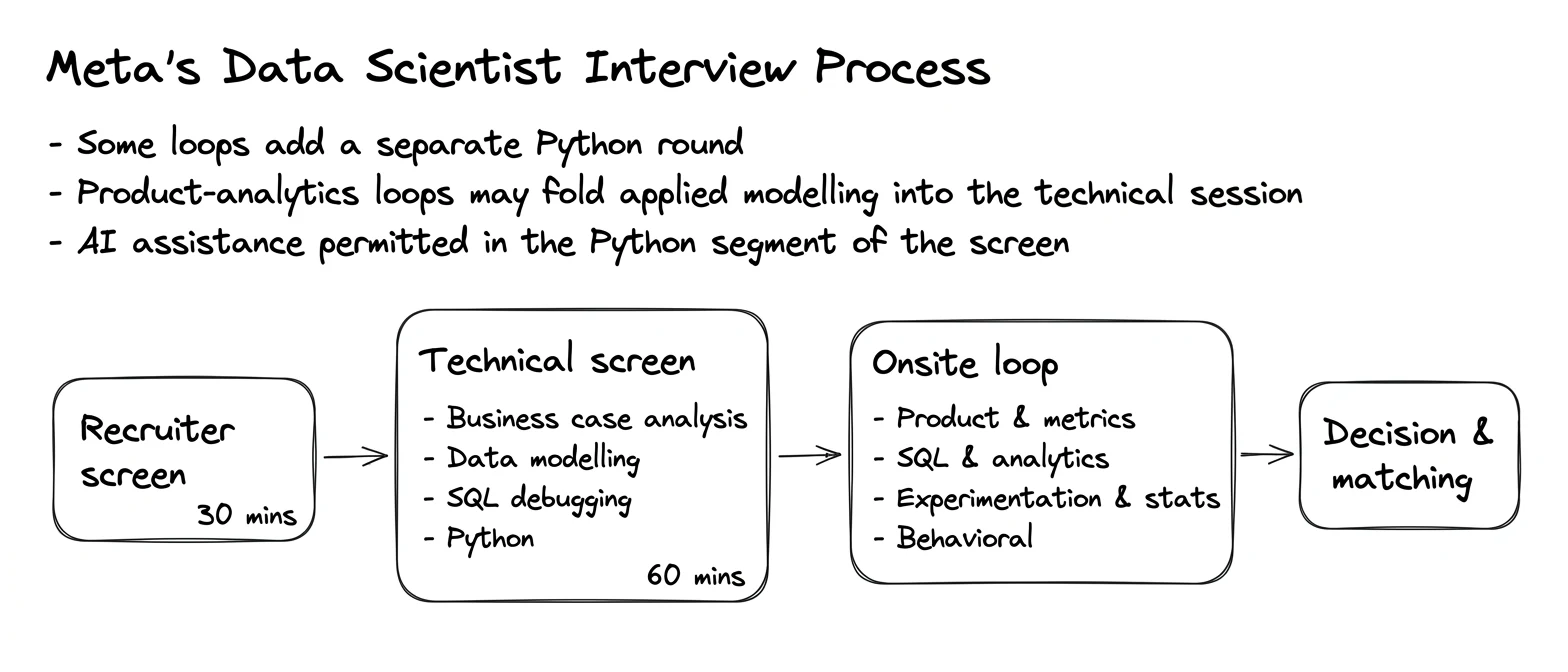
- Recruiter call — typically 30 minutes. Background, level, which product area is hiring (product analytics is the largest), location and timeline. Ask which screen format you will get and whether the loop includes Python, because formats differ by team and level. Offers are typically not team-specific until matching after the loop.
- Technical screen — typically 45 to 60 minutes, shared editor. The screen combines SQL on product-style tables with a product case built on the same data, and you explain your reasoning throughout. Expect joins, CTEs, window functions and aggregations, followed by questions such as what the numbers mean, which metric you would track, and how you would test a change. The richest analytics screen in these reports ran as one integrated hour at a senior level:
- Business case. A deliberately under-specified problem. The expected move is to scope it, ask targeted clarifying questions, define success metrics and name trade-offs before any technical work.
- Data modeling. A star schema with an explicit fact-table grain, a justified partitioning choice, and follow-ups on slowly changing dimensions and late-arriving data.
- SQL debugging. A pre-written query with several defects. Some are plain logic errors. Others are assumptions about clean data that produce wrong totals without raising any error.
- Python. Clean a messy log or transaction dataset into a summary. AI assistance was allowed, and the interviewer said the grade was on judgment, verification and the reasoning behind each decision.
- Full loop — typically four 45-minute interviews. The widely described product-analytics loop is Technical Skills, Analytical Execution, Analytical Reasoning and Behavioral. Some data-track loops in 2026 used an AI-native format instead. One onsite was described as AI-based full-stack work.
- Technical Skills. SQL on a realistic product problem, then a follow-up that uses your query's output to discuss metrics or an experiment. The interviewer checks that the query is correct and that you catch data-quality traps: duplicate rows before a join, nulls that fail a comparison, filters applied at the wrong stage.
- Analytical Execution. Hypotheses for a launch, success metrics, quantitative reasoning and experiment design. Expect probability and statistics in context: sample size, significance, and reading a result that surprises you. A recurring follow-up in these reports is why an offline improvement did not show up online. Distribution shift, feedback loops and calibration are the expected explanations.
- Analytical Reasoning. Product sense on a real surface. Reported themes include comparing metrics to judge whether a dating product has an advantage, and classifying user segments on a photo-sharing app, with features, pitfalls and how you would evaluate the classification. You are graded on structure: the goal, then the users, then the metric plus a counter-metric, then how you would decide.
- Behavioral — 45 minutes. Conflict, ambiguity, influencing a partner who doesn't report to you, and explaining a technical result to non-technical stakeholders. As in other Meta loops this year, expect specific questions about how you use AI tools in your analysis.
- Committee and matching. Feedback is not shared. The process typically runs four to six weeks, and team matching comes after the committee's decision.
What They Actually Evaluate
Coding and Algorithm
SQL is the main language, and debugging counts as much as writing. You need to read a query for its intent and then for the ways the data could break it. Signal comes from saying what you are checking while you check it: the grain before and after each join, how nulls are handled, and whether a filter runs before or after the aggregation. Python is graded on how you handle edge cases in messy data, not on remembering library functions. If you use an assistant, your verification of its output is part of the grade.
- Fix an AI-generated query and address data quality issues
- Average Reactions per Post
- Weekly Churn Rates
- Python Data Processing: Merge two messy sources and compute a summary dictionary
Domain Deep Dive
This covers product sense and experimentation. Interviewers want metrics tied to a product goal, a counter-metric that guards against gaming, and an experiment you could actually run. Candidates lose signal by listing metrics without saying which decision each one would change. They also lose it by treating an offline gain as proof when live behavior can differ. The framing and modeling skills from the screen carry over here: a fact table at the wrong grain usually means the business question was never pinned down.
Behavioral and Leadership
The prompts are conventional, but each answer is pressed for your individual contribution and a number. Because this track sits between engineering and the business, interviewers listen for how you persuaded a partner with data and how you handled a result nobody wanted.
What They Don't Test
- Syntax recall in isolation. The debugging segment gives you someone else's query. What earns credit is reading it for intent and for silent data defects.
- Library memorization in Python. The interviewer said outright that recalling specific functions was not the point. Edge-case handling and reasoning were.
- Building models. Modeling appears only as a discussion of features and evaluation, never as an implementation task.
- Speed to an answer. The business segment rewards not answering yet. Surfacing the ambiguity is the behavior being graded.
The Real Filter
The main rejection path is the product framing at the start of the screen and in Analytical Reasoning. Candidates misjudge it because it sounds like small talk before the technical part. The interviewer leaves out constraints on purpose. The candidates who pass ask what decision the analysis serves, which population and time window count, and what would make the result wrong, and only then choose metrics. Candidates who start answering right away carry an under-specified problem through the modeling, the query and the case.
The second pattern is the SQL defect that raises no error. A query can return a plausible number that is wrong because it assumed clean data. Practice reviewing queries you did not write, and narrate each check out loud.
The third pattern is the offline-to-online gap. It comes up as a follow-up rather than the main question. It separates candidates who can report a metric from candidates who can explain why it moved or failed to. Have a real example ready.
Data Source
Based on 25 candidate-reported interview experiences, primarily from 2026 Q2 through 2026 Q2.
FAQ
What is it like to work as a Data Scientist at Meta?
The reports describe hiring, not the job, and say nothing about pay. What is documented is that product data scientists work alongside product and engineering teams, set a surface's goal metrics, and turn questions into experiments and recommendations. That is why every round comes back to the decision an analysis supports.
What is the culture like?
It is quantitative, direct and focused on impact. In 2026 there is also a push across the company toward AI tooling, which now shows up in analytics interviews as AI-assisted Python and questions about your AI workflow. Layoffs and reassignments this year have also made headcount timing less predictable.
How hard is it to get in?
It is competitive. The screen packs several skills into one continuous hour with no break between them. A strong loop still goes to a committee and then to team matching, and hiring freezes can affect the timing after that.
Which round is hardest?
In the reports that describe it, the integrated technical screen is the hardest, because a weak framing at the start drags down every later segment. Within the loop, Analytical Execution is typically described as the most demanding, especially its experiment-interpretation follow-ups. Behavioral is the most predictable.