Luma AI · Study
Luma AI Interview Process & Questions
TrueInterview
September 4, 2026 · 7 min read
At Luma AI, the first gate is an automated assessment with no interviewer, and it is graded on how much gets finished, not on difficulty. The assessment depends on the track. Machine learning candidates write numerical and image routines with every library import disabled. Software candidates fill in a large, half-written codebase against hidden tests. Later stages are small-company and team-specific: a substantial take-home for product roles, model-debugging rounds for ML roles, and a closing conversation with leadership.
This guide breaks down each stage of the Luma AI interview, what interviewers evaluate in each round, and how to prepare, with questions candidates were actually asked.
Verified: Based on 2 candidate-reported interview experiences, cross-checked against recent public accounts.
Luma AI interview process
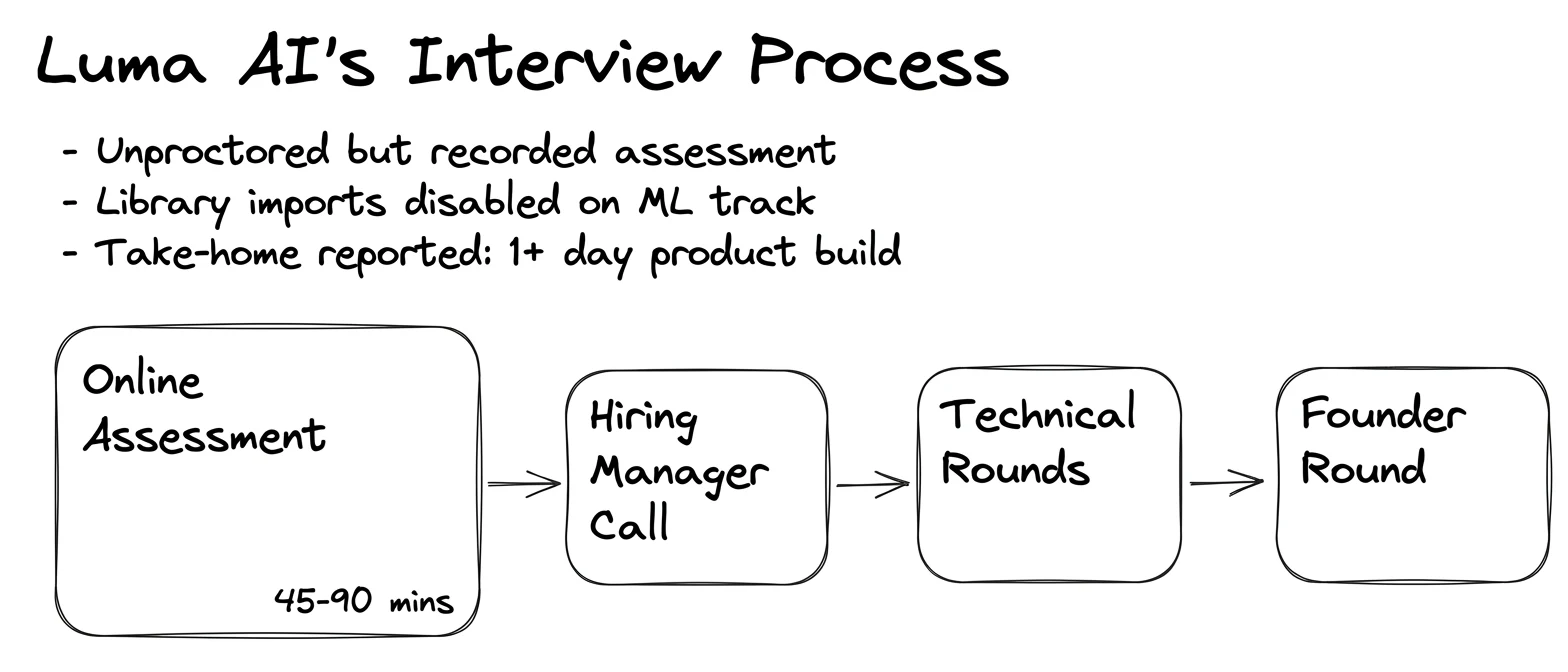
The process is not standardized and splits early by track. Both reported candidates started with an online assessment. One was rejected there, and the other was still waiting on a result, so evidence for the later stages is thinner. Those stages typically include a recruiter call, one or two technical rounds shaped by the team, a take-home for product engineering roles, and a closing conversation with the CEO or CTO. The process typically takes two to four weeks from first call to decision.
Here's what the interview process can look like:
- Machine learning online assessment: One hour, seven short problems, no library imports, scored against a points cutoff.
- Software engineering online assessment: A 45- or 90-minute task that completes partially written code against provided tests.
- Take-home project (product roles): A self-contained build over several hours, followed by a review of the trade-offs.
- Technical rounds: Coding and system design for engineers, plus a past-work walkthrough and hands-on model debugging for ML and research roles.
- Leadership conversation: A closing round with the CEO or CTO on experience and fit.
Tip: Treat both assessments as timed delivery exercises, and finish and verify one unit of work before starting the next. The problems are easy to medium, and advancing depends on how many you complete: about five and a half of seven on the ML set.
Machine learning online assessment
Machine Learning Engineer candidates get one hour for seven problems, with all library imports disabled, so every routine is written from language primitives. The reported set was copying an image, a non-standard transpose, softmax from its formula, a Gaussian image filter, a simple string task, the minimum distance among a set of points, and a long data-processing task with NaN handling and conditional aggregation. Scoring is cumulative. A cutoff of 700 points was cited, roughly five and a half problems fully solved.
Interviewers evaluate:
- Math from scratch: Softmax and Gaussian kernels written without libraries, including numerical stability, such as subtracting the maximum before exponentiating.
- Index discipline: Image copies, transposes and convolution windows with correct edge handling.
- Data hygiene: NaN handling and conditional aggregation done exactly as specified.
- Throughput: Enough problems fully solved to clear the cutoff.
Practice writing array, image and numerical routines in plain code, timing yourself at under ten minutes each.
Note: The data-processing problem is the longest in the set. Solve the short image and math problems first. Partial credit across many problems scores worse than complete solutions to most of them.
Sample questions for the machine learning online assessment
Here are some questions reported by recent candidates:
-
Implement softmax directly from its formula, with no numerical libraries.
-
Apply a Gaussian filter to an image represented as nested lists.
-
Find the minimum pairwise distance among a set of 2D points.
-
Clean a tabular dataset with missing (NaN) values and compute conditional aggregates.
Software engineering online assessment
Software candidates take an unproctored, automated refactoring assessment. Camera and screen recording stay on throughout, and AI tools are banned. You get a requirements document and partially implemented code, and you add the missing behavior until the provided tests pass. There are two versions. The 45-minute one is a graph and recursion task, a simplified itinerary reconstruction. The 90-minute one is a multi-layered, versioned key-value store that ships with a very large volume of code. Neither needs heavy algorithms, and both sit below medium difficulty. The reported candidate wrote Java.
Interviewers evaluate:
- Requirement extraction: The edge cases and error conditions buried in a layered prompt.
- Codebase navigation: Finding the methods you own inside a heavily commented skeleton, and leaving the regions marked do-not-modify alone.
- Error handling: Exact behavior on the invalid inputs the description names.
- API fluency: Map and list operations written without looking anything up.
Practice completing someone else's half-finished code against unit tests with a hard stop.
Note: Style and performance do not appear to count. The tests check behavior, so brute force and convenience shortcuts are fine. The rejected candidate spent at least ten minutes just understanding the prompt, worked in a cramped split-screen editor with no global search-and-replace, and ran out of time on both versions.
Sample questions for the software engineering online assessment
Here are some questions reported by recent candidates:
-
Complete a multi-layered key-value store that keeps versions of nested values and answers lookups as of a given version.
-
Finish a recursive graph traversal that builds a route from a list of edges, following the stated tie-breaking rules.
Take-home project
Product and full-stack candidates are typically given a substantial take-home. Reported versions offered a choice among several prompts covering frontend, backend and infrastructure, with a budget of roughly eight to twelve hours. Staff-level candidates were asked to build a deployable end-to-end product with documentation and a recorded walkthrough, and to submit their AI-assistant session history. A follow-up review covers the trade-offs, scaling limits, customer needs and UI choices.
Interviewers evaluate:
- Shipping: A working, deployed product rather than a polished fragment.
- Product judgment: Who the user is and why each feature exists.
- Trade-off reasoning: What breaks at scale and what you would build next.
- Use of AI tools: How you directed the assistant, since the session history may be reviewed.
Scope the take-home to something you can finish and deploy, and write down the trade-offs as you go.
Sample questions for the take-home project
Here are some questions reported by recent candidates:
- Build and deploy a small end-to-end product from one of several prompts, with docs and a video walkthrough.
- In the review, explain how the design would hold up at scale and what you would change for real customers.
Technical rounds
Later technical rounds come from the team's actual work rather than a generic question bank. Engineers typically get coding and a system design round, which turns into ML systems design for roles that touch training or serving infrastructure. ML and research candidates walk through past work and do hands-on model rounds, such as debugging a denoising network in a notebook. Expect questions on diffusion, samplers and video model trade-offs.
Interviewers evaluate:
- Practical debugging: Finding why a model or pipeline misbehaves, quickly and methodically.
- Generative model depth: Diffusion training and sampling, guidance and video-specific architecture choices.
- Serving awareness: GPU scheduling, latency and throughput for large models.
- Ownership: A concise account of one or two systems you shipped, with real results.
Prepare one deep project walkthrough and refresh diffusion fundamentals before these rounds.
Sample questions for the technical rounds
Here are some questions reported by recent candidates:
- Debug a denoising network in a notebook and explain each fix.
- In a build-style design round, design a ride-hailing service end to end, then discuss how it scales.
How Luma AI makes hiring decisions
Assessments are scored automatically and give no feedback. After the assessment, the hiring team and leadership decide together, and most loops close with the CEO or CTO. Some candidates reported slow follow-up and generic rejections after substantial take-homes.
How to prepare for the Luma AI interview
- Write the math without imports: Softmax with max subtraction, Gaussian kernels, and copy, transpose and filter loops with correct edges.
- Finish before moving on: Cumulative scoring rewards completed problems, so verify each one before opening the next.
- Practice inside half-built code: Locate the editable regions, ignore decorative comments and avoid refactoring code the tests do not cover.
- Read for error cases, skip optimization: List every failure mode in the prompt before coding. Brute force passes.
- Scope the take-home to ship: Deploy something complete and document its trade-offs.
- Refresh diffusion basics (ML roles): Samplers, guidance and debugging a training run.
About working at Luma AI
Luma AI builds multimodal generative models, including the Ray3 video model behind Dream Machine. A $900M Series C in late 2025 funded large-scale training and expanded hiring. Teams are small, and engineers work close to the models, from training and evaluation to serving and the product.
Luma AI hires engineers across research and product. Teams include:
- Research and ML engineering: Training and evaluating video and multimodal models.
- Infrastructure and reliability: Model serving pipelines, GPU resource management and large-scale training stability.
- Data infrastructure: Pipelines that feed training and evaluation.
- Product engineering: Customer-facing apps, APIs and AI agent features.
- Forward deployed engineering: Deploying Luma's models with customers and partners.
Experience and education requirements
Product engineering postings ask for two or more years of professional software engineering experience. One posted hybrid Bay Area range was $168K to $252K base. ML and research roles expect hands-on deep learning experience, ideally with diffusion or video models, and strong coding. Infrastructure roles weight distributed systems and GPU work.
FAQs about the Luma AI interview
How long does the Luma AI interview process take?
Typically two to four weeks from the first call to a decision. A take-home adds several days.
What is the hardest round of the Luma AI interview?
The online assessment, because of time rather than difficulty: the rejected software candidate found both versions simple but could not finish either. Staff and research engineer loops are considered the hardest overall.
What language should I use?
Use the one whose map and list APIs you know without looking anything up. The software candidate chose Java and found its verbosity costly under the clock.