LinkedIn · Study
LinkedIn Software Engineer Interview Process
TrueInterview
July 24, 2026 · 14 min read
LinkedIn grades how code reads, not just whether it works, often in rounds where nothing is compiled. Many loops run every coding session as a whiteboard or shared-editor exercise with a spoken dry run, and one junior candidate who solved everything was rejected mainly over naming and structure. Many loops also add an AI-assisted coding round, which in these reports sinks more candidates than the algorithms do. Leveling is the third filter: Staff and Senior Staff applicants have been offered one level lower after clearing the technical bar because their stories lacked the target scope. A rejection carries a one-year cooldown.
This guide breaks down each stage of the LinkedIn Software Engineer interview, what interviewers evaluate in each round, and how to prepare, with questions candidates were actually asked.
Verified: Based on 42 candidate-reported interview experiences, primarily from 2025 Q4 through 2026 Q3, cross-checked against recent public accounts.
LinkedIn Software Engineer interview process
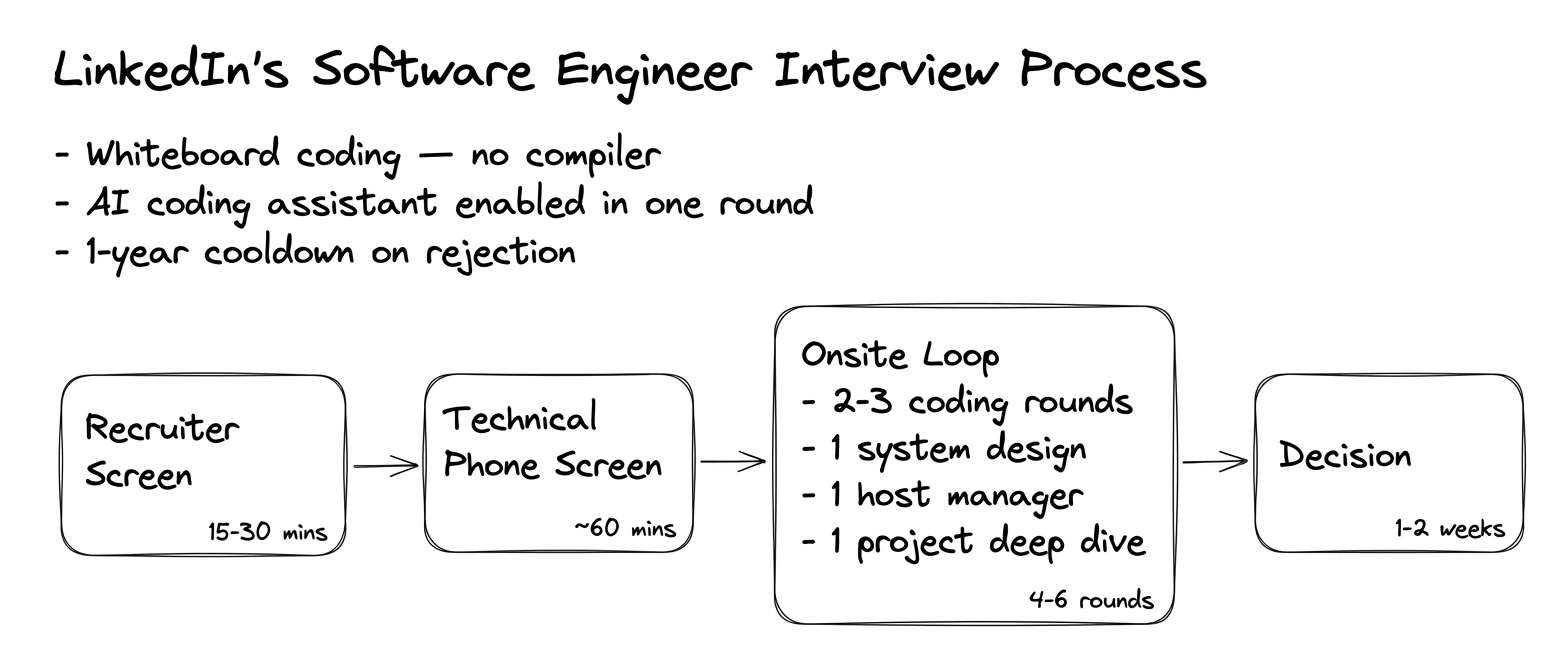
LinkedIn hires engineers into specific teams, with postings split into application and systems or infrastructure tracks. The usual shape is a recruiter call, one technical phone screen, and a virtual or on-campus onsite of four to six rounds of 45 to 60 minutes, over four to eight weeks. Some pipelines add a proctored assessment; one ran four phone rounds instead of an onsite day.
New-grad loops lean on coding and one design round. Senior loops add a project deep dive and a host manager who probes scope. At Staff, the phone screen often packs behavioral, coding and design into one hour, and the loop can carry two design rounds.
Here's what the interview process can look like:
- Recruiter screen: A 15-to-30-minute call on background, team, level, location and timing.
- Online assessment (some pipelines): Webcam-proctored code-style multiple choice plus one implementation problem.
- Technical phone screen: About an hour: often a behavioral opener, then one to three coding problems.
- Coding interviews (two or three): Medium problems that change mid-round, usually without running code.
- AI-assisted coding interview: A familiar task built with an assistant in the editor, then reviewed, tested and extended.
- System design interview (one or two): A data-intensive design, often bounded to one machine or subsystem.
- Project deep dive and craftsmanship: A past project defended on a whiteboard, or a talk on quality and engineering values.
- Host manager interview: 45 minutes on motivation, ratings, promotions and measured results.
Tip: Write every solution as code someone will review: descriptive names, small functions, then a spoken trace of one normal and one edge case, because that trace replaces running tests in most rounds.
Recruiter screen
The call covers background, motivation, target level, location and timing; outreach, referral and cold applications lead to the same loop. Ask which organization the requisition sits in: one candidate learned during the onsite that the recruiter's team description did not match what the host manager wanted. Scheduling is the weakest link, with a week of silence after sending availability, slots booked verbally with email to follow, and last-minute reshuffles.
Some pipelines add an assessment. One webcam-proctored version had five multiple-choice questions on TypeScript style, then a matrix class with cell updates and submatrix sums driven by parsed text commands; a prefix-sum approach passed.
Interviewers evaluate:
- Team fit: A reason for this team, not just for LinkedIn.
- Level evidence: Scope that justifies the level; down-level talks can start here.
- Logistics: Location, timing and competing processes.
- Input handling in the assessment: Turning raw command lines into calls is graded.
Prepare a two-minute summary pitched at your target level and ask exactly which round types your loop contains.
Sample questions for the recruiter screen
Here are some questions reported by recent candidates:
- Tell me about yourself and your current role.
- Why LinkedIn, and why this team?
- Implement a matrix class supporting set(row, col, value) and submatrix sums, reading operations from input commands.
Technical phone screen
The screen runs about 60 minutes in a shared editor, sometimes with a silent second interviewer. Many open with 10 to 15 minutes on a project or behavioral stories, which squeezes coding time. Expect one to three problems: top-k frequent words, iterative traversal pushed toward Morris traversal, LRU cache with thread-safe tests, max stack, parentheses with one bracket type then three, shortest word distance, nested list weight sum, sometimes a SQL query. Entry-level screens have opened with DNS and load-balancer basics.
Many prompts are custom. One was a cache evicting the lowest-ranked item, with ties broken by least recent access. Another was a meeting scheduler improved to logarithmic search with a segment tree, then made thread-safe for heavy writes. A third was insert-delete-getRandom with duplicates, where the candidate described tests instead of coding, then added per-item expiry. One Senior screen combined ML basics, a recruiter-messaging design and three coding problems; that candidate was rejected on this round alone.
Interviewers evaluate:
- Optimal complexity: A working but suboptimal answer does not reliably pass.
- Rigor: Some want a proof, such as why the median minimizes total distance on a line.
- Adapting to follow-ups: Rank updates, expiry and concurrency added without a restart.
- Testing discipline: Edge cases and invariants, sometimes instead of code.
Practice medium problems in a plain editor within 35 minutes, leaving time for a follow-up that changes one constraint.
Tip: Questioning the premise is rewarded. A candidate who argued that evicting purely by rank was a poor default and proposed a pluggable policy was told no one had raised it before; the round ended early with all material covered.
Sample questions for the technical phone screen
Here are some questions reported by recent candidates:
-
Build a fixed-size cache that evicts the lowest-ranked entry, breaking ties by least recent access, then support rank changes.
-
Design a max stack and say how it changes if popMax is rare.
-
Find the point minimizing the sum of distances to points on a line and prove it, then place k routers to minimize squared distances.
-
Insert/Delete/GetRandom in O(1) with TTL per item (follow-up)
Coding interviews
Onsites have two or three coding rounds, and several candidates reported that every one was whiteboard plus verbal dry run. Problems are medium fundamentals with a mid-round twist: two-sum becomes two-product, a binary tree merge becomes an N-ary merge keyed by label and then serialization, islands moves to a grid too large for memory, smallest-sum pairs become smallest-product pairs. Staples include linked-list intersection in O(1) space, inclusive and exclusive task time, BST lowest common ancestor both ways with a correctness argument, LFU cache, and a uniform 0-to-6 generator from a biased coin.
Some rounds are original: counting distinct values in a sorted array of billions with a few hundred distinct values by skipping runs with binary search, ranked-choice voting, a config parser feeding dependency impact analysis, a robot exploring an unknown grid, and pow(x, n), where negating the smallest integer overflows. One round fit four short problems back to back.
Interviewers evaluate:
- Code quality as its own axis: Naming and decomposition count even on a whiteboard; a correct but messy solution led to a rejection.
- Edge-case rigor: Overflow, ties at equal distance, empty input.
- Re-deriving under a new constraint: Changing the invariant, not replaying a memorized answer.
- Scale follow-ups: "Too large for memory" is close to a default question.
Practice trees, graphs, intervals, heaps and caches, then rework each with one constraint changed, written by hand with a spoken trace.
Note: Working solutions are not enough. A candidate rejected without obvious failures noted that optimal complexity was expected on the phone screen and on the N-ary generalization; treat every round as equally weighted.
Sample questions for the coding interviews
Here are some questions reported by recent candidates:
-
Merge two N-ary trees whose children are matched by key, letting the second tree's values win, then serialize the result.
-
Compute each task's inclusive and exclusive time from start and end events in one stack pass.
-
Find the k elements closest to a target in a sorted array, then handle an unsorted array and one too large for memory.
AI-assisted coding interview
Many recent loops, and a few phone screens, include a round with an AI assistant enabled in the editor. The most common task is an LRU cache: generate a scaffold, review it, generate tests, fix failures, then discuss locking granularity without the tool. Variants split the cache into four steps (plain, with expiry, an extension, thread-safe), add hit and miss counters with a predicted hit ratio, or swap in grid shortest path, a meeting-slot finder, or a multi-part aircraft turnaround problem.
The rules vary, so confirm them. Some interviewers grade prompting and verification; in another loop, the recruiter and interviewer both said the algorithm must be the candidate's. One interviewer told a candidate partway through to stop using the assistant on the harder sub-problem.
Interviewers evaluate:
- Ownership of the algorithm: You choose the approach; the tool writes boilerplate.
- Review discipline: Catching generated bugs, like eviction that never removes the map entry, before running anything.
- Throughput: Finishing two of four sub-tasks was named as one rejection reason.
- Unaided fallback: Concurrency follow-ups and the moment the tool is removed.
Practice building an LRU cache with expiry and thread safety alongside an assistant in 45 minutes, reviewing every generated line.
Note: The tool can sink the round. One candidate lost about 15 minutes to an extension that loaded the wrong model and hung while the interviewer did not intervene; another kept overriding off-plan suggestions. Narrate your choices and be ready to type the core logic yourself.
Sample questions for the AI-assisted coding interview
Here are some questions reported by recent candidates:
-
Use the assistant to draft an LRU cache, test it, add expiry, then compare coarse- and fine-grained locking.
-
Implement an LRU cache with hit and miss counters and predict the hit ratio under several access patterns.
-
Find the earliest start minute for a meeting among unsorted, overlapping half-open bookings in a 1,440-minute day.
System design interview
Most loops have one design round and Staff loops often two. Prompts are data-intensive and often scoped down: a single-machine key-value store over 100,000 append-only files and a billion keys with only the index in memory, a metrics platform with alerting explicitly excluded, a job scheduler listing everything due in the next N hours under heavy writes, top-k exceptions, and malicious-IP blocking at an API gateway across data centers. Others: calendars with recurring events and time zones, news feed, typeahead, user activity by minute, hour or day, and a NoSQL store scaled to a million queries per second at a 50/50 read-write split.
Domain prompts appear as well: an LLM recruiter-message generator, job-posting classification, and a CI scheduler with follow-ups on whether code changes are pushed or pulled.
Interviewers evaluate:
- Scoping to the prompt: Respecting stated exclusions such as no alerting.
- Numbers before boxes: Key counts, value sizes and write rates driving storage choices.
- Read and write paths: Including recovery and compaction.
- Explicit trade-offs: Push versus pull fanout with read-your-own-writes, approximate versus exact counts.
- Shared vocabulary: Component names agreed early.
Practice bounded designs (single-box storage, time-windowed counters, schedulers, calendars) at full depth.
Tip: Name components in the first two minutes. One candidate said "aggregator" while the interviewer meant "collector," spent minutes at cross purposes, and never reached sharding.
Sample questions for the system design interview
Here are some questions reported by recent candidates:
-
Design a key-value store on one machine over 100,000 append-only files and a billion keys whose values cannot fit in memory.
-
Design a calendar with recurring events, exceptions and time zones, and compute occurrences for a window.
-
Design malicious-IP blocking at the API gateway, then extend it across data centers.
Project deep dive and craftsmanship
Most loops include a round about your own work. In the technical communication version you draw a simple architecture diagram and explain it; the deep dive then probes decisions, your contribution, success metrics and what you would rebuild. A craftsmanship round, where present, has no code: one opened with what success means to you, then covered quality standards, ownership, technical debt and mentoring.
Interviewers evaluate:
- Clarity: A diagram and narrative a peer can follow.
- Personal contribution: What you decided, not what the team shipped.
- Trade-off reasoning: Why this database or rollout, and what you rejected.
- Measured outcomes and values: Success metrics, tests, reviews and mentoring as real practice.
Choose one project you can whiteboard in five minutes and defend for forty.
Sample questions for the project deep dive and craftsmanship
Here are some questions reported by recent candidates:
-
Present your most impactful project with a diagram, then explain what fails first at scale.
-
What does success mean to you in software engineering?
-
Explain a Project with a Diagram and Deep Dive into Your Design
Host manager interview
This 45-minute round is blunter than most behavioral interviews. Managers ask about your latest performance rating, promotion attempts, how your week splits across coding, design and mentoring, a cross-team disagreement, a mid-project pivot, useful feedback, and what your next role must offer. One asked "so what was the result?" after every story. Some add design, such as organization-wide monitoring or reducing stale job postings; on a developer-infrastructure team it became CI/CD domain questions.
Interviewers evaluate:
- Scope at the target level: Multi-team influence for Staff, not just strong execution.
- Concrete results: Every story ends with a number.
- Candor: Ratings, promotions and failures discussed plainly.
- Motivation and domain fit: A specific reason for this team and its area.
Prepare six to eight stories with measured endings, each pitched at the level you want.
Sample questions for the host manager interview
Here are some questions reported by recent candidates:
-
What was your last performance rating, and how have your promotion attempts gone?
-
Tell me about unblocking yourself on the critical path with no one to turn to.
-
What do you want in your next role that your current job cannot provide?
-
Define Project Success, Handle Direction Changes, and Apply Feedback
How LinkedIn levels and evaluates Software Engineer candidates
Interviewers file independent feedback and the hiring team decides, usually one to two weeks after the onsite; one candidate was rejected the next day, others heard nothing. Reasons shared were brief: code quality, an unfinished AI task, stories that undersold impact.
Level is judged across the loop, mostly in the host manager round. A Staff applicant got a Senior offer after strong technical rounds because the stories lacked Staff scope; a Senior Staff applicant was moved to Staff before the loop. A 2026 interviewer mentioned a hiring freeze, and LinkedIn cut about 5% of staff in mid-2026. Rejection brings a one-year cooldown.
Tip: Prepare your flagship project at two altitudes: execution detail for engineers, and cross-team influence with a business result for the manager who sets your level.
How to prepare for the LinkedIn Software Engineer interview
- Write code for review: Clean names and structure plus a spoken trace, since most rounds never run code.
- Practice mutated classics: Solve each staple with one changed constraint: N-ary keys, products, streams, data beyond memory.
- Rehearse the AI round as a workflow: Plan, generate, review, test, fix, and be ready to drop the tool mid-task.
- Master stateful structures: LRU, LFU, max stack, rank-based eviction, expiring random sets, interval schedulers, and thread-safe versions.
- Bring proofs: Argue why the median minimizes distance and why rejection sampling is uniform.
- Drill bounded designs: Single-box storage, windowed counters, lookahead schedulers, time-zone-aware calendars, gateway blocking.
- Pitch stories at your target level: Your decision, alternatives, cross-team influence, and a number.
- Pin down your loop: Confirm the round types, AI rules and team before the onsite.
About the LinkedIn Software Engineer role
LinkedIn engineers build the feed, search, messaging, jobs and learning products and the platforms beneath them. LinkedIn created Kafka, its services are largely Java, and Espresso and Venice serve online and derived data. LinkedIn is owned by Microsoft and headquartered in Sunnyvale, with engineering in other US offices such as Seattle.
| Level | Primary focus | Impact scope |
|---|---|---|
| Software Engineer | Well-scoped features; the usual new-grad entry | A component of one team |
| Senior Software Engineer | Features and services owned end to end | A team's systems |
| Staff Software Engineer | Technical leadership across projects | Several teams |
| Senior Staff Software Engineer | Direction for a product or platform area | An organization |
| Principal Staff Software Engineer | Architecture and standards | Multiple organizations |
LinkedIn hires Software Engineers across product and platform organizations. Teams include:
- Feed: Feed infrastructure, timelines and ranking for the home feed.
- Talent and jobs: Job postings, recruiter tools and candidate messaging.
- Search: People, job and content search and typeahead.
- Data infrastructure: Kafka streaming and storage such as Espresso and Venice.
- Developer productivity: CI/CD, builds and internal tooling.
- Trust and security: Abuse and malicious-traffic detection.
Software Engineer experience and education requirements
Postings ask for a bachelor's in computer science or equivalent experience, with strong data structures, algorithms and design. Senior postings commonly ask for about four years of Java or C++, Staff about eight; an advanced degree can offset some years. Candidates used mainstream languages such as Python, but one interviewer could not follow a Python-specific derivation, so explain reasoning plainly.
FAQs about the LinkedIn Software Engineer interview
How long does the LinkedIn Software Engineer interview process take?
Typically four to eight weeks, with a decision one to two weeks after the onsite.
What is the hardest round of the LinkedIn Software Engineer interview?
For mid-level candidates, coding: optimal complexity, clean structure and a mid-round change in 45 minutes without a compiler. For Senior and Staff, the host manager round and project deep dive, where levels are set.
Is there an AI-assisted coding round?
In many recent loops. It uses a familiar problem, usually an LRU-style cache. Confirm whether the algorithm must be yours, and expect concurrency follow-ups without the tool.
Can you be down-leveled?
Yes, commonly at Staff and above, when stories show individual execution rather than multi-team influence. Recruiters have also proposed a lower level before the loop.
How are offers structured?
Base salary, an annual bonus, and stock units vesting over four years, the first portion after one year. Postings in pay-transparency states list a base range.