LinkedIn · Study
LinkedIn Machine Learning Engineer Interview Process
TrueInterview
July 24, 2026 · 11 min read
LinkedIn's machine learning loop hides its hardest questions behind easy prompts. A coding problem solved in two minutes, such as finding the point on a line that minimizes total distance, is graded on the proof that follows, and one Staff candidate with a flawless implementation was offered Senior because the derivation wobbled. Probability and sampling run through every stage, and the design rounds are built on LinkedIn's own member, job and skills data, where a data and labeling story beats a model architecture. Behavioral scope is scored as hard as code: two recent Staff applicants were down-leveled to Senior.
This guide breaks down each stage of the LinkedIn Machine Learning Engineer interview, what interviewers evaluate in each round, and how to prepare, with questions candidates were actually asked.
Verified: Based on 9 candidate-reported interview experiences, primarily from 2025 Q4 through 2026 Q3, cross-checked against recent public accounts.
LinkedIn Machine Learning Engineer interview process
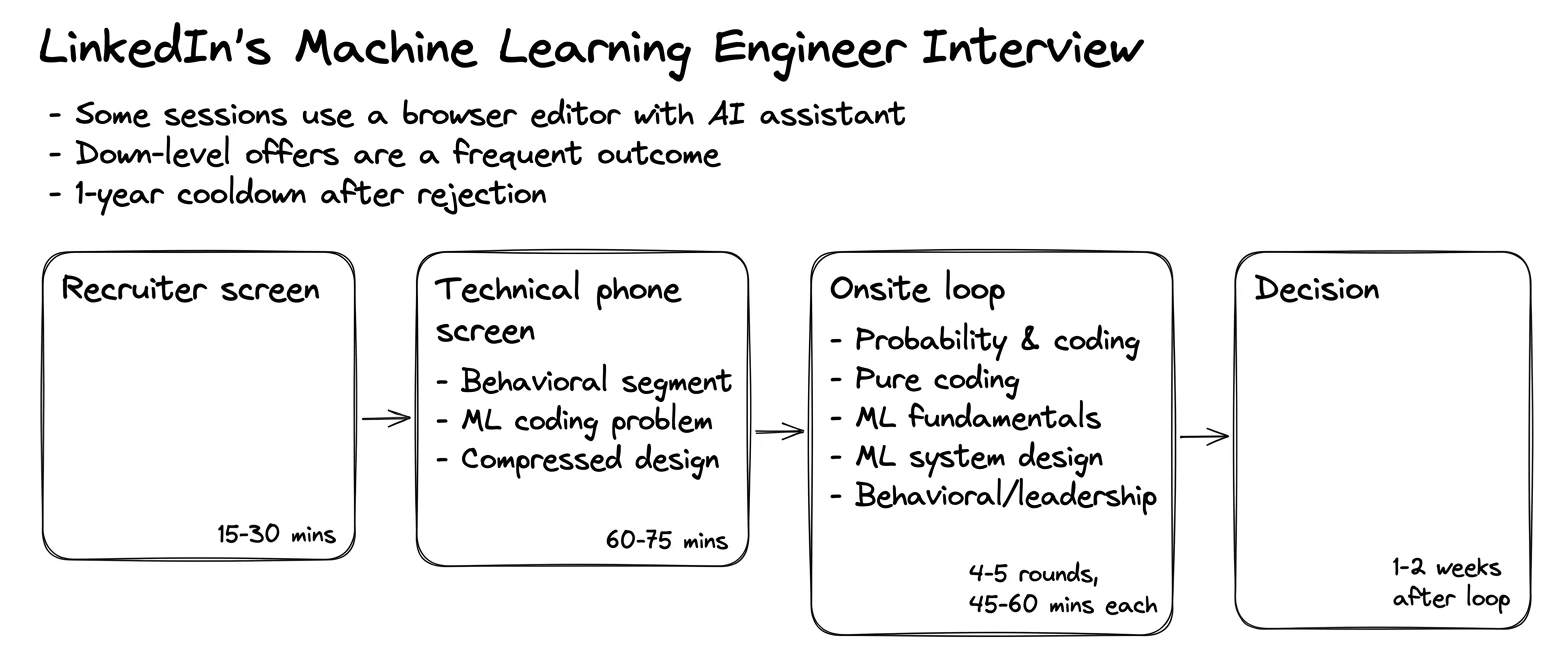
The loop varies more by team than by title: product relevance, platform and applied AI teams hire under the same machine learning or AI engineer titles, and their prompts diverge. The common shape is a recruiter call, one consolidated technical screen (one candidate sat four separate screens instead), and an onsite of four or five rounds of 45 to 60 minutes. Some loops compress the onsite into a single blended session of project discussion, coding and theory. Most reports are Staff-level, where technical leadership and project planning are added on top; Senior candidates face the same round types with less weight on cross-team influence.
Here's what the interview process can look like:
- Recruiter screen: A short call on background, target level, team and timing.
- Technical phone screen: About an hour mixing behavioral questions, an ML-flavored coding problem and a compressed design discussion.
- Probability and sampling interview: Simulating random variables from a given distribution, with escalating follow-ups.
- Coding interviews (one or two): Medium algorithms plus ML code written or debugged from scratch.
- ML fundamentals interview: A fast, derivation-heavy pass across classical ML, deep learning and statistics.
- ML system design interview: A product problem on LinkedIn's data, such as skills extraction or job classification.
- Behavioral and leadership interview: Conflict, mentoring and prioritization stories, plus project planning at Staff.
Tip: Prepare the proof behind every classic you consider trivial. Why the median minimizes absolute distance, why rejection sampling from a biased coin is unbiased, and why the alias method samples in constant time all decided outcomes.
Technical phone screen
After a short recruiter call on level, team and timing, the screen usually runs about an hour and is consolidated: a behavioral segment, an ML-flavored coding problem and a mini design discussion, sometimes with a second interviewer shadowing. One Staff candidate who later received an offer had about 20 minutes left to design a ranking system. Coding prompts are short to state: a uniform integer from 0 to 6 using a coin of unknown bias, multinomial sampling with prefix sums and binary search, stratified sampling over class-grouped JSON records, or the L1 meeting point followed by placing K routers to minimize squared distance. Scheduling can be slow, with a reschedule and a week of waiting reported.
Interviewers evaluate:
- Correctness of the randomness: Explaining why each outcome has exactly the target probability, not only code that runs.
- Follow-up readiness: Normalizing weights that do not sum to one, or building a biased coin from a fair one via binary expansion.
- Compressed design structure: Data, features, model, serving and evaluation named in the first two minutes.
- Behavioral specifics: A cross-team conflict or a broken process you fixed, with your personal impact.
Practice short sampling problems in 25 minutes, leaving time to state the proof aloud.
Note: The coding problem can be a statistics question in disguise. One candidate solved the median meeting point with quickselect and was still down-leveled from Staff to Senior because the optimality proof was shaky.
Sample questions for the technical phone screen
Here are some questions reported by recent candidates:
-
Using only a coin with unknown bias, return integers 0 through 6 each with probability one seventh.
-
For a target user in a movie-ratings matrix, find the k most similar users and predict a missing rating.
-
Design a LinkedIn Learning recommendation system in a few minutes, focusing on features from job posts.
Probability and sampling interview
The most distinctive round in the track. The reported flow starts with simulating an M-sided die with given probabilities via a cumulative array and binary search, then asks what to do when the probabilities do not sum to one, then how to handle a huge but concentrated distribution, where the alias method and precomputed lookup tables are the expected answers. A second prompt in the same hour asked for a uniform point inside a circle, deriving the square-root transform on the radius rather than reciting it.
Interviewers evaluate:
- Derivation over recall: Showing why uniform radius sampling clusters points near the center.
- Complexity trade-offs: Logarithmic binary search against constant-time alias sampling and its preprocessing cost.
- Edge handling: Zero weights, unnormalized inputs and floating-point drift in the cumulative array.
- Engineering judgment: Exploiting a skewed distribution instead of treating every side equally.
Rehearse inverse-CDF, rejection and alias sampling until you can derive each on a whiteboard.
Sample questions for the probability and sampling interview
Here are some questions reported by recent candidates:
-
Simulate a weighted M-sided die, then handle probabilities that do not sum to one.
-
The probability list is huge but most mass sits on a few sides; make sampling fast.
-
Sample a point uniformly from the area of a circle and justify the transform.
Coding interviews
One or two rounds of medium algorithms judged on optimal complexity: an O(n) monotonic-stack problem, word ladder followed by why a deque beats a list for the BFS queue, and interval merging. The second flavor is ML code from scratch: a sparse vector and matrix class where any O(M*N) work or dense allocation disqualifies, debugging a logistic regression trainer, or completing a recommender trainer that turns profile and click data into embedding features. Some rounds run in an editor with an AI assistant enabled; one candidate lost about 15 minutes to an assistant that loaded the wrong model and froze the session.
Interviewers evaluate:
- Optimal complexity without hints: Needing a nudge to reach the intended bound reads as a miss at Staff.
- Mathematical completeness: One candidate found the logistic regression bugs but left the gradient unsimplified and was rejected.
- Readable code: One candidate was told directly to replace single-letter variable names.
- Handling shifting scope: Restating the goal when an interviewer switches mid-round, as from data loading to a hand-written MLP and back.
Practice graph, stack and interval mediums alongside ML code in plain Python with no library calls for the core math.
Note: The logistic regression bugs were textbook ones: a gradient that ignored the labels, a sigmoid derivative applied to the pre-activation, and a loss missing its negative-class term. Knowing the standard forms cold leaves time to finish the derivation.
Sample questions for the coding interviews
Here are some questions reported by recent candidates:
-
Implement sparse vector and matrix multiplication from scratch without dense storage.
-
Find and fix three bugs in a logistic regression trainer, then derive and simplify the gradient.
-
Complete a recommender trainer that turns member profiles and clicked or skipped items into features.
ML fundamentals interview
One round, plus follow-ups seeded through every other round. Reported coverage: activation functions compared head to head (ReLU, sigmoid, SwiGLU, SiLU), loss choice per problem setting, Adam internals including bias correction, feature selection by filter, wrapper and embedded methods, calibration with Platt scaling and isotonic regression, and tokenization with BPE and WordPiece. On statistics: the MLE for a normal distribution, why it cannot be applied directly to a Gaussian mixture, and how EM works. A model you volunteer, such as random forests, draws hyperparameters, a boosting comparison and overfitting controls.
Interviewers evaluate:
- Derivations on demand: Writing the likelihood and solving it, not naming the result.
- Depth on your chosen model: Internals, failure modes and alternatives.
- Precision on basics: One candidate explained overfitting correctly but was marked down for lacking concrete examples.
- Current awareness: Recent AI developments came up unannounced in one round.
Prepare one-page derivations for MLE, EM, Adam and calibration, and pick one model you can defend to the last hyperparameter.
Sample questions for the ML fundamentals interview
Here are some questions reported by recent candidates:
-
Derive the MLE for a normal distribution, explain why it fails for a Gaussian mixture, and walk through EM.
-
Compare Platt scaling and isotonic regression for calibrating probabilities.
ML system design interview
Prompts come from LinkedIn's own products and lean on classical modeling more than prompt engineering: mining skill tokens from profiles and resumes and deciding which are genuine skills, classifying job postings and creating new categories when none fit, building a job category table with multi-class logistic regression, generating recruiter outreach with retrieval plus a language model, and cutting latency in a recommendation system from both the infrastructure and modeling side. A feed prompt pushed on pointwise, pairwise and listwise ranking; an ads bidding prompt asked for an ML forecasting pipeline behind the pacer.
Interviewers evaluate:
- Data and labels first: Where labels come from, how noisy they are, and how cold start is handled.
- Formulation flexibility: One rejected candidate was faulted for not reaching one-versus-rest immediately.
- ML alongside rules: A rule-based ads pacer was accepted, but a missing ML forecast pipeline drew negative feedback.
- Serving and evaluation: Latency budgets, offline-to-online metrics and retraining loops.
Practice skills, jobs and feed designs out loud, each starting from the data rather than the model.
Sample questions for the ML system design interview
Here are some questions reported by recent candidates:
-
Design LinkedIn Skills: extract candidate skill tokens and decide which are real skills.
-
Classify new job postings into categories, creating new ones when none fit.
-
Design a personalized feed and compare ranking objectives.
Behavioral and leadership interview
At least one full round, plus a behavioral opener in most screens: conflict between two teams resolved without escalation, a mentoring relationship that failed, a hard-deadline cut and how it was communicated, and a broken process you fixed. At Staff, one loop added planning a recommendation feature end to end: scope, team size, milestones and dependencies. Interviewers may steer to older projects; one candidate never got to present a recent language-model project.
Interviewers evaluate:
- Organizational impact: Feedback cited stories describing what was built but not its wider impact.
- Level-appropriate scope: Staff stories must show multi-team influence, not strong personal execution.
- Planning realism: Milestones, staffing and dependencies for a feature you would lead.
Prepare each project at two altitudes, personal contribution and organizational impact, and lead with impact.
Sample questions for the behavioral and leadership interview
Here are some questions reported by recent candidates:
-
Describe a conflict between two teams with competing priorities and how you aligned them.
-
Tell me about a mentoring relationship that failed and what you changed.
How LinkedIn levels and evaluates Machine Learning Engineer candidates
Feedback is pooled after the loop and sets both the decision and the level. Down-leveling is a frequent outcome: of two recent Staff applicants who received offers, one landed at Senior for a shaky proof and the other for behavioral stories pitched below Staff scope. Detailed feedback is uncommon, though several candidates heard specific notes on naming, derivations or missing ML pipelines. A rejection carries a one-year cooldown.
Tip: At Staff, treat the behavioral round and the proof follow-ups as level-setting rounds; strong code alone tends to land at Senior.
How to prepare for the LinkedIn Machine Learning Engineer interview
- Master sampling end to end: Inverse CDF, rejection sampling from a biased coin, the alias method and the circle-area transform, each with its proof.
- Prove the classics: Why the median minimizes L1 distance, and correctness arguments for routine algorithms.
- Write ML code without libraries: Sparse linear algebra and logistic regression with a fully simplified gradient.
- Keep algorithms sharp: Stacks, BFS, intervals and quickselect still eliminate strong modelers.
- Build a derivation sheet: MLE, EM, Adam bias correction, calibration and tokenization.
- Design from the data: Skills, job classification, outreach and feed ranking, starting with labels, noise and cold start.
- Pitch stories at your target level: Cross-team conflict, mentoring failure and an end-to-end project plan.
About the LinkedIn Machine Learning Engineer role
Machine learning engineers at LinkedIn combine applied science with production engineering, owning both modeling decisions and the services that train and serve them across feed, search, jobs, notifications and ads. Many recent postings use AI Engineer titles for this work. Roles are typically hybrid, with offices in Sunnyvale, Mountain View, San Francisco, Bellevue and New York.
| Level | Primary focus | Impact scope |
|---|---|---|
| Engineer (IC2) | Features and model improvements with guidance | A component |
| Senior Engineer (IC3) | End-to-end ownership of models and pipelines | A product surface |
| Staff Engineer (IC4) | Technical leadership across projects | One or several teams |
| Senior Staff Engineer (IC5) | Direction for an area | An organization |
| Principal Staff Engineer (IC6) | Strategy across organizations | Multiple organizations |
LinkedIn hires Machine Learning Engineers across teams that include:
- Hirer AI and Talent Marketplace: Recruiter tools, candidate matching and job recommendations.
- Notifications AI: Models deciding which content reaches members and when.
- Ads AI: Ranking, bidding and pacing for advertising.
- CoreAI and ML systems: Training and serving infrastructure used by product teams.
- Enterprise and Premium AI: Agentic and generative features for paid products.
Machine Learning Engineer experience and education requirements
Postings ask for a bachelor's degree in computer science or a related field, or equivalent experience; Senior Staff roles ask for roughly seven to ten or more years. Common requirements are production code in Python, Java or Scala, PyTorch or TensorFlow, and large-scale recommendation or statistical modeling; publications at venues such as KDD, WWW or WSDM and generative AI experience are listed as preferred.
FAQs about the LinkedIn Machine Learning Engineer interview
How long does the LinkedIn Machine Learning Engineer interview process take?
Typically several weeks from recruiter call to decision, with scheduling the usual source of delay.
What is the hardest round in the LinkedIn Machine Learning Engineer interview?
The ML fundamentals round, because it is the least bounded and every answer invites a derivation. The probability round is close behind, since its follow-ups escalate until something breaks.
Is there an online assessment?
No recent candidate describes one for this track; the first technical stage is a live screen.
How much does a LinkedIn Machine Learning Engineer make?
Posted US base ranges include about $164K to $268K for Staff AI Engineer, $170K to $277K for Staff Engineer in ML, and $191K to $315K for Senior Staff ML roles. Packages add an annual bonus and stock, and the stock share grows with level.