LinkedIn · Study
LinkedIn Infrastructure Engineer Interview Process
TrueInterview
July 24, 2026 · 14 min read
LinkedIn's infrastructure loop is a resource-constraint exam disguised as a scale exam. Design prompts are often bounded to one machine or one class, such as a key-value store over 100,000 append-only files whose megabyte values cannot fit in memory, or an alert monitor specified as four exact methods. Nearly every data structure draws a "make it thread-safe" or "the input no longer fits in memory" follow-up, and the AI-assisted coding round is graded on how you audit generated code, not on typing speed. A technical communication round and a host manager round look like conversations but set your level, and down-leveling by one step is a common outcome.
This guide breaks down each stage of the LinkedIn Infrastructure Engineer interview, what interviewers evaluate in each round, and how to prepare, with questions candidates were actually asked.
Verified: Based on 42 candidate-reported interview experiences, primarily from 2025 Q4 through 2026 Q3, cross-checked against recent public accounts.
LinkedIn Infrastructure Engineer interview process
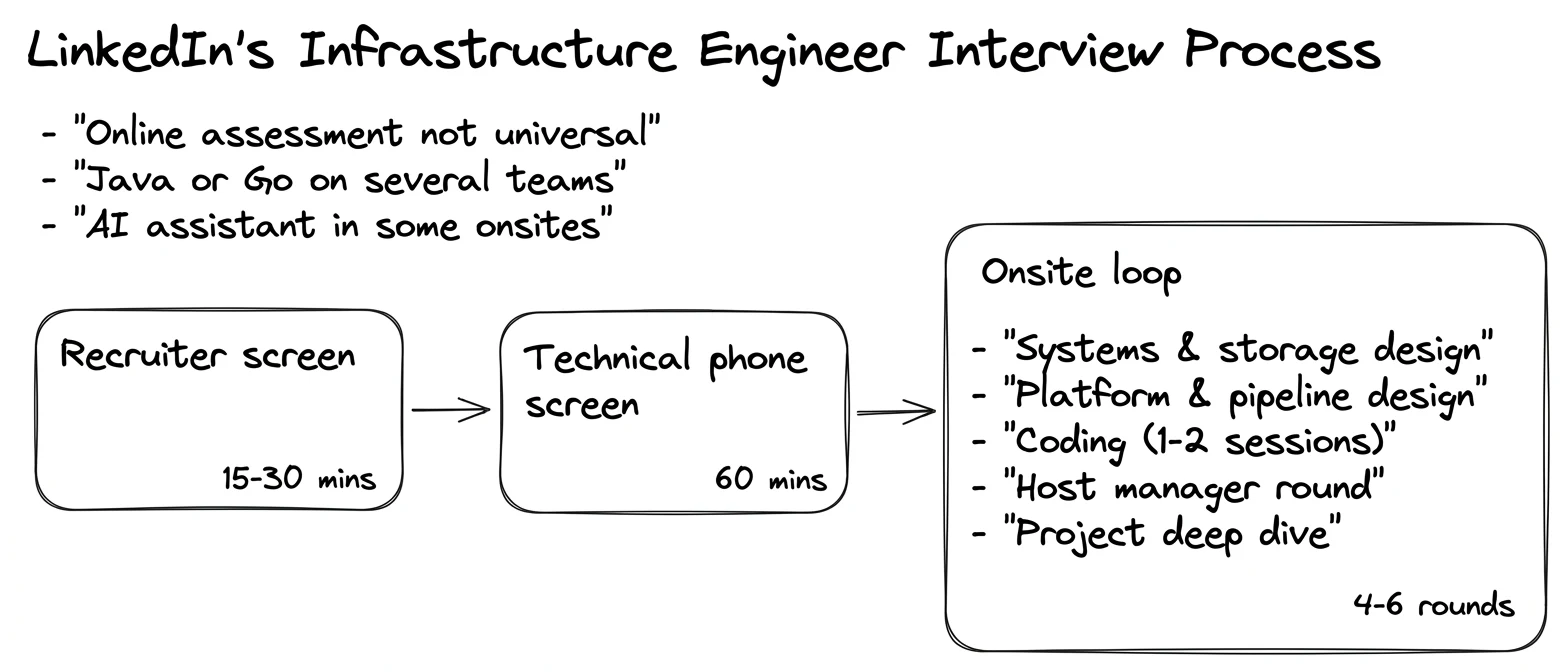
Infrastructure engineers interview on LinkedIn's software engineering loop, but the hiring team shapes the content: storage teams lean on key-value and log-structured design, observability-adjacent teams on metrics pipelines, developer-experience teams on CI/CD scheduling.
The skeleton is a recruiter call, a technical phone screen of about an hour, and a virtual onsite of four to six rounds of 45 to 60 minutes, typically four to eight weeks end to end. Entry-level loops open with networking fundamentals and keep one design round; Senior loops add a second; Staff loops weigh behavioral scope as heavily as design.
Here's what the interview process can look like:
- Recruiter screen: A 15- to 30-minute call on background, target level, team and location.
- Online assessment (some pipelines only): A proctored test of code-quality multiple choice plus one implementation problem.
- Technical phone screen: About 60 minutes with an engineer, often opening with project questions before one or two problems.
- Coding interviews (one or two): Medium problems on stateful structures, graphs and streams, frequently never executed.
- AI-assisted coding interview: One problem in escalating parts, solved with an AI assistant in a shared editor.
- System design interviews (one or two): A bounded storage design and an operational platform design.
- Technical communication and project deep dive: You diagram a system you built and defend its decisions.
- Host manager interview: About 45 minutes on motivation, scope, outcomes and sometimes domain knowledge.
Tip: Treat "the data no longer fits in memory," "the input is now a stream" and "make it thread-safe" as default follow-ups for every structure you practice. Candidates with those answers ready kept control of the round.
Recruiter screen
The call covers background, why LinkedIn, target level, location and timing. Infrastructure requisitions span storage, streaming, traffic, systems and developer infrastructure, so pin down the team early: one candidate learned only in the host manager round that the recruiter's team description did not match the manager's needs, and another applying at Senior Staff was moved to Staff and onto a CI/CD team outside their background. Expect slow scheduling and reshuffled slots; one interviewer disclosed an unannounced hiring freeze at the start of a 2026 screen.
Interviewers evaluate:
- Level fit: Years of experience and scope of past ownership against the requisition.
- Team alignment: Whether your systems background survives the team's domain probe.
- Motivation: A specific reason for this team rather than generic interest in scale.
Ask for the exact round list, the team's domain and whether the AI-assisted round is included.
Sample questions for the recruiter screen
Here are some questions reported by recent candidates:
- Tell me about yourself and your current role.
- Why LinkedIn, and why infrastructure on this team?
- What level are you targeting, and where are you with other companies?
Technical phone screen
The screen runs about an hour, sometimes with a silent second interviewer. Many open with 10 to 15 minutes on a recent project, then one or two problems in a shared editor; entry-level screens have started with DNS resolution, load balancers and basic networking. A few pipelines first send a proctored assessment with code-style questions and a submatrix-sum class driven by parsed commands.
Prompts favor stateful structures over puzzles: a cache that evicts the lowest-rank entry with last access as the tiebreak, then handles rank changes; a Max Stack where the interviewer asks how the design changes if popMax is rare; a flatten-nested-list iterator; an LRU cache whose tests must cover concurrency; and insert-delete-getRandom with duplicates, extended with a per-item TTL. One Staff screen asked for the test plan verbally instead of code.
Interviewers evaluate:
- Composing structures: Combining a hash map, heap and linked list with the cost of every operation stated.
- Challenging assumptions: A candidate who questioned a pure rank-based eviction policy was told no one had before, and the round ended early with everything covered.
- Testing: Edge cases, invariants and, for randomized structures, how to check the distribution.
Practice cache, stack and iterator designs to a tested version in 30 minutes, then rehearse their TTL and thread-safe extensions aloud.
Sample questions for the technical phone screen
Here are some questions reported by recent candidates:
-
Implement a fixed-capacity cache that evicts the lowest-rank item, breaks ties by last access, and supports rank updates.
-
Support insert, delete and uniform getRandom in constant time with duplicates, then give each item its own time-to-live.
-
Return all length-K substrings without repeated characters, then take the string as a stream and several values of K at once.
-
Insert/Delete/GetRandom in O(1) with TTL per item (follow-up)
Coding interviews
Onsites include one or two coding rounds of 45 to 60 minutes. Code is often never compiled, so correctness rests on a verbal dry run. Problems are medium and come in families that mirror infrastructure work: inclusive and exclusive time from nested task logs, impact analysis over a configuration-file dependency graph, merging N-ary trees by key, a robot pathfinding through an unexplored grid with probe-and-move APIs, and counting distinct values in a sorted array of billions with only hundreds of distinct values.
Escalation comes from a constraint change, not a harder algorithm. Number of Islands becomes a grid too large for memory; a BFS through an abstract interface reaches billions of nodes; a meeting scheduler moves from binary-search insertion to a segment tree, then to thread safety under write-heavy load, where one candidate justified a plain mutex over a read-write lock. One round was a low-level design: an alert monitor that records alerts, reports the last 15 minutes, gives a severity distribution and detects a volume spike.
Interviewers evaluate:
- Optimal complexity without hints: Working but suboptimal solutions failed in rejected reports, especially on binary-to-N-ary generalizations.
- Exploiting structure: Skipping runs in a sorted array with binary search for O(k log n).
- Edge-case rigor: Even an easy power function was probed on the minimum integer input.
- Code quality: One junior candidate was rejected mainly for naming, readability and modularity despite passing solutions.
Practice medium graph, stack and interval problems with a spoken dry run, then answer the out-of-memory and concurrency follow-up for each.
Note: Proofs are sometimes required. Candidates were asked to prove that the median minimizes total distance on a line and to justify a binary-search comparison condition, not just code it.
Sample questions for the coding interviews
Here are some questions reported by recent candidates:
-
From start and end events of nested tasks, compute each task's inclusive and exclusive time in one pass.
-
Parse simplified JSON configuration files, build their dependency graph, and list every file affected by one change.
-
Guide a robot through an unexplored grid using turn, move, wall-detection and jump APIs to reach a target.
-
Alert Monitor — Rolling Window + Severity Distribution + Spike Detection
AI-assisted coding interview
Most recent onsites replace one coding round with an AI-enabled round: a shared editor with an assistant panel and one problem split into three or four parts over about an hour. The LRU cache is the usual vehicle: standard, then TTL, then counters or hit-ratio prediction under given workloads, then thread safety with coarse versus fine-grained locking. Other prompts include a three-part aircraft turnaround problem and a nearest-supply-point graph search.
The rules vary. Some interviewers framed the round around your normal AI workflow; others required the algorithm to come from the candidate. In one Staff loop the interviewer switched the assistant off partway through.
Interviewers evaluate:
- Ownership of the algorithm: You state the approach before prompting and can continue unaided.
- Review discipline: Catching a map not updated on eviction, undefined variables or snippets that conflict across parts.
- Testing: Generating and running tests rather than trusting a clean-looking draft.
- Throughput: Completing two of four parts was cited as the main reason for one rejection.
Rehearse a prompt, review, test and fix loop on a four-part LRU cache inside 50 minutes, and confirm the AI rules beforehand.
Tip: When the assistant drifts from your plan, write that piece yourself. Candidates stuck in regenerate-and-review loops said hand-writing would have been faster. One session lost 15 minutes to a broken assistant.
Sample questions for the AI-assisted coding interview
Here are some questions reported by recent candidates:
-
Build an LRU cache, add per-entry TTL, then make it thread-safe and compare locking granularities.
-
Add hit and miss counters to an LRU cache and predict its hit ratio under several workloads.
-
Find how far a landing point is from the nearest supply point on a map of paths, then solve a harder variant unaided.
System design interviews
Senior and Staff loops carry two design rounds, entry-level loops one, each 45 to 60 minutes on a whiteboard. The first is often bounded storage: the single-machine store where only the index lives in memory, an in-memory store built on nothing but a map that must add begin, commit and rollback, a distributed key-value store probed on partitioning, replication and consistent hashing, or scaling a single-node NoSQL store to 50 million pairs at one million queries per second split evenly between reads and writes.
The second is an operational platform: metrics answerable at any time granularity for an external visualization tool (one version excluded alerting), a cron job scheduler with an at-least-once versus exactly-once debate, malicious IP blocking at the API gateway across data centers, exception monitoring with a top-k view, and user activity queryable over the last minute, hour or day. On a CI/CD team the scheduler prompt drew follow-ups on streaming build output and push versus pull triggering.
Interviewers evaluate:
- Sizing before drawing: Key count, value size, write rate and retention drive the layout.
- Failure paths: Compaction, crash recovery and what survives a restart on one box.
- Time-series mechanics: Bucketing, roll-ups, downsampling and retention.
- Approximation trade-offs: Count-min sketch versus exact counting for top-k, precision against memory.
Practice one log-structured storage design and one metrics pipeline until you can size, draw and defend failure handling in 40 minutes.
Note: Agree on component names early. One candidate spent minutes at cross purposes saying "aggregator" while the interviewer said "collector," and lost the depth the round was graded on.
Sample questions for the system design interviews
Here are some questions reported by recent candidates:
-
Design a key-value store on one machine over 100,000 append-only files with about a billion keys, where only metadata fits in RAM.
-
Design a metrics platform for production services that answers at any time granularity, without alerting.
-
Stop malicious IP addresses at the API gateway, then extend the design across multiple data centers.
Technical communication and project deep dive
Most loops include one or two rounds on your own work. In technical communication you pick a past project, draw a simple architecture diagram and explain it; the deep dive, sometimes on the same project, digs into original decisions, your contribution and measurable outcomes. One entry-level candidate defended an internship host auto-remediation system on database choice and failure scenarios. Some loops add a craftsmanship round with no coding, on what success means, quality standards, ownership and technical debt.
Interviewers evaluate:
- Clarity of the diagram: Components, data flow and boundaries a listener follows in minutes.
- Decision rationale: Why this store or consistency model, and what was rejected.
- Personal contribution: What you drove versus what the team did.
Prepare one infrastructure project you can diagram in five minutes and defend for forty, with numbers for load, latency and failures.
Sample questions for the technical communication and project deep dive
Here are some questions reported by recent candidates:
-
Present a previous project and draw a simple diagram of its key components.
-
Walk through a feature you recently built and the trade-offs you considered.
-
Explain a Project with a Diagram and Deep Dive into Your Design
Host manager interview
The hiring team's engineering manager runs about 45 minutes with no coding: a project you drove, a disagreement with another team, a mid-project change of direction, the most useful feedback you received, and what your next role must offer. Infrastructure managers add operational scenarios such as a critical outage colliding with other priorities, and ask about your performance rating, promotion history and how your time splits between coding, design and mentoring. Some mix in a technical segment: a fleet-wide monitoring system with anomaly detection, or, on a CI/CD team, domain questions on build pipelines and package management.
Interviewers evaluate:
- Concrete outcomes: One manager asked "so what was the result?" after every story.
- Scope at the target level: At Staff, cross-team leadership plus the team's domain depth.
- Operational judgment: Prioritizing and communicating during incidents.
Attach a quantified ending to every story and rehearse a frank account of your rating and promotion history.
Sample questions for the host manager interview
Here are some questions reported by recent candidates:
-
How would you handle a critical service outage while committed to conflicting priorities?
-
How do you define success, and how do you handle a project whose direction changes midway?
-
What are you looking for that your current job cannot provide?
-
Define Project Success, Handle Direction Changes, and Apply Feedback
-
Explain a Difficult Technical Decision and Its Implementation
How LinkedIn levels and evaluates Infrastructure Engineer candidates
A debrief weighs every round alongside the host manager's assessment, and rejected candidates rarely learn which round decided it. The target level comes from the requisition but moves with the loop: a Staff applicant received a Senior offer because their stories were not pitched at Staff scope, and another was moved from Senior Staff to Staff before the onsite. Decisions have come the day after the onsite, after more than a week, or not at all after a full Staff loop.
Tip: The Staff bar is a leadership bar. Candidates down-leveled from Staff had solid technical rounds but stories about their own execution; prepare examples where you set direction for other teams.
How to prepare for the LinkedIn Infrastructure Engineer interview
- Drill bounded storage design: Practice log-structured stores, in-memory indexes, compaction and crash recovery on one machine before multi-region architectures.
- Own one metrics pipeline: Size ingestion, choose a time-series layout, and explain roll-ups, downsampling and retention for any-granularity queries.
- Make thread safety a reflex: For every cache, scheduler and monitor, name the primitive, the lock granularity and why the read-write mix justifies it.
- Rehearse the four-part AI round: Run LRU, TTL, counters and thread safety with an assistant in under an hour, hand-writing whatever drifts.
- Prepare out-of-memory and streaming answers: Islands, top-k and substring problems all reach "the input no longer fits."
- Dry-run without a compiler: Trace a concrete example aloud and write production-quality names and structure.
- Build one project you can diagram in five minutes: It serves technical communication, the deep dive and the host manager round.
- Calibrate stories to the level: Quantify every outcome and, at Staff, center cross-team influence.
About the LinkedIn Infrastructure Engineer role
Infrastructure engineers build and run the platforms product teams depend on: the streaming layer around Kafka, Samza and Brooklin, online stores such as Espresso and Venice, traffic and edge infrastructure, the compute fleet, and the developer infrastructure that builds, tests and deploys code. The work is platform engineering for internal customers, with on-call ownership; Site Reliability Engineering is a parallel title family.
| Level | Primary focus | Impact scope |
|---|---|---|
| Software Engineer | Delivers well-defined components with guidance | Features within a team's system |
| Senior Software Engineer | Designs and ships subsystems independently | A service or major component |
| Staff Software Engineer | Leads technical direction for a system, mentors | A team's platform and its dependencies |
| Senior Staff Software Engineer | Sets architecture as technical lead | Multiple teams |
| Principal Staff Software Engineer | Drives strategy for an infrastructure domain | An organization |
| Distinguished Engineer | Recognized expertise across domains | LinkedIn and the industry |
LinkedIn hires Infrastructure Engineers across teams that include:
- Streaming infrastructure: The pub-sub and stream-processing ecosystem, handling trillions of messages a day.
- Storage infrastructure: Espresso, the distributed NoSQL source-of-truth store for hundreds of applications, and Venice for derived data.
- Traffic infrastructure: Edge routing and load balancing for internet-facing services.
- Systems infrastructure: The server, operating system and container fleet.
- Developer infrastructure: CI/CD, builds, package management and developer experience.
- Site reliability: Capacity, disaster recovery and monitoring for core data systems.
Infrastructure Engineer experience and education requirements
Postings ask for a BA/BS in computer science or a related discipline, or equivalent practical experience. Experience requirements rise with level: about two years for Senior, four or more for Staff, five or more with technical leadership for Senior Staff, and 14 or more years of distributed-systems work for Principal Staff. Distributed systems, Linux and networking are the preferred background, with Java dominant on the backend.
FAQs about the LinkedIn Infrastructure Engineer interview
How long does the LinkedIn Infrastructure Engineer interview process take?
Typically four to eight weeks; onsites often land about two weeks after the screen, and decisions range from the next day to never.
What is the hardest round of the LinkedIn Infrastructure Engineer interview?
The bounded system design round, because candidates prepare at the wrong altitude. The alert monitor or single-machine store looks small, then demands precise reasoning about memory budgets, layout, compaction and recovery. At Staff, the host manager round is the second filter because it sets the level.
How much does a LinkedIn Infrastructure Engineer make?
Recent infrastructure postings list these base salary ranges; total compensation adds an annual bonus and stock.
- Senior Software Engineer: ~$128K–$210K base
- Staff Software Engineer (reliability): ~$152K–$248K base
- Senior Staff Software Engineer: ~$180K–$300K base
- Principal Staff Software Engineer: ~$218K–$357K base
What happens after a rejection?
A one-year cooldown applies before reapplying, and round-level feedback is rare, so note your weak spots right after the loop.